Springfield Voters Should Be Skeptical About Convention Center Claims

A version of this commentary appeared in the Springfield Business Journal.

On November 4, Springfield voters will decide on a proposal to increase the city’s hotel tax by three percent. The proceeds from the new tax will help fund a new convention center for the city. A recent report paid for by the Visit Springfield tourism bureau said exactly what Visit Springfield wanted it to say: that a new convention center will generate enormous revenue for the Springfield area. The report claims a new convention center will drive $1.3 billion in new spending over the next 30 years. Exaggerated estimates like this one have been made on behalf of convention centers all around the country for decades, and the historic evidence is clear that Springfield voters should be dubious of such claims.

Between now and November, Springfield residents who visit St. Louis should drive by the largely empty dome attached to St. Louis’s downtown convention center to see how these convention center promises often play out. That dome was a part of a large convention center expansion in the 1990s. The same promises of growth, revenue, and utopia were all made when St. Louis voters approved a similar hotel tax increase back then. Now the dome is mostly empty, and the regional body that manages it is struggling to pay for its upkeep. St. Louis’s local tourism agency thinks the solution is the same thing it always is: further expansion of the convention center. Like a Cold War general in a Kubrick movie or a carpenter with a box full of nails, tourism agencies have the same solution for every problem. Economic recession? Expand the convention center. Economic growth? Enlarge the convention center. Global nuclear war? Definitely gonna need a bigger convention center to commiserate in.

The increased hotel tax isn’t the only public money being used as part of this plan. Other local sales taxes are slated to be used for funding, and state tax dollars are being considered. Tourists, Springfield residents, and possibly all of Missouri will get to pay for this new event space, whether it is actually needed or not.

Haywood Sanders is a researcher and writer with the University of Texas–San Antonio who has studied convention center expansions for decades. He has documented how cities and tourism agencies systematically inflate projections to get these projects approved. Sanders has reviewed the Springfield convention report and noted in an interview with a Springfield News-Leader reporter earlier this year that the report didn’t state how it calculated its room occupancy estimates and ignored underwhelming numbers of comparable convention centers in Overland Park, Kansas, and St. Charles, Missouri. Sanders states that the convention-center industry peaked in the early 2000s and shows no signs of returning to the success it enjoyed back then. With two major convention areas so close by in Branson and Lake of the Ozarks, a new center in Springfield will face intense competition. But I have no doubt that local Springfield convention-center boosters will ignore reality in their quest for tax revenue and city spending.

Visit Springfield wanted a report that claims a convention center will be an economic boon for the city. They got it. As Springfield residents prepare to decide on the hotel tax increase proposal, they should study the work of Heywood Sanders and others to learn about how these claims have been made about many other convention centers in many other cities, and how they usually fail. Springfield voters can also go to St. Louis to see the failures of these promises with their own eyes. Taxpayers should not be on the hook for convention centers whose overstated benefits, such as they are, will largely go to private entities. This is the Show-Me State, and the claims being made by supporters of the convention center for Springfield should be met with a healthy dose of skepticism by voters.

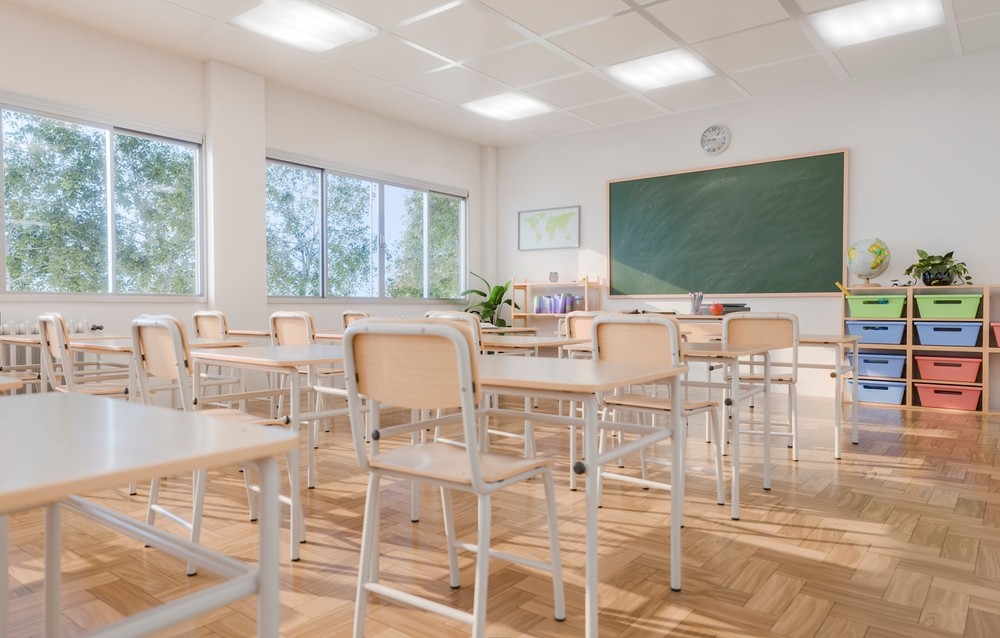
PRiME Summit Celebrates Schools with Impressive Test Score Growth

I was fortunate to attend an event in late September celebrating Missouri schools that demonstrate high test score growth. The event, organized by the St. Louis University PRiME Center, was held at a central location in Columbia on the University of Missouri campus.

There are two aspects of the event that I really like. First, it recognized high-performing schools. Too often in education we choose not to differentiate school performance—we don’t punish poor performers, and we don’t reward excellence. I like that the event promoted the positive impacts of schools that generate high achievement growth. I was also pleased to see coverage of the recognition some schools received in the local media and in school newsletters and announcements (e.g., see here and here).

Second, I like that the event was centered on test-score growth, which is a far better measure of the impacts of schools than test-score levels or proficiency rates. Growth captures how much students learn during the year, not just where they start. This means schools in low-income communities are not penalized for low starting points as long as their students make good progress. This important design feature of growth is illustrated in this report from the Missouri Department of Elementary and Secondary Education (DESE). Not surprisingly, the high-growth schools recognized at the event included many in high-poverty areas.

We need more events like this. When schools perform well, we need to recognize them, thank them, and remind them they are on the right path. This validation matters, especially for schools that show high growth despite low overall achievement levels due to external factors. Without acknowledgment, educators in these schools might not realize the positive impacts they’re making.

I hope the PRiME event becomes a mainstay and is the beginning of a more concerted effort in Missouri to reward academic excellence. If we want our schools to thrive, we need to show them that their success matters.

(Disclosure: As a researcher, one of my main areas of work is on growth modeling and value-added modeling in education. I am part of the team of researchers who estimate the growth model for DESE.)

What’s Wrong with the Housing Market?

If you’ve been in the market for a home recently, you know prices are through the roof. Prices went up sharply when interest rates bottomed out during the COVID pandemic. The low interest rates effectively made houses cheaper relative to the sticker price because most people borrow to buy a home. The lower total price, inclusive of loan interest, stoked demand, and prices went up in response.

Then, interest rates went up.

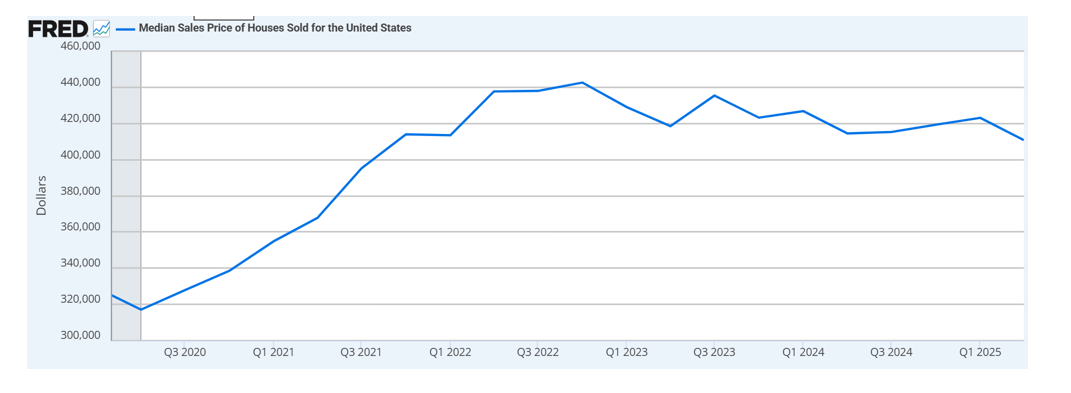
In a well-functioning market, the process should have reversed itself. The higher interest rates pushed the total price of purchasing a home back up, which surely lowered demand. At the same time, with house prices still far above the pre-pandemic level, builders should have been building like mad to bring homes to the market. These two forces should have resulted in a housing price correction. But this is not what happened. The higher interest rates have cooled demand, but prices remain high. Below is a chart I created using the Federal Reserve Economic Data (FRED) system. It shows the trend in the median U.S. home price since February 2020, just before the pandemic. The average price of a home in the United States grew by roughly $120,000, or about 38 percent, from the first quarter of 2020 to the third quarter of 2022. It has declined modestly of late, but not much.

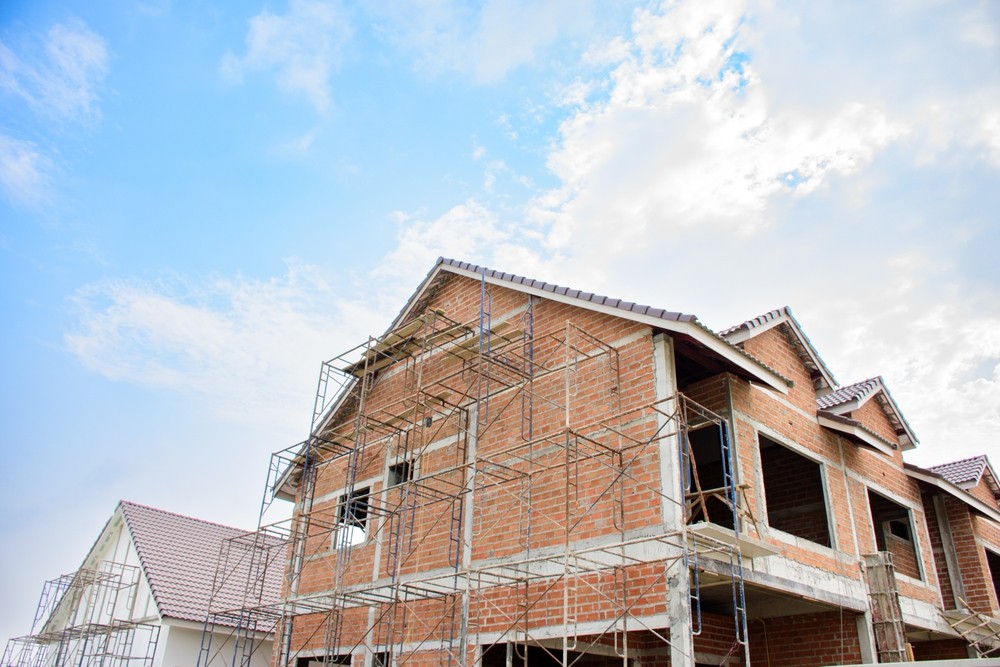
The bizarre thing is that builders haven’t responded to the higher prices. In fact, FRED data show new housing starts today are lower than before the pandemic. Meanwhile, many existing homeowners are “locked in” with low-rate mortgages and reluctant to move, further constraining supply. Even with tempered demand due to the combination of high prices and high interest rates, the lack of supply is keeping prices elevated.

But what are the builders doing? They should be falling all over themselves to bring new houses to the market. Think of it this way: If it was profitable to build homes in Q1-2020, it should have been even more profitable by Q3-2022, continuing until today.

A recent issue of the Journal of Economic Perspectives (JEP) brings together several groups of economists to weigh in on the housing market. I read the issue with great interest. One of the most striking findings is that in many major markets, the price elasticity of housing supply is very low, which means builders barely respond to rising prices with new construction. This is odd. Normally, suppliers should respond strongly to higher prices, which put more money in their pockets. In fact, the invisible hand of the free market depends on it.

The articles discuss several reasons builders have responded so weakly to higher prices. With respect to the recent situation specifically, one might initially blame it on rising construction costs, but the articles suggest this is not the primary explanation. Rather, they emphasize the role of regulations and zoning. Local land-use rules, approval processes, and other restrictions make it slow and costly to build, even when market prices suggest that building more housing should be profitable.

Another interesting finding from the research is that we don’t need to focus on building low-income housing to make housing affordable. If we build higher-end homes, people will move into them from less desirable homes, which will then become more affordable. The effect of building homes at the higher end of the market cascades down.

In short, we just need to get out of the way of the market.

So, the next time you hear complaints about high home prices or a shortage of low-income housing, remember the biggest obstacle is the rules we’ve chosen for ourselves. Deregulating housing construction, and thereby expanding supply, offers the clearest path to putting homeownership in reach for more Americans.

Unsafe Schools and Parental Empowerment with Tiara Jordan-Sutton

Susan Pendergrass talks with Tiara Jordan-Sutton, Founder and Executive Director of Activate Missouri, about school safety, parental power in education, Missouri’s failure to implement the federal Unsafe School Choice Option, and more.

Listen on Spotify

Listen on Apple Podcasts 

Listen on SoundCloud

Timestamps

00:00 Empowering Parents in Education
02:48 Safety Concerns in Schools
05:36 The Role of Legislation in School Choice
08:35 Mobilizing Parents for Change
11:25 Building a Movement for Educational Reform
14:16 The Future of Education in Missouri

Produced by Show-Me Opportunity

The Unsafe School Choice Option (USCO)

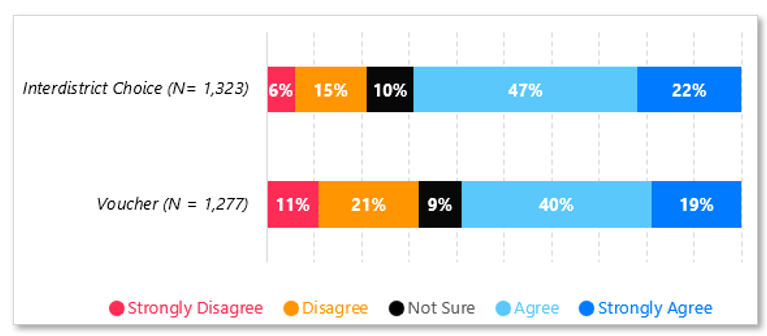
The Unsafe School Choice Option (USCO) is a federal safeguard created under the Every Student Succeeds Act (ESSA), which ensures that students attending persistently dangerous schools can transfer to a safer public school. Yet, in the decade since ESSA became law, Missouri has never identified a single unsafe school, despite reporting tens of thousands of violent incidents and weapons violations. This one-pager explains how Missouri’s overly narrow definition leaves families without the protections ESSA guarantees and outlines steps policymakers can take to fix it.

If the PDF does not display, click here to download.

Use Taxes on the Ballot in Missouri This November

There are several cities seeking to impose use taxes during special elections on November 4. These cities include Ladue and Creve Coeur in St. Louis County, Levasy in Jackson County (now accepting applications for county executive), Festus in Jefferson County, and Hallsville in Boone County. I am sure there are others.

One thing I noticed about all the cities that I listed is that they contain lots of “U’s” and “L’s,” so I guess we know who the patron saint of this blog post is.

A use tax is simply a sales tax imposed on goods you purchase online or via catalogue and have delivered to your home. Municipal use taxes in Missouri actually predate the internet, but not surprisingly, most cities didn’t pass them until online shopping took off over the past fifteen years or so.

I am generally unsympathetic to the idea that these cities need a tax increase. If Creve Coeur needs more tax revenue, why did it just pass an enormous tax abatement in a very prosperous area that absolutely does not need tax subsidies to encourage development? If Festus needs more tax revenue, why did it put the fix in to sell its water system to another public entity without going out for bids as good government principles require? I don’t have any specific criticisms of Ladue, but I highly doubt the city is in financial trouble. This famous doggerel about Boston Brahmins could easily have been written about Ladue:

And this is good old Boston,
The home of the bean and the cod,
Where the Lowells speak only to Cabots,
And the Cabots speak only to God.

My view is that use taxes are a good way to expand the tax base, level the playing field for businesses, and raise local revenues. However, this last point is key. They should not be used simply as a way for cities to get more revenue. Cutting other taxes after the use tax is imposed (should voters pass it)—especially if you have a particularly harmful tax — is a great way to achieve the above benefits without a tax windfall for the city. Cities can lower their property tax rates, reduce their utility tax rates, or adjust other sales taxes (altering sales tax rates is much trickier than other types of taxes).

I don’t know if any of these cities have pledged to reduce other taxes if the use tax passes. Without such a pledge, the use tax would likely be a significant revenue gain for the city. If you think your city, town, or village actually needs that revenue, then so be it. But I’d be hard-pressed to buy that for the cities listed above, especially Ladue, Creve Coeur, and Festus.

The Free-City Project for Missouri

A version of the following commentary appeared in the Columbia Missourian.

In 2001, a group of very libertarian-minded activists launched the Free-State Project, which encouraged thousands of libertarian believers in minimal government to move to New Hampshire. The overall success of the project has been limited, for a variety of reasons, but if imitation is the sincerest form of flattery, then I’d like to see people in Missouri flatter the Granite State and try to do a similar thing here in one of our many cities.

What would such a limited-government, free-market oriented municipality look like in Missouri? To start with, it should be modeled on successful, small-government municipalities like Weston, Florida, and Sandy Springs, Georgia, which provide many local services by contracting with the private sector. It should not be based on the more radical, no-government “utopias” like Grafton, New Hampshire, where the removal of almost all government services led to an increase in bear attacks.

How many limited-government activists would it take to create a free city in Missouri? Not very many. There are hundreds of existing municipalities here with less than a hundred residents where, at most, a few dozen show up to vote in local elections. If, say, 50 true free-market believers moved into one city, what types of changes could they make to create that desired free city?

To start with, they could remove all municipal planning and zoning rules and replace them with private contracts managed by property-owner associations where allowed. Those property-owner associations could manage issues like short-term rentals, trash collection, and home-based businesses.

Municipalities, especially small ones, could focus on contracting with larger cities or counties to provide many services, like policing or building inspections. The new free city could contract with private companies to provide many other services, like trash collection and recreation management. It could similarly contract with nonprofits for some other services where profit opportunities are limited, such as animal shelters. If it had municipal utilities, it could privatize them into regulated, private utilities. The free city could reduce local code requirements, permitting rules, and occupational licensing to the largest extent possible. The important ones, like fire codes and elevator inspections, could be kept, while arbitrary or obsolete regulations, like television repairman licenses and pool-table taxes, could be thrown out.

None of these examples are farfetched. Every one of the above examples is already in place in a city somewhere in Missouri. Private utilities provide water, gas, and electricity to millions of Missourians. Cities contract with counties and other cities for services all over the state. In St. Louis County, every municipality (88 at last count) contracts with the county for at least some inspection services. Nonprofits provide important services to the public, like Pinnacles Youth Park near Columbia, and operate many animal-care facilities. Private businesses operate city-owned golf courses and manage municipal swimming pools throughout the state.

How would a free city fund these services? It would maximize private contracts between residents and companies and enact user fees to the largest extent possible. Low general sales and property taxes could fund the rest, along with revenues shared from other sources, like the gas tax. Importantly, such a city would avoid special deals such as tax abatements or tax-increment financing, for some businesses or people. Making the sales and property tax bases as wide as possible would allow the rates to be as low as possible for everyone. This free city would absolutely avoid the errors of a local income tax such as exist in Kansas City and St. Louis.

Overall, a Missouri free-city project would create a municipal government system not all that different from those in many rural, unincorporated parts of Missouri. It would just be in a more urban or suburban setting. It may seem unrealistic to expect hundreds—or even dozens—of people to make such a move based on political philosophy. But as a model of quality, low-tax local government, it is perfectly realistic. While no city may have enacted all of these ideas, each of them has been enacted with success somewhere. We just need the right number of people to put it together all at once.

I vote we try it somewhere near the Lake of the Ozarks.

Support Us

The work of the Show-Me Institute would not be possible without the generous support of people who are inspired by the vision of liberty and free enterprise. We hope you will join our efforts and become a Show-Me Institute sponsor.

Donate
Man on Horse Charging