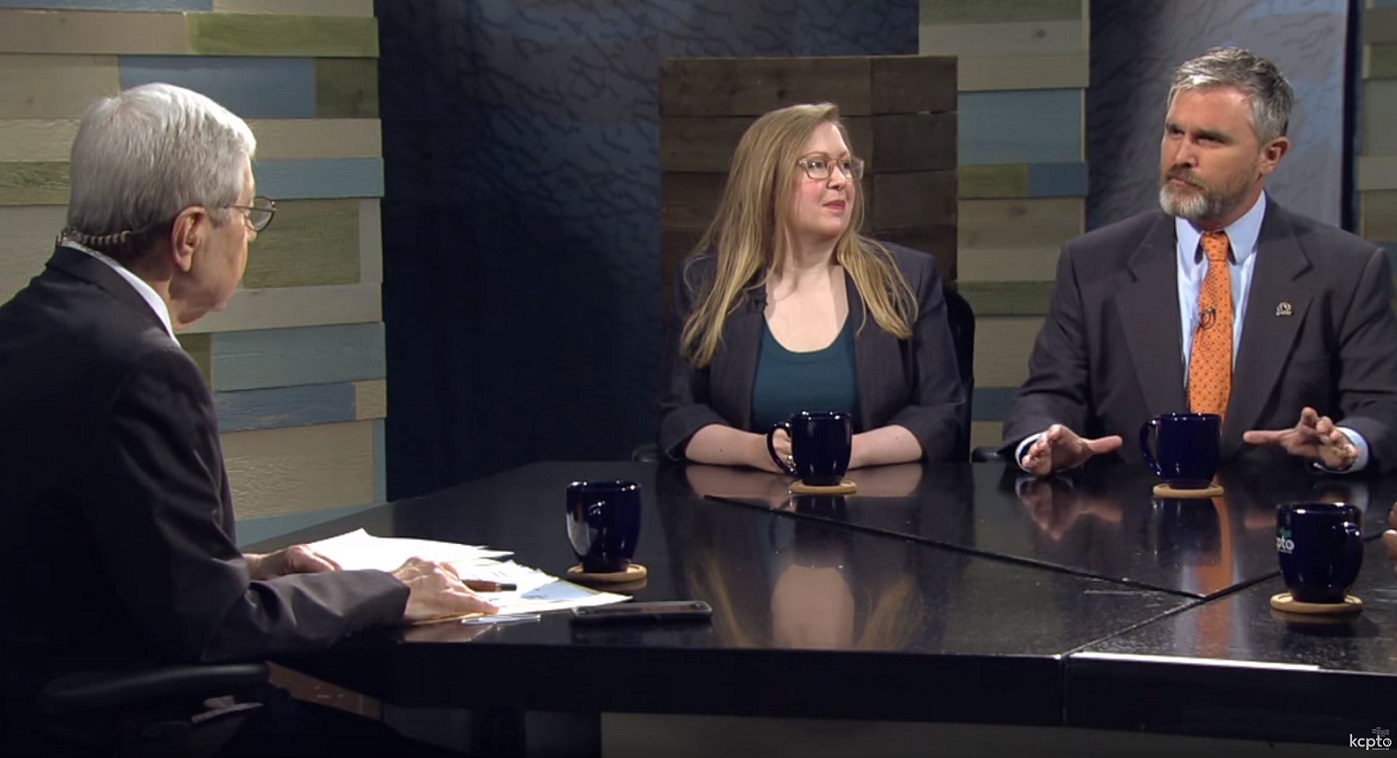
On Thursday, April 12, Patrick Tuohey appeared on KCPT’s Ruckus to discuss education funding and economic development.
Should Five Percent Appear Too Small…
The Beatles famously sang the above lyric in their song Taxman. It comes to mind because, believe it or not, leaders in Kansas City think that a 14 percent sales tax is—I am not making this up—not high enough.
KSHB TV, WDAF TV and The Kansas City Star reported on the matter. The latter quoted Kansas City’s Mayor James saying, “I’m not asking the state legislature to do anything other than leave us alone.” (This is usually the Mayor’s response unless he is looking for more money from state government, such as in tax credits or state funds.)
The Star reports,
And if the city imposes a new 1 cent sales tax for the Central Business District—part of a deal it struck last month with Power & Light District developer Cordish to help pay for parking garages—the cumulative rate would be 13.6 percent.
You don’t need to be an anti-tax ideologue to wonder if there is a point at which sales taxes are just too high. Back in 2014, Steve Vockrodt of The Pitch asked, “City Hall rationalizes these incentive deals by saying they boost the local economy and expand the tax base. But if that’s true, then why do all these tax proposals keep coming up?” That was back when the sales tax at the Power & Light District topped out at 11.1 percent.
If Kansas City is undergoing revitalization—as city leaders claim—then why are we still raising taxes for the many to give tax breaks to the few? If this is success, it appears taxpayers can’t afford much more of it.
I Don’t Think We’ll Be Making the Honor Roll
The results are in, and they’re not great. On Tuesday, the U.S. Department of Education released the Nation’s Report Card, and Missouri is middle of the pack—at best. Nationwide, Missouri 4th graders rank 24th in reading and 25th in math. Unfortunately, our 8th graders dropped to 26th in reading and a troubling 33rd in math. And when you control for demographics, we fared even worse.
The Nation’s Report Card is based on the National Assessment of Educational Progress (NAEP), and the same test is administered in all 50 states every two years by the U.S. Department of Education. It’s the only test that we can use to see how we’re doing compared to other states. Oddly, the Missouri NAEP coordinator doesn’t seem concerned that our students are less prepared than half of the country because, as he stated, the Missouri-based test—MAP—more accurately reflects the current reality of Missouri classrooms.
The NAEP also gives us a chance to see how our performance is trending over time. After a decade of changes to the Missouri School Improvement Program (we’re now on MSIP 5) that miraculously continues to find that over 90 percent of schools are “fully accredited,” after nearly $11 billion in spending each year, and after steadfast refusal to expand educational options in Missouri—we haven’t made much progress.

You can argue that the NAEP standard for proficiency is too high and our students shouldn’t be expected to meet it, or that it doesn’t matter how we compare to other states. But, at some point, it’s up to Missouri policymakers to own up to the fact that we aren’t making any headway.
Recently, I wrote a blog post about Indianapolis and how it offers parents robust choices for their children’s education. Indiana, in general, has been proactive and innovative when it comes to public education. Their rankings this year? They’re 10th in 4th-grade reading and 7th in math, and they’re 7th in 8th-grade reading and 17th in math. Other states with strong school-choice environments, such as Florida, did similarly well.
Missouri students need to learn to read and write, and we need a functioning accountability system. Giving parents options means that they have a say in holding schools accountable, and unlike what we’ve been doing, it just might work.
Legislative Update: TIF Reform
Researchers and activists across Missouri have long decried the way in which city governments too easily give away taxpayer money. One particularly odious handout is tax-increment-financing (TIF), which allows city leaders to give away money that belongs to other taxing jurisdictions such as schools and libraries.
Happily, legislators are considering a reform proposal that would make three important changes to how TIF projects are awarded.
- It would eliminate TIF for the use of anything other than combating blight, eliminating TIF for “conservation areas,” and “economic development areas,” ensuring that it is used in “redevelopment areas” only inasmuch as they are blighted. Regarding blight, it removes from the blight definition such considerations as “defective or inadequate street layout,” “deterioration of site improvements, improper subdivision or obsolete platting” and “morals.” We’ve suggested a completely new standard for blight, but the language in the proposal is a step in the right direction.
- Once a TIF plan is sent to a city government for final approval, that body must hold a 30-day comment period before it votes on the proposed district.
- Finally, and perhaps most importantly, it grants those taxing jurisdictions a 60-day period after the city council or board of aldermen approves the TIF plan to decide on whether to withhold half of their portion of the TIF taxes excluded.

Proponents of TIF have argued that school districts have no incentive to give up their property tax and with vote to exclude themselves every time. But that argument does not stand up under examination. Missouri school districts have voted to support TIF in the past when it made sense. And in Kansas, where school superintendents may withhold all of their tax funds, they rarely if ever do.
The most powerful parts of this bill are the 30-day comment period and the ability of the taxing jurisdictions to exclude half their taxes. These provisions mean more time to consider the impacts of TIF plans and give more influence over the process to those with the most to lose.
Some will undoubtedly claim that this reform will kill TIF, but that’s unlikely. What it will do it make it more likely that TIF projects are a good deal for everyone, including developers, cities, libraries, and school districts. Taxpayers will need to remain vigilant, and this bill gives them more time to comment. Who could be against that?
Public Employee Pensions: Time to Get Our Heads Out of the Sand
Andrew Biggs’ Show-Me Institute essay on the current condition of the Missouri State Employees Retirement System (MOSERS) demonstrates that, like so many state plans, MOSERS is experiencing a decline in its funding health. This is bad for public employees and for taxpayers.
Consider the costs to taxpayers. As of 2018, the plan has assets equal to less than 70 percent of their liabilities and—just to maintain that level of funding—the Missouri state government will have to contribute nearly 20 percent of its total employee payroll to the plan this year. In addition, employees hired after 2011 contribute 4 percent of their paychecks to the system. Imagine a private-sector benefit that cost nearly one-quarter of employee salaries but was considered so sacrosanct as so be untouchable. The hard truth is that we’re going to have to start talking about policy changes aimed at averting a funding crisis. Biggs’s essay explores various options, including grandfathering current plan participants and designing a new system for future employees.
Of course, MOSERS is just one of many public pension plans in the state. The pension systems for teachers aren’t any better. Teachers argue that they work for low salaries and, in exchange for their sacrifice, they are “taken care of” with generous retirement benefits. But that is only true for those teachers who start their teaching career right out of college and work in the same state for at least twenty-five years. In fact, an analysis of the Missouri Public Schools Retirement System (PSRS)—the plan that covers all Missouri teachers other than those in Kansas City or St. Louis—found that a teacher in the Springfield district would have to work for 26 years in order to hit the “crossover” point at which their total retirement benefit is worth more than what they contributed.
Imagine that! Working for 26 years before your retirement plan is worth more than you put in.
While the PSRS is in better financial health than MOSERS, total annual contributions to the plan are 29 percent of payroll (with 14.5 percent coming from the teacher and 14.5 percent from the school district). This is only likely to get higher because there are now 78,000 teachers (active members) supporting 60,000 retired teachers. In 2000, roughly the same number of active teachers supported just 25,000 retirees. In addition, while the plan is currently nearly 84 percent funded, it has an unfunded liability of more than $7 billion and its administrators continue to assume that the plan will earn a 7.6 percent return on its investments every year, indefinitely. You don’t have to be a math teacher to know those numbers just don’t add up.
Innovation Brings Hope for Teacher Pensions
The city teacher retirement plans in Missouri are in trouble. There’s a solid chance that the Kansas City Public Schools Retirement System (KCPSRS) could be out of money in just 20 years. And the St. Louis Public School Retirement System (STLPSRS) is taking the St. Louis Public Schools (SLPS) and charter schools to court to solve its funding problems. The good news for teachers and taxpayers is that there’s still time to protect current and future retirees. The building isn’t on fire yet, but there’s smoke under the door and it’s time to start talking about innovative solutions.
According to a 2017 asset/liability analysis commissioned by KCPSRS, the system only has enough money in the bank to pay 64 percent of what it owes to current and future retirees. We’ve written about this problem before, but it’s worth repeating. The fund needs to earn at least 5 percent per year, every year, for the next 20 years, or they’ll be out of money. That’s right—no money left in the fund. (For reference, between 1998 and 2018 the annualized Dow-Jones Industrial Average inflation-adjusted return was 5.528 percent.) Not surprisingly, the KCPSRS has requested increases to the school contribution rate over the next few years from the state legislature. So, Kansas City Public Schools and Kansas City charter schools will have to take another chunk of their revenue out of the classroom to send to KCPSRS.
STLPSRS was also just 64 percent funded (see p. 11) in 2016 and has almost as many retirees as active teachers. An annual analysis by actuaries determines how much SLPS and the St. Louis charter schools have to contribute to the fund each year. However, difficulty keeping up with increasing costs led SLPS to request that the state legislature cap their contribution rate at 16 percent, and they did. Unfortunately, STLPSRS looked at how that cap would affect the fund and determined that it would leave them with a $192 million shortfall within 15 years, so they’re suing SLPS and the St. Louis charter schools.
Economic conditions, unaffordable benefit promises, and an unwillingness to use realistic investment return assumptions have resulted in shaky fund positions, lawsuits, and balancing the books on the back of the youngest workers. What’s worse is that in 2017, the average pension payment took about $1,200 per student out of the classroom.
Does it have to be this way? No. We’re actually seeing teacher retirement benefit innovation from within public education. In 19 states, charter schools may choose to participate in their state’s pension plans or not. A recent analysis of charter school participation in five states found that the schools most likely to opt out of the state plan are urban schools, elementary schools, and those that are managed by charter networks. And new schools in high-cost states like California are much less likely to join than they were just five years ago.
Most of the opt-out charter schools offer their teachers 401k or 403b plans in which the teachers are vested in less than one year. The reasons given for choosing this path include wanting to lower their estimated costs, giving teachers a wider range of investment options, and making their benefits more portable.
For today’s youngest teachers, this is an important point. Most of them will not meet a vesting period of ten years in one state, which means they will lose the amount that their employer contributed for them. Even if they stay, Missouri teachers have to work for 26 years before their contributions are higher than their expected benefit. When you take nearly 10 percent off the top of a teacher’s salary, plus another 6 percent for Social Security, you have to wonder why anyone would want to be a public school teacher in Kansas City or St. Louis.
Do Kentucky Teachers Even Know Why They’re Protesting?
Kentucky public school teachers are right to be worried about their retirement benefits. According to the Kentucky Teacher Retirement System’s (KTRS) 2017 annual financial report, the fund was about $14 billion short of what it needs to pay the benefits already promised to working and retired teachers. According to the KTRS report, “Since fiscal year 2008, the state has not paid the full recommended annual employer contribution necessary to prefund the benefit requirements of members of the retirement system as determined by the actuary.” Further, “If contributions by the employer to the system in subsequent fiscal years are less than those required, the assets are expected to become insufficient to pay promised benefits.”
The words are complicated and confusing. But two years ago, Beau Barnes, a KTRS lawyer, summed it up this way, “It’s a 100 percent certainty that if we don’t do something very soon, this problem continues to get much, much worse very quickly.”
What this means is that, as in so many states, Kentucky’s teacher retirement plan is in a hole that is only getting deeper. It is time to stop digging, and it appears they’re trying to do so. If Governor Bevin signs SB 151, current and retired teachers will be guaranteed pension payments for every dollar that they have been promised, plus an annual cost-of-living adjustment of 1.5 percent. New teachers—only those hired for the 2019–20 school year and thereafter—will be placed in a hybrid, cash balance plan, similar to what just about everyone in the private sector has today. This will allow the state to deal with the debt the plan has accumulated without it growing.
So, why Kentucky teachers are walking out? Are they that concerned about the next year’s crop of new teachers? Or is it just that they don’t really understand the system, the seriousness of the problem, and how reform actually protects their benefits by finding a way out of the financial mess? We found a similar lack of understanding when we surveyed Missouri teachers about pensions. So, while the teacher’s unions are whipping teachers into a frenzy behind the false narrative of “they’re taking our pensions!” Kentucky parents have to scramble to make arrangements for their kids.
A word of caution for St. Louis public school teachers. The financial situation of their retirement fund isn’t much better, and the fight over how much the St. Louis Public School Retirement System (PSRS) needs and how much St. Louis Public Schools (SLPS) is willing to pay is now in the courts.
Cities May Actually Be the Culprit in Underfunding Schools
Education funding is a hot topic in several states, with lawsuits alleging that state governments are failing to meet their constitutional duties to provide adequate resources. While the issues regarding state funding are important, it’s often the cities that are leeching money away from local school districts.
According to National Center for Education Statistics, just under half (46.6%) of aggregate local school district funding comes from states. Forty-five percent comes from local sources, including 36.4 percent from local property taxes. Those local property taxes are the source of much consternation between cities and school districts.
Across the country, municipal economic development policies such as abatement or tax-increment financing (TIF) allow cities to freeze, reduce or redirect property taxes to developers in order to offset the risks of their investment. In short, the practices permit one political body—cities—to divert the funds of another political body—school districts! And the loss of revenue to schools can be in the millions each year. A story from the St. Louis Post-Dispatch put the cost at $18 million per year for a single district:
The school district relies far more heavily on property taxes, collecting about 61 cents on each tax dollar paid. That means the district, which has little to no say over whether property taxes are abated on real estate projects, missed out on about $18 million in revenue last year.
The Kansas City Public School District (KCPS) estimates that it loses about $26 million each year. Chicago public schools claim a much higher cost to their schools from TIF—as high as $177 million in 2015 alone.
Proponents of these economic development subsidies claim that the funds redirected from schools come only from the increase in property tax—the increment—due to the new development. Without the subsidy, they claim, there would be no new development and so no increase in property tax in the first place. But studies of TIF, such as those conducted on Chicago, St. Louis and Kansas City by UNC–Chapel Hill professor William Lester conclude that there is little if any economic development resulting from TIF. Research shows that areas without TIF grow at the same rate as those with TIF—suggesting that TIF itself plays little to no role.
Part of the reason is that one of the standards for determining the appropriateness of TIF subsidies, often called the “but-for test,” is so weak as to be meaningless. The St. Louis Development Corporation (which oversees TIF in St. Louis) issued a report on its own programs in 2016 that found that due to poor quantitative measurement, one “cannot readily determine what may or may not be deemed a project worthy of consideration for a City tax incentive.” But developers have learned how to game the system, and city politicians are often all too willing to oblige so that they can point to new construction as evidence of their political success. Even worse, these developments are often subsidized in already economically vibrant parts of the city—further evidencing the lack of need for a subsidy.
California was the first state to adopt TIF in 1952, but subsequent policies required the state to reimburse school districts for funds lost due to municipal TIF policy. As a result, California became the first state to end TIF in 2012. While states have differing TIF policies, the basic impact on school districts is the same. Tax revenue that would have gone to support education is diverted to subsidize development—development that research suggests may have happened anyway.
Missouri is considering several reforms to its TIF policy, including narrowing the circumstances under which TIF may be used, strengthening the criteria a project must meet in order to qualify for TIF, and requiring any economic impact analysis to be conducted by a third party. Last year the Illinois legislature mandated a study of its TIF policies that is due to be released soon.
Parents and educators are right to look to governors, state legislators and school boards to make sure education funding is sufficient and that the funds are spent wisely. They should also make sure that the new local housing development, shopping mall or office building isn’t being underwritten by funds diverted under the noses of those same political bodies.
Crosby Kemper III Discusses Development Subsidies on KCPT’s Ruckus
On Thursday, March 29, Crosby Kemper III appeared on KCPT’s Ruckus to discuss subsidies for the parking garage of a luxury apartment development along with other local and regional issues.