St. Louis County Council Ethics Committee Issues Stinging Rebuke of County Executive

Jeremy Kohler of the St. Louis Post-Dispatch reported last month on a St. Louis County ethics committee report investigating county leases with Northwest Crossings.

While Kohler’s piece is worth reading, you might want to start with the ethics committee report. The report, which is available through a link at the bottom of this post, lists 14 findings in the executive summary on page 3. In short, the committee found that the County Executive’s personal staff negotiated a lease with Northwest Crossing that failed to properly represent the county and did so against the advice of the career professionals who usually conduct such negotiations. The staff is accused of misleading others about the costs and the process by which the contract was negotiated, and that additional costs for the lease were paid through budgetary sleight-of-hand. The committee also found that the Executive and his staff refused to provide documentation when asked.

The deal appears to have exposed county taxpayers to a lot of additional costs. The Post-Dispatch concludes that the lease “will cost taxpayers at least $69 million and could run as high as $77 million.” Skeptics might write this off as mere bureaucratic bungling, but the ethics committee report suggests darker motives.

Because the committee lacks the resources to further investigate, it recommended the full St. Louis County Council refer the matter to both the U.S. Attorney for the Eastern District of Missouri and the Missouri Attorney General.

Irrespective of whether a crime has been committed, the report makes it clear that the County did not have in place the type of basic policies necessary to ensure transparency, accountability, and integrity. Taxpayers should be asking why not.

Who Runs the KCPD?

Mayors in Kansas City long have complained about a lack of control over the police department. But the truth is more nuanced. While Kansas City mayors thankfully do not have the raw political control that mayors elsewhere do, they are not as powerless over policing as some seem to suggest. What they do seem to be lacking during this year’s long spike in homicides, however, is willpower.

In 1939 the power to appoint members of the Kansas City Board of Police Commissioners was given to the governor in order to combat rampant local corruption. Kansas City is the only major city in United States whose local elected political leadership does not control the police. In speaking with several former members of the Board of Police Commissioners—appointed by different governors and serving at different times with different mayors—I learned that governors are not all powerful nor are mayors powerless.

First, the observation that the Kansas City police department lacks local control is misleading. Members of the commission, including a seat reserved for the sitting mayor, are all local figures who must be residents of Kansas City. The tradition for appointing commissioners is to choose people who already have distinguished themselves in the community—thus reducing the chance that people use their position as a political platform. And while the appointments are made by the governor with Senate approval, none of the former commissioners with whom I spoke ever felt as if they were serving a gubernatorial agenda. Some reported hearing from the governor’s office about every 12 to 18 months, and then just to be kept abreast of lawsuits. Despite the power of appointment, Republican and Democrat governors alike do not exercise significant authority over the KC police in practice.

While the police board provides local control, they do not represent local political control. In other cities, police chiefs must be wary of municipal politics and palace intrigue that can only distract them from their main concern: public safety. In Kansas City, police chiefs are a step removed from politics because they do not owe their position directly to elected officials.

None of this is to say that the mayor does not have a significant amount of power. Commissioners all indicated that there was deference given to the various mayors who served on the commission—even though their level of participation varied. For example, Mayor Funkhouser was engaged in police processes. Mayor Berkeley was attentive but passive. Mayor Barnes’ attendance was sporadic and picked up toward the end of her tenure.

Though Kansas City has a city manager form of government, the mayor has one power that researchers have found is among the most consequential any mayor can have: the veto. While a mayoral veto can be overridden by the vote of 9 councilmembers, it presents him with a great deal of influence over legislation—including the budget of each city department. What greater power over local policing could there be than the budget?

If a mayor wanted the police department to hire more social workers, hire more uniformed officers and/or provide more and different training, decrease the number of officers with take-home cruisers, or increase foot patrols and community policing, he has a great amount of leverage to do so. The power of the purse makes the mayor a more consequential figure than any single governor, any single police board commissioner, any single police chief. No Missourian has more power over policing in Kansas City than the mayor—should he wish to use it.

The current extraordinary challenge to public safety requires an extraordinary response from city leaders. The tools are in place—but will we have the leadership?

Another Study Is Just What St. Louis Doesn’t Need

Kicking bad habits can be tough. When you know you’re doing something that’s bad for you, planning to quit is the easy part. In the end, no matter how carefully you plan, you won’t succeed unless you have the willpower to change your behavior.

St. Louis City officials, who have a serious bad habit to kick in the form of development subsidy giveaways, plan to study how they can reform their use of these subsidies as part of an overall, city-wide development plan. The half-million-dollar study will come after years of pressure to change (read: provide some rhyme or reason to) how the City awards tax subsidies.

A report released in 2016 showed that the City gave away more than $700 million through programs like tax-increment financing (TIF) and tax abatement from 2000 to 2014. (In just the 2016–2017 fiscal year, the City and school district lost nearly $30 million due to these incentives.) That same report concluded (p. 6) development subsidies generally fail to accomplish their goals of spurring economic growth and eliminating blight.

While I’d like to celebrate the City’s commitment to reshaping its development policies, I’m skeptical much will come of the exercise. Taxpayer-funded studies—even fancy half-million-dollar ones—are no substitute for the willpower to do what’s right.

It ought to frustrate taxpayers that, with numerous studies and reports replete with reforms on hand, the City has decided to—in St. Louis fashion—study incentive policies once again. Not only will the study itself be costly, but the longer reform takes, the more projects will receive taxpayer-funded subsidies. If officials are serious about reform, they should put subsidy requests on hold until new policies are in place.

More importantly, officials have not shown much interest in limiting their own power to award incentives. Indeed, they have little political or financial incentive to do so. (The City even reportedly lobbied against TIF reform this legislative session.) For example, even though the City has a policy of limiting TIF incentives to 15% of a project’s total costs, it frequently awards much larger subsidies, and often to developments with numerous other subsidies in hand (see, for example, here and here). When a luxury high-rise in the Central West End gets a 15-year abatement, it’s reasonable to question whether the City has no intention of taking its foot off the gas even though it clearly could.

St. Louis (like Kansas City) desperately needs incentive reform. Taxpayers, schools, libraries, and other jurisdictions need incentive reform. If St. Louis is serious about reshaping how it awards subsidies, officials should show that now by enacting policy changes. No more studies, no more plans, no more wasting of taxpayer dollars.

Missouri’s Economy Struggles Despite a Low Unemployment Rate

The Bureau of Labor Statistics recently released some good news about the employment numbers from May: Fourteen states saw their unemployment rates decrease, and the rest of the states’ unemployment rates stayed the same. Missouri’s unemployment rate held steady at 3.6 percent last month—below the national average of 3.8 percent. Looks like Missouri’s economy is doing pretty well then, right?

Missouri’s low unemployment rate is welcome news, but it doesn’t tell the whole story. There are other important factors that predict economic well-being, such as labor force participation and statewide output, where Missouri’s economy is underperforming compared to other states. Tennessee, for example, is a demographically similar state but has shown significant growth compared to Missouri while also boasting a 3.5 percent unemployment rate.

As shown in the graphs below, Missouri’s labor force is stagnating. During an economic expansion, one would expect the number of interested laborers to increase. Missouri, however, defies these expectations. Our labor force shrunk by almost 30,000 people from 2016 to 2017. In this same period, our neighbor to the southeast, Tennessee, saw a spike in their labor force with 81,000 people joining.

People are entering the workforce in Tennessee to take advantage of the employment opportunities there. Some are Tennessee residents who have decided to look for work, and some are coming from outside the state. The state’s low unemployment rate suggests that Tennessee is capable of absorbing these additional potential workers and turning them into payroll employees. Compared to Missouri, Tennessee is attracting and employing people at a faster rate.

Labor force comparison, Missouri vs Tennessee

Additionally, Missouri’s production lags behind that of Tennessee as well. Missouri’s real gross domestic product, the measure of overall economic health, is growing slowly. Since 2012, Tennessee routinely experienced 2 to 4 percent annual growth in real GDP. Missouri struggles to hit 1 percent annual growth. The growing gap between Missouri’s and Tennessee’s GDPs, shown below, is stark.

GDP comparison, Missouri vs. Tennessee

Such slow growth is problematic for Missouri’s economy. The national economy is doing well, but Missouri is failing to take advantage of the rising levels of consumption, investment, and employment found throughout the country and is consequently losing out on major economic opportunities.

So what about Tennessee as compared to Missouri makes its economy grow faster and pull more people into the workforce? There are a few possibilities. First, Tennessee has no income tax, and two years ago Tennessee began to phase out the tax on investment income and will eliminate it entirely by 2022. Second, beginning in 2014 Governor Bill Haslam started reforming higher education by offering all high school graduates the opportunity to earn an associate’s degree or professional certification at no cost to them. Moreover, there has been greater coordination between colleges and businesses to ensure that the curriculum fits employers’ needs so that students learn skills that are in high demand. Third, Tennessee is a Right-to-Work state. Fourth, Tennessee is known as having a business-friendly environment.

It may be hard to pinpoint exactly what has led to Tennessee’s success, but tax-cutting policies combined with investment in workforce development and other pro-business policies like Right to Work stand out as reasons Tennessee is experiencing growth that Missourians can only envy. Continuing to push for elimination of the individual income tax and exploring potential workforce development policies could work just as well in Missouri.

City Chooses Highest Bidder to Conduct Economic Development Analysis

While we wait for the city’s report on economic development incentives, over a year late at this point, we thought we’d look over the other companies that bid on the project. After all, Kansas City is spending twice the amount on this study that St. Louis spent on a similar project just two years ago. And the vendor they chose, the Council of Development Finance Agencies (CDFA) isn’t exactly the sort of organization you’d turn to for a disinterested study of incentives.

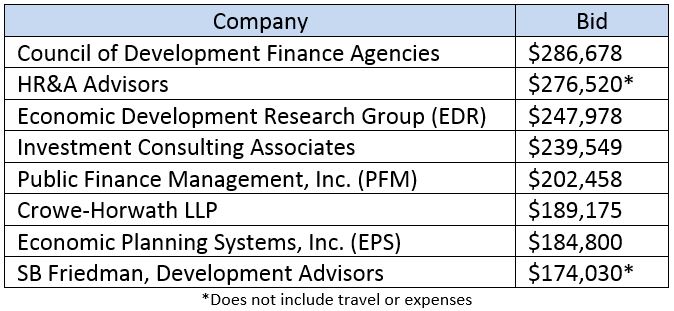
Kansas City issued a request for proposals with the deadline of June 12, 2016. Eight companies submitted bids to complete the work. The companies and their total bid prices are listed below. Note that CDFA, which was awarded the project, was the highest bidder. The final contract award was even higher: $350,000.

Bids

I have attached electronic copies of the RFP and all the bids at the bottom of this post. Feel free to dig through them and let us know what you find. Here are some things we found noteworthy:

  • Collins Noteis & Associates (“a WBE-certified firm specializing in urban planning, community planning, economic development planning, and government affairs”) is listed as a subcontractor on at least two of the bids: EPS and EDR.
  • EPS’ bid includes as a subcontractor Parsons & Associates, which is a Kansas City–based public relations firm whose work would account for just over 10 percent of the cost. Why is a PR firm contracting to provide economic analysis?
  • CDFA’s winning bid included participation of the W. E. Upjohn Institute for Employment Research. This is promising because the Upjohn Institute recently published a study concluding that:

The existing research on incentives is that in some cases they can affect business location decisions, but that in many cases they are excessively costly and may not have the promised effects. The new research suggests that much of this consensus is justified.

  • CDFA’s bid lists the Hardwick Law Firm LLC as a “team member.” Herb Hardwick, founder of that firm, still serves as counsel to the Kansas City TIF Commission—whose work CDFA will be assessing. This could be a significant conflict of interest.

The CDFA contract is operating under its fourth deadline extension, which ends in late July. We don’t know if a fifth extension will be sought or granted. But given the great cost, the delays, and questions raised by the choice of vendor, one wonders if anyone at City Hall is interested in a serious analysis of our incentive regime.

Trump vs. Harley-and the World

In its own words, the Trump Organization is “the world’s only global luxury real estate super-brand,” with five- and six-star hotels bearing the Trump name in major cities around the globe. These hotels share a core brand philosophy of “Live life without boundaries.”

So why is President Donald Trump taking Harley-Davidson—another U.S.-based global super-brand—to task?

A day after the company announced plans to serve the European market with motorcycles built in Europe, the president thundered: “A Harley-Davidson should never be built in another country—never!” He accused the company of hoisting the “white flag” of surrender and predicted “If they move, watch, it will be the beginning of the end.”

Harley-Davidson, Inc., made its announcement after the European Union raised tariffs on U.S.-made motorcycles by 25 percent—in retaliation to the 25 percent tariff on European exports of steel to the U.S. imposed by the Trump administration. Noting that the higher EU tariff would add approximately $2,200 to the average cost of a motorcycle exported from the U.S. to Europe, the company said:

Increasing international production to alleviate the EU tariff burden is not the company’s preference, but it represents the only sustainable option. Europe is a critical market for Harley-Davidson. In 2017, nearly 40,000 riders bought new Harley-Davidson motorcycles in Europe, and revenue generated from the EU countries is second only to the U.S.

The president said that he had “chided” Harley-Davidson executives on an earlier occasion for moving production to India as a way around high motorcycle tariffs in that country. But is it reasonable to expect a profit-seeking enterprise to keep all production and employment in the U.S., regardless of the cost in lost sales, profit, and overall competitiveness?

Certainly, the Trump Organization has not followed such a policy. Under licensing or other arrangements, it has fancy hotels bearing the Trump name in four different cities in India (Mumbai, Delhi, Pune, and Kolkata). Apart from Chicago, however, the Trump Organization has no luxurious hotels anywhere in the great American heartland. Why not?

Presumably, it made more sense from a business perspective to build hotels for the super-rich in India—though other cities in the American Midwest would have welcomed the same investment.

The president faulted Harley-Davidson for not being more “patient”—suggesting that his deliberately provocative approach to trade negotiations would force other nations to bend to his will for fear of losing access to the rich U.S. marketplace. As he said a couple of months ago— “Trade wars are good, and easy to win.”

But as Joe Haslag, the chief economist for the Show-Me Institute, notes, the president is playing “a very dangerous game,” because “the size, scale, and scope of the products that we are now talking about in increasingly acrimonious trade negotiations are staggering—a potentially U.S.-GDP-changing event.”

A grand strategy? Maybe, but early results are not promising. Mid Continent Nail in Poplar Bluff says its orders have dropped in half as a result of having to raise prices to make up for the higher cost of importing steel from Mexico. It has laid off 60 workers and says it may have to dismiss all of its 440 remaining workers by Labor Day.

In 2017, the Trump administration withdrew from the Trans Pacific Partnership—an agreement that would have reduced tariffs in Asian markets on motorcycles made in the U.S. That seems to have prompted Harley-Davidson’s earlier decision to build a manufacturing plant in Thailand. It may also have been a factor in the company’s decision to close its Kansas City manufacturing facility by 2019.

What caused the world-famous company with the “HOG” stock exchange symbol to make those choices? Surely it was rising tariffs on manufactured goods—a problem that does not exist in the luxury hotel business.


Millennials *Still* Prefer the Kansas City Suburbs

For years, census data demonstrated that people are eschewing urban settings for the suburbs. Then, for a while, some urbanist pied pipers told us that if we only subsidized amenities popular with the so-called creative class, the millennials would return to the cities. In a twist, we paid the pipers handsomely and the children marched out of town anyway.

We’ve argued this basic fact for years, and some of the better-known pipers have even changed their tune (but not without charging the townspeople nonetheless). According to a recent study published by SmartAsset based on Pew Research data, Kansas City, Missouri, is not in the top 25 destinations for millennials. Overland Park, Kansas, ranked 14th.

More noteworthy, SmartAsset previously released a study indicating that two Kansas City suburbs ranked in the top 25 places in the United States where millennials are buying homes. Olathe, KS ranked first (!) and Overland Park 11th in the entire country. Kansas City, Missouri—despite our entertainment district, Sprint Center, streetcar, and subsidized corporate headquarters and high-rise luxury apartment buildings—did not appear anywhere in the top 25.

None of this should be surprising. We know that millennials are looking for exactly what previous generations wanted: homes in the suburbs, cars, and good schools. Yet Kansas City leaders persist in telling us we’re a millennial magnet. We aren’t.

There is no shortcut to growing a city; no magical policy that can reverse national demographic trends. A better investment, as Show-Me Institute analysts have argued for years, is for government’s action to be broad and neutral: keep taxes low for everyone, maintain infrastructure, deliver necessary city services, and ensure quality education. Maybe those aren’t as appealing as shiny new construction projects, but they are more successful.

Supreme Court Rules Against Agency Fees in Janus

For the legal eagles out there and the laypersons just curious to take a look at the decision, you can find the Court’s opinion here. I’m going to leave the most relevant summary from the opinion below, and for those unfamiliar, note that the “Abood” referenced here is the Supreme Court case Abood v. Detroit Board of Education, which allowed for agency shops in the government context. The Court’s view that the ruling in Abood  “is inconsistent with standard First Amendment principles” tells you just about everything you need to know about why it was overruled.

I and others will have more analysis of this over the next few hours and days, but suffice it to say that this is a win for supporters of the First Amendement, for government employees, and for taxpayers.

2. The State’s extraction of agency fees from nonconsenting publicsector employees violates the First Amendment. Abood erred in concluding otherwise, and stare decisis cannot support it. Abood is therefore overruled. Pp. 7–47.

(a) Abood’s holding is inconsistent with standard First Amendment principles. Pp. 7–18.

(1) Forcing free and independent individuals to endorse ideas they find objectionable raises serious First Amendment concerns. E.g., West Virginia Bd. of Ed. v. Barnette, 319 U. S. 624, 633. That includes compelling a person to subsidize the speech of other private speakers. E.g., Knox v. Service Employees, 567 U. S. 298, 309. In Knox and Harris v. Quinn, 573 U. S. ___, the Court applied an “exacting” scrutiny standard in judging the constitutionality of agency fees rather than the more traditional strict scrutiny. Even under the more permissive standard, Illinois’ scheme cannot survive. Pp. 7–11.


School Districts: Time to Turn in Your Homework

Taxpayers pay thousands of dollars a year to support their local school districts. Shouldn’t they be able to monitor how the schools are spending their money?

The passage of House Bill 1606 tells me that the Missouri Legislature thinks they should. If it’s signed by the governor, the new law would address transparency in school district spending by requiring public school districts to develop a searchable database to track their expenditures and revenue, which would be made publicly available. It also directs the Department of Elementary and Secondary Education to create a template for schools to use for expenditure and revenue tracking if they do not have a website to host a database.

It is encouraging to see the legislature offer this tool, which would allow taxpayers to scrutinize their schools’ spending decisions, especially when audits give reason to question the wisdom of certain expenditures.

Given some of the difficulties we’ve encountered in obtaining spending records for the Show-Me Checkbook Project,we understand that navigating the process for requesting information can be frustrating. That is why I (along with Show-Me Institute Director of Government Accountability Patrick Ishmael) testified in favor of the creation of a database similar to the one proposed in House Bill 1606, where public entities can upload their spending data as a way to increase transparency.

I hope the creation of a database to track school district spending will lead to the establishment of other databases to monitor how cities, counties, and special taxing districts spend their money. The legislature is to be commended for taking this step toward more transparency.

Support Us

The work of the Show-Me Institute would not be possible without the generous support of people who are inspired by the vision of liberty and free enterprise. We hope you will join our efforts and become a Show-Me Institute sponsor.

Donate
Man on Horse Charging