Can above-average investment returns solve Missouri’s pension crisis? Dr. Andrew Biggs of the American Enterprise Institute reveals the answer in our “Ask an Economist” series.
Learn more about pension reform at showmeinstitute.org

Can above-average investment returns solve Missouri’s pension crisis? Dr. Andrew Biggs of the American Enterprise Institute reveals the answer in our “Ask an Economist” series.
Learn more about pension reform at showmeinstitute.org
If you aren’t a regular reader of Tony Messenger’s column in the St. Louis Post-Dispatch, please take a moment to read his latest piece about the proposed soccer stadium in St. Louis. In it, he writes,
The current St. Louis soccer stadium proposal is hands down better than the last one, in that the ownership group . . . are seeking significantly less from city taxpayers than the previous effort. [New York-based journalist Neil] DeMause agrees with that.
“The latest plan is arguably less onerous for the public than lots of other stadium projects out there — and certainly better than the previous soccer proposal for St. Louis,” deMause says. “But that’s damning with faint praise, because the median in stadium deals is ‘pretty awful.’”
St. Louisans were told last year that the deal before them was the best they could hope for. It wasn’t. There is no reason to believe this latest deal is the best, and every reason to think we can do better.
When ESPN Radio host Bernie Miklasz took to the air to attack David Hunn’s St. Louis Post-Dispatch story on the effort by St. Louis leaders to subsidize an MLS stadium, he showed a deep lack of familiarity with economic development subsidies. Perhaps because of this misunderstanding, he was very dismissive. And it may be too much to expect a sports commentator to be completely impartial about an opportunity to bring a major league sports franchise here. Ironically, however, while Miklasz called for an “honest discussion,” he didn’t invite us on his show to have that discussion, nor did his producer respond to our subsequent request to be on his show.
So we did the next best thing: We created a response video to show what that honest discussion might have looked like. Enjoy.
2018 was a year of change in Missouri. Lawmakers passed much-needed tax cuts for families and businesses, expanded education options for Missouri students, cut burdensome red tape, and fought back against big government through labor and transparency reform. But there’s still more work to be done. Let’s keep the momentum going in 2019! This year please make your tax-deductible donation to the Show-Me Institute. All contributions to the Show-Me Institute are tax-deductible. Click here to donate.
Wait, what? One of the largest local school districts in St. Louis is buying billboards, sending mailers, and making videos to convince parents to move there because they overbuilt and have a bunch of empty seats? Imagine billboards saying, “Move to Chesterfield . . . because the Chesterfield Mall has lots of empty storefronts!” Or, “Move to the City of St. Louis—we built too many houses!”
A system that allows parents to exercise school choice only if they move is inefficient at best. That said, parents with means learn the rules quickly and willingly blend their real estate and education decisions together. So, it’s unlikely that Hazelwood has some secret gems in its education portfolio that parents have yet to discover. Hazelwood built schools based on real estate trends that didn’t materialize. Hazelwood property owners are paying for schools with empty seats.
It’s time to break the connection between real estate and education. Parents should be free to choose a school that is a good fit for their child without moving. Schools should appeal to parents for what they offer—and if it works well for enough parents, the seats will be filled.
Luckily, we can shop at the Chesterfield Mall (or what’s left of it) and enjoy the restaurants and entertainment in the city without moving. And both of those activities pale in comparison to a child’s only shot at getting an education.
Taking the ACT or the SAT has become an important rite of passage on the path to college for most students. These tests are critical to the future of a huge number of students, so states should care how their students perform on them. Unfortunately, recent test results aren’t anything to brag about.
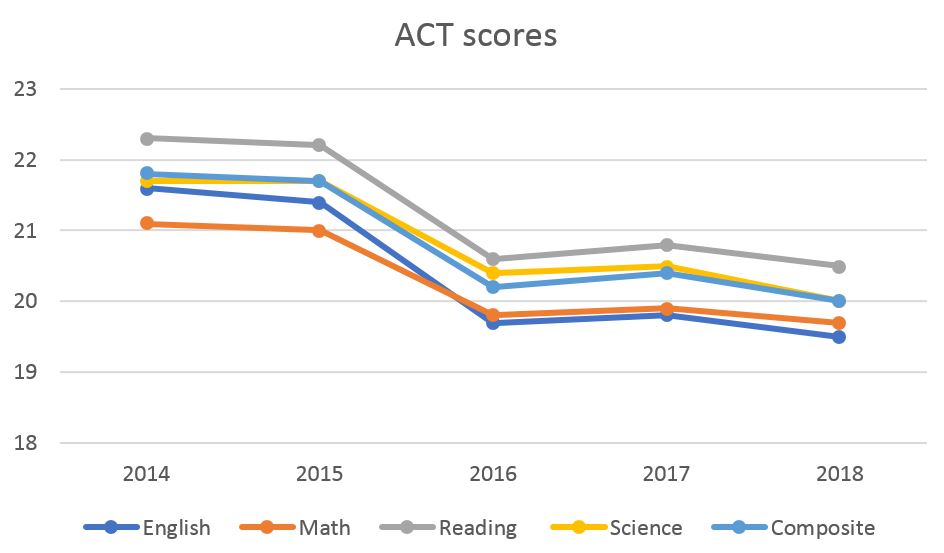
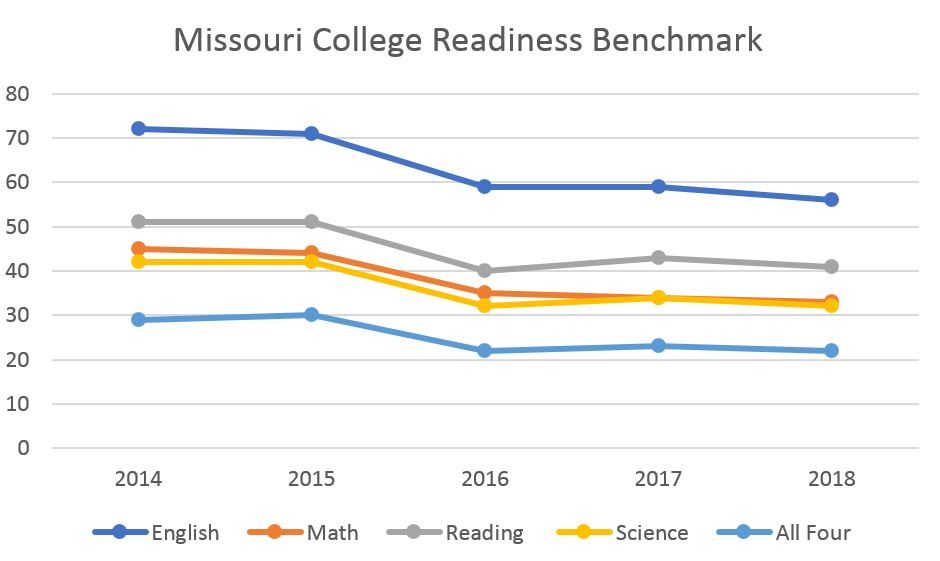
A few weeks ago, ACT released Missouri’s 2018 graduating class state report. It reports that a dismal 22 percent of the class of 2018 graduates were college-ready in English, math, reading and science. The test results from the last three years provide a some insight into how well our students are prepared for life after high school.
The graduating classes of 2016, 2017, and 2018 had 100 percent test participation because of DESE’s three-year plan to supply the ACT to all high school juniors. Before the Department of Elementary and Secondary Education (DESE) provided the ACT to every student, information about test results only applied to the approximately 77 percent of the 2015 class (page 3). It shouldn’t be surprising that average scores declined with the addition of a large group of participants who otherwise wouldn’t have taken the exam. Previously, some students would decline to take the test for financial reasons, but for others it was because they knew they weren’t prepared for such a test, or because they had no intention of going to college and therefore didn’t see any reason to take it. As a group, such students might reasonably be expected to score lower than students who looked at a high ACT score as an important asset in trying to get into a good college and who had the resources to prepare for the exam. But just because the decrease in overall scores can be explained doesn’t mean it should be excused. The ACT still measures readiness for life after high school, and seeing low scores—even from those who don’t plan on going to college—should concern all Missourians.
DESE stated the class of 2018 was the final year of the state provided ACT tests. But the three years of results revealed that when all of our students are tested, there are more students than we originally thought whom high schools are not preparing. Now that we’ve seen the real scope of the problem, will DESE acknowledge the issue or try to sweep it under the rug by celebrating when test scores inevitably go back up next year?
On November 19, the Missouri State Board of Education met in a closed session to determine who would be selected as the state’s next commissioner of education. It was high time to do so. In a tumultuous session almost a year ago, the board removed the last commissioner, Dr. Margie Vandeven, and struggled to agree on the process for finding a new one. Lack of Senate confirmation led to the withdrawal of five members appointed by the former Governor, and it wasn’t until last summer that the Board even had enough members for a quorum. An interim commissioner has been filling the office.
In September, the reconstituted board announced that it was conducting a search to find a new commissioner. Like many, we hoped that the state would hire someone with a fresh vision and a vigorous approach to reform who would be determined to improve the performance of schools in Missouri.
The need for new leadership is undeniable.
When Dr. Vandeven was named commissioner of education back in 2014, the state’s education system had an ambitious goal: to have Missouri’s students performing among the best in the nation— “Top 10 by 2020.” Needless to say, that goal was never achieved. On the National Assessment of Educational Progress (NAEP), also known as “The Nation’s Report Card,” Missouri ranked 31st in 8th grade math in 2007 among the 50 states. Fast forward to 2017, and our ranking in the same subject and grade was 32nd.
During this same time, Missouri has had a revolving door of state standardized tests for students. According to a study published in Education Next¸ Missouri was the only state in the nation to actually lower proficiency standards between 2009 and 2017. Every other state is demanding more from their schools, while we’re asking for less. Why are we okay with that?
Not surprisingly, the Top 10 by 2020 goal has been quietly dropped. We have lost (at least) a decade in improving student outcomes, and we have no North Star.
During Dr. Vandeven’s tenure, the Department of Elementary and Secondary Education (DESE) began the process of revising the Missouri School Improvement Program (MSIP), the system used to accredit school districts. Today, out of 527 public school districts, not a single one is unaccredited and just six are provisionally accredited. DESE technically only accredits districts, not individual schools. Yet when the St. Louis Public School District became fully accredited, every school was given an enormous banner to hang outside with the school name and “Fully Accredited!” on it. What’s a parent to think?
There are far too many schools in Missouri with rates of proficiency in the single digits. DESE touts a high school graduation rate of nearly 90 percent, and then reports that fewer than 43 percent of graduates are college- or career-ready. Doesn’t every student deserve to have at least one high-quality option for their education?
It would be churlish to place the entire blame for this state of affairs on Dr. Vandeven, or any single official. Education is a complex process, educational bureaucracies are notoriously hard to change, and education in Missouri has been troubled for a long time.
But for precisely those reasons, we need to face the truth: Doing the same thing but expecting different results won’t work. During Dr. Vandeven’s tenure as commissioner, DESE made no real effort to provide parents useful information about how well our schools and districts were serving students. And DESE has stood firmly against any form of school choice for parents outside of Kansas City or St. Louis, regardless of how well (or poorly) students are being served by their assigned public school.
It is clearly time for a fresh look and a new approach at DESE. And yet last Wednesday, the board announced that the search for a commissioner was over, and that the new commissioner of education would be . . . the former commissioner of education, Dr. Vandeven.
We’ll have more to say about education in Missouri—a lot more—as state government prepares for the Legislature to reconvene in January. But for now, this much is clear:
If the members of the board, and the Governor who appointed them, had been trying to send the signal that they were satisfied with the status quo in Missouri; that they were throwing in the towel on real reform in the public schools and real options for Missouri families; that they were more interested in not making waves with the educational establishment than in making the lives of our children brighter—they made exactly the right choice.
After years of delays and rising costs, the $51 million-dollar Loop Trolley finally opened to the public on Friday. However, passengers who were aboard the Trolley for its maiden voyage didn’t get quite the ride they expected.
One obstacle would have been difficult to predict. A two-car accident along the trolley’s route escalated into a shooting, and in the ensuing investigation police tape blocked the trolley’s path.
The other, longer-term problem involves not police tape but red tape, and should have been recognized and addressed long ago. The 2.2-mile vintage trolley line, which is supposed to transport passengers to and from the Delmar Loop, is only taking them halfway because of a dispute between the Trolley company and University City. According to Gregory Rose, U City’s city manager, the trolley enterprise hasn’t met the conditions required for the permit needed to operate there. U City will be off-limits to the trolley until (1) a $300,000 insurance bond is provided for cleanup efforts if the Trolley fails; and (2) a potentially dangerous electric pole along the route is removed. According to the St. Louis Post-Dispatch, the company has been aware of these issues for years. Which raises the question: Why weren’t these problems addressed earlier?
Since its inception nearly a decade ago, the Trolley has been plagued by construction delays and rising costs. It may even be responsible for the closure of numerous business, some of which had been in the Delmar Loop for decades.
Perhaps worst of all is that even if everything had gone smoothly for the trolley, there is little evidence that streetcars spur economic development. Considering the time and money that have been spent, and the revenue lost to local businesses during the construction, we’re long past the point of wondering whether the trolley was a worthwhile investment. The only question now is whether policymakers in St. Louis can learn from their mistakes.
The Show-Me Institute is pleased to offer internship opportunities for Spring 2019.
Those wishing to be considered for an internship should submit an application (see link below) and the requested supporting materials no later than Friday, December 7, 2018. Applications will be accepted on a rolling basis. We will begin conducting interviews as applications are received. Applicants can expect a decision no later than Monday, January 7, 2019.