

What if the choices we make for our health care were governed by the same rules that control the choices we make regarding the education of our children? How would we react to being told that our son or daughter couldn’t be treated by a specialist who practiced a few blocks away, on the other side of an arbitrary “health care district” line? A new video explores this scenario and highlights the absurdity of restricting educational options for children by sending them to schools based on where they live rather than what they need. Click above to see the video or find it on Twitter at #schoolchoice.
There Is Not a Teacher Retention Crisis in Missouri

I wasn’t able to attend the recent meeting for the Missouri State Board of Education, but from what I can gather from Twitter, an alleged teacher retention crisis was a major topic of conversation. In his report to the board, Paul Katnik, assistant commissioner in the Office of Educator Quality, cited some alarming figures. Board member Vic Lenz reportedly said it is going to take a collaborative effort among all stakeholders to address the issue of teacher recruitment and retention.
There certainly is a problem, but it isn’t what you may think. The problem is misunderstanding.
Katnik was relying on a DESE report to the Missouri General Assembly in December 2018. The report lists turnover figures which could easily be mistaken for statewide turnover numbers. Check out the table below.
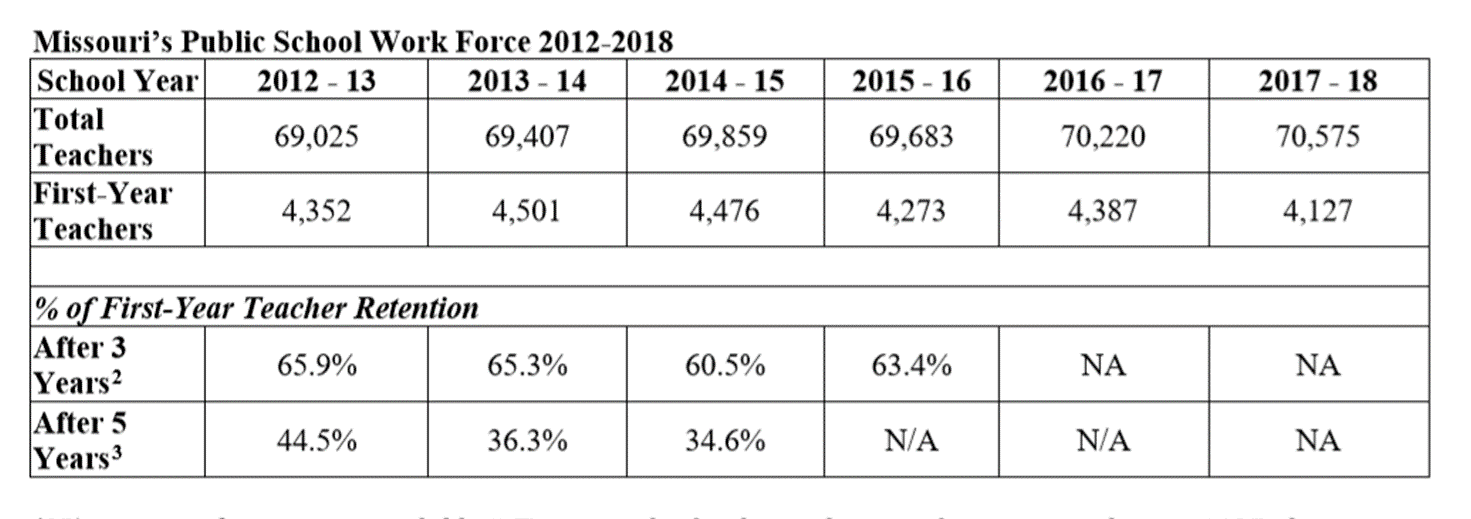
In the report, DESE claims that the three-year teacher retention rate for teachers starting in 2015-16 was just 63.4%. This number drops to a shocking 34.6% for the five-year retention rate of teachers starting in 2014-15. To the casual observer, the takeaway is that only roughly a third of our teachers are staying in the profession. What’s worse, these numbers seem to be going down over time. In other words, teacher retention appears to be going from bad to worse.
But, that is not what this table is actually showing. The figures presented here are not retention in the field, but retention at the school/district level. In other words, if a teacher were to leave one district for another they would be counted as not being retained.
In this post, I use data provided by DESE to show the state retention rate of educators in Missouri. I limited the data to only individuals who appeared to be full-time employees in their start year.
In the figure below, I look at the cohort survival for new teachers beginning in 2000 and 2009. The teachers are tracked for nine years, all that was possible given the data. As you can see, retention rates for new teachers in 2000 and 2009 are almost identical. After nine years, nearly 45% are still in the education profession in Missouri. This is well-above DESE’s five-year estimate of retention.
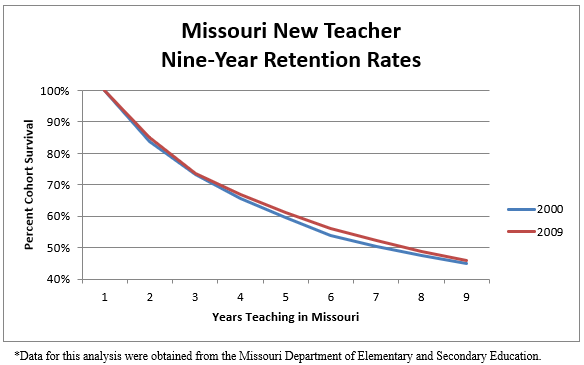
These number more closely fit the percentage of teachers leaving the field in the U.S. Department of Education’s Teacher Attrition and Mobility study, which found roughly 7-8% of teachers leave the profession each year.
Looking at a shorter period of five years, I compare the retention rates for new teachers in 2000, 2009, and 2013 below. As this chart shows, the five-year cohort survival is getting better, not worse. For new teachers in 2013, over 65% were still in the profession after five years.
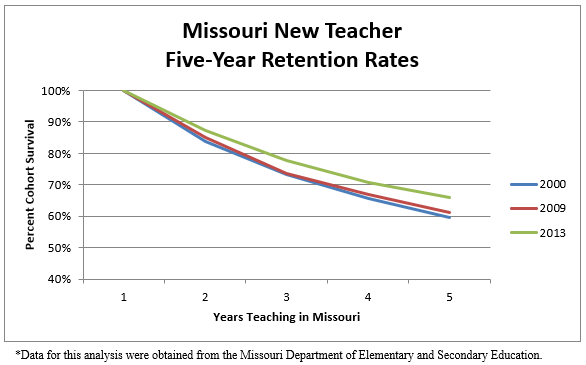
The numbers presented here are different than DESE’s numbers because we are measuring different things. They look at building level turnover. That is not the best way to measure a state’s health in teacher retention. We have over 500 school districts, and we should expect some movement of teachers among the districts. People move, their spouses get jobs elsewhere, and they seek higher pay or job advancement. For all sorts of reasons, teachers change schools. That is not an indictment of the field and does not require state intervention.
Before the State Board of Education begins a massive collaborative effort to address the non-issue of a fictitious teacher retention crisis, they should look at all the facts. Whether you look at new teachers starting in 2000, 2009, or 2013, sixty percent or more are still in the profession in the state after five years.
We do not have a statewide epidemic, but many individual school districts may have teacher retention problems. And, just as these problems are local, they will in most cases require local solutions, not broad statewide policies.
New Year, New Sales Taxes

By now it shouldn’t surprise us. As we head into the new year, governments across Missouri are getting ready to collect more in sales taxes.
Over the past eight or so years, the number of distinct sales tax jurisdictions in Missouri has grown by more than 9 percent—a total of 199 new jurisdictions created. This growth is caused by several factors, but mostly by new and overlapping special taxing districts, such as ambulance districts, levee districts, and, most prominently, transportation development districts (TDDs) and community improvement districts (CIDs). These districts are formed to collect sales and other taxes to fund various improvements and services. Unfortunately, TDDs and CIDs usually just help pad developers’ bottom lines.
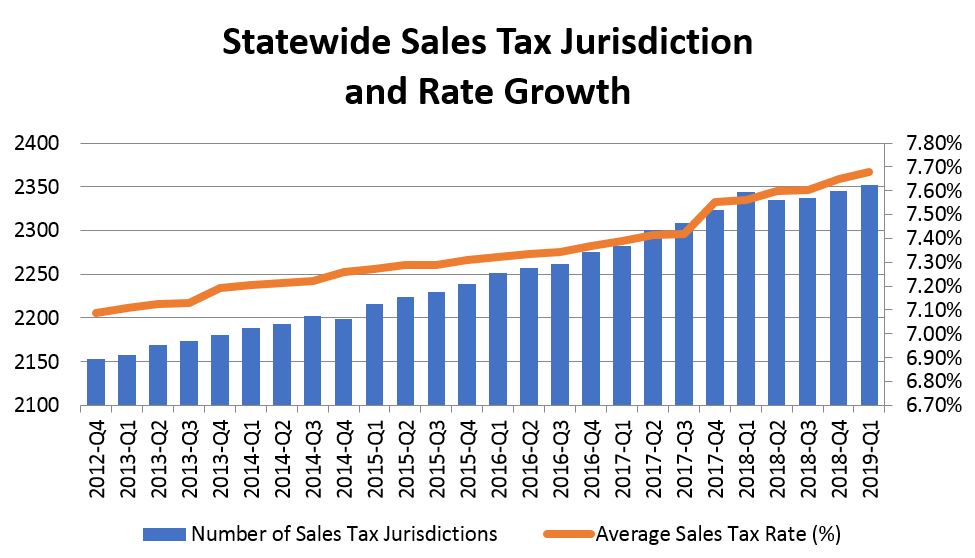
Source: Missouri Department of Revenue, Sales/Use Tax Rate Tables, numerous years.
As the figure above shows, with the increase in sales tax jurisdictions comes an increase in the average sales tax rate. This means that as more and more jurisdictions come on the scene, taxpayers cough up more and more money.
However, just because the average sales tax rate has been on the rise, it doesn’t necessarily mean all Missourians are paying more in sales taxes. As noted above, the driving force behind the rate increases has been the creation and overlapping of special taxing districts, which usually encompass relatively limited geographic areas. And although the TDDs and CIDs that are driving the rate growth are all over the state, about two-thirds are in the St. Louis and Kansas City metro areas, where much of the state’s population lives. So, overall, even if some Missourians are not significantly affected by the recent rate increases, many are.
Unfortunately, as things stand there is little taxpayers can do to curb the state’s sales tax rate growth. That’s because many if not most TDD and CID taxes can be established without the approval of the general public. These districts can be formed by property owners—often developers—meaning the taxpaying public has no say in whether the rate hikes become law. Real reform would have to come in the form of significant changes to the laws governing TDDs and CIDs. So, as the new year gets going and the legislature meets in Jefferson City, lawmakers keen on lowering (regressive) taxes should take some time to think about redesigning the laws that allow these districts to be established.
Kansas City and St. Louis Increasingly in Debt

In June 2013, the Show-Me Institute published a paper comparing St. Louis and Kansas City’s expenses with six peer cities. One of the expenditures compared was debt service per capita. For Missouri’s two biggest cities, debt was high then and has only gotten higher since. In an upcoming paper by Show-Me Institute analyst Elias Tsapelas, we revisit those numbers. The chart below shows just the spending on debt.
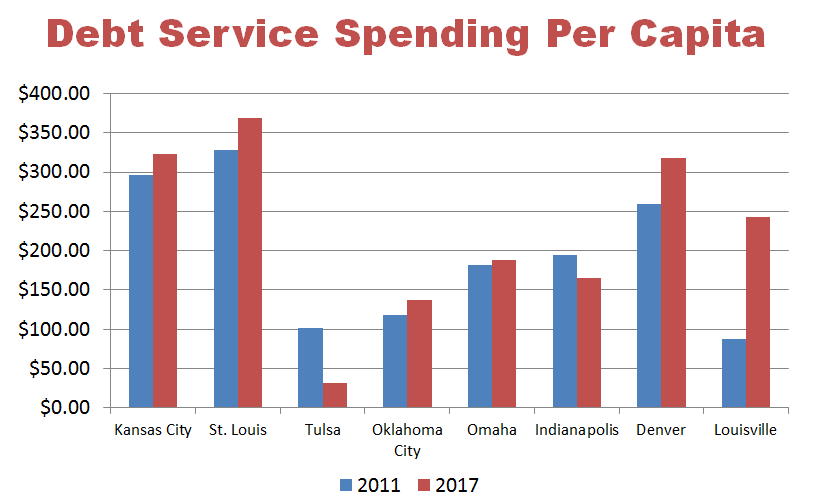
Kansas City’s and St. Louis’s debt service per person were the highest of the cities we studied a few years ago and remain the highest today, despite some dramatic increases in debt in Louisville and Denver. Tulsa and Indianapolis actually reduced their per capita debt payments!
For Kansas City, debt service spending rose from $296.24 per person in 2011 to $322.90 in 2017. St. Louis’s numbers rose from $328.15 to $369.33 in the same time period. Long-time readers of this blog shouldn’t be surprised; we pointed this out almost two years ago when Kansas City and St. Louis ranked 101st and 112th out of 166 cities in a study of financial health by the California Policy Center. Nor should it surprise Kansas City’s leaders. As we wrote at the time,
The Mayor’s own Citizens Commission on Municipal Revenue 2012 report cites high debt as a problem and offers, “Because current debt levels are high compared to peer cities, the impact on the City’s credit rating from issuing additional and significant levels of debt must be of primary concern.”
As Kansas City approaches a mayoral election and St. Louis yet again ponders subsidizing a sports stadium for wealthy would-be owners, city leaders need to focus on long term financial sustainability and stop buying expensive municipal baubles on taxpayer credit.
Missouri’s Biggest Cities Spend $100 Million Annually Just to Give Away Money!
An excellent story in the St. Louis Business Journal points out that according to a recent study by the Milken Institute, Kansas City and St. Louis are at best middling when it comes to economic growth. Reporters Brian Robbins and Jacob Kirn augmented that study by highlighting just how much Missouri’s two biggest cities spend on economic development to get such unimpressive results:
Nine key organizations, including the St. Louis Economic Development Partnership, St. Louis Regional Chamber and St. Louis Development Corp., claim a role in economic development. They collect and spend some $78 million annually, mostly from businesses and taxpayers.
…Kansas City counts roughly 10 key entities focused on development, and spends $21 million, according to the review. Its organizations include the Unified Government of Wyandotte County/Kansas City, Kansas and Kansas City Area Development Council. Kansas City’s rankings for job growth (91st), wage growth (83rd), and high-tech gross domestic product growth (96th) were better than those of St. Louis.
Note that the combined $99 million spent in Kansas City and St. Louis is just on the staff and overhead of the organizations that offer economic incentives—it does not include the additional hundreds of millions of dollars for the incentives themselves! While Kansas City’s growth barely places us in the top half of the 200 cities studied, St. Louis fares much worse. The Lou ranks 152nd in job growth, 142nd in wage growth, and 99th in high tech GDP growth.
Despite faring slightly better than St. Louis, it appears Kansas City proper isn’t getting much for its efforts. If you look at the news release webpage of the Kansas City Area Development Council—the same folks that put together the still-secret regional bid for Amazon’s second headquarters—you’ll find ten press releases for 2018. Several of them talk about positive developments in the Kansas City “region,” but only one, TrialCard, is actually about new jobs within the borders of Kansas City, Missouri. The announcement projected 225 new jobs.
Well, maybe. A Kansas City Business Journal story at the time suggested those numbers are temporary:
The Kansas City center will get up to the 200-225 employee mark beginning around November, including temporary workers, and drop to between 100 to 150 after about February, (TrialCard VP Scott) Dulitz said. Over time, he said, activity—and the employee count—could increase.
As if to underscore the St. Louis Business Journal’s point about the money spent, the release included:
KCADC was proud to work with a number of regional partners in attracting TrialCard to the region including the State of Missouri, Missouri Partnership, City of Kansas City, Missouri, Economic Development Corporation of Kansas City, Missouri, Clay County Economic Development Council, KCP&L, Spire Energy, Cushman & Wakefield and CBRE.
The problems with Kansas City and St. Louis won’t be solved by lavish economic development incentives. Instead, city leaders need to focus on the basics: infrastructure, public safety, education and the like. There is no shortcut to success—no matter how much you spend.
Patrick Tuohey on KCPT’s Ruckus

On Thursday, January 3, Show-Me Institute Director of Municipal Policy Patrick Tuohey appeared on KCPT’s Ruckus to discuss the earnings tax and the Clean Missouri reforms.
Proposal to Make PACER Free to the Public Deserves Support
Court documents are, generally speaking, public information, and in Missouri the public has free access to a vast array of state litigation information through its Case.net system. Unfortunately, the same can’t be said for federal judicial records currently nested behind the PACER (“Public Access to Court Electronic Records”) paywall. However, if one U.S. representative has his way, that may change. Ars Technica reports:
The PACER system has been on the Web since the late 1990s. To avoid using taxpayer funds to develop the system, Congress authorized the courts to charge users for it instead. Given the plunging cost of bandwidth and storage, you might have expected these fees to decline over time. Instead, the judiciary has actually raised fees—from 7 cents per page in 1998 to 10 cents per page today. Even search results incur fees. The result has been a massive windfall for the judiciary—$150 million in 2016 alone.
Critics like the legal scholar Stephen Schultze point out that this is not what Congress had in mind. In 2002, Congress required that the courts collect fees “only to the extent necessary” to fund the system. It obviously doesn’t cost $150 million per year to run a website with a bunch of PDFs on it. Despite that, federal courts have used PACER revenues as a slush fund to finance other court activities. For example, one judge bragged at a 2010 conference about using PACER funds to install flatscreen monitors and state-of-the-art sound systems in court rooms.
Legislation has now been introduced that would require courts to make PACER documents available for download free. And this is a good thing.
I am sympathetic to the concern that the public writ large should not be on the hook for every undertaking by government, which is why I often support user fees for a wide array of government services, including for roads. But when it comes to good governance, there is a shared interest in transparency that government should bake into its standard operating procedure.
In slight contrast to our Show-Me Checkbook Project, the interest in transparency in our courts isn’t necessarily about oversight; while cities themselves are often black boxes to the public in terms of their spending, most court records are easy to obtain. The question in both cases, however, is whether the public should essentially have to pay twice for these records: through our tax dollars first, and then again when we want to see what our tax dollars have paid for.
For purposes of good governance, I don’t think paying twice—for checkbook records, or for court records—is appropriate, and I hope PACER becomes an open resource for the public very soon.
Innovation in Child Care Coming from Private-Sector Employers

Here’s a problem most working parents have faced: You’ve found a good sitter or daycare center for your children, but on a day when you absolutely need to be at work, your sitter is ill—or maybe it’s your child who is ill, and the daycare center won’t let you bring her in. It’s hard enough to find one trustworthy childcare provider. Having a backup plan for emergencies is even tougher.
It’s a common problem that can cause real difficulty for anyone whose job demands aren’t always flexible, but do we need the government to fix it? Here are how some employers have chosen to deal with the issue: Companies including General Mills and Starbucks now offer a backup childcare benefit, and Best Buy recently began rolling out a new program that helps parents by giving them 10 days of subsidized childcare a year that they can access quickly through Care.com. The only cost to parents is a $10 a day co-pay.
Such programs can help both companies and their employees: The company doesn’t lose productivity from workers having to stay home, and employees don’t have to use up valuable vacation or sick days to attend to their kids when other plans fall through.
It’s a win–win scenario—a private-sector solution based on a voluntary, mutually beneficial arrangement. And it doesn’t require government intervention in the form of subsidies, which would require a decision about whether to pay for them in higher taxes or to reduce spending elsewhere. Best Buy specifically cited the lower federal corporate taxes as helping make this new backup childcare benefit possible. Wouldn’t it be better for Missouri policymakers to take a similar approach by simply making it easier for companies meet the needs of their workers?
Brenda Talent on KETC’s Donnybrook
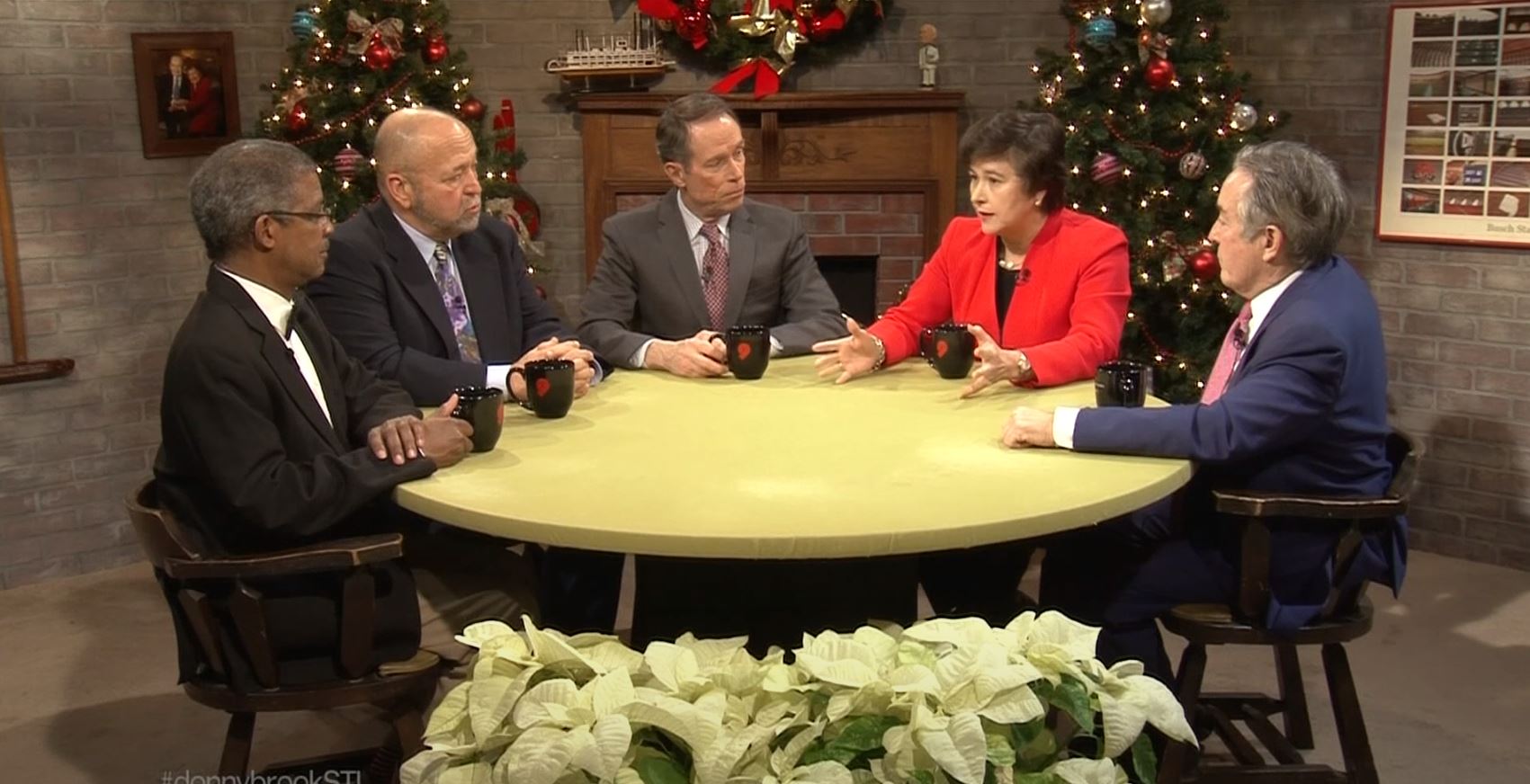
On December 27, Show-Me Institute CEO Brenda Talent appeared on KETC’s Donnybrook to discuss the biggest issues of 2018.
