Missouri’s Starting Teacher Salary Is Higher Than Previously Reported

“Missouri ranks 49th nationally in average starting teacher salary at $31,842.”

This quote comes from an ABC 17 news report, but it is simply not true. They attribute that statistic to “A recent report by the Missouri Department of Elementary and Secondary Education.” Over the past few weeks similar stories have spread like wildfire across Missouri media outlets. The Kansas City Star calls this “pathetic.” The Herald-Whig draws on this statistic to claim that Missouri’s school funding is “inadequate.”

There’s just one problem—the statistic is completely wrong.

Although the $31,842 figure is attributed to the Missouri Department of Elementary and Secondary Education (DESE), DESE officials did not calculate the figure. In his report to the State Board of Education, Paul Katnik, assistant commissioner at DESE, cites this figure from Niche.com. But, of course, Niche.com didn’t calculate the figure. It cites a report from the National Education Association. We don’t know how the NEA calculated the figure.

What is shocking is that people who should recognize how wrong the number is have not done so. Rather, they are perpetuating this lie. For instance, Todd Fuller, the director of communications for the Missouri State Teachers Association (MSTA) is quoted by KOMU as saying, “I don’t think it’s surprising that we’re ranked where we are…For starting teacher salary to be that near the bottom, it’s discouraging.” The MSTA’s own research contradicts this low salary number!

MSTA collected the starting salary schedule of every school district in the state. It then calculated the average starting salary for each school district. In 2018-19, the starting minimum salary was $34,290. It hasn’t been as low as the DESE reported figure in over five years.

What’s more, the MSTA figure is undoubtedly a lower bound. The MSTA calculations weight each district evenly. Smaller school districts tend to have lower teacher salaries, but they hire fewer teachers. So, we can conclude the average is most likely higher than $34,290. (It’s worth noting that all of these salary figures do not include benefits like health or retirement. This means the economic benefit is quite a bit higher than the salary would indicate.)

So, what is the real starting teacher salary? Using DESE data containing teacher salaries for all Missouri teachers in 2017, I attempt to answer that question. First, I limit the data to those who are reported as first-year teachers in Missouri public schools with no experience in another state. Then, I remove any teacher who is not listed as full-time or is not making $25,000, the required minimum for a full-time teacher.

When I do this, the average starting teacher salary in Missouri is over $37,000. It is slightly higher when we consider the extra pay teachers get for engaging in additional duties, such as tutoring.

Should we really quibble about a few thousand dollars? Absolutely! We should demand accurate information from our policymakers, especially when those statistics are being used to drive policy discussions. We have already seen calls to raise the state minimum starting teacher salary. Interestingly, only three school districts start teachers out at the minimum, according to the MSTA report.

In 2017, just 39 teachers earned a salary of $25,000 and less than two percent of the total teacher workforce earned less than $30,000. Moreover, many of these “teachers” are not what we would consider regular classroom teachers. Of the teachers earning less than $30,000, at least 16 of them are classified as “in school suspension” teachers. Another 58 are listed as “Advisory/Homeroom.”

If you raised all these teachers up to $30,000, it would increase average pay in the state by about $30 a year in average salary. Importantly, it would place an inordinate financial burden on small, rural school districts. The end result of this blunt policy change would likely be teacher layoffs, increased class sizes, more four day school weeks, or the cutting of extra programs in these districts.

The debate about teacher pay is important, but this is the wrong way to go about it. I’ve said it before and I’ll say it again: If we are going to have important policy discussions, we should have that discussion honestly and with the correct facts.


There’s a Bike Lane Around Here Somewhere

Do you need an example of the price we pay when we fail to look ahead? Look no further than Kansas City’s new parking protected bike lanes.

The three-mile route opened in August, running along Armour Boulevard in Midtown. Advocated for by groups such as BikeWalkKC, the $700,000 project was highly praised by both city officials and the media. However, the lack of foresight in planning these lanes quickly became evident.

Protected bike lanes, where bikers ride in between the curb and a row of parked cars, have the potential to help keep riders safer than they would be if they were in the main traffic lane, side-by-side with moving cars. According to a story from KSHB news, some residents have complained of extremely limited visibility when turning out of cross streets onto Armour Boulevard. But the same story noted that the Kansas City Police Department had not seen an increase in accidents along the road where the bike lanes were added, so cyclists and drivers seem to have been fortunate so far.

The onset of winter, however, has revealed another problem, as the lanes have been obstructed—first by large piles of leaves, and later by snow and ice, rendering them unsafe and almost unusable. Many bikers are using the popular neighborhood site Nextdoor to vent their frustration:

“I had to be in the middle of the street on Armour on my daily morning bike commute, which completely defeats the purpose of the bike lanes…Everyone seems to have a problem with these new bike lanes, myself included, and I’m a cyclist!”

The need to keep the new bike lanes cleared should hardly be a surprise. People continue to bike, whether to work or for fun, year-round – not just during the warm months. It takes only common sense to recognize that bike lanes, just like streets for motor vehicles, need maintenance and upkeep if they are to remain usable in bad weather. But as the picture above shows, there’s little evidence that bike lane got any attention after the snowfall earlier this month. (And yes, that snow-covered area just to the right of the row of cars really is the bike lane.)

No one wants to see cyclists put at risk, whether by motor-vehicle traffic or by treacherous bike paths. But spending over half a million dollars on a bike path—especially one that is rendered useless by bad weather—is hard to justify. According to a 2016 report from the League of American Bicyclists, only 0.4 percent of Kansas City commuters ride their bikes to work. I don’t know what fraction of those riders take this specific stretch of Armour Boulevard, but we aren’t talking about a large number of riders.

I hope that in the future, city leaders will think carefully about the benefits and costs, and the future obligations, that come with projects like the Armour Boulevard bike lanes.


Show-Me Institute Issues Brief Regarding “Pay to Stay”

Recently the Columbia Missourian ran a story about jail bond bills—payments that defendants are required to make to cover their own incarceration in county jails. According to the story, only seven of Missouri’s 114 counties do not collect such funds. And a defendant who is unable to “pay to stay,” may be sentenced to longer jail terms with higher resulting board bills.

In effect, the counties are operating debtor’s prisons.

George Richey is one person who has had a run in with these board bills. According to the Missourian,

Of the $3,226 assessed to Richey in 2015, $3,150 is for board at $35 a day.

Almost 2 1/2 years later, Richey is still paying for that bill, with a balance of around $1,600 left as of May. That is, until he was hit with a new board bill in 2016 of an additional $2,275—the result of being jailed because he couldn’t fully pay the first bill.

Missouri is not alone in this practice. According to a study by the Brennan Center for Justice, “as of 2015, at least 43 states authorize room and board fees and at least 35 states authorize medical fees to be charged to inmates in either state or county correctional facilities.”

Through his public defender, Richey filed suit against the state of Missouri seeking to end the practice, and Missouri’s Attorney General lent support to Richey’s effort, noting in an amicus brief filed with the Missouri Supreme Court, “De facto debtors’ prisons have no place in Missouri, and I am proud to stand up against a system that seeks to treat its poorer citizens as ATMs.”

Last week, the Show-Me Institute joined the Institute for Constitutional Advocacy and Protection, the Fines & Fees Justice Center, the Roderick and Solange MacArthur Justice Center, and Fair and Just Prosecution in submitting an amicus curiae brief to the Missouri Supreme Court. The brief notes that the current system burdens both the individuals being fined as well as the courts, and that there are other, more effective ways to collect debt. The filing concludes:

Jail debt, when imposed on indigent individuals like Mr. Richey, is irrational, unjust, counterproductive, and likely unconstitutional.  This Court should reverse the trial court’s denial of Mr. Richey’s motion to retax costs.

There are plenty of opportunities for criminal justice reform in Missouri, and we have written about many of them in the past. Often such reforms focus on how to maintain public safety while reducing costs to taxpayers. This effort, however, focuses on protecting the liberty of individuals from pernicious government. We hope the courts will agree.

State of the State Highlights Show-Me Research

In Governor Parson’s State of the State address last week, he touched on many topics that Show-Me Institute analysts have been writing about for years. A brief list of topics from the speech, accompanied by links to relevant writings from Show-Me Institute researchers, follows:

  • Workforce development wasn’t just mentioned in the speech—it was singled out as one of the two most important policy priorities moving forward. Patrick Ishmael has been out in front of this issue, writing on the importance of workforce development, particularly in the area of vocational training. Readers of this blog may also have seen posts by Emily Stahly on the potential for charter schools to help give Missouri a more skilled workforce, and by Abigail Burrola on how a focus on industry-recognized credentials could better prepare our high-school graduates for good jobs after graduation.
  • Infrastructure was the other issue designated as a top priority, particularly the pressing need to fund necessary repairs and improvements to Missouri’s highway system. Back in 2016, Joe Miller wrote a comprehensive paper on options for funding the Missouri Department of Transportation. More recently, Graham Renz and Patrick Tuohey have advocated for user fees as the best way to fund our state’s transportation needs, whether through a gas tax or some form of tolling.
  • The Governor noted the drain on the state’s finances caused by Missouri’s high incarceration rate and his desire to avoid building more prisons. Ways to help keep prison populations down include reform of laws governing mandatory minimum sentencing and efforts to help ex-offenders enter the workforce, as Patrick Tuohey has written.
  • The need to control the growth in the cost of the state’s Medicaid program was also discussed. Elias Tsapelas has not only written on this topic, but has also looked at measures being taken in other states to address the problem

Even topics mentioned only in passing during the speech have been covered by Show-Me Institute analysts, including telemedicine, tax credit reform, and educational challenges facing children with autism and other disabilities.

It’s encouraging to hear that so many long-overdue reforms may be on the docket during the current legislative session. As we watch to see if 2019 will bring important changes to Missouri policy, we’ll continue to research and advocate free-market solutions that will help move our state forward.

New Year, New Sales Taxes

By now it shouldn’t surprise us. As we head into the new year, governments across Missouri are getting ready to collect more in sales taxes.

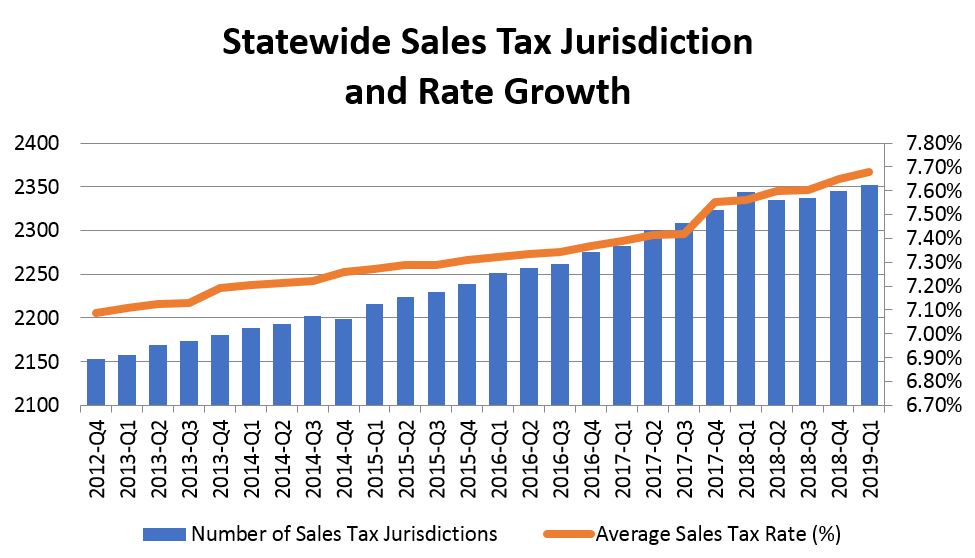
Over the past eight or so years, the number of distinct sales tax jurisdictions in Missouri has grown by more than 9 percent—a total of 199 new jurisdictions created. This growth is caused by several factors, but mostly by new and overlapping special taxing districts, such as ambulance districts, levee districts, and, most prominently, transportation development districts (TDDs) and community improvement districts (CIDs). These districts are formed to collect sales and other taxes to fund various improvements and services. Unfortunately, TDDs and CIDs usually just help pad developers’ bottom lines.

Graph: Statewide Sales Tax Jurisdiction and Rate Growth

Source: Missouri Department of Revenue, Sales/Use Tax Rate Tables, numerous years.

As the figure above shows, with the increase in sales tax jurisdictions comes an increase in the average sales tax rate. This means that as more and more jurisdictions come on the scene, taxpayers cough up more and more money.

However, just because the average sales tax rate has been on the rise, it doesn’t necessarily mean all Missourians are paying more in sales taxes. As noted above, the driving force behind the rate increases has been the creation and overlapping of special taxing districts, which usually encompass relatively limited geographic areas. And although the TDDs and CIDs that are driving the rate growth are all over the state, about two-thirds are in the St. Louis and Kansas City metro areas, where much of the state’s population lives. So, overall, even if some Missourians are not significantly affected by the recent rate increases, many are.

Unfortunately, as things stand there is little taxpayers can do to curb the state’s sales tax rate growth. That’s because many if not most TDD and CID taxes can be established without the approval of the general public. These districts can be formed by property owners—often developers—meaning the taxpaying public has no say in whether the rate hikes become law. Real reform would have to come in the form of significant changes to the laws governing TDDs and CIDs. So, as the new year gets going and the legislature meets in Jefferson City, lawmakers keen on lowering (regressive) taxes should take some time to think about redesigning the laws that allow these districts to be established.


Support Us

The work of the Show-Me Institute would not be possible without the generous support of people who are inspired by the vision of liberty and free enterprise. We hope you will join our efforts and become a Show-Me Institute sponsor.

Donate
Man on Horse Charging