Good News-Criminal Justice Reform Headed in the Right Direction in Missouri

A few years ago, Missouri was on track to need two new prisons, potentially costing the state hundreds of millions in tax dollars. But not any longer. From 2017 to 2018, Missouri’s incarceration rate decreased by 7.1 percent, the largest drop in the country according to the Vera Institute for Justice.

This decrease follows some recent reforms, including improving parole and probation practices, expanding community-based treatment for mental health and substance abuse, and raising the age of criminal responsibility from 17 to 18 years. Now, the legislature is considering other reforms. One would amend sentencing guidelines to allow judges the discretion to give an alternative sentence to imprisonment for certain non-violent crimes when appropriate. Additionally, lawmakers are examining regulations regarding occupational licenses for ex-offenders that can shut them out of jobs and increase the likelihood they return to prison. Reforms like these can provide taxpayers with the best public safety return on their investment make a lot of sense.


It’s a Head-Scratcher

I just don’t get it. A recent article in The 74 describes how the vibrant charter school sector and strong authorizers have led to a rising tide for both charter public school students and traditional public school students in Washington, D.C. It makes me scratch my head. Why don’t we want that in Missouri?

The article, which cites the dramatic rise in scores on the National Assessment of Educational Progress (NAEP) for both groups of students, concludes with three takeaways that other cities can learn from DC:

  • Cities should embrace charter schools while limiting authorizers to one or two “strong” ones.
  • Cities should welcome the potential positive effects of competition. It’s been a force for positive change across the country.
  • If cities allow that to happen, middle-class families will stay.

This dynamic of charters having a broad, positive impact for everyone is playing out in big cities—Chicago, Indianapolis, Denver, Nashville, Boston—and in small cities.  While we haven’t seen dramatic results in St. Louis or Kansas City, we also haven’t embraced charter schools. There continues to be this odd notion in Missouri that charter schools are an intervention for low performance. Everywhere else they’re an option—often sponsored by local school boards—that parents across all types of communities and backgrounds are choosing.

Here’s the more important point—Missouri has a lot of other cities that would benefit from school choice. The school districts in Springfield, Joplin, Jefferson City, and Cape Girardeau are not exactly thriving. And yet, school boards and state legislators in these cities continue to fear public school choice. This year, the Missouri Senate filibustered a bill that would have made it much easier for charter schools to open in these cities. The Senate floor was held hostage for hours to ensure that the traditional public school monopoly wasn’t threatened by parents who want something else.

How long will Missouri continue to cross its arms and staunchly defend the status quo of thirty years ago? How long will the positive stories about what’s working when it comes to improving public education only be about other states?


Missouri’s Municipal Failure

According to the Brookings Institution Metro Monitor 2019, per data from 2016–2017, Kansas City ranked 78th in economic growth out of the 100 largest metro areas in the United States. St. Louis fared a little better at 69th. Kansas City ranked 84th in prosperity (measured by productivity, standard of living, and wage growth); St. Louis ranked 52nd. Missouri’s cities are underperforming.

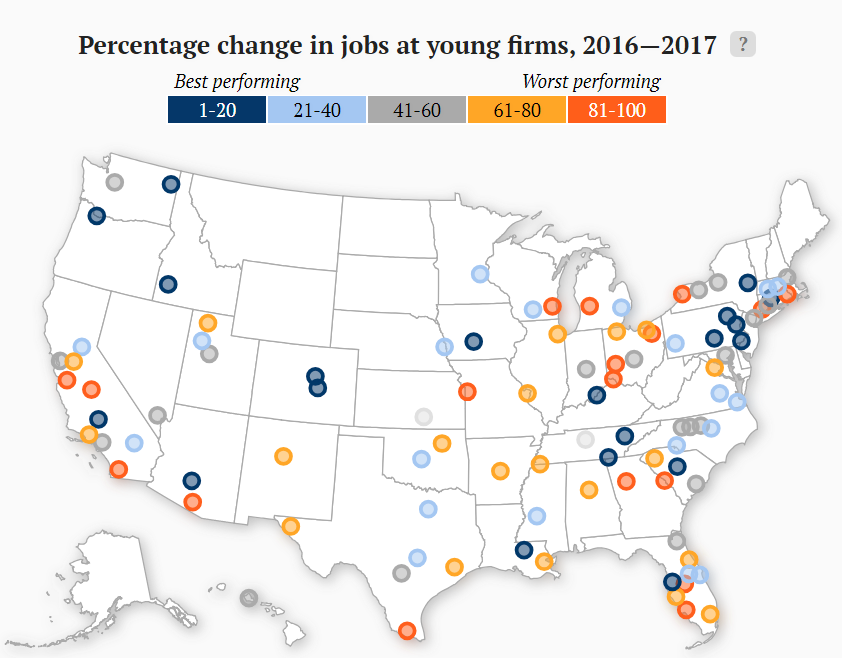
The Kansas City metro area, despite all the talk about innovation and tech jobs, scored 81st in percentage change in jobs at young firms—one of the worst performances in the United States.

Missouri’s top cities spend hundreds of millions of dollars on incentives and subsidies each year in an effort to improve the economy. Exactly what have we gotten in return for all this spending?

Report after report details exactly how St. Louis and Kansas City have given away such a huge amount in incentives. We’ve rebuilt downtown Kansas City, yet haven’t grown or created jobs in any meaningful way. In fact, it appears we’ve actually overbuilt Kansas City. The population of St. Louis is actually shrinking despite all the investment.

Any reasonable person would look at this and conclude that while these incentives and subsidies may make wealthy developers wealthier, they aren’t actually creating very many jobs or doing much to increase investment. That is certainly what the research says.

So why are we still doing it?


Charter Schools Can Exist in Rural Areas, Too

There are 1,300 charter schools in rural and township areas nationwide. Exactly zero of them are in Missouri, and that’s a problem. There are plenty of examples of charter schools serving rural areas very effectively. A recent article from the 74 Million highlights the story of a charter school serving rural, low-income students in Gaston, North Carolina.

KIPP Gaston College Prep opened in 2005. Six years after graduation, 61 percent of graduates from the 2009 class had earned college degrees. The degree-earning rate after six years was 48 percent for the class of 2010, and 62 percent for the class of 2011. The graduating class sizes are small, with 48 graduates in 2009 and 568 alumni so far, but the early returns are very encouraging. These rates are impressive considering only 11 percent of children raised in the lowest-income quartile (annual family income of $37,564 or less) earn bachelor’s degrees within six years. Gaston KIPP families mostly fall toward the bottom end of that lowest quartile.

In the 2016–17 school year, the National Center for Education Statistics reported that over 225,600 Missouri students that attended a public school in a rural or township area qualified for free and reduced-price lunch (representative of a low family income but not necessarily the lowest income quartile)—roughly a quarter of all Missouri public school students. As the achievement gap between high- and low-income students persists, successful efforts to support rural, low-income students should be encouraged.

KIPP Gaston College Prep is just one example of how educational choice can benefit students beyond urban areas. Isn’t it time Missouri expands charter schools to better serve its low-income, rural students?


Film Tax Credits Still a Bad Idea

It is appropriate that in the St. Louis Post-Dispatch story on an effort to reinstate film tax credits, the newspaper chose a scene from the movie “Three Billboards Outside Ebbing, Missouri.” The town of Ebbing does not exist; neither do the benefits of film tax credits.

Back in 2010, Missouri’s own Tax Credit Review Commission wrote in their report that the film tax credit should be cut because it “serves too narrow of an industry and fails to provide a positive return on investment to the state.” As my colleagues wrote in 2015, “according to data gathered by the Bureau of Labor Statistics, jobs related to film production decreased during the time the film tax credit program was in place.” What has changed since then that justifies a change in policy? No one is saying.

Instead, the sponsor of the effort to offer yet another state tax credit sings paeans about the work ethic of Missourians, telling the Post-Dispatch:

If given the opportunity for a production company to select anywhere they would choose without having the tax credits being part of the equation, they would certainly choose Missouri more often than other states that don’t have the work ethic and the pride that we have as Missourians.

The characters portrayed in “Three Billboards” and the Netflix show “Ozark” aren’t the examples of work ethic for which any state would want to be known. Furthermore, wasting money on investments that fail to provide a positive return isn’t a good work ethic; it’s careless.

What’s worse, governments don’t even do a good job of picking films anyone will see. A study from the Beacon Center of Tennessee found that “using available box office data, over 40 percent of films that receive grants made less at the box office than they received in incentives.” If we want to promote a good work ethic, let’s stick with rewarding filmmakers who apply their craft well, rather than filmmakers who merely apply for handouts.

It would be laudable if supporters of this proposal argued that Missouri’s taxes are too high, and that there would be more private investment if we lowered them. Instead, they are effectively saying “taxes are too high, and we’d like to lower them for one particular industry that we favor.” That is wrong; government should not be picking winners and losers. It’s just bad policy.


Students Who Are Bullied Deserve Educational Options

Kids can be terrible. I know. I have four of them. They bite. They kick. They scream. They mock. They tease. They do just about everything you tell them not to . . . sometimes because you tell them not to. As parents, my wife and I try our best to teach them to love each other, to have compassion, to offer forgiveness, and to just be decent people. We fail at this on a daily basis.

That is why I have some sympathy for teachers and school leaders when it comes to issues related to bullying. I have four kids; they have hundreds. I understand that some amount of bullying or fighting is going to occur at schools because schools are filled with children.

This doesn’t mean we can’t do anything about it. Parents and schools need to be proactive about preventing these kinds of problems. But what do we do for students who do not feel safe at school right now?

In most cases, our policies require the child being bullied to confront their bully. They have to come forward to their parents, teachers, or principals. Then, often times, they have to work with that student to overcome differences. While there may be some merit in attempting to build these bridges, sometimes this is just a bridge too far.

The problem with all of this is that most parents have little recourse. They can bring the issue to the attention of the school, but then they must trust the professionals to address the issue that first happened under their watch.

Students should not be forced to continue attending a school where they don’t feel safe.

As my colleague wrote about recently, Florida did something innovative to address this problem. It created the Hope Scholarship Program, which allows “purchasers of motor vehicles to contribute their vehicle sales tax to fund private school scholarships.” Those scholarships are awarded to victims of bullying or physical attacks.

School choice programs, such as this or Empowerment Scholarship Accounts, give parents control. These programs equip parents with the resources to place their child in a school where they will feel safe and supported.

Teachers and school administrators will do the best they can to help students and prevent bullying. But like it or not, it will occur. When it does, those children deserve educational options.


Health Care Desperately Needs Competition-Retail Medicine Provides It

If you need a flu shot, you could make an appointment with your physician, wait at a potentially inconvenient location, and likely receive an expensive bill. Or, you could head to your local grocery store and quickly receive the shot for under $30 with additional incentives like discounted shopping coupons. Some places like Walmart have even delivered flu shots for free, realizing they are a way of getting people into the store.

Why is there such a difference between the two? Charles Silver and David Hyman, authors of Overcharged: Why Americans Pay Too Much for Health Care, argue that it is because of the free market.

Traditional providers, like hospitals and clinics, are expensive and inconvenient for the consumer because their pricing is primarily based on what insurers will pay. In comparison, retail providers, like the clinic found in your grocery store, have to price their services in order to attract customers and strive for convenience. The two offer many of the same services but have completely different ways of doing business.

Retail providers are becoming an increasingly disruptive challenger of traditional providers. This should not be surprising—when providers are able to compete the results typically are lower-priced and more attractive options for the consumer. Just as internet shopping is disrupting brick-and-mortar businesses, retail medicine is disrupting traditional medicine, an industry that is used to being insulated from competition.

A great example of this is the way retail medicine is transforming audiology. While traditional audiologists charge steep prices for hearing aids and hearing checks (with additional charges for things like testing, warranties, and damage coverage, which can often make up 70 percent of the total price of a hearing aid), retailers are improving services while lowering costs. Costco Hearing Aid Centers offer similar services to that of audiologists without the additional charges.

Silver and Hyman write:

As more retailers enter the field, prices will become easier to compare and competition will intensify. Bargain-hungry consumers will look for better deals, but they will be interested in quality too . . . With pressure on both quality and price, retail offerings are bound to improve. (pg. 325)

Competitive pricing offered by the retail sector also allows people to avoid markups that come with using third-party payers. While most retail providers take insurance, patients pay out-of-pocket one-third of the time. In contrast, patients who visit primary care doctors pay out-of-pocket only ten percent of the time. Silver and Hyman view this as an important factor in the success of retail providers:

When we pay for health care the same way we pay for other services—by spending our own money instead of an insurer’s—good things happen: prices fall and quality improves as providers compete for business. (pg. 320)

Competition provides good things indeed. Want to learn more about market solutions for health care problems? Join us in St. Louis or Kansas City to learn more from Cato Institute scholars Charles Silver and David Hyman as they discuss why the American health care system is so dysfunctional and costly.




Support Us

The work of the Show-Me Institute would not be possible without the generous support of people who are inspired by the vision of liberty and free enterprise. We hope you will join our efforts and become a Show-Me Institute sponsor.

Donate
Man on Horse Charging