An IRC Bonus Pay Program Would Benefit the Ozarks

A survey released earlier this year suggests the Ozark region has a workforce problem. The survey asked businesses in the Ozark region questions about the state of the workforce in the area, and a majority indicated they have difficulty finding applicants with the relevant knowledge and skills to fill jobs. 

If employers are looking for a more skilled workforce, getting more students to earn industry-recognized credentials (IRCs) would be a step in the right direction. IRCs are credentials awarded from industry groups after passing an exam, allowing the bearer to demonstrate proficiency in a specific field. Earning an IRC is a great way to jump immediately from high school to a job.

85 percent of businesses responding to the workforce survey said they have some or considerable difficulty finding applicants with an IRC (only around a quarter of respondents said IRCs were not applicable). According to the survey respondents, IRCs are the most challenging type of educational attainment for employers to find in prospective employees, even including postsecondary degrees.

The variety of survey respondents is also notable. Responses came from a number of industries including healthcare, education, manufacturing, construction, and finance. This is good evidence that the problem of IRC scarcity is widespread and not just confined to pockets of the Ozark economy. The Missouri Department of Elementary and Secondary Education has approved 81 types of IRC exams; only 16 of those exams were completed successfully by an Ozark student. In total, a mere 470 IRCs were awarded to high school students in the Ozark region in 2017. If each IRC was earned by a different student in the graduating class, then only 8 percent of Ozark graduates would have an IRC. The real number is likely even lower than 8 percent, because one student can earn multiple IRCs.

The survey responses make it clear that there’s unmet demand in the Ozark region for students graduating with an IRC in hand. One way to increase IRC attainment is to offer a financial incentive to schools and teachers. An IRC bonus pay program would give teachers financial compensation for each of their students that earn an IRC. Florida implemented an IRC bonus pay program and saw an explosion in students earning IRCs.

The Ozark region has a workforce problem that IRCs could help solve. It’s time to get creative in finding ways to prepare students for life after high school.


 

Subsidies Still Don’t Grow the Economy

Kansas City has been spending loads of money on economic development subisides for years. But instead of actually spurring economic development, these subsidies often just move economic activity from one place to another, as Patrick Tuohey mentioned in this post from two years ago:

https://showmeinstitute.org/blog/subsidies/kansas-city%E2%80%99s-economic-diversion

Patrick mentioned this idea again in our latest podcast with Dr. Susan Pendergrass. They discussed Patrick’s latest report on Kansas City’s flawed 2018 economic development study. You can find a link to the study (with supporting documentation) and the podcast below:

https://soundcloud.com/show-me-institute/smi-pod-designed-to-be-worthless-the-incentive-study-that-wasnt

https://showmeinstitute.org/publication/subsidies/kansas-citys-2018-study-economic-development-incentives

School Choice Legislation and “The Valley of Death”

Half a league, half a league,

Half a league onward,

All in the valley of Death

Rode the six hundred.

“Forward, the Light Brigade!

Charge for the guns!” he said.

Into the valley of Death

Rode the six hundred.

From “The Charge of the Light Brigade” by Alfred, Lord Tennyson.

On a warm evening at the end of May, I sat in a cramped office in an industrial park. It was after work hours, so there wasn’t much commotion at the truck rental or plumbing supply businesses located across the street. The building was not much to look at, but what was going on inside was priceless.

The room was packed full of parents and school children who were itching to get out of the uniforms they had been wearing all day. We were gathered that evening for our school’s “spring sharing,” where students display their artwork and offer recitations. Hearing my four-year-old and six-year-old recite poetry from memory filled my heart. But nothing could top my feeling of pride when my 13-year-old took the floor with his classmates.

They began with the “St. Crispin’s Day Speech” from Shakespeare’s Henry V. That speech has long been one of my favorites. Next, in a choral performance, the students recited “The Charge of the Light Brigade,” by Alfred, Lord Tennyson. The poem depicts a military blunder from the Crimean War, a battle few today know anything about. There was my son, reciting every word.

Weeks earlier, my three boys and I went on a school trip to Kansas City. While visiting the World War I museum, we stood on the glass walkway above the 9,000 poppies, each representing 1,000 military personnel who died in the war. The children, led by their teachers, joined together in reciting “In Flanders Fields” by John McCrae.

Some may ask, “What’s the benefit of having children memorize poems and speeches such as these?” Anyone who heard the voices of 30 children honoring the fallen soldiers understands the importance.

At our kid’s previous school, they attempted to teach kids character skills directly. Our first grader once brought home a coloring sheet with a superhero wearing a cape emblazoned with the word “Yet!” They were trying to teach perseverance and grit.

While these are wonderful traits to teach to children, we learn much more from the lessons of history, from the beauty of poetry, and from the trials of those who have gone before us than we will ever learn from a coloring page. Our new school is exactly what my wife and I had been looking for. To us, this is what education should be.

Few, however, will get to experience this type of education in our state—our school is a private school.

Indeed, many in the public education lobby have been patting themselves on the back for preventing school choice policies from passing this past legislative session. Charter school expansion never received a vote, and Empowerment Scholarship Accounts legislation was filibustered on the Senate floor.

It’s sad that people are excited about denying parents a chance to find a school that is the perfect fit for their family.

It still isn’t clear today who was responsible for the failure in the charge of light brigade—it seems that miscommunication led 600 men into the valley of death. We have no doubt, however, who blocked school choice legislation in Missouri because they won’t stop applauding themselves.

Missouri Families Deserve Choice

My son, I’m happy to say, is a well-adjusted adult who participates in plenty of active sports—mostly surfing and rock climbing. But, I clearly remember his time as a youth baseball player when he got the “Utility Player” award many years in a row. It wasn’t that fun for him and it wasn’t that fun for me. Maybe team sports just aren’t his thing.

Imagine the feeling of having your eleven-year-old son receive “The Most Annoying Male Award” from his teacher—who he spends 6 or 7 hours a day with for most of the year—knowing that his social skills are compromised by autism. My heart hurts for that child and his parents. I can’t imagine they’re excited about sending him back to that school in the fall.

This didn’t happen in Missouri; it happened in Gary, Indiana. I guess there’s some silver lining in that because almost half of the public school students in Gary have chosen a charter school. Hopefully his parents can find a better fit—a school that celebrates his strengths instead of making fun of him.

But what if this happened in Missouri? The parents’ choices would be to move, pay private school tuition, or to send their son back to the school that humiliated him. The Missouri legislature has consistently denied parents in the state any option other than their assigned public school. The Department of Elementary and Secondary Education (DESE) tries to reassure themselves and everyone else by claiming 99 percent of districts in the state are “fine.” But fine as defined by DESE is not the same as fine as defined by every parent. Shouldn’t there be options available for parents who want, or more importantly need them?


Another Year without Reform

Missourians hoping for a reprieve from rising health care costs will have to wait at least another year. Once again, the legislature failed to pass any measures to rein in growing costs. The Trump administration has made it easier for states across the country to request waivers from Obamacare’s most costly mandates. However, instead of applying for waivers that could help reduce health care costs, the state’s policymakers decided to devote their time to doling out generous tax incentives for General Motors.

The cost of health care is hurting the state’s budget and Missourians’ pocketbooks. This year, Missouri passed the largest budget in the state’s history and Medicaid is a bigger portion of the budget than any other single item. Medicaid today consumes more of the budget than ever before, and shows no sign of slowing down. In fact, Missouri’s Medicaid enrollment today is less than it was in 2005, but the program costs nearly twice as much.

Premiums for private coverage also continue to rise, partly as a result of restrictions imposed by the Affordable Care Act. My colleagues have advocated for the expansion of short-term medical plans to help ease cost inflation. Short-term medical plans allow consumers to personalize their coverage without costly Obamacare restrictions, such as mandated maternity and mental health coverage. Bills that would expand short-term plans have received support in both chambers the past two years. Hopefully a bill expanding the availability of short-term plans will finally pass next year.

The lone bright spot in health care policy was the creation of the “Missouri Health Insurance Innovation Task Force.” When the task force meets later this year, they will “develop innovative ways to transform the health insurance marketplace” and request an innovation waiver from the federal government. I’ll be outlining some market-based reforms the task force should consider in a future blog post.

The work of this task force and the reforms they consider could bring substantial health care savings for Missourians. Sadly, the implementation of any reforms won’t be completed until at least next year.  It’s nice to have a glimmer of hope for the future, but that doesn’t make the present any less disappointing.


Charter Schools Offer Flexibility

In partnership with the Department of Conservation, the Columbia school district is developing a 10-day program where fifth graders from Boone County can get hands-on learning experience outdoors. Kids that get to participate may enjoy getting out of the classroom to learn about wildlife, conservation, and survival skills. But why limit project-based learning to a few days?

At one elementary school in Kansas, kids in kindergarten through fourth grade split time between their classrooms, a greenhouse, and a small farm right on school grounds. As a charter school, Walton Rural Life Center is able to replace traditional curriculums with a project-based program that focuses on agriculture. Students at Walton have chores and sell plants they grow and eggs from chickens they raise to supplement what they learn in the classroom.

I am thankful that my niece and nephew are able to attend Walton and I know how much the community cherishes the school, but I wonder why students in Missouri do not have access to similar opportunities. The article about the Columbia project mentions that the idea for a magnet-type nature school fizzled out because of a lack of state funding a few years ago. But using the charter school model could help solve that. A charter school, as in the case of Walton, would be eligible for additional federal funds to help defray starting costs.

With the flexibility and innovation that comes with charter schools, communities in Missouri could have customized schools that meet the needs and interest of their students instead of settling for programs that last just a few days. Whether it is project-based learning or a college-prep academy, charter schools can provide new opportunities to students in all parts of the state.


Charter Schools Don’t Cause Financial Distress

One of the most common arguments made against charter schools is that they financially harm traditional public schools. However, new research from the Center for Reinventing Public Education (CPRE) helps debunk this claim. The CRPE study looked at school districts in California and found no evidence that charter school enrollment increases the likelihood of financial distress (defined as a condition in which is a district is likely to fall short of financial obligations in the next two years) in California school districts.

The study found no statistically significant correlation between the financial status of school districts and their charter enrollment. Charter school critics note that when a student transfers from a traditional public school to a charter school, their previous school no longer receives funding associated with that student (which makes perfect sense, since the school is no longer responsible for the student). But the data in the study gives no indication this process is causing financial problems for districts. When CRPE looked at long-term trends regarding charter enrollment and the number of districts in financial distress, it found that while charter enrollment has steadily increased, the number of districts in financial distress has not increased every year.

Many factors contribute to financial struggles in school districts. Costs of pensions, benefits and grossly overestimating enrollment can cause a district to be short on money. These are the real causes of financial troubles in school districts, not the convenient bogeyman of charter schools. While the study looked at California schools, there’s no real reason to think the results would be different in Missouri. Charter schools shouldn’t be limited in Missouri out of misplaced worry that they will financially harm school districts; they should instead be expanded for the opportunities they provide students.


What Can Credentials Get You?

Missouri’s employers have open positions that they want to fill, but they struggle to find qualified applicants. It’s a situation that should spell opportunity for anyone who is ready to embark upon a career; however, “qualified” is the key word here. Conventional wisdom tells us that a college degree is the key to a good job, but what if you don’t have the resources or the time to invest in a 4-year college degree?

Fortunately, the findings from a recent nationwide survey conducted by Gallup, the Strada Education Network, and the Lumina Foundation, suggest that a college degree isn’t necessarily the only thing that employers are interested in. Researchers looked at two types of credentials that can be earned without a college degree and measured their impact on the employability and the earning power of the people who earned them. The credentials studied were the following:

  • Certificates “awarded by educational institutions for completion of professionally oriented courses that typically represent a year or less of work.”
  • Certifications “awarded by independent bodies that verify specific skills and competencies through testing”

The survey looked at adults 18 to 65 years old who had no postsecondary degree and compared those who had earned a certificate/certification with those who had not. The results suggest that earning a credential offers some real benefits in terms of employment rate and income.

  Percentage employed full-time Median income
With credential 85% $45,000
Without credential 78% $30,000

It’s important to note that the study involved subjects of widely varying educational levels. Some had been to college (but hadn’t earned a 4-year degree), while others hadn’t completed high school. Those who hadn’t finished high school are overrepresented in the non-credentialed group, while those who had gone to vocational/technical school are overrepresented in the credentialed group. This means that we can’t easily separate the effect of the credential from the effect of the amount of education a participant has had.

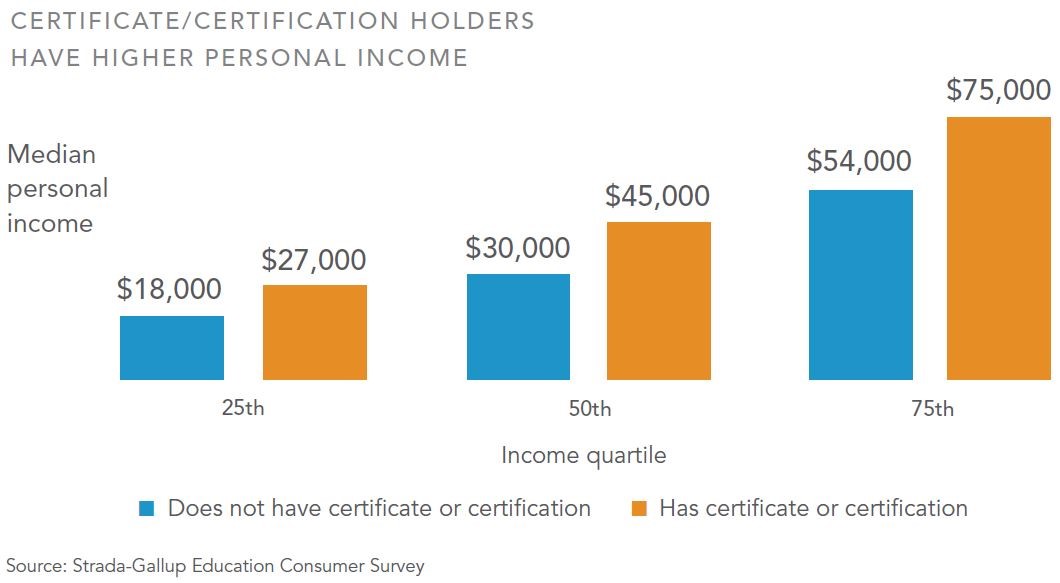
However, the study also found a benefit to having a credential among low-, middle-, and high-income earners:

Certificate holder income

There’s strong evidence that educational programs that result in students earning these certifications provide real benefits, but what does that mean for Missouri?

It could mean a lot, especially with respect to prioritizing needs when allocating the money Missouri spends on education. Credentialing programs appear to offer a positive return to students on the money invested in them. So why can’t these programs capture the imaginations of the public (and of policymakers) in the way that things like pre-K programs do—even though the case for the long-term benefits of pre-K is anything but ironclad?

Nothing against imagination, but when making spending decisions, policymakers are better off being guided by the facts. Although this survey covered adults aged 18 to 64, investing in high schoolers so they can earn industry-recognized credentials could help students leave high school qualified to enter the Missouri workforce immediately. In this case, the facts are lining up behind credentialing programs as a possible way to help Missouri’s workers and employers alike.


Support Us

The work of the Show-Me Institute would not be possible without the generous support of people who are inspired by the vision of liberty and free enterprise. We hope you will join our efforts and become a Show-Me Institute sponsor.

Donate
Man on Horse Charging