Pennsylvania is Reducing Licensing Barriers. Why Doesn’t Missouri?

Following in Arizona’s footsteps, Pennsylvania enacted an occupational licensing reciprocity law on July 1. This means Pennsylvania will accept occupational licensing from other states, given that certain criteria are met. Teachers, among others, can now move to Pennsylvania and start working immediately, instead of having to wait to get a new license. This reform will reduce barriers for workers and make Pennsylvania a more attractive choice for workers.

Missouri should take note, since it licenses over 200 professions and does not have a reciprocity law that applies to all workers.

Put simply, an occupational license is the government giving you permission to work for pay. Show-Me Institute analysts have written  about the negative effects of licensing in the past; it can be especially harmful to specific people and industries. An Institute for Justice (IJ) report details the significant negative effects licensing is having on Missourians.

Twenty-one percent of Missouri workers need a license or certificate to do their job—that’s higher than the national average of 19%. Architects, barbers, interior designers, massage therapists, and others all have to pay fees and follow government instructions to do their jobs.

IJ estimates that Missouri has lost 38,556 jobs and $188 million in output due to licensing requirements. To take one example, cosmetology jobs go unfilled because a lot of people can’t pay hundreds in fees, nor can they commit to 1,500 hours of schooling. The same thing happens with  other professions. Unfilled jobs mean missed opportunities for output, including new products and more services, resulting in  less economic activity in Missouri.

Money, time, and human capital could be used more efficiently with less restrictive licensing.  IJ estimated the amount of misallocated resources in Missouri, or resources that were not put to their most efficient use, at $3.55 billion. Workers devote time and money to unnecessary education, consumers pay higher prices to cover the costs of licensing, and people get jobs outside their area of expertise because they cannot meet requirements. All of these burdens on workers hurt our economy.

Occupational licenses have become much more burdensome than helpful. While the reciprocity laws passed by Arizona and Pennsylvania don’t completely eliminate the problem, they do reduce barriers and promote mobility in the workforce. Missouri is bearing substantial costs from occupational licensing. Why is Missouri standing in the way of people trying to earn a living?

 

Trolley Folly

Show-Me Institute analysts have been a bit of a broken record on the Loop Trolley. But that’s because the project was ill-conceived from the start, with numerous mishaps and delays along the way.

Recent news is unlikely to reassure those skeptical about the project. A St. Louis Post-Dispatch article from last week shared some alarming numbers about the Loop Trolley:

Statistics released Tuesday showed the trolley sold 2,210 tickets in June, producing $4,062 in revenue. That’s up from 1,744 tickets and $3,861 in revenue in May but less than the line’s peak month of March, when 2,421 tickets were sold.

Overall since the trolley opened last Nov. 16, 11,364 tickets have been sold, producing farebox revenue of $22,283.

These are not particularly impressive totals. They’re nowhere close to what the public was promised when the project was being sold years ago. As the Post-Dispatch article mentions, back in 2015 trolley officials predicted 394,000 riders a year. In 2017, officials claimed the first year of operation (which was supposed to be 2018) would generate nearly $400,000 in revenue. The year isn’t over yet, but you don’t need a degree in math to see that things are off track. 

However, Kevin Barbeau, the executive director of the Loop Trolley Co., told the Post-Dispatch there are important caveats to keep in mind. The trolley has only been running four days a week, and the initial projections were based on a full seven-day-a-week schedule. The plan was to have three cars running, but because of delays, there are only two cars in service.

I’m sure that missing a car and only operating four days a week is hurting business. But whose fault is that? The extensive delays in acquiring and renovating the third trolley car can’t be blamed on anyone but the Loop Trolley Co.

Even with optimistic projections, future revenue and ridership with three cars fully operational for seven days a week looks grim. If the trolley saw a fifteen-fold increase in revenue in the second half of the year, it would still fall short of its annual revenue goal. Barbeau claims secondary revenue sources from things like advertising and fundraising will pick up once the trolley is running on a daily basis. But based on all the broken promises and delays, it’s hard to take trolley boosters at their word.

Keep in mind that most of the trolley’s $1.3 million annual operating budget comes from a special sales tax levied on Loop customers, which has raised on average $780,000 a year since 2016. Taxpayers have been paying full freight for this project, despite the missing car and part-time operating schedule. If operating at half capacity is a valid excuse for missing ridership and revenue targets, shouldn’t taxpayers get half their money back?

Special Taxing District Map Now Available

Missourians have a new tool to track the state’s numerous special sales tax districts. Last week, Missouri’s Department of Revenue unveiled a map outlining the state’s many special taxing jurisdictions, including transportation development districts (TDDs), community improvement districts (CIDs), and others. This map is supposed to be a step toward transparent governance. Unfortunately, as currently constructed, the map lacks the functionality to adequately illuminate Missouri’s opaque region-specific tax burdens.

Each year, Missourians pay millions of dollars in sales taxes they often don’t know exist. My colleagues have written often about the problems with these special taxing districts. Many are created without a public vote, the projects often have questionable public benefits, and they usually lack oversight. It was welcome news that consumers were going to have a resource that illustrates whether a special sales tax will be collected any place they wish to shop. The bad news is the map is incapable of showing the cumulative sales tax rate for those locations.

To find the total sales tax burden for a specific address, you’ll need to go to another website. Missouri has more than 2,000 sales tax jurisdictions, and at least 1,400 of those are considered “special.” The remaining jurisdictions are made up of Missouri’s cities and counties who have their own sales and use taxes, but none of those are included on the map.

The map, as a whole, does paint a picture of just how overgrown the state’s special taxing districts have become. Nonetheless, you would think the Show-Me State could create a map that allows taxpayers to accurately determine their cumulative sales tax burden no matter where they are making purchases in the state without having to input a specific address.

See the Department of Revenue’s new map here.


A Snake, or CID, in the Grass

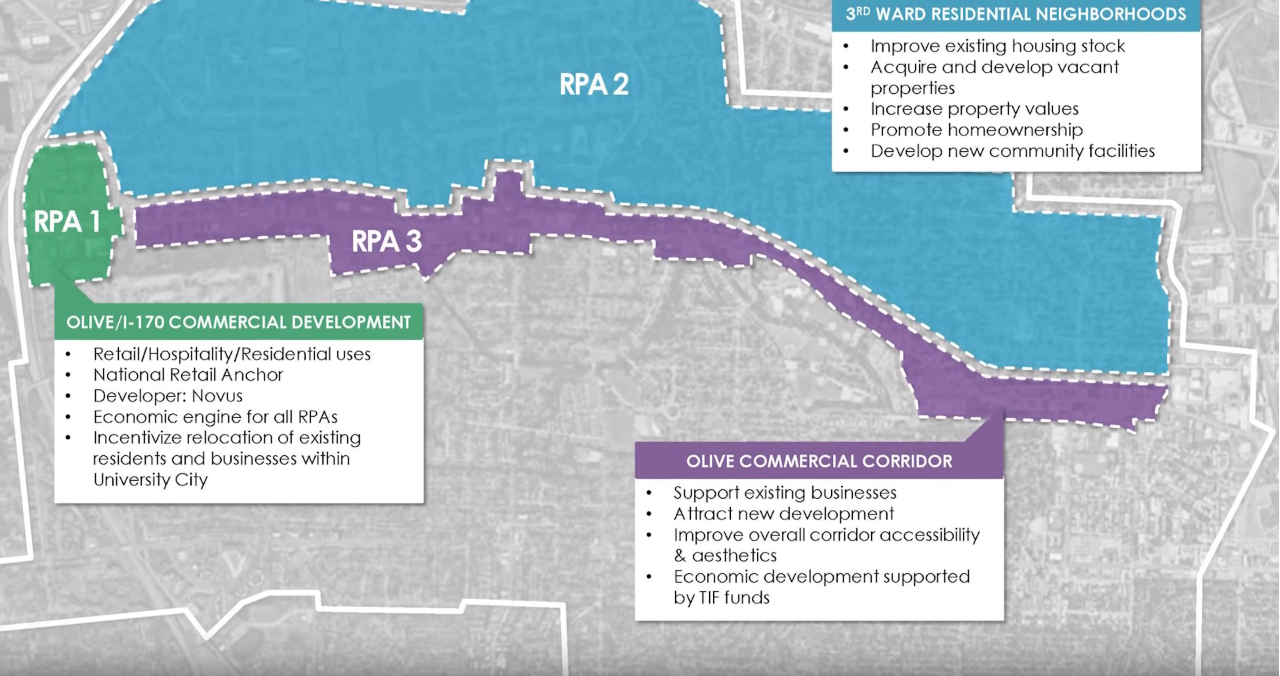
After a year of controversy and egregious accounting errors, the University City TIF plan has been approved. The plan calls for $70 million in future property, sales, and other tax revenues to be returned to the developer, Novus, as a subsidy for the $190 million development.

There is much to bemoan in the deal. Besides the fact that nearly half of the project’s costs will be covered by taxpayers, the upfront payments from Novus the city negotiated—funds to improve the Olive Blvd. corridor and Third Ward in general—have been cut in half, at least in the short term.

But there is something else lurking in the deal worth worrying about.

Although it seems to have been a part of the plan from the outset, a community improvement district, or CID, will be created in the main development area. The district will be controlled by the developer, and will collect a 1% sales tax to fund . . . pretty much anything associated with the development (see pp. 20-21). (CIDs often fund site improvements, such as earthwork and infrastructure, but it is not uncommon for them to fund developments more directly.) And while the final agreement states that no other CIDs or related districts may be formed in the area, it only prohibits proposed districts that would overlap with the main development area, not the entire development footprint, which extends south of Olive Blvd (see pp. 21-22). So there could be even more special sales taxes for University City in the future.

So, what does this mean? In short, more taxpayer money than meets the eye will subsidize the project. In more concrete terms, it means that everyone who shops in the main development area, where a Costco is slated to be built, will pay an extra 1%. That might not sound like much, but it is important to keep in mind that CIDs and their close cousin, transportation development districts (TDDs), have collected more than a billion in revenue from Missourians since their inception. As I’ve detailed previously, CIDs and TDDs are growing at alarming rates, and have altered the state’s tax landscape. Perhaps it should be no surprise that they’re written into this recent mega-deal. 

If policymakers at the local level seem inclined to approve handouts like these, what can be done to stop taxpayer abuse? As Patrick Tuohey and I make clear in a recent paper, the most effective reforms would come at the state level, and would either prohibit developers from forming CIDs and TDDs without a public vote (what will likely happen in the case of this CID) or rescind their sales taxing authority. Short of these reforms, consumers can only brace themselves for higher and higher taxes.

Disclaimer: The author lives in University City’s Third Ward.


Don’t Be Nostalgic for A Failed Policy

There are a lot of policies that seem like a good idea, but aren’t. Busing low-income children of color to schools far away from their home in order to expose them to more middle-class white children is one such idea. And busing children in both directions for the sole purpose of achieving racial balance, as was done in Charlotte-Mecklenburg, North Carolina, has also proven to be a failed policy. Giving disadvantaged children “opportunities” to witness the way middle-class kids move through the world is a patronizing idea. And it doesn’t reduce educational achievement gaps.

Busing may have been the only option for blending the two separate school systems in the South in the latter half of the last century. But today, it remains wildly unpopular with parents. White, middle-class children are the key to the policy and yet, when busing goes into effect, they tend to flee the school. Many urban districts don’t have enough white children to create any sort of balance. And suburban districts are often not interested in participating.

The research on the academic impact of such programs is labeled “variable” at best by its most ardent supporters. In fact, there is stronger evidence that having a teacher of the same race as the student improves academic outcomes. In other words, the race of the person at the front of the room can make a difference in a way that the race of the other students doesn’t.

You know what is popular with parents, and especially with low-income parents of color? Getting to choose where their children attend school rather than having them be assigned or bussed to one. And in many cases, parents would prefer to be able to choose a school where the staff looks like their child, rather than a school where the other students don’t. Researchers at Stanford have determined that low-income black and Hispanic students who attended charter schools of their choice made significant academic gains when compared to their matched peers who attended traditional public schools in the same district. This is a policy that works.

Before there were options like charter schools, the only way to get children from distressed neighborhoods out of their troubled schools was to pick them up every day and take them somewhere else. We now know that giving every parent options for where to send their children to school negates the need for districts to shuffle kids around. It’s time to stop arguing about who’s for or against a failed policy from 50 years ago and give disadvantaged parents the educational options they want and need.


TIF Tyranny Claims Another City

Last month, big business scored yet another victory at the expense of taxpayers.

The University City Council unanimously approved a measure to use tax-increment financing (TIF) to fund a private development at the intersection of I-170 and Olive Boulevard. The developer now gets $70.5 million for a $190 million project.

This vote comes after more than a year of controversy and scrutiny. One concern is that the project would force out dozens of low-income families, several small businesses, and even a Korean church. And earlier this year, University City was criticized for its lack of transparency and closed-door negotiations. The city also underestimated the projected tax revenues of the project by $27 million.

And what do the residents of U City get in return? The city promised the project would bring 150 to 250 “livable wage” jobs to residents, but the agreement does not guarantee any particular number of jobs nor does it require that the developer mandate that its tenants hire locally. The developer must merely request that tenants hire locally. And there is nothing that guarantees that the development won’t be abandoned after the 23-year life of the TIF, once the tax breaks are gone.

Nevertheless, TIF advocates almost always seem to prevail. As  Show-Me Institute researchers have pointed out countless times before, development subsidies primarily just boost revenue figures for favored businesses and pad sales tax revenue for cities. There is no conclusive evidence that TIFs do anything to increase jobs, and they deprive local taxing districts of millions of dollars in foregone property tax revenue.

The 3rd Ward of University City may well become the next case study on why TIFs are ineffective.


Student Loan Forgiveness Isn’t Education Policy

Yes, we have a student loan debt crisis. And it’s growing. In Missouri, 58 percent of 2017 college graduates had debt when they graduated, and the average amount owed among those with debt was $27,108. Fortunately, creative ideas for getting out of this mess abound. Many of them revolve around more flexible payment schedules, improving the financial literacy of young people, making sure that colleges and universities have some skin in the game, or just making college more affordable.

And while loan forgiveness would provide immediate relief to debt holders, it’s important to make the distinction between debt relief and actual education policy. Loan forgiveness would be a very costly policy that wouldn’t expand access to college. In fact, a recent analysis of the costs and benefits of several forms of “free college” found that only one didn’t create education benefits that exceeded the costs. And that was loan forgiveness. Why? Because in this case, those who qualify have already received their education. The benefit of that education is there whether their loans are forgiven or not. So the benefit stays the same, and the cost goes up.

If a student loan holder truly didn’t understand what they were signing up for, they should have a broad array of repayment options tied to their salary. If they were scammed by a loan processor or for-profit college that was selling snake oil, by all means they should have recourse. But a plan to take one point in time and forgive all debt for all holders, regardless of their occupation, income, or repayment status is being floated in order to make headlines by those who make a living spending other people’s money on other people.

We can do better.

Many Missourians Are Moving . . . To Missouri

If you live in a rural community in Missouri and it feels like your neighbors are moving away, you might be right—but they aren’t going as far as you might think. A recent report from the Jefferson City News Tribune notes that according to the Census Bureau, at least 52 Missouri counties and St. Louis City lost population from July 2017 to July 2018. That means almost half the counties in Missouri had negative population growth.

But while population loss in roughly half of Missouri’s counties sounds terrible, there’s more going on here.

A great deal has been written about the growth of big cities across the country, but news outlets are slowly picking up on a trend that shows small and middle-sized cities gaining steam with young people. Think cities like Waco, TX and Knoxville, TN as opposed to Austin, TX and Nashville, TN—cities that aren’t necessarily state population hubs but that play an important role in their regional economies.

In fact, it seems that young people’s attraction to big cities is often overstated. Research increasingly suggests they are equally drawn to the less-costly option of smaller cities and suburban areas. Census Bureau data show that suburban growth is outpacing large city growth, with large city growth tapering off.

How is this playing out in Missouri? While most rural counties and Saint Louis City saw population declines, many medium-sized cities—Springfield, Columbia, and Lee’s Summit to name a few—have seen population increases according to the Census Bureau. Since Missouri’s total population only grew by a small percent, most of this population change is attributed to intrastate migration.

So while it is true that rural populations are dipping, it’s at least in part because of regional population consolidation in cities not far from where residents formerly lived.

And when you think about it, this migration trend makes a lot of sense. Small and medium-sized cities provide many employment, entrepreneurial, and social opportunities that may not always be available in rural areas, and these cities are often more affordable and community centered than big cities. While this trend isn’t great for rural counties—that is, the political subdivisions themselves—it is good for the people moving toward better economic and social prospects. As farms in rural areas become more productive and require fewer laborers, having access to city resources and opportunities will be all the more important for these residents.

Unfortunately, Missouri has struggled with overall population growth in recent years. During that same July 2017 to July 2018 time period mentioned above, Missouri was 29th in the nation in population growth, with a paltry 0.3% increase. This rate is consistent with the low population growth rates that we’ve seen for years. So, while this trend of intrastate migration is positive, we can’t forget that Missouri still struggles to attract new residents.


Support Us

The work of the Show-Me Institute would not be possible without the generous support of people who are inspired by the vision of liberty and free enterprise. We hope you will join our efforts and become a Show-Me Institute sponsor.

Donate
Man on Horse Charging