Kansas Sports Authority Lets Chiefs Play as Home Team, Referee and Rulebook

Listen to this article

The package of subsidies offered to the Kansas City Chiefs by the Missouri Legislature during last year’s special session was bad.

But that bill was not nearly as bad for taxpayers as what is being offered to the team by our neighbors in Kansas. House Bill 2793—the Kansas Sports Authority Act—offers the team, well, it seems, everything.

The bill sets up a Sports Authority to administer the site of a new stadium. That in and of itself is not unique. The Truman Sports Complex, in which the Chiefs and Royals currently play, is administered by the Jackson County Sports Complex Authority. But the power and portfolio of what is being considered in Kansas is breathtaking. Consider the following:

  • The authority board includes “a representative of the professional sports team” using the facility as a voting member. This means the Chiefs would have a vote on such things as negotiating its lease, financing, and operations. Having the team oversee itself is a crazy conflict of interest and uncommon in other similar authorities if not absolutely unique, for obvious reasons.
  • But the Chiefs aren’t merely one of several votes on the authority. The bill allows additional sports facilities to be placed under the authority if the governing body requests it and the Chiefs also recommend it—giving them an unusual role in expanding the authority’s jurisdiction. This provision may exist because team ownership wants to make sure nobody else can siphon away public funds.
  • The authority’s powers “shall not be exercised in a way that conflicts with the terms and conditions set forth in the STAR bond agreement dated December 22, 2025.” This means the authority is locked into the already-negotiated agreement with the team, limiting its ability to adjust terms later.

The three items hand the Chiefs an incredible amount of power. The bill gives the Chiefs a voting seat on the governing authority, binds that authority to the STAR bond agreement the Chiefs negotiated, and gives the team an effective veto over whether additional sports facilities are added to the authority.

But wait, there’s more!

  • Contractors must use competition only “to the extent reasonable and practicable in the authority’s sole discretion.” This is a significant weakening of competitive bidding requirements, increasing the risk of opaque contracting and favoritism.
  • The authority is exempt from multiple statutes including the Kansas Civil Service Act and the Kansas Administrative Procedure Act, removing the standard hiring, rulemaking and administrative oversight safeguards that normally apply to public entities spending public funds.
  • The authority must submit annual reports and testify if legislative committees request it. But this so-called oversight is largely after-the-fact reporting, with no routine legislative approval required for major contracts, bonds or development agreements.
  • You read that correctly: the authority may issue special-obligation bonds for stadium construction and infrastructure. Although not legally state debt, political pressure often arises if revenues underperform, creating potential taxpayer exposure. If you doubt this, read up on the fiasco over Platte County and the Zona Rosa shopping center.
  • In addition to capturing the increase in sales taxes in the approximately 300-square mile STAR bond district, the authority will be exempt from paying state and local sales and use taxes on purchases of materials, machinery, and services used to construct or equip the facility.
  • “Insofar as the provisions of this act are inconsistent with the provisions of any other law, whether general, specific or local, the provisions of this act shall be controlling.” Yeah, that’s in the bill. The authority’s statute is designed to override conflicting state or local laws, potentially weakening local regulatory control.
  • And what happens when the stadium is completed and paid for? Nothing. The statute does not include a sunset provision or dissolution trigger. That means the authority could become a permanent quasi-government entity in perpetuity.
  • But at least the authority’s power is limited to the stadium, right? Nope. The authority’s purpose includes not just sports facilities and infrastructure used for it, but any “civic, community, athletic, educational, cultural and commercial activities.” “Commercial activities” seems like something that could cover, well, anything.

Kansas State Senator Mike Thompson claims that this measure will set up an unaccountable  “shadow government.” That seems like an over-the-top claim, but the provisions of this bill suggest he is at least directionally correct.

If Food Truck Reform Is Good for One County, It’s Good for All

Listen to this article

With Kansas City preparing to host matches during the 2026 FIFA World Cup, Missouri lawmakers are considering a bill to simplify food truck licensing in Jackson County. The proposal would allow vendors licensed by the county to operate in any municipality without additional city permits.

The change would remove a common barrier: multiple permits just to cross a city boundary.

The idea makes sense. But if it will help entrepreneurs and visitors during the World Cup, why should the same principle not apply across Missouri? As the Squirrel Nut Zippers sang, “If it’s good enough for Grandad, its good enough for me.”

Food truck regulations vary widely by city. Vendors operating across a metro area may face requirements for multiple permits, fees, and regulatory approvals.

Show-Me Institute writers have written about these barriers for years. In 2019, we noted that St. Louis food trucks still faced significant regulatory constraints despite growing demand. Food trucks offer a flexible and relatively low-cost entry into the restaurant business, but local regulations can make that opportunity harder to pursue.

In some places, additional rules beyond health and sanitation standards function as a de facto ban on mobile vendors.

Health and safety regulations would remain under the proposal being considered in Jefferson City. Missouri already regulates food safety through inspections and sanitation standards administered by local health departments.

The real issue is duplication. Requiring vendors who already meet health standards to obtain a license in every municipality adds cost and delay without improving safety.

Every occupational license carries costs: higher prices for consumers, barriers to entry for workers, fewer providers, and lost time and money for licensees. The central policy question is whether those costs are justified by clear benefits to public safety or product quality.

Several Missouri communities have taken steps to loosen food truck restrictions in recent years. Clayton, for example, expanded opportunities for food trucks to operate at events and public gatherings while maintaining basic safety requirements.

Such changes recognize that mobile vendors are part of the broader restaurant ecosystem and often serve as a first step toward larger businesses.

Starting a small business often requires navigating numerous regulatory steps and fees. Reducing unnecessary barriers can make it easier for entrepreneurs to test new ideas and serve customers.

That flexibility helps explain the popularity of food trucks: vendors can move where demand is strongest, serve events, and test new concepts without the overhead of a traditional restaurant.

Major events like the World Cup highlight that advantage. When large numbers of visitors arrive, mobile vendors can help meet the temporary surge in demand for food and entertainment.

But the benefits of reducing unnecessary regulation should not depend on an international sporting event. If getting government out of the way helps vendors serve World Cup visitors in Kansas City, it should also help them serve customers across the rest of Missouri.

Are Opportunity Zones Just Federal-Level TIF?

Listen to this article

When Congress created Opportunity Zones in 2017, the goal was simple: use tax incentives to steer private investment into distressed communities. Investors could defer or eliminate capital-gains taxes if they reinvested those gains in designated census tracts.

The hope was that these incentives would spur development and expand opportunity in struggling neighborhoods. But new research suggests the program may suffer from the same problems as Tax-Increment Financing (TIF).

In a recent paper from the National Bureau of Economics, “Understanding the Employment Effects of Opportunity Zones,” the authors examine employment outcomes through 2023. They find that jobs located within Opportunity Zones did increase modestly. But most of those gains appear to come from nearby communities rather than representing new economic activity. Sound familiar?

The authors estimate that job growth inside Opportunity Zones is largely offset by job losses in adjacent low-income tracts. Their overall conclusion is that the program mainly results in a “spatial reallocation of jobs and households” rather than broad economic gains.

The distribution of those jobs also matters. Most of the new positions in Opportunity Zones are filled by workers who live outside the zones—often in more affluent neighborhoods. Meanwhile, the economic circumstances of existing residents show little improvement. Employment among residents rises slightly, but median earnings and poverty rates do not change significantly.

These results should sound familiar to longtime readers of the Show-Me Institute. I’ve argued that programs like TIF often fail to generate new economic growth. Instead, they tend to shift development across neighborhoods or municipalities. Projects still get built, but just in a different place.

The evidence on Opportunity Zones suggests something similar may be happening at the federal level.

Investment incentives can influence where development occurs. But that does not necessarily mean they create new economic opportunities for the people policymakers mean to help.

TIF is TIF is TIF, even at the federal level.

Letter Grades for Schools and Districts Are Coming to Missouri

A version of this commentary appeared in the St. Louis Post-Dispatch.

Last week the Missouri House of Representatives passed a bill requiring the Department of Elementary and Secondary Education (DESE) to assign A–F letter grades to schools and districts statewide. The bill now heads to the Senate, which is considering its own version. The letter grades will be based entirely on student academic outcomes, primarily proficiency rates and growth in achievement. Districts and schools will be required to post their grades publicly.

The context for this legislation is Governor Kehoe’s executive order from January that mandates school and district A–F letter grades. The executive order ensures the grades are coming; the legislation is meant to refine the executive order and codify it.

All of this action signals considerable enthusiasm about school and district letter grades in the capital. Why? First, DESE’s current school report cards are difficult to interpret. They contain a mountain of data but fail to clearly indicate what matters most. For parents and taxpayers trying to understand how their local schools are performing, the information is overwhelming and comparisons across schools are difficult. Transparency that cannot be understood is not transparency at all.

Second, A–F letter grades are part of a small bundle of policies that other successful states are using to increase student learning. States with high national test scores (e.g., Louisiana, Mississippi, Texas, Florida) assign A–F letter grades so parents and taxpayers can quickly understand how effective or ineffective their local schools are. The grades are a simple way to make schools accountable to the public. I wish Missouri were more of a leader; we’re not, but we can at least follow when other states blaze the trail.

Letter grades work because everyone understands what they mean. An “A” signals excellence. An “F” signals failure. And by making the grades based on proficiency and growth—rather than diluting them with peripheral and non-academic metrics—the new policy keeps attention where it belongs: on students’ academic outcomes.

Still, there are detractors. Critics worry the grades could stigmatize low-performing schools, which is an understandable concern. But at the end of the day, if we want real change, we must be willing to confront poor performance. Our schools are not fixing themselves. If we lack the courage to call out low performers, what hope is there for children trapped in the schools we’re so afraid to grade?

Another objection is that school grades are too simplistic—no single measure can capture everything a school does. Videos featuring students and teachers are circulating online cautioning that a letter grade doesn’t tell the whole story.

This is true—a letter grade doesn’t tell the whole story. However, academic achievement and growth are not minor details; they are central to a school’s mission. We must recognize that a letter grade based on these metrics tells a very important part of the story. To many, myself included, it is the most important part. Moreover, critics offer no compelling alternative, essentially responding with (my paraphrase) “trust us, we’re doing our best.”

The need to hold schools accountable might be less urgent if Missouri weren’t on a decade-long trajectory of declining academic achievement. We currently sit well below states like Mississippi and Louisiana—perpetual bottom-dwellers among states until relatively recently—in test score rankings based on the National Assessment of Educational Progress (NAEP). And these rankings aren’t just numbers. A recent high-quality academic article shows that high NAEP scores correspond to higher incomes, improved educational attainment, and declines in teen motherhood, incarceration, and arrest rates.

I want these things for our children. And we can have them. This is not a zero-sum game. We just need to commit to success.

Opponents of letter grades don’t want us to put a label on failure. I understand. Acknowledging failure is uncomfortable and requires courage. But acknowledging failure is the first step in fixing anything, and our schools are no exception.

Fire District Sales Taxes

Listen to this article

Until 2025, fire protection districts in parts of Missouri—mostly rural areas—were allowed to impose a sales tax of up to one half of one percent within their district. In the 2025 legislative session, a bill was passed to give all fire districts the ability to impose a sales tax, and also increased the maximum tax to one percent. Have any Missouri fire districts (and the smaller ambulance districts) taken the opportunity to ask voters to approve this new or higher sales tax?

Of course they have. It seems like almost all of them, especially in the five urban counties where fire and ambulance district sales taxes were previously prohibited.

Property taxes were how fire districts were entirely funded in those five urban counties. The rest of the districts also primarily relied on property taxes where the sales tax was limited to one half of one percent. That is apparently going to change. It shouldn’t. Fire protection literally protects your property, and should be paid for as such, through property taxes.

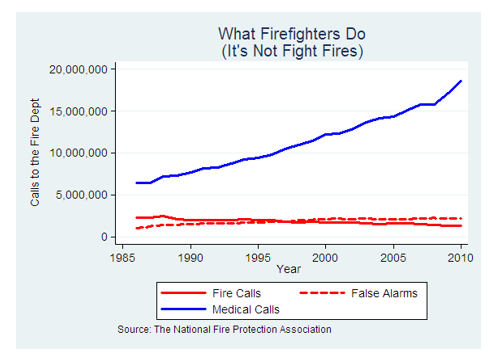
But of course, fire districts (and municipal fire departments) don’t actually fight many fires anymore. They answer medical calls and respond to car accidents, which are not so closely tied to one’s property. Here is a chart from Marginal Revolution.

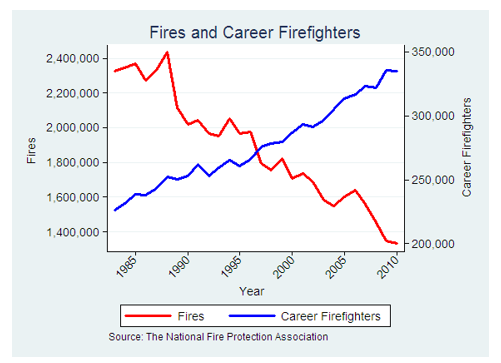
If a higher sales taxes pass, the fire districts are required to reduce their property taxes by an amount equal to half of the new sales tax collections. That’s nice, I guess, but it still means a substantial increase in funds for the fire districts. Fire districts will have to justify all the new spending, which they will mostly do by continuing to send the full fire truck out for a huge number of calls that don’t require a fully staffed fire truck. While this chart and the prior one end in 2010, the changes they noted since 1985 have not reversed in the past 15 years. The number of annual fires has leveled off, simply because it gets harder to reduce something once it has declined dramatically (which is wonderful). The number of career firefighters has continued to increase, reaching 364,000 by 2020.

Fire districts, particularly the larger ones in suburban areas, are often controlled by fireman’s unions. They get their allies elected in low-turnout April elections. Yes, the fire district officials care about public safety. Nobody disputes that. But they are often intensely focused on increasing pay and pension benefits for their members. Unlike city officials who have to fund a municipal fire department along with many other city departments under an umbrella of citywide tax revenues, fire district officials only care about their fire district. They don’t have to put funding into a bigger picture. They just want to maximize funds for the district.

Everyone wants quality fire protection, and firemen certainly deserve good pay and quality benefits. But taxpayers can’t afford to maintain the very generous benefits as is, and expanding the tax base for fire districts by allowing more and higher sales taxes is likely going to end up increasing those salary and benefits substantially. Will it lead to better public safety for the people of Missouri? Maybe. Will it lead to much higher local spending? Definitely.

Income Tax Elimination, Early Literacy Bills, and Data Centers in Missouri

David Stokes, Elias Tsapelas, and Avery Frank join Zach Lawhorn to break down the latest from the 2026 Missouri legislative session, including updates on the push to eliminate Missouri’s income tax. They also discuss why the film tax credit doesn’t work out for Missouri taxpayers, which provisions of the early literacy bills are still moving forward, the growing debate over data center incentives and energy demands, and more.

Listen on Spotify

Listen on Apple Podcasts 

Listen on SoundCloud

Produced by Show-Me Opportunity


The Wrong Way to Fix Property Taxes

Listen to this article

A version of this commentary appeared in the St. Louis Business Journal.

Missouri’s property tax system works best when the assessments are accurate, the tax base is wide, and the rates are low. That combination will help grow Missouri’s economy for everyone while properly funding the necessary functions of local government. However, a radical change in the system is being put before voters in St. Charles, Jefferson, and Franklin counties in April. These three counties will vote on whether to prohibit any property tax increases due to reassessments. Current law requires local governments to roll back tax rates as assessments increase, but we all know that taxes still go up, sometimes substantially.

This change would also reduce the ability of school districts to fund themselves and would make them more dependent on state aid. Consider the following: Parkway school district in St. Louis County is 89% funded by local taxes. However, Fox school district in Jefferson County is only 51% locally funded, while Wentzville school district in St. Charles is only 64% locally funded, and St. Clair school district in Franklin is just 45% locally funded. These changes would make school districts in these three counties more dependent on state aid, not less. Again, I’m aware that many voters may view that as a benefit, but it is anything but.

At the Show-Me Institute, we support low taxes, and I am well-aware of how tempting this will be to voters. But using market valuations in reassessment to set tax levels is a good system. While our property tax system needs reforms, eliminating any and all tax increases from reassessments will make Missouri more dependent on other taxes that hurt our economy far more than property taxes do. Hate them as much as you wish, but property taxes indisputably harm economic growth less than other taxes do.

Numerous other harmful effects would come from diluting the market forces (in the form of assessments based on market values) that form the basis of property taxation. California provides us with an example of the harms of these types of property tax caps with its famous Proposition 13, passed in 1978, which dramatically limited increases in property assessments and taxes. Proposition 13 certainly had its intended effect of lowering property taxes for California homeowners. However, it also reduced mobility, significantly increased alternative taxes, limited homeownership opportunities, and caused substantial tax disparities for similar properties receiving similar services. These negative consequences are exactly what St. Charles, Jefferson, and Franklin counties would experience over the long run.

There are also significant constitutional concerns with this legislation. Missouri Constitution Chapter X, Section 3 states that “taxes . . . shall be uniform upon the same class or subclass of subjects within the territorial limits of the authority levying the tax.” So, consider the issue of the Meramec Valley R-III school district. This school district serves families in three counties. If voters approve these tax changes, the property tax system in one of those three counties would remain unchanged (St. Louis), while in the other two (Jefferson and Franklin) it would be illegal to have a tax increase from reassessment. It would certainly seem unconstitutional for property owners within the same taxing district who own the same type of property (single-family homes) to face different tax and assessment systems for the same services.

We need property tax reform in Missouri, but this total limitation is too severe. If enacted, the property tax proposals before the voters in these three fast-growing counties would make the region’s overall tax system worse, not better. I hope voters will look past the easy appeal of a tax limit to think about the long-term harms.

Missouri Should Update Its Renewable Portfolio Standard to Include Nuclear Energy

Listen to this article

A version of the following commentary appeared in the Columbia Missourian.

Missouri, like many states, mandates that a certain share of electricity come from renewable energy sources. Those sources typically include solar, wind, and biomass—but in many states, including Missouri, they exclude nuclear energy.

A productive debate could be had about whether state government should issue any such mandates. But in the meantime, legislators in Jefferson City have introduced several bills using different approaches, each of which would broaden Missouri’s existing standard to include nuclear energy.

Governor Kehoe discussed the issue in his recent State of the State Address, recognizing the long-standing mismatch between policy and reality.

What Is Missouri’s Current Policy?

Missouri’s current renewable portfolio standard (RPS) mandates that no less than 15 percent of each electric utility’s sales come from generated or purchased renewable energy resources (such as solar, wind, biomass, small hydropower, and other non-nuclear sources certified by the state as a renewable). Many other states have adopted similar standards.

Justifications for RPSs vary. Some view them primarily as a tool to improve air quality or limit greenhouse gases. Others argue that portfolio standards help newer energy technologies compete with established fossil fuels or ensure a diverse and resilient mix of energy sources. In any case, if Missouri is going to have an RPS, nuclear energy should be included.

Is Nuclear Energy Clean?

If Missouri’s RPS exists in order to protect the environment, nuclear energy’s exclusion is unreasonable.

Nuclear energy is a zero (or near-zero) emissions energy source, in terms of both criteria pollutants (those that affect air quality) and greenhouse gases.

Further, to produce the same level of electricity, solar farms need 31 times more land than nuclear plants, while onshore wind farms need 173 times more land. In terms of total direct and indirect land use, nuclear is by far the most efficient.

What About Nuclear Waste?

This concern is common but often misguided. Nuclear energy does produce waste, but the waste is compact, carefully managed, and tightly regulated. Much of what is labeled “waste” still contains usable energy. In fact, only about four percent of nuclear fuel is truly unusable after each use, and the United States could reduce nuclear waste in terms of both volume and radioactivity if the industry recycled used fuel. While existing American nuclear power plants are not well equipped to use spent fuel, new advanced reactor designs are increasingly capable of using it to generate electricity.

Regardless, the presence of safely stored waste should not prevent nuclear energy from being included in an updated portfolio.

Government Interference in the Energy Market

Past arguments have held that subsidies level the playing field for renewable energy. Yet, while solar and wind have expanded rapidly in recent years, only seven nuclear plants have been constructed in the U.S. since 1990. Factors such as regulatory burden have also contributed to nuclear energy’s stagnation, but government interference has played a role. Subsidies, tax-credits, and mandates have actually significantly distorted the market in favor of renewables.

The lion’s share of the more than $80 billion in federal support for renewables came through tax expenditures—driven overwhelmingly by the investment tax credit (ITC) for solar projects, which is claimed when a project begins operation, and the production tax credit (PTC) for wind generation. State RPSs create guaranteed demand for these resources, while federal tax policy lowers the cost of supplying them—effectively a double incentive.

This is not to argue that nuclear energy should be subsidized to a similar degree. However, including nuclear energy in Missouri’s RPS would at least make existing policy more even-handed. Nuclear energy meets growing electricity demand cleanly and reliably. The Missouri Legislature should update the state’s RPS to recognize this fact.


Support Us

The work of the Show-Me Institute would not be possible without the generous support of people who are inspired by the vision of liberty and free enterprise. We hope you will join our efforts and become a Show-Me Institute sponsor.

Donate
Man on Horse Charging