Missouri’s Report Card and ESSA Requirements

Event Details: 

Missouri has spent more than $6 billion in 2019 on public education.

Do we know what we are getting for our money? How well are our schools performing? Which schools are performing better than others?

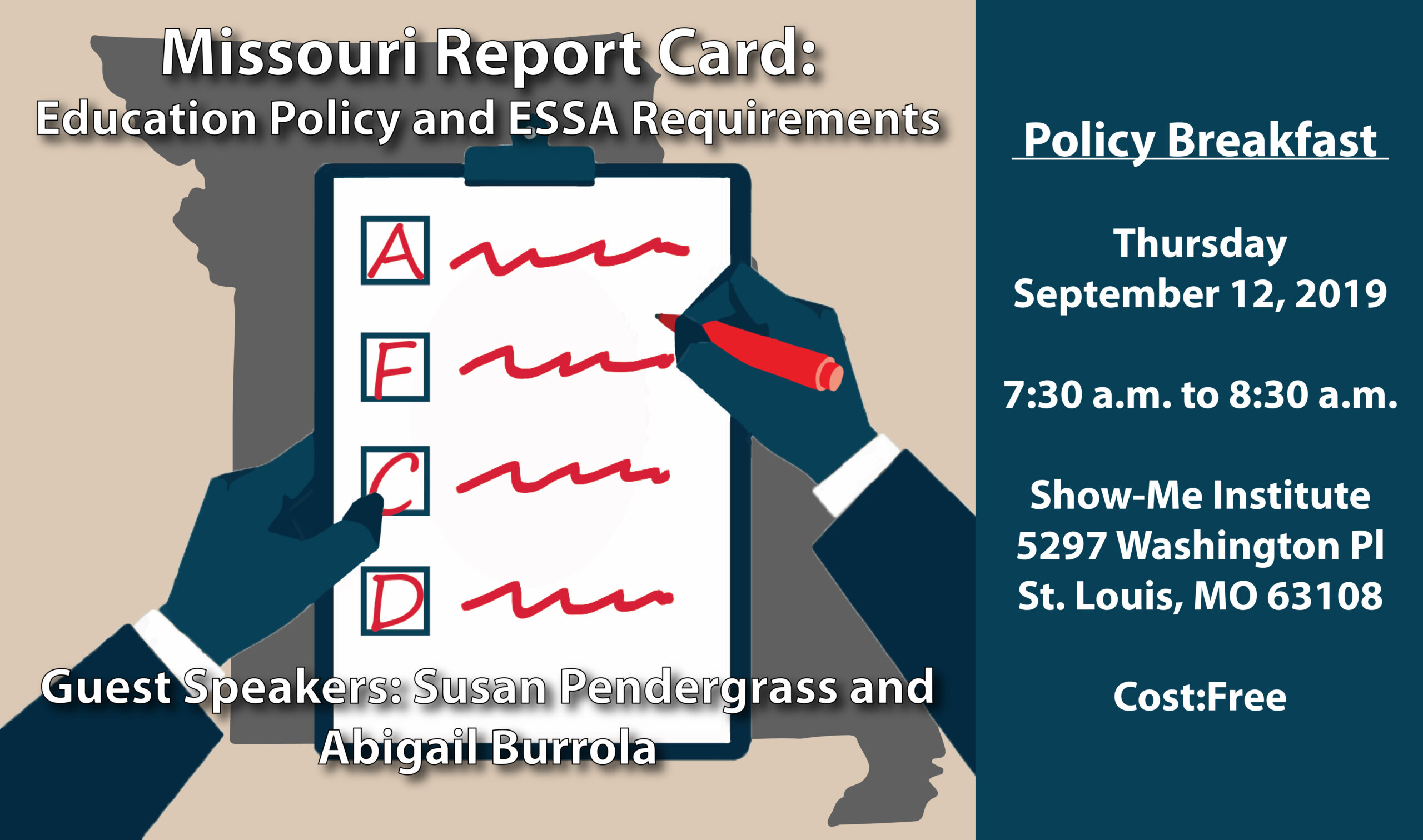
Dr. Susan Pendergrass and Abigail Burrola have created a report card that evaluates and grades how well Missouri provides school performance information based on federal requirements in the Every Student Succeeds Act (ESSA).

Join us at this St. Louis Policy Breakfast where they will present their findings.

RSVP here.

Featured Speakers:

Susan Pendergrass, Director of Research and Education Policy

Before joining the Show-Me Institute, Susan Pendergrass was Vice President of Research and Evaluation for the National Alliance for Public Charter Schools, where she oversaw data collection and analysis and carried out a rigorous research program. Prior to coming to the National Alliance, she was a senior policy advisor at the U.S. Department of Education during the Bush administration and a senior research scientist at the National Center for Education Statistics during the Obama administration. Susan holds a doctorate in public policy from George Mason University with a concentration in social policy.

Abigail Burrola, Analyst

Abigail Burrola graduated from Azusa Pacific University with a bachelor’s degree in political science in 2018. She is originally from the Minneapolis area, and her policy interests include special education practices and rural school choice.


Kansas City Should Rely On Its Strengths

Everyone knows that Kansas City is one of the best places in America to find barbeque, but according to a recent report, it is also among the best in another category: cities best positioned for economic growth.

Business Facilities’ 2019 Metro Rankings Report scored Kansas City in the top ten on its list of major American cities with the highest potential for economic growth.

Kansas City landed on the list based on a few different factors, including the city’s quality of life and cost of living. Researchers at the Show-Me Institute have often urged Kansas City to play to exactly these strengths. Back in 2016, urban policy expert Wendell Cox published a paper walking through the advantages the region offers:

The fundamental question is, “What competitive advantages does Kansas City have over other metropolitan areas, and how can it maintain or expand those advantages?” The answers are clear. Kansas City’s strongest advantages are its low cost of living (the result of superior housing affordability), superior mobility, and a complete array of lifestyle choices. However, each of these advantages could be threatened by policies that currently enjoy favor within urban planning circles.

These factors might not be the most impressive on paper, but they are very important to those choosing to move into or stay in the region. Instead of playing to these simple strengths, Kansas City officials seem to be determined to become the next Denver, Dallas, or Seattle, using economic incentives to build trendier entertainment districts and businesses.

But Kansas City is unique, and has a lot to offer without trying to chase the trends of other areas. People live here for simple reasons like affordability and ease of transportation. A city government that chooses to spend taxpayer dollars on subsidizing things like sports stadiums or streetcars instead of bolstering basic city services is doing the region a disservice.

Kansas City risks squandering its potential for growth if policymakers fail to understand what the city does best. As my colleague Patrick Tuohey has previously stated, “If we want Kansas City to succeed, we need to understand exactly what we have to offer.”


Hoping for the Best with the Internet Sales Tax

Last year Show-Me Institute writers discussed the possibility of Missouri imposing a new tax for online purchases, but there was no action taken on the issue during the 2019 legislative session. However, it’s likely the “Internet sales tax” discussion will come up in the 2020 legislative session, so this is what you should know about the issue.

In the June 2018 South Dakota vs Wayfair decision, the U.S. Supreme Court overturned what was essentially a “physical presence” rule for requiring a seller to collect a sales  tax in the United States. That means states can now impose a sales tax collection responsibility on internet retailers even if they don’t have property or employees in the state.

Some assume large companies will be most affected by this change, but many big companies have a physical presence in the states they do business, so they already collect and remit sales taxes. For example, Amazon has a warehouse in Missouri and collects taxes on its sales in the state accordingly. This means that those likely to be most affected by a new collection responsibility are smaller Internet retailers based outside of Missouri.

In the Wayfair majority opinion, Justice Kennedy claimed the physical presence rule “has prevented market participants from competing on an even playing field.” This may be true, but policymakers should consider how a tax increase could affect Missourians. Internet sales taxes aren’t paid by retailers; they’ll be paid by Missouri taxpayers. The costs of “evening the playing field” through tax policy have to be paid by someone, and it’s almost always consumers that have to pick up the bill. This could add to an already-high sales tax burden for Missourians.

A bill introduced last year that would have implemented an Internet sales tax made some progress in the legislature, but the legislative session ended before any real action could be taken.  It’s a good bet that this issue will come up again in 2020. Missourians interested in tax policy should monitor the debate closely, as a new law implementing an Internet sales tax could have big ramifications for our state.


St. Louis’s Ridiculously High Sales Taxes

It is often claimed that Missouri is a low-tax state (which it is not), but it is painfully clear that some of Missouri’s cities are certainly not “low-tax” cities.

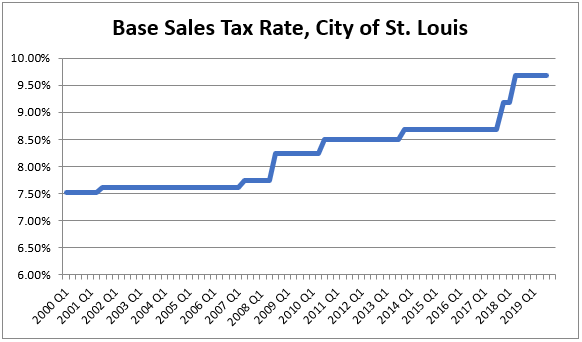
The sales tax rate in St. Louis is now one of the highest in the nation, only behind places like Chicago and Seattle. Currently, the base sales tax rate in the City of St. Louis sits at 9.679%. So, when you shop, you’re paying nearly 10% extra in taxes, and when you shop in one of the many areas with overlapping special taxing districts, you’re paying close to 12%. The rate is high relative to other cities, and it is high absolutely—it is pretty darn expensive to spend your own money in the Arch City.

The chart below depicts the base sales tax rate in St. Louis over the past 20 years. Slowly and steadily (and sometimes in quick bursts), it has been on the rise.

Sales tax graph

Source: Missouri Department of Revenue, Sales/Use Tax Rate Tables

Recent increases are due to special sales taxes for additional public safety funding and expanded economic development initiatives (like the north–south MetroLink expansion, which is unlikely to spur any development).

As I’ve written before, with each increase in the sales tax rate, policymakers will have fewer and fewer chances to go to taxpayers for projects that truly need funding. St. Louis may soon reach a point where the public is simply unwilling to cough up more of its money, however pressing the public need. Some residents and businesses may just call it quits and move elsewhere.

Moreover, we should all ask ourselves whether we’re getting the government we’re paying for. When the city has basic infrastructure woes (you should see the road I drive on every day for work), has trouble keeping refuse trucks running, and seems most occupied with giving away subsidies, it is hard to believe St. Louis government is worth nearly 10 cents on the dollar (in addition to the numerous other taxes it levies). 

Policymakers, like the rest of us, could always use extra cash. But there is a point at which we must make do with what we have. St. Louis officials should begin tightening their belts instead of asking for more, just like the average taxpayer must.

Kansas City Controls Its Police Department

For eight years Kansas City was served by a mayor who didn’t seem to understand his role in overseeing the Kansas City Police Department. But as has been argued in this space previously, the mayor not only serves on the Board of Police Commissioners, he controls the police department’s budget. In fact, the Kansas City mayor wields veto power over the police budget—perhaps the greatest power any political leader could have over a department.

City leaders’ influence over policing was confirmed when I spoke to a number of former members of the police board last year. And it was confirmed again when Kansas City Police Chief Rick Smith was interviewed this week by KCMO Radio’s Pete Mundo. Smith said (starts at 3:44):

We’re still funded by the city. So we still talk with the city manager and go through the budget process just as every other department head in the city does. We go through this process and talk about, “hey, where can we make gains, where can we not?” The last two years we’ve had additional officers, it’s been a handful.  Sometimes it’s 25; I think last year a dozen. We’re getting some, it’s just slow.

There are plenty of discussions to be had about what ought to be done to help the Kansas City police better respond to rising crime rates, and not all of it can be done through policing. But we know that policing matters and specifically that increasing the number of police reduces homicides. The fact that the number of police in Kansas City has fallen during a years-long spike in homicides is unconscionable. Whatever policies are adopted to combat this increase, it is good to know that those charged with making the decisions understand how policy is made.


Here Is Where LIHTCs Go

Since its introduction in 1996, Missouri’s Low-Income Housing Tax Credit (LIHTC) has been the state’s primary tool for incentivizing the development of affordable housing. It has also been Missouri’s costliest tax credit program, and one of its most inefficient. For a program that has cost the state billions, Missouri taxpayers deserve to know how the money is being spent.

That’s why I reached out to the state agency in charge of allocating the tax credits, the Missouri Housing Development Commission (MHDC). The MHDC charged $122.76 for a list of projects and costs from the last 19 years of LIHTC allocation. (I also requested similar data from the 14 other states that have a state LIHTC program; they all provided the information free of charge.)

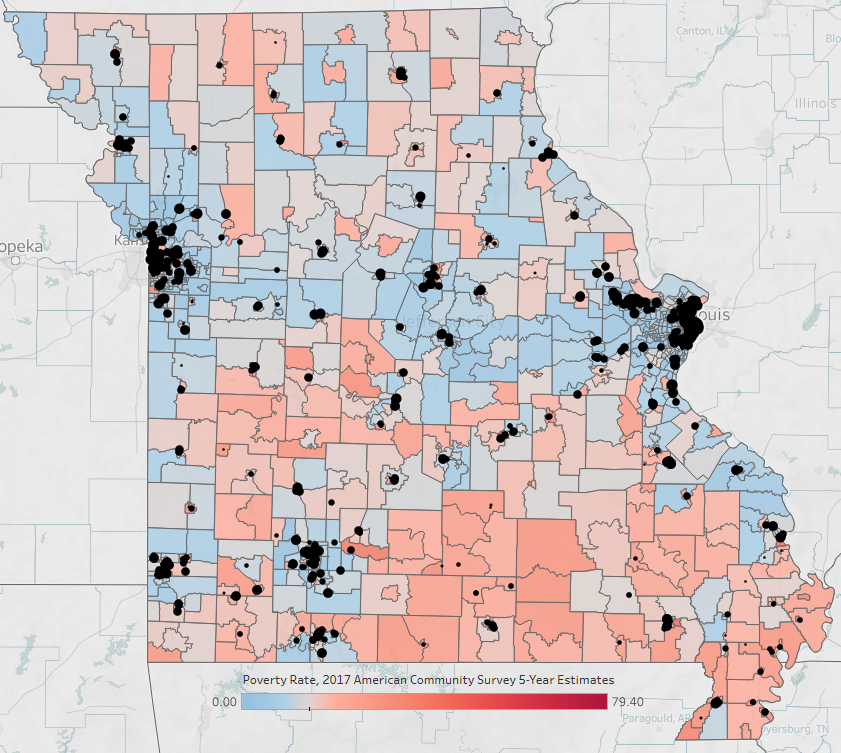
Missourians now can find where these LIHTC projects are located and how much they receive in subsidies from state and federal governments. The link below has a map displaying data on LIHTC projects since 2000:

LIHTC Interactive Map

The census tracts are colored by poverty rate, with the red and blue diverging at the statewide poverty rate of 14.6 %. The black dots represent every LIHTC project awarded since 2000. When hovering over a dot, the project’s name, address, city, county, owner, year awarded, and federal and state annual LIHTC allocation are shown.

Having this data is a good first step in analyzing and ultimately proposing solutions to the complex, problematic system that is Missouri LITHC.


The Entirely Predictable Failure of Sports Teams Subsidies

The River City Rascals are taking their ball and going home. This was not entirely surprising as the team was operating under a one-year lease extension with the city of O’Fallon.  According to the St. Louis Business Journal:

The one-year extension came together after O’Fallon in October 2018 terminated the Rascals’ lease at CarShield Field and barred the team from the facility, saying at the time that the team’s ownership was “repeatedly behind on rent.” O’Fallon later let the Rascals back into the facility as it worked through negotiations with the team for new lease. O’Fallon said Monday that the Rascals still owe the city a balance of $36,600 on a debt of $60,000 from several years ago, and plans to discuss the debt with the team as it winds down operations.

Let’s not mince words: The city of O’Fallon was spending taxpayer money on a private enterprise exactly because the people of O’Fallon and the surrounding areas decided not to spend their own money on it. How was this ever a good idea? This comes on the heels of a similar situation in Wyandotte County, Kansas that we discussed and wrote about previously: A city spending limited taxpayer resources on a faltering private enterprise that only postposed the inevitable.

Incredibly, the larger cities on both sides of Missouri are contemplating even bigger versions of the same mistake, either by building a baseball stadium in downtown Kansas City or a Major League Soccer stadium in downtown St. Louis. The owners may be different, but the policy remains the same: City leaders using taxpayer dollars to shift the risk (but not the reward) from private investors to public taxpayers.


Bring the Free Market to College Athletics

Popular video game developer EA Sports has recently hinted at a return of its cult-classic game, NCAA Football. The game was discontinued in 2014 after a lawsuit settlement required EA Sports to begin paying student-athletes for the use of their likeness, a course of action made impermissible by NCAA amateurism bylaws. Nevertheless, speculation about the game’s possible revival is surfacing following a May announcement that the NCAA would be reviewing its policy on student-athletes’ ability to benefit from their own image. The impact of this issue exceeds the realm of virtual entertainment, and there is much the state of Missouri can do to promote free-market solutions to the financial woes of college athletes.

Missouri should be as cognizant of the benefits student-athletes provide public universities as any other state. The University of Missouri athletic department brought in $107.3 million worth of revenue in 2018, and its men’s basketball ticket revenue rose nearly 70 percent after signing highly-touted recruit Michael Porter Jr. in 2017. Although student-athletes do receive a sort of payment in free tuition and room and board, this compensation often pales in comparison to the massive sums of money the players generate. Shouldn’t Missouri allow student-athletes greater opportunities to profit from their position in the market?

Other states are already addressing the question of student-athlete compensation. Both Colorado and California have proposed bills in the past few months granting student-athletes the ability to sign endorsement deals, superseding the authority of the NCAA. Federal legislators have even gotten in on the action, as several members of the House of Representatives have introduced a bill that would alter the tax code definition of an amateur to allow college athletes to profit from public appearances.

Legislation like this provides benefits for all involved parties. It allows student-athletes whose performance merits it to earn money without imposing costs on universities. Since schools no longer use third-party endorsement deals or individualized merchandise, students profiting from such deals wouldn’t interfere with university revenue. Moreover, providing these opportunities to student-athletes may give Missouri schools an edge in recruiting battles. In short, these policies introduce the free market to college athletics, and if Missouri acts it could be a win for the state.

Support Us

The work of the Show-Me Institute would not be possible without the generous support of people who are inspired by the vision of liberty and free enterprise. We hope you will join our efforts and become a Show-Me Institute sponsor.

Donate
Man on Horse Charging