Meet the New Report Card, Same as the Old Report Card

I’m a researcher. When it comes to data I like digging in, and I like unpacking. So, when I heard that the Missouri Department of Elementary and Secondary Education (DESE) was releasing the latest year of test scores, I was super excited. But even more exciting was that DESE had redesigned how the data would be presented to parents. This was something I’ve complained about a ton and it was finally getting fixed! But like the kid who’s hoping for a pony on Christmas morning, I should have known better.

The data are fine and I have a bunch of enormous new spreadsheets to start analyzing. The presentation of the data, on the other hand, was the big letdown.

For example, if you were to look at the new report card for a school or district, you would see the following types of graphs:

School report card example

The Commissioner of Education said that she hopes people use these graphs to ask questions. Well I certainly have a few. I would like to know—are students getting a year’s worth of growth in a year? This particular district is “On Track,” others are “Floor,” and the rest are “Exceeding.” I’m guessing that “Floor” is below average growth of all schools in the state, “On Track” is average growth, and “Exceeding” is above average growth. Why not just say that? Why use words like “Floor” when what you mean is below average?

Here’s another question that most folks are interested in—what percentage of students can read (called English language arts, or ELA, here) or do math on grade level? The set of colored bars that would seemingly reveal this information say 331.9 for ELA and 324.4 for math. What does that mean? The words that go with these bars are “Floor,” “Approaching,” “On Track,” and “Target.” Is “Target” the same as “Exceeding”? Why don’t these reports just show the percentage of students who scored Proficient or above?

Finally, is the district’s performance getting better or worse? This district scored -1.9 in ELA and -1.1 in math. I’m guessing that not’s good, since they’re on the orange side, but what do those numbers actually mean?

Collecting and reporting data is one of DESE’s main jobs. They’re supposed to have gotten parent input in designing school and district report cards that are parent friendly. These are not even research friendly. Why do states like Delaware, Illinois, and Michigan have terrific school and district report cards while we have these? When will DESE step up? 
 

Fighting Blight Can Help Address Crime

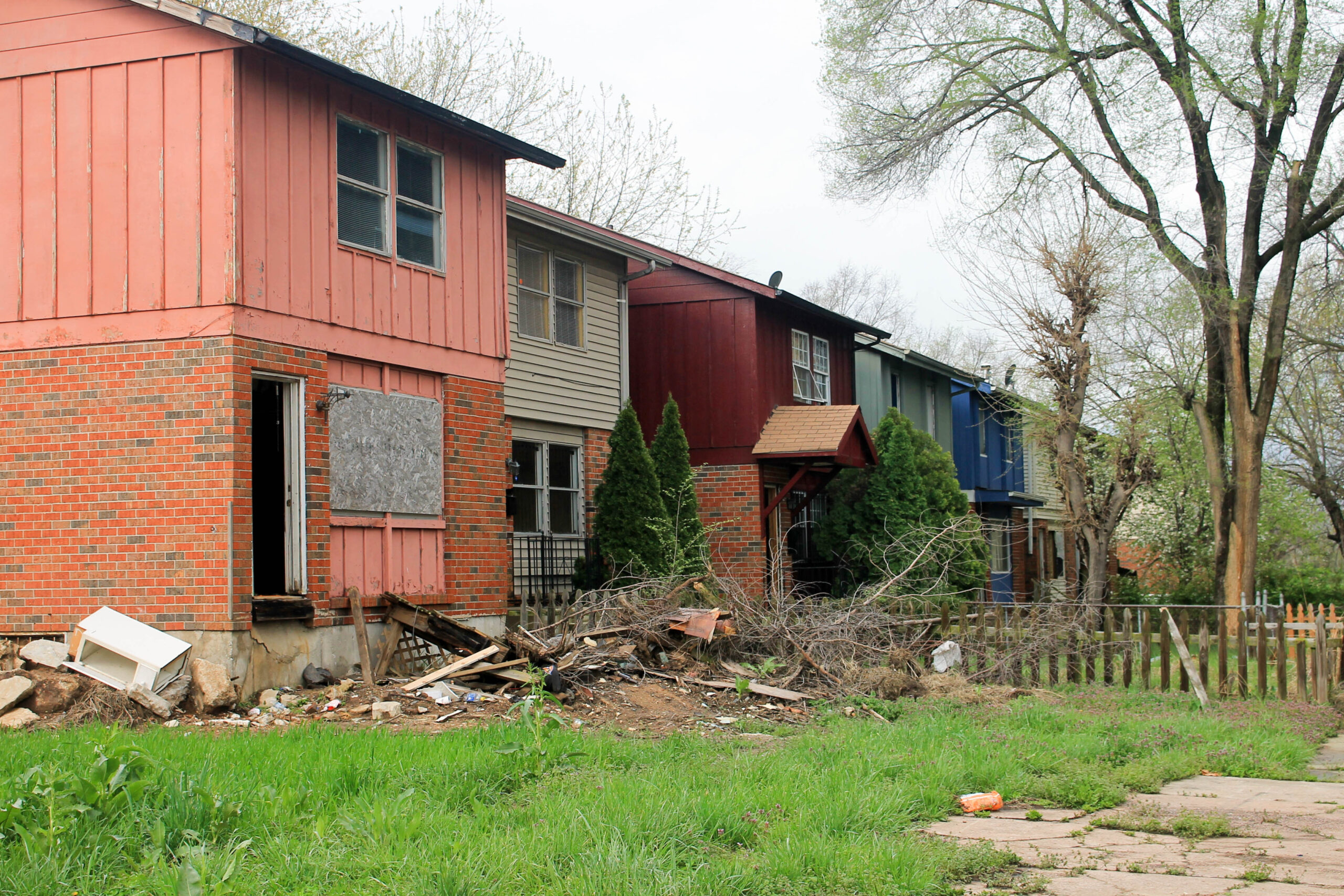
A new article from the Manhattan Institute details research that indicates addressing blight can have a positive impact on crime. While this is not a surprise—the broken windows theory has been around for decades—it shows concrete results for programs in Philadelphia and elsewhere.

The Philadelphia LandCare (PLC) program was started when residents of a particularly bad-off neighborhood team up with the state horticultural society to clean up vacant and trashy lots. The article reveals:

PLC is simple and was designed to be applied across the neighborhood. Trash and debris are removed from a vacant lot. The land is then graded, and grass and a few trees are planted. A low wooden post-and-rail fence is installed with openings to permit residents access to the newly greened spaces. The fence prevents illegal dumping of garbage and construction debris; it is also a visual sign that someone is maintaining the property. The result is a small “pocket park.” The rehabilitation of such lots takes less than a week to clean and green. The lots are maintained through twice-monthly cleaning, weeding, and mowing during the growing season (April through October). The cost to clean and green a typical lot is roughly $1,000–$1,300, along with $150 per year to stabilize the lot through biweekly cleaning and mowing.

The maintenance costs are higher in Missouri. St. Louis City’s Forestry Division (yes, St. Louis has a Forestry Division!) bills $108 per property per time they mow, and try to visit each property (there are 11,000) only 3 or 4 times each year instead of biweekly. As for Kansas City, a few weeks of calls and emails to various city departments and individuals have yielded no results on the costs of maintenance.

Kansas City is slowly making good on its promise to demolish dangerous structures, an important part of blight remediation. Addressing blight requires more. Churches, community groups, and charities of all kinds need to work together to address blight just like the people of Philadelphia. We clearly cannot expect government to do it for us.


Stop Debating School Choice. Give Us Options Now!

At a recent legislative forum hosted in Boone County by the Missouri State Teachers Association, state lawmakers debated the merits of charter schools (h/t Columbia Missourian). Some were in favor of expanding charter schools; others were opposed. Currently, Missouri only has charter schools in St. Louis and Kansas City. The Show-Me State limits the expansion outside of these cities and currently has no private school scholarship program.

We have been debating the issue of school choice in Missouri for more than 20 years now and it doesn’t look like our lawmakers are any closer to reaching a consensus. Meanwhile, a revolution has taken place in Florida. Ron Matus has documented this change in his terrific piece, “Miami’s Choice Tsunami,” appearing in the winter edition of Education Next.

Matus explains:

Today, 45 percent of Florida students in K-12 attend something other than their assigned schools. Charter schools are part of the mix. So are private schools that can be accessed with choice scholarships. So is an ever-growing array of district options.

This wave didn’t just happen.

In 1996, the Florida Legislature passed a law allowing creation of charter schools. The first opened that fall in Miami’s Liberty City community. Two decades later, Florida had 295,814 students in 655 charter schools—and one of the largest charter sectors in America.

In 1997, the Legislature created the Florida Virtual School to ramp up online learning. It started with 77 students and five courses. Today, it serves more than 200,000 students a year.

In 1999, the Legislature created the McKay Scholarship, a state-funded private school voucher for students with disabilities. In 2018-19, it served 30,695 students in 1,525 private schools.

In 2001, the Legislature created the Florida Tax Credit Scholarship for low-income students. As of June 2019, it was serving 104,091 students in 1,825 private schools. In students and funding, it is the largest private school choice program in the U.S.

The results in Florida speak for themselves. The state is seeing incredible gains in student achievement on the National Assessment of Educational Progress, known as “The Nation’s Report Card.” As the Orlando Sentinel reported, “Something very good is happening in Florida.” Indeed, it is.

In Miami, the focus of Education Next article, the beloved superintendent, Alberto Carvalho, embraced school choice. Matus writes, “Instead of resisting the inevitable forces of choice and customization that are re-shaping public education, Carvalho and Miami-Dade chose to harness them . . . They realized it was too powerful to avoid—and too brimming with opportunity not to embrace.”

It is time for Missourians to stop debating the merits of school choice. Choice is good. Options are good. Competition is good. While we fail to act, innovation is happening elsewhere. Now is the time to act. Now is the time to expand educational opportunities in Missouri.


If You Love it, Let it Go

All good things must come to an end; many misguided policy initiatives and programs must come to an end too. 

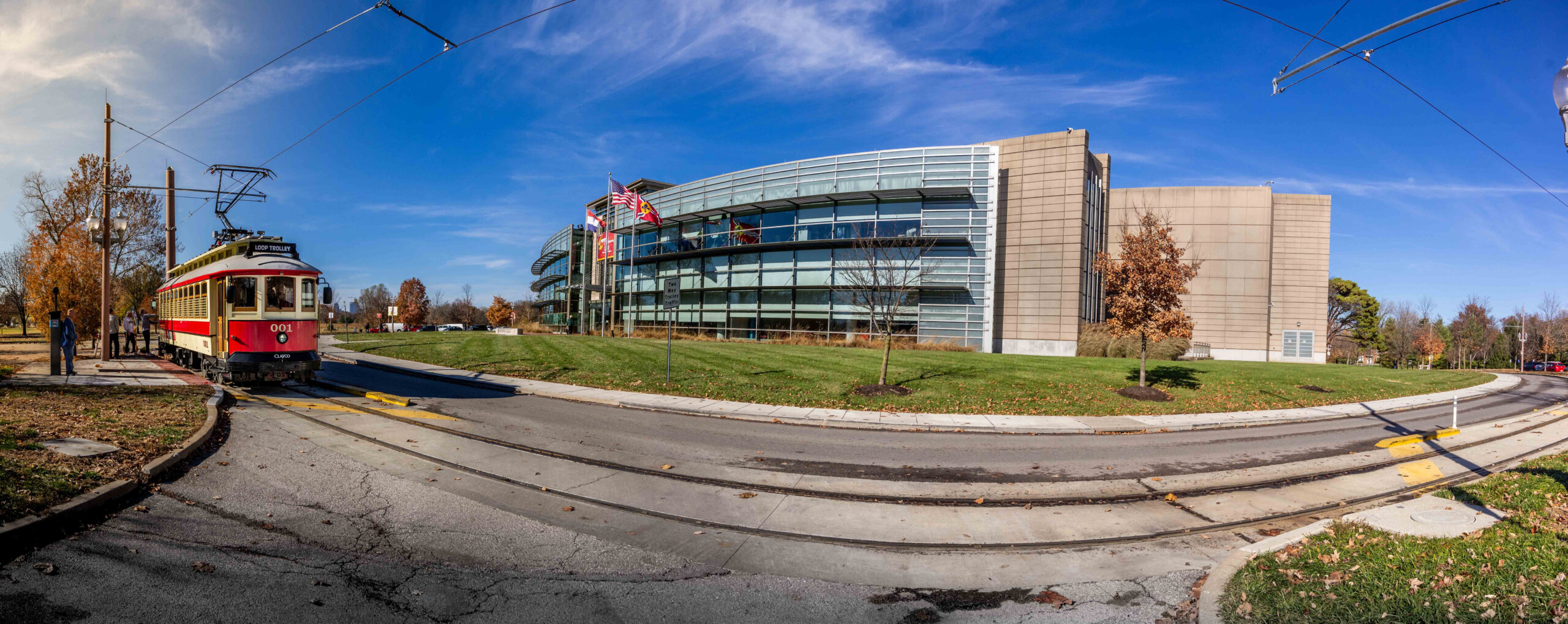
As some readers will be aware of by now, the 8th wonder of the world, the Delmar Loop Trolley, is in a financial pickle. The head of the company said that it needs $200,000 by next month to continue operations through the year, and $500,000 more to operate in 2020. One could call this a shocking policy failure, but I think many of us saw this coming. Whether it’s putting together or working within a reasonable budget, finishing a project on time or with appropriate permitting, or coming even remotely close to meeting ridership projections, the trolley leadership has proven time and time again that it cannot be trusted by policymakers or taxpayers.

(You should know that when your plan to boost ridership is to have stand-up comedians ride the rails, your project is absurd.)

But what I do find shocking this time around is the total lack of accountability exhibited by trolley leadership. They claim the trolley’s failure should be chalked up to delays in getting additional trolley cars on the tracks. So, the firm renovating the trolley cars is responsible for the delays, and thus responsible for the trolley’s laughable performance.

But this finger-pointing is all too easy to see through. First, the firm renovating the cars is accountable to the trolley company, its customer, and so, the trolley company should be compensated for the delayed product delivery. If the trolley company cannot be compensated by a contracted vendor for its failure to deliver, then the trolley company simply entered a bad agreement.

Second, it seems there are a number of other and far more reasonable explanations for the trolley’s failure. For one, the project was delayed for years and developed a sort of toxicity, and so would-be riders just gave up on ever riding. When you fail to deliver half a dozen times, people tend to just give up on you. Another explanation is that the trolley just doesn’t provide a valuable service, and so people just don’t ride it. Who wants to pay to sit on a glorified bus that takes you down the loop slower than the pace of an average pedestrian? And how many people do you honestly think are going to drive to the loop just to pay to take the trolley to the history museum? I’ll let you in on a little secret: not very many! (I am in the loop every day, and the most common number of riders I see is zero.)    

But what about the $200300 million in development the trolley has apparently spurred? Doesn’t that make the project worthwhile? Well, no. For one, most if not all of the recent development around the trolley has been subsidized. Who can tell if it was the trolley or the subsidies that spurred the development? Two, the loop is hot real estate, and so I think the strong market, rather than the presence of a needless novelty, is what spurred development. Three, the only reason for thinking the trolley spurred this development is that it occurred after the trolley was in place. But temporal succession is not identical to causation. Moreover, there is little evidence in general to suggest that vintage streetcars or streetcars in general spur investment.

So what should policymakers do at this point? Well, they needn’t rip up the tracks and say goodbye to the trolley forever. Here is a modest proposal: Don’t bail out the trolley company again. Force its leadership to find the funding on its own. In the meantime, shut the trolley down if need be. The more the trolley company is responsible for itself, the better it will be. And, let’s be honest; it won’t be leaving many riders stranded. 


Show Me the Money

As my colleague recently wrote, the Missouri Department of Transportation (MoDOT) appears to be making do with the money they have to keep Missouri’s roads in respectable shape, but not bridges.

While it is good news that MoDOT appears to use available funds efficiently, that does not mean it has enough money to cover all needed infrastructure repairs in Missouri.

MoDOT has been in the midst of a years-long funding strain (pages 33-38). Between 2000-2010, MoDOT relied heavily on federal reimbursements and issued billions of dollars of bonds to fund its projects. Both sources, however, began to dwindle in 2011. While Missouri has the seventh-largest highway system in the country, it has the second-lowest fuel tax. Multiplying the problem, a decrease in money raised in Missouri for transportation means a decrease in matching federal funding.

Federal money makes up 42% of MoDOT’s budget. The fuel tax is the second largest component at 23%. The gasoline tax was set at $0.17 in 1996 and is still $0.17, meaning the value of that money has dropped significantly due to inflation. Relative to the size of the highway system, the revenue Missouri brings in per mile is less than a quarter of the national average. Simultaneously, construction and upkeep-related expenses have significantly increased due to lower productivity and higher regulatory barriers, as well as asphalt, crushed stone, and paving mixtures being significantly more expensive than just a decade ago. Having less money to spend on more expensive projects has made upkeep more difficult.

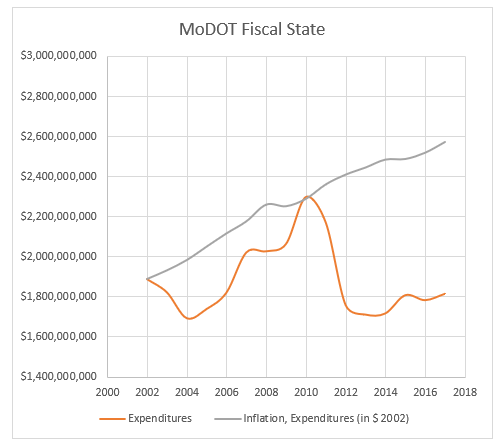
The amount of money MoDOT spent fell in 2011 and has not kept up with inflation, as you can see in the graph below:

MoDOT expenditure graph

Source: Missouri Budget Fiscal Years 2003–2017. Graph made by author. https://www.modot.org/previous-reports-joint-committee.

The surge in expenditures in 2010 coincides with the passage of the American Reinvestment and Recovery Act (ARRA) in 2009, commonly known as the federal stimulus package. The ARRA added $400 million to MoDOT’s budget, which dissipated just as quickly due to the large number of projects for which it was needed. In 2014, ARRA funds totaled less than 1% of MoDOT’s revenues dedicated to the highway system (page 8).

Relying on large and sudden injections of federal money is not a viable funding solution, and any bonds that are issued face their day of repayment.

To raise the revenue needed to maintain our roads and bridges, a clear solution presents itself – increased use of user fees. The concept is simple and works in everyday life. Those who use a service pay for that service in return.

Numerous other states employ user fees in the form of more effective gasoline taxes and tolling, significantly boosting transportation revenue in a market-based way. Legal hurdles remain, though. Tolling interstates in Missouri would require federal approval, as Missouri turned down the opportunity to toll I-70, and questions remain regarding constitutional limits on where the funding to construct a turnpike authority can originate.

User fees may only be part of MoDOT’s solution, but they could increase its budget to meet current needs.


Tennessee Proposal Leading Medicaid Reform

Policymakers searching for ways to improve Missouri’s Medicaid program should look no further than Tennessee. A new proposal from the Volunteer State would reform the way the federal government pays for Medicaid services in Tennessee. Instead of the open-ended funding relationship currently used across the country, Tennessee has requested the federal government begin offering Medicaid dollars as a lump sum payment, or block grant. Though there are many details yet to be ironed out, the plan represents a promising approach for states to begin reining in Medicaid’s ever-growing costs.

If approved by the federal government, Tennessee’s proposal would be the first of its kind. Medicaid’s current funding relationship between states and the federal government is riddled with “misaligned financial incentives”. Medicaid currently uses a matching dollar structure. For every dollar Missouri spends on an approved service, the federal government will spend nearly two. Because there is no limit to the amount of federal Medicaid dollars Missouri can receive, the arrangement encourages further state spending which grows the overall cost of the program. This structure also discourages states from finding innovative ways to provide better care at a lower cost. Under Tennessee’s plan, the state would actually get to keep 50% of the money it saves as a result of more efficiently administering the program.

Block grants also provide the opportunity for states to improve quality of care. Once the anticipated program savings are achieved, the dollars saved could be invested back into the program for initiatives chosen by each state depending on individual state needs. And as Tennessee’s governor noted, there won’t be a change to eligibility requirements or a reduction in benefits under the block grant proposal.  Advocates of the Tennessee proposal believe that by properly aligning Medicaid’s funding incentives and increasing local control of the program, up to a billion dollars per year could be saved.

Medicaid block grants are not a new idea; Show-Me Institute analysts have promoted block grants for years. But this idea remains as important as ever. It is not a coincidence that the cost of Medicaid has continued to rise each year since 2014 when the federal government expanded its role in the state/federal partnership. Missouri’s policymakers should pay attention to what happens in Tennessee, because a similar proposal may be the best way to fix Missouri’s Medicaid program.


Student Achievement Rises with More Charter Schools

Missouri has long resisted the expansion of charter schools into any suburban or rural area. Opponents of charter schools argue they threaten the success of students, but the research doesn’t support this claim.

A new study from the Fordham Institute found that a higher percentage of charter school enrollment (referred to as “charter market share”) among black and Hispanic students in large urban areas is associated with higher English language arts and math achievement. A similar result was found for Hispanic students in suburban and rural districts, and black students in rural districts. And these results are measuring overall achievement in an area—not just the students attending charter schools.

The study used data from the Stanford Education Data Archive containing student performance on NAEP, the National Assessment of Educational Progress exam. The data contained scores from both charter and traditional public schools. Further analysis of the individual geographic areas in the study could help determine if the effect of competition from charters on traditional public schools varies across regions. But the study does contradict the argument that charter schools only have higher achievement because the best students transfer to charter schools. If that were the case, then overall achievement would not rise.

Charter schools in Missouri wouldn’t be a threat to traditional public schools. They could provide educational opportunity for many students who do enroll in a charter school and also boost overall achievement. Missouri shouldn’t be afraid to offer students who happen to live outside of Kansas City and St. Louis opportunities like charter schools.


What Happened to Those 800 Dangerous Buildings?

Three and a half years ago, Kansas City leaders were so embarrassed by a KCPT documentary on urban blight they committed to tearing down hundreds of dangerous buildings. Were they successful?

According to The Kansas City Star back in February 2016:

City Manager Troy Schulte recently estimated it would cost $10 million to knock down all the most dangerous houses and other buildings in the city. That backlog of 870 buildings has built up because in the past, the city has only been able to spend about $800,000 annually to demolish about 100 houses, and more properties keep getting added to the list every year.

The city sold bonds to raise the $10 million to pay for the demolition. Work started in June 2016 and it was to take two years to tear down about 800 buildings. In April 2018, Channel 41 reported that the city surpassed it goal and “taken care of” 895 buildings in two years. That is because many were sold and rehabilitated, not demolished.

According to city data, only 609 buildings actually have been torn down by the city in the three years since. While this is slower than initially planned, it represents good progress toward addressing blight.

As of October 7, 2019, there are 343 dangerous buildings remaining on the city’s list.


Support Us

The work of the Show-Me Institute would not be possible without the generous support of people who are inspired by the vision of liberty and free enterprise. We hope you will join our efforts and become a Show-Me Institute sponsor.

Donate
Man on Horse Charging