‘Tis the Season . . . of Free-Market Activity!

The holiday shopping season is the perfect playground for market forces. Voluntary exchange for mutual benefit (in other words, shopping) is the driving force behind the market, allowing us to buy things that we can’t produce ourselves. As you’re out enjoying the wintry weather this holiday season, be on the lookout for these free-market concepts:

Competition: Each product is competing for a spot on your shopping list, and each store is competing for your business. Stores have big sales and new products and advertisements appear to try to win your business. Searching for the best deals among stores is the epitome of a competitive marketplace.

Entrepreneurship: Ever see a new product and think, “Wow, that’s a good idea”? Well, someone before you had that exact thought, and they turned it into reality. Your shopping list is full of the results of entrepreneurial ventures, and your holiday purchases will help determine which ones are successful.

Options: An overwhelming number of options is perhaps both the best and worst part of holiday shopping, but we’re lucky that the free market gives us all these choices. Entrepreneurs have the freedom to pursue new ideas, stores have the opportunity to try and outdo competitors, and shoppers have the option to buy the products they want. And if you want to avoid the chaos of the season, you can choose to shop online!

Holiday shopping would be pretty lackluster without these (and other) free-market concepts. As I’ve said before, products find their way to your home through these concepts, so remember the free market when you’re checking things off your list this year.

The End of History as We (No Longer) Know It : A New Year’s Day Reflection

Imagine you are in a car accident on New Year’s Eve. Like Jason Bourne in The Bourne Identity, you wake up to a strange new reality: You don’t know who you are, where you are, and what you have done in your time on earth. That’s how the new year begins for you.

Surely, it would be a giant shock to discover your memory was gone.

To be cut adrift from your own past is, literally, to lose your own life in the midst of living it. Suddenly, you have no friends, no background, no identity. You have lost any sense of meaning and purpose of the life you once led. And how can you even begin to think about the future if you don’t know your own past?

But what if we as nation were to wake up one day in the same condition—destitute of any knowledge or understanding who we are as a people and what was going on at different stages in the long and eventful history of our country?

If not yet there, we may be fast approaching that state.

“We’ve been raising several generations of young Americans who are, by and large, historically illiterate,” says David McCullough, two-time winner of the Pulitzer Prize for history. As someone who has lectured at scores of colleges and universities across the country, he adds, “I know how much these young people – even at the most esteemed institutions of higher learning—don’t know. It’s shocking.”

By way of example, he tells the story of being approached by a college sophomore at a top Midwestern University who told him, “Until I heard your talk this morning, I never realized the original colonies are all on the East Coast.” “McCullough thought, “What have we been doing so wrong that this obviously bright young woman would get this far and not know that?”

In The Nation’s Report Card: U.S. History 2010, the U.S. Department of Education found that only 12 percent of high school seniors performed well enough to be rated “proficient” in their knowledge of the rudiments of U.S. history. To put that another way, 88 percent of high school seniors flunked the minimum proficiency rating, and only two percent correctly answered a question about the Supreme Court’s landmark decision in Brown vs. Board of Education.

When speaking in different forums about the dangers of historical illiteracy, McCullough puts “gratitude” high on his list of the many “benefits to history.” “Every day, we’re all enjoying freedoms and aspects of life that we would never have had if it weren’t for those who figure importantly in history.” And again he says: “I think that America has come further in giving opportunity to the best that’s in human nature than any other country ever in history.”

Yes, we ought to be grateful. At the same time, we ought to be keenly aware of the great danger to the good life that we are living posed by collectivist thinking – the kind of thinking that is the deadly enemy of individual liberty and the idea that people should be free to lead their own lives as they choose as long as they don’t impose upon the same freedoms of other people.

Metaphorically speaking, no country—not even the United States—is an island, entire in itself. In order to understand our own history, we also have to understand world history and how other people have coped in dealing with some of the same problems that we have faced in our own country.

Today, most Americans under the age of 40 are unaware of the millions upon millions of people murdered or starved to death by communist regimes around the world over the past century. They just have no idea.

Why? At both the high school and university levels, the true history of Marxist-inspired socialism isn’t being taught—or, if it is, it is being taught in a sanitized fashion to glosses over the enormous crimes against humanity committed by Vladimir Lenin, Joseph Stalin, Mao Zedong, Pol Pot, and other communist leaders.

In the hands of gifted historians like David McCullough—the author of best-selling books on Harry Truman, John Adams, and the Wright Brothers—stories of historical figures and important events tell us more about ourselves than we guessed possible.

In both our schools and our homes, we need to upgrade the teaching (and learning) of history. It really should be an eye-opening experience—something that makes us more aware of who we are and what we are capable of doing as a people and a nation.


Highest and Lowest Spending Schools in the St. Louis Area

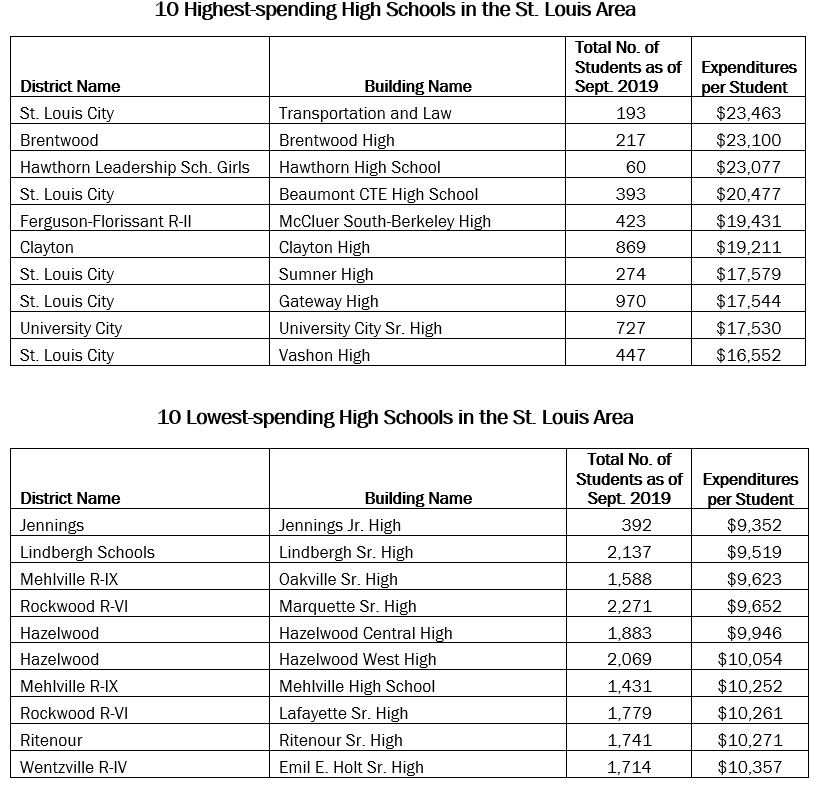
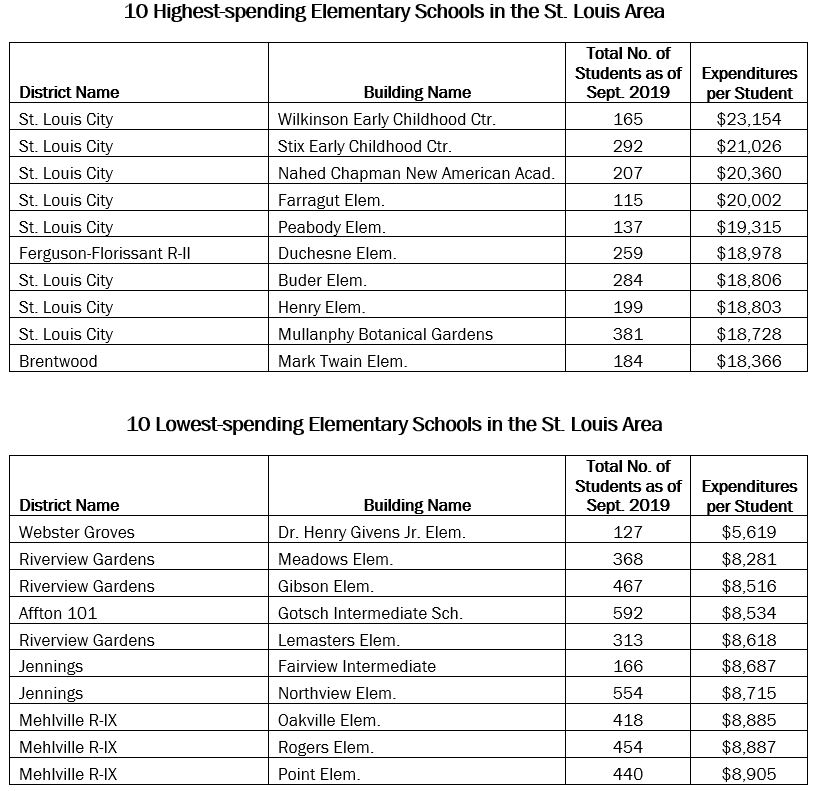
When Congress updated No Child Left Behind (NCLB) with the Every Student Succeeds Act (ESSA) in 2015, many hailed the new legislation for increasing transparency and reducing the federal government’s role in education (though it still plays a pretty big role). Among other things, ESSA required states to report how much money is spent at the school level. In the past, finances were only calculated for school districts. District-level reporting often masked significant differences among schools within a district. On December 12, the Missouri Department of Elementary and Secondary education released the school-level spending data.

In the coming weeks, Susan Pendergrass and others at the Show-Me Institute will dive deeper into the numbers. For now, I want to take a quick look at the data to show the schools in the St. Louis area (St. Louis City, St. Louis County, and St. Charles County) with the highest and lowest spending. I display the top and bottom ten high schools and elementary schools.

High school spending

Elementary School Spending

For a similar report on Columbia, Missouri, schools, check out the Columbia Missourian.

Clunk, Clunk, Clunk Goes the Trolley

After 13 months of operation, the Loop Trolley will be shutting down on December 29 due to a lack of money. Trolley advocates hope it can re-open next year under new management, but this could mark the end of the line for a project beset by problems from the very beginning.

The Loop Trolley Company treasurer admitted to the St. Louis Post Dispatch that the Trolley’s “capability to continue on with funding through sales tax and fares … does not look any better and is not going to look any better.”

As Show-Me Institute analysts noted for years, the trolley was a bad idea, despite the vocal support of a few backers. If there was a market for a trolley, private investors should have been the ones to fund it. Instead, the Delmar Loop visitors who don’t seem very interested in riding the trolley were forced to pay extra taxes.

So is this the end of the line for the Trolley? The Bi-State Development Agency, or Metro in common parlance, met Tuesday and is considering taking over the trolley to avoid jeopardizing future federal transportation grants.

The overall failure here is staggering. Twenty years. Fifty-one million dollars. Nine delays. Closed businesses. Dismal ridership. Broken promises.

If this is the legacy of the Loop Trolley, perhaps at the very least it can serve as a warning. Forcing a project on people that do not want it, no matter how much taxpayer money you can get, is simply not a good idea.


St. Louis is Doing a “Poor” Job with Local Taxing Districts

“Poor” is never the rating you want. Unfortunately, that’s what St. Louis got in a recent audit of the city’s local taxing districts. The audit found that “in the areas audited, the overall performance of this entity was Poor” and the city needs to “significantly improve operations.”

Local taxing districts are political subdivisions that fund specific improvements and services through taxes and fees, so taxpayers should be concerned by this bad rating. The government is taking and distributing hard-earned taxpayer money through these districts, but is it doing so responsibly?

Here are the findings as summarized on page 2 of the audit report:

Findings

So, is St. Louis responsibly taking and distributing taxpayer money? The answer is no.

The state auditor found serious problems with the creation and implementation of local taxing districts. These districts take a lot of taxpayer money each year. According to the report, CIDs bring in approximately $10 million each year, and in the last fiscal year TDDs brought in $3.8 million. This is bad news for taxpayers; the last thing we want is the city playing fast and loose with our money.  

Show-Me analysts have long been critical of special taxing districts in Missouri. There have been calls for reform of these districts in the past. While it’s great that more attention is being given to this problem, the time for reform is long overdue. When it comes to handling taxpayer dollars, the city needs to be doing a lot better than “poor.”


Making Growth Understandable

School test scores are a snapshot. If the test is a good one, it tells us how much a student knows at any given time, but it doesn’t tell us how much he’s learned over the course of a school year. For that you need to know how well the student scored in the past and measure that against the present. That’s called “growth data.” A recent Data Quality Campaign (DQC) publication highlights how important growth data is for parents, and suggests ways to help parents find and interpret growth information.

The DQC publication is a resource for parents, explaining why growth data is important for understanding student progress and how it can provide insight into their child’s school. It even explains different types of growth measurements in non-academic terms and could help parents work through jargon that may be on a school report card.

Unfortunately, the Missouri school report cards produced by the Department of Elementary and Secondary Education (DESE) don’t clearly explain growth data like the DQC does. In fact, the report cards don’t effectively inform parents about student growth at all, let alone explain what growth means.

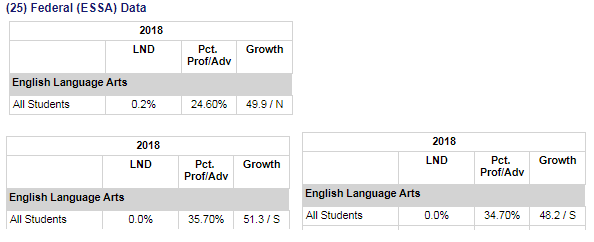
To be sure, Missouri school report cards currently have a “growth” column in a section labeled “Federal (ESSA) Data”. The screenshots below are from three different district report cards. The growth numbers are all indecipherable.

Federal ESSA data

The explanation on the report card doesn’t help much either. The report card states that numbers above 50% represent positive growth. ‘S’ and ‘N’ indicate whether the data was statistically significant or not. However, DESE doesn’t indicate how much growth the 50 percent benchmark represents, or even what defines growth. This “information” is not useful for parents who want to gauge how their child’s school is performing.

DQC’s approach actually informs parents. To explain how growth is calculated, DQC asks, “Did teachers help students in this school do better than we expected them to perform, even if they didn’t get to a grade-level target?” Framed in this way, there is context to the meaning of growth data and what it tells us about a school. DESE and the DQC are both talking about growth, but the different ways they present and communicate the information can make a major difference.

Parents should be able to easily find how much a school teaches students each year. But as long as student growth information is hidden behind statistical jargon and vague definitions, parents may never know how much students are learning at their child’s school.

Waddell & Reed and the Border War

Having been granted $62 million worth of Missouri state subsidies, Waddell & Reed is asking for an additional $40 million in local tax breaks. The surprise here is that the additional local incentives are supported by the mayor of Kansas City, who campaigned for office promising to reform economic development incentives.

What is less surprising is that the governor of Kansas, who embarked on a highly publicized economic development truce with the governor of Missouri, is critical of the additional Waddell and Reed incentives. The Kansas governor is quoted in The Kansas City Star as saying:

My executive order limiting the use of state incentives was premised in part on Missouri local units of government bringing their property tax incentives to a level playing field with Kansas. Without that action, a true ceasefire cannot occur.

There always was less to the border war truce than people wanted to admit. The agreement was vague and full of loopholes, and I wrote as much in the Kansas City Business Journal in August. No piece of legislation or executive order is as important as a leader’s resolve, and without the ability to say no to incentives, the truce is meaningless.


Why Can’t Missouri Be Like . . . Illinois?

Missouri’s Department of Elementary and Secondary Education (DESE) released its school report cards earlier this year in an attempt to fulfill the transparency requirements in the national Every Student Succeeds Act. DESE’s report card either  missed or barely met many of the requirements listed in the federal law. The deadline for one specific requirement—reporting on spending per student at the school level—has been pushed back to June 2020, allowing states more time to collect the data. Missouri has not yet published the school spending data; it will (hopefully) be on the 2018–19 Missouri school report cards,  

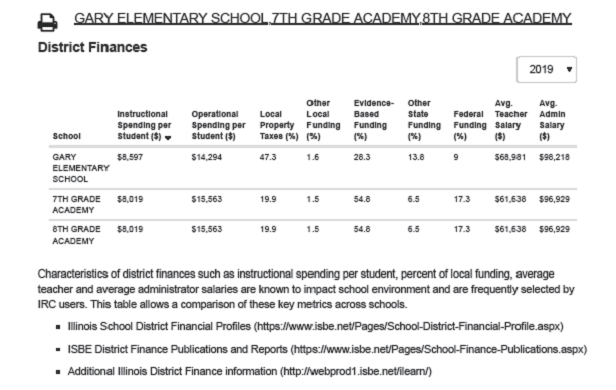
Of course, there’s no reason to wait for the final minute to report. Nineteen other states, including Illinois, have already released school-level spending ahead of the deadline. But Illinois takes it a step further and breaks out that spending by subcategory, including spending for instructional purposes, teacher salary and benefits, and classroom supplies. The state also has a high quality, organized school report card website that allows people to easily compare schools. Parents and school leaders can compare schools’ spending and academic performance at the same time.

The screenshot below shows a few randomly selected schools in Illinois and their spending comparisons, and also shows how much of school funding comes from different sources (local, state, federal or evidence-based funding). Further comparisons might reveal districts where one school spends more money per student and does poorly in academics, while another school that receives less money but does very well in academics.

Spending graph

Information about school-level funding will provide more detail and context for how schools are performing. Parents in Illinois and other states that have already published this information can use it to form a more complete picture of school performance. Why does it seem like DESE always waits until the last possible minute to comply?


DESE’s APR Summary Reports Hide Achievement Gaps

If you want to find out how Missouri students are performing, you might think you could go to the Department of Elementary and Secondary Education’s (DESE) website to find out. After all, it’s DESE’s job to house the state’s education data. But you’d be wrong, because DESE isn’t nearly as helpful or transparent as it should be.

The Annual Performance Report (APR) on the DESE website does contain some information. However, as Show-Me Institute writers have pointed out, this report doesn’t show how many students are performing at grade level. It lacks clear labels, leaving the reader confused about what the terms mean. It also doesn’t present the raw data, it only gives results, on an undefined 100–500 color-coded scale, after DESE has gone through the APR calculations. Those calculations are not explained.

Within the APR summary report is the subgroup achievement section. That’s a likely place to look for achievement gaps, but this section isn’t helpful either. It is hard to tell how students in different subgroups are doing because DESE uses a “super subgroup.” The super subgroup is a combination of scores from Black students, Hispanic students, students who quality for free and reduced-price lunch (indicating a low family income), students with disabilities, and English Language Learners. There is no information about performance from each group separately.  

In contrast, resources like the National Assessment of Educational Progress (NAEP), also known as the “Nation’s Report Card,” show student’s academic achievement and disparities between different groups of students.

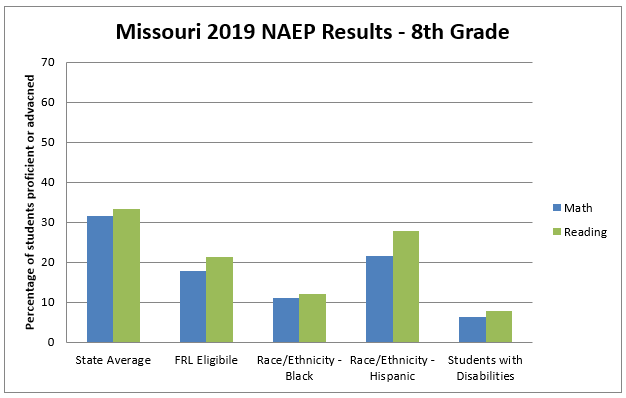
Missouri’s NAEP result data can easily be broken out to provide a clear picture of achievement gaps. The starkest gaps are for students with disabilities. Only 6 percent of Missouri’s 8th grade students with disabilities were proficient in math, and only 8 percent were proficient in reading. That’s 26 and 25 percent lower than the state average, respectively. Other subgroups, including students who qualify for free and reduced price lunch programs and Black and Hispanic students, also have lower rates of proficiency than the state average, as shown in the graph at the top of this post.

The NAEP results provide valuable information for parents about how Missouri students are performing. DESE’s APR Report, with its “super subgroup” that hides more than it reveals, leaves parents in the dark.

Why should Missouri parents have to go searching beyond DESE’s website for information they need? They shouldn’t. DESE should be helping, not hindering parents (and taxpayers) who want to know how their schools are performing.


Support Us

The work of the Show-Me Institute would not be possible without the generous support of people who are inspired by the vision of liberty and free enterprise. We hope you will join our efforts and become a Show-Me Institute sponsor.

Donate
Man on Horse Charging