If Believing in Explicit Phonics Instruction Makes Me Weird, So Be It

When financial guru Dave Ramsey takes a call on his radio program from a young couple who have paid off their debt, house and everything, he often shouts, “I’m talking to weird people!” These people have made sacrifices to live frugally and get out of debt. That’s just not normal in our society.

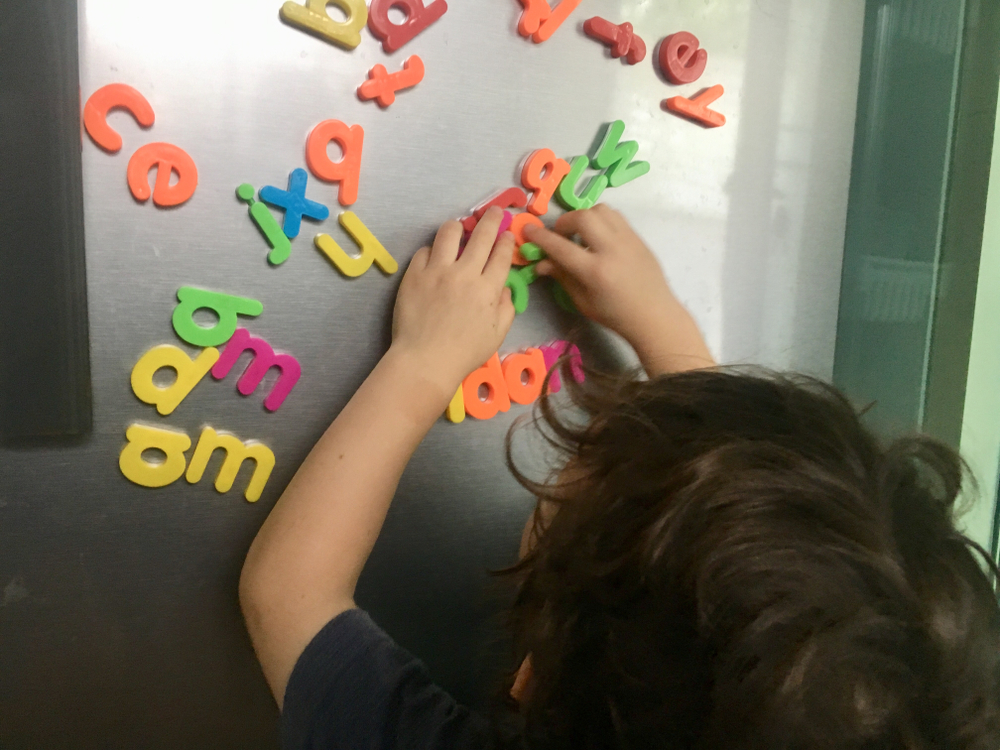
I had the same thought recently while attending a curriculum night at my child’s school. As a former first-grade teacher, I’ve conducted curriculum nights myself, and I’ve never seen anything like this. In one session, our school principal explained how and why the school has students learn all of the phonograms. She explained how explicit phonics instruction “unlocks the English language” for children. The parents ate it up. They kept peppering her with questions and they dared not interrupt her (even though she went 10 minutes past the ending time). Fortunately, her husband prompted her that we needed to stop or we might have been there another hour.

Looking around the room at the parents so eager and excited for explicit phonics instruction, I knew that I was talking to weird people.

A year earlier, my wife and I decided to pull our first grader out of our highly touted public school district. By all indicators, our former school is doing very well. In fact, we bought our home in this school district (zoned for this elementary school) when our son was born because of the quality of this school. Then, just after his first year in the school, we decided it wasn’t right for us. We reached this decision after attending the school’s curriculum night. That night made us very concerned about what the school was teaching our child. For starters, the teachers did not believe in explicit phonics instruction or in teaching spelling. To paraphrase one teacher: “It’ll just click one day.” That was the day it clicked for us; we did not share the instructional philosophy of our child’s school.

The very next week, we enrolled him in the school he now attends. The school has a classical education model. They explicitly teach phonics, spelling, penmanship, and diagraming sentences, among other things. In hindsight, we wished we would have enrolled him sooner. At the time of our decision, however, we questioned ourselves. I asked my wife why we couldn’t just be satisfied with our public school. Most people send their children to public schools and are perfectly happy. Why couldn’t we? Are we just weird? She assured me that we weren’t weird. We just liked a different type of educational model.

Now, I’m pretty sure she was wrong—we are weird . . . and we’re not alone. Parents all over the place, even in the best school districts, are dissatisfied with their local public schools because they want something different. I heard it from parent after parent as we discussed why we made the switch to the classical school. They were dissatisfied with their child’s school. They wanted something different. This isn’t a criticism of public schools, although there are some abysmal public schools. It is just a statement of fact that a school cannot believe in explicit phonics instruction and whole language instruction at the same time. Individual schools simply cannot be everything to everyone.

The fortunate weird parents, like my wife and me, can afford (or can sacrifice like the Dave Ramsey callers) to pay for private school tuition. Many others cannot. They are trapped in schools that don’t meet their needs or share their beliefs.

It is time for Missouri to change this. All parents, not just the fortunate, should be able to choose the school that aligns with their vision of a quality education. We all deserve to find our group of weird people.


The Myth of “Free” Medicaid Expansion

How do you pull the wool over taxpayers’ eyes in making a financial obligation totaling more than $2 billion disappear from sight?

Well, you could try the hidden ball trick. Indiana’s Trine University softball team played this old ruse to perfection in advancing to the 2019 Women’s College World Series.

In a surprise pick-off move, Trine pitcher Kate Saupe turned and fired a bullet to second base. But the ball got away from the infielder and rolled into the outfield. So it seemed. Actually, the ball never left the pitcher’s glove. When the runner tried to advance, Saupe tagged her for the game-winning out.

In promoting the idea of a cost-free expansion of Missouri’s Medicaid program, the Missouri Budget Project, the Missouri Hospital Association, and others are using a similar (and equally spectacular) misdirection play to gain public support for a policy initiative that would be neither cheap nor free.

At $10.9 billion, Medicaid already accounts for 39.6 percent of Missouri’s 2019 budget. That’s more than education, prisons, public safety, or roads. It’s the most for any service funded in part or total by Missouri taxpayers.

So how can Missouri boost the number of Medicaid participants from 850,000 to more than a million people—and save money? It can’t. If we increase Medicaid enrollment more than quarter, there has to be a similar increase in costs—something on the order of $2 billion a year.

The hidden ball here is to treat the federal contribution in this joint state-federal program as “free money” —a manna-from-the-heavens gift from Uncle Sam to the Show-Me State. But the money is not free. Like the residents of other states, Missourians are on the hook for federal Medicaid obligations, no less than state Medicaid obligations. They pay the final bill either way—through state and federal taxes.

Under the Affordable Care Act, the federal government set out to expand Medicaid to include people earning up to 138 percent of federally defined poverty level.

As originally written, this legislation would have required states to comply with the planned expansion of Medicaid or face the loss of all federal matching funds, split roughly on a $3-to-$2 basis between the federal government and the states. The Supreme Court struck down that part of the law in 2012. The Obama administration then agreed to a $9-to-$1 split in favor of the states if they opted to participate in the expansion. What had been a “gun to the head” (as Chief Justice John Roberts wrote) suddenly became a mouth-watering carrot.

Kansas recently became the 37th state to opt into Medicaid expansion. If Missouri were to follow suit, it would still need to put up 10 percent of the cost. Citing a Washington University study, Medicaid expansionists think they have found a way to make even that cost disappear. But this is just one more example of cost-shifting as opposed to cost reduction.

According to the study, Missouri could re-enroll existing recipients currently classified as permanently and total disabled (PTD) based on income, rather than disability. That would trigger the new $9-to-$1 federal match—meaning more federal funds for the same people.

But there is a problem: This maneuver appears to be against the law. So the federal Office of Inspector General said in a recent audit of New York State when it tried to do same thing.

Over the last two decades, Medicaid has been a rapidly rising cost at both the state and national levels. But it remains a deeply troubled program that is not succeeding in its basic mission of providing ready access to high-quality healthcare for low-income families and individuals.

When it comes to promoting needed change in healthcare, using feel-good, sleight-of-hand accounting to promote a false idea of something-for-nothing benefits is a step backward, not forward.


About That “Economic Impact Study” Conducted on Free Bus Service in Kansas City . . .

In a January 26, 2020 column for The Kansas City Star, the CEO of the Kansas City Area Transportation Authority (KCATA) advocates for making bus transit inside Kansas City free. His piece is largely an emotional appeal, but then he offers this:

But don’t take my word for it. Look at the research. An economic impact study was conducted by the Center for Economic Information at the Department of Economics at the University of Missouri-Kansas City that indicates between $15 and $17 million will be generated from the Zero Fare initiative. For those living paycheck to paycheck, as most Americans are, the cost of a monthly bus pass or cumulative single fares can make the difference in deciding which bills to pay. Tax revenue alone is expected to increase about $700,000 from the increased spending, and 100 jobs would be created.

UMKC’s Center for Economic Information (CEI) has no such study on its website. And the public information officer at KCATA responded that the CEI had not yet presented the final version of its paper. So I asked for a copy of whatever the KCATA CEO had used to make his claim. I was sent a four-page “draft mini report” dated December 5, 2019. (A PDF copy of this mini-report can be found at the bottom of this page.) The report does not list an author. But it didn’t require a degree in economics to see serious flaws in the analysis.

First, the study does not contemplate the net effect of a fare-free bus system—it simply adds up the costs saved by passengers and ignores any additional cost occurring elsewhere. It does not consider any additional tax, reduction on city spending in other programs or additional costs to the KCATA due to increased demand and wear and tear. Like a child arguing in favor of getting a family dog, the report counts all the benefits and none of the cost. For this reason alone this mini-report ought to be dismissed immediately.

I shared the draft report with some university economists for their comments. Each of them pointed out the failure to account for additional spending to cover the lost fare revenue.

Dr. Howard Wall at Lindenwood University in St. Louis pointed out that the authors misapplied the model they used to calculate the benefit. Understood correctly, the model, called IMPLAN, calculates the impact of additional money injected into an economy from outside—such as the local impact of a large federal grant. But this is not the case with fare-free buses in Kansas City. The policy would only move money already within the local economy by shifting the burden of bus fare. The UMKC mini-report argues, in effect, that one can fill a bathtub by moving water from one side of the tub to the other.

Dr. Byron Schlomach at Oklahoma State University was dismayed by the speciousness of the claims of growth in regional gross domestic product (GDP).  The only way regional GDP could rise by the amount claimed in the analysis is if free buses attracted huge numbers of people (or made workers more productive) and added money or physical capital such as buildings and machines. As you can guess, there is no evidence for this anywhere. It’s hard to imagine any scenario in which eliminating bus fare in Kansas City attracts significant residents, jobs, or capital.

Dr. Schlomach also offered another compelling point. He wrote by email, “Pricing plays an important role even in 90% subsidized, publicly-owned enterprises like bus transit. It can provide information for where and when the service is most highly valued and serve as an indicator for where resources should be allocated.” How would KCATA collect information on the popularity of routes if not through the farebox? Perhaps it could install people-counting sensors on every bus entrance, but then that too is an additional expense not considered in this analysis.

But the giveaway from UMKC is on the last page. The draft mini-report spends one-fifth of its total content discussing the ideas of Henri Lefebvre, a 20th-century French Marxist philosopher and sociologist. Why this is included in a memo claiming to be an “economic impact” analysis is a mystery. But it indicates that this was not an attempt to understand the impact of a significant change in public policy—it does none of that.

Rather, it seems that advocates of fare-free buses, aware that the research and experiences of others who have considered fare-free buses, sought out someone willing to make dubious claims of a positive economic impact. That UMKC lent its name to this is a shame.


A Taxing Endeavor

Here’s some good news for those who think user fees are the best way to fund Missouri’s transportation needs.

Several bills have been introduced in the Missouri legislature, and one has made it out of committee, to raise the gasoline tax anywhere between one and ten cents per gallon. For the largest tax hikes, the changes would be phased in until the limit is reached, while smaller ones would take effect immediately. One bill would index the tax to inflation to ensure the tax keeps up with the rest of the economy. Another bill would place a surcharge on petroleum imports, taxing the distributers rather than consumers directly.

Considering all the proposals, the more modest changes could raise about $144 million, while the biggest increase could raise over $400 million. Other than the amount of money raised, what are other differences between these bills?

Indexing the gas tax to inflation is a good way to reduce future transportation funding crunches. Further, for each bill that would raise the gas tax on drivers, 30% of the revenue would go to cities and counties while the remaining 70% would go to the Department of Transportation (MoDOT).

The proposal to place a surcharge on petroleum imports rather than on drivers themselves could especially benefit MoDOT, though at the expense of local governments. Due to the tax not being on consumers themselves, all of the money raised would go to MoDOT’s state road fund and none to county and local governments, which also rely on gas taxes for local road maintenance. This bill would also lower income taxes in an effort to be revenue neutral.

Policy implementation aside, this boils down to a simple point.

According to a Missouri House Task Force, Missouri’s transportation infrastructure is “deteriorating (65),” jeopardizing traveler safety and economic growth. Roads and bridges are a vital part of our state’s economy, transporting nearly $500 billion of goods annually. Those who use them should contribute to their upkeep, and the standard means of doing so has become inadequate, as the spate of bills to increase the gas tax attests.

The problem has to be dealt with, or the whole state – drivers and non-drivers alike – will lose out. Infrastructure is a key component of the state’s long-term economic health. Since it must be recapitalized, user fees are the fairest and most efficient way of doing it.


Renewable Energy: Too Much of a Good Thing?

Since the Green New Deal became mainstream news a year ago, calls for more and more renewable energy have multiplied, including here in Missouri. There is nothing wrong with generating electric power from wind and sunlight. In fact, there are benefits to using “free” fuel sources like wind and sunlight compared to extracting coal or natural gas. However, even renewable energy has trade-offs. Uncooperative weather, high energy storage prices, and the way the electric grid works pose challenges to incorporating more wind and solar power.

This raises the question: Can there be too much renewable energy? Despite the abundance of wind and sunlight, is there a point where the costs outweigh the benefits (including the cost of harnessing these supposedly free fuel sources)? I address these questions in a recent op-ed posted at Real Clear Energy.


Workforce Development for Rural Missouri

Workforce development is a hot topic in Missouri right now. The governor deemed the issue important enough to give it prominent mention in his state of the state speech. One critical component of workforce development is ensuring that students from rural high schools are prepared to enter the workforce and get good jobs. Graduation follow-up data from the Missouri Department of Elementary and Secondary Education (DESE) can tell us what high school graduates from rural districts do after graduation, and this data can direct workforce development efforts.

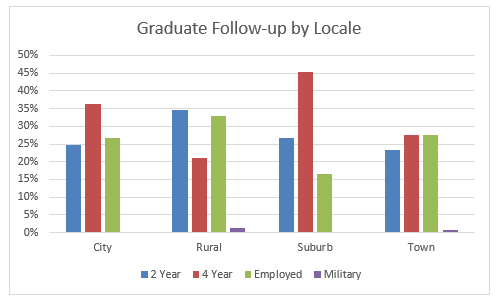
After graduation, districts and schools follow up with their graduates to see what they’re currently doing, and then DESE compiles the data. I connected the DESE data with the federal data set that labels each district with different locale types, ranging from big cities to remote rural areas. You can see the results in the graph at the top of this post (the data may not add up to 100 percent due to data privacy and inability to contact all students).  

Looking at the 2018 data, 33 percent of rural district students entered employment and 35 percent enrolled in a 2-year college following graduation, both of which were the highest percentages for each category out of all locales. On the other hand, rural schools had 21 percent of its students attend a 4-year college or university, the lowest percentage out of all locales.

Workforce preparation for rural communities, thus, should have a strong focus on preparing students for high-demand, well-paying jobs they can enter soon after graduation. This could mean students taking the proper classes and having access to the credentials and skills training they need to be set up for a successful career immediately. Taking job-specific courses or earning college credit during high school should also be an option to help bridge students from high school to technical school.

Missouri needs to consider the data when planning for workforce development. There are good jobs available to Missourians, and the state needs to make sure students are ready to fill them.


The Latest Episode of the Show-Me Institute Podcast

https://soundcloud.com/show-me-institute/smi-podcast-its-right-because-its-right-corey-deangelis

We celebrated National School Choice Week on the SMI podcast with Corey DeAngelis. In this episode, Corey and Dr. Susan Pendergrass discuss the moral case for school choice, educational freedom in rural areas, and more.

Corey DeAngelis is the director of school choice at the Reason Foundation. He is also an adjunct scholar at the Cato Institute.


Occupational Licensing Reform Is on the Move

Today, the Missouri House passed two pieces of occupational licensing legislation. Both are worthwhile, but one would make Missouri a reform leader on the national level.

The first, HB 1511, would allow for out-of-state licenses held by military spouses to be accepted here in Missouri. This has been a popular reform in recent years, and already every state, including Missouri, has some version of reciprocity for military spouses in place.

The real game-changer is the second bill, HB 2046, which would allow for this sort of licensing reciprocity for anyone. This means that someone who holds a valid occupational license in good standing from another state could come to Missouri and qualify for the same license here with few or no administrative burdens.

This bill would have a plethora of positive effects on Missouri. It would make the state a much more attractive place to relocate by eliminating the over-burdensome requirements for re-licensing a worker. But it also should offer consumers greater choice and competition in the market for all kinds of services, including health care.

Occupational licensing burdens workers and the economy. As Show-Me analysts have written and testified, reducing government barriers to work is good for workers, consumers, and the state economy. Many other states are considering licensing legislation like this, and this bill would help Missouri become a more competitive and attractive state for consumers and professionals alike.


New Path to Medicaid Block Grants

Today, the federal government released long-awaited guidance for states interested in block granting federal Medicaid funding. This marks a significant development on the health care policy front, and is an opportunity for states interested in new approaches to reining in Medicaid’s runaway spending.

As I’ve written before, the way that Medicaid is funded plays an important role in explaining the program’s growth. The status quo encourages states to spend as much as possible to receive more matching funds from the federal government. One of the best ways to improve the program and simultaneously contain costs would be to abandon the open-ended funding structure, and instead provide states with a yearly lump sum (block grant) payment of federal funding.

Show-Me Institute analysts have written about the benefits of Medicaid block grants for years, but until today no such proposal had ever received federal support. The new federal guidance indicates the current administration is serious about giving states more flexibility in deciding how to best administer their Medicaid programs. Unfortunately, there may be a serious weakness in the guidance provided today. It appears block grants may be limited to states that have already expanded Medicaid.

How the federal government treats Tennessee’s application will be telling. Tennessee, which has not expanded Medicaid, submitted a waiver application for block grants months ago. As Missouri has also not expanded Medicaid, the reception to Tennessee’s application should provide clues as to the likelihood of Missouri being able to successfully apply with a similar proposal.

Today’s guidance may offer a new path for Missouri’s policymakers who are serious about addressing Medicaid’s cost problem; the question is whether they will be ready to seize the opportunity.


Support Us

The work of the Show-Me Institute would not be possible without the generous support of people who are inspired by the vision of liberty and free enterprise. We hope you will join our efforts and become a Show-Me Institute sponsor.

Donate
Man on Horse Charging