Is U City Considering Eminent Domain After All?

Trust your gut. That’s about as good and as universal of a piece of advice as you can get.

Skeptics of a massive taxpayer-subsidized redevelopment project in University City were right to trust their guts. While the City’s website says that “The City will not use eminent domain under the tax-increment financing (TIF) law to condemn owner-occupied residential property,” now it sounds as if that might be an option. In a recent interview, City Manager Gregory Rose said “there may be an option that the developer says ‘we understand what council’s position has been regarding the use of eminent domain but we’d like you to take a look at this’ . . . and so the council will end up making that decision at that time.”

Why might eminent domain be on the table now? Well, my gut is telling me this: City officials have a lot to gain (in terms of sales tax revenue) from the development going through, and now, given that some homeowners don’t want to sell for the price being offered to them by the developer, city officials might be starting to worry. And if they have convinced themselves that this development must happen, no matter the cost to taxpayers, then kicking property owners out of their homes might be a price they are willing to pay.

This is worrisome for several reasons. First, the economic renaissance promised by development proponents, which is the main justification for the project, is unlikely to occur. Unfortunately, TIF—the subsidy mechanism the development most heavily relies on—just hasn’t been shown to increase surrounding property values. Trust me, a part of me wishes TIF did this, as I live just a few minutes from the redevelopment area. Unfortunately as the economic research suggests, TIF projects don’t make the neighborhoods surrounding them more valuable. If the ends justifying a blunt tool like eminent domain aren’t likely to materialize, we might not want to incur the costs of using that tool.

Second and most important is the fact that property owners—especially owner-occupied residential property owners—simply shouldn’t be forced out of their homes for the benefit of a private developer. Perhaps certain public projects, such as interstates and railroads, can justify the coercive removal of property owners from their property, but it is far from clear that homeowners should be ousted from their homes so that a politically-favored big-box store can make a nice profit. We’ve seen how these things can go.

But if you wonder why you, perhaps someone living far away from University City, should care about this, just keep in mind that your local government body is populated by the same sorts of people that populate University City government. If we are to learn anything from public choice theory, it’s that institutions—such as local governments—have values and goals of their own, and that the people behind local institutions are as fallible and greedy as everyone else. This isn’t to cast a blanket of doubt on all institutions, but rather to make clear that the violation of property rights in some areas of Missouri is a threat to the property rights everyone in the state.

In the end, University City officials should get over their infatuation with the I-170 & Olive redevelopment and abandon their apparent “any means necessary” strategy for ensuring its materialization. The threat of use of eminent domain is politically and morally disturbing, and would signal to University City residents and others that their homes and lives are for sale, so long as city hall thinks that the price is right. 

Serious TIF Reform May Be in the Cards in 2020, With A Tweak

As we’ve often noted, tax-increment financing (TIF) in Missouri drains millions of dollars from legitimate government uses every year, often benefiting developers by pushing off their tax burdens onto other taxpayers. It’s why we were happy to testify on Senate Bill 570—a TIF reform bill—when it came up for a hearing in January. As amended, the bill would tighten the definition of “blight,” limit the kind of TIF development that could happen in flood plains, and allow for school districts to opt out of having their tax revenues diverted to TIF projects. After passing out of committee, an amended version of the bill proceeded to pass out of the senate unanimously. Unfortunately, that unanimous result may have been due to the fact that several other sections of the bill were amended. These amendments work against the reform purposes of the original bill, including a cavalcade of TIF carveouts for certain cities.

But is there something for reformers to work with here? I think so.

The amended bill includes in the definition of blight certain impoverished census tracts in St. Louis, which forms the kernel of a good idea. Well-maintained parking lots in wealthy neighborhoods hardly meet a rational definition for “blight,” and yet, public officials regularly tumble through the usual legal gymnastics to provide taxpayer support for such projects. Instead, binding “blight” to some objective definition of local poverty would return the state’s TIF programs to their original purpose—aiding areas faced with intractable poverty and enormous barriers to development.

Herein lies the opportunity: Make “blight” contingent on two factors. The first factor would be based on the common definition of blight, including unsafe and unsanitary buildings. The second factor, however, would require the property to be in an impoverished census tract. A “blighted” parking lot in the Central West End doesn’t need a tax benefit to see redevelopment, but a blighted block in the poorest sections of North St. Louis very well might. If tax benefits are going to be meted out, they should be helping poor areas pull themselves up by their bootstraps, not helping wealthy areas polish their wingtips.

Whether SB 570 makes it into law is anyone’s guess; its rapid progress this early in the session would seem to bode well for it. But if TIF reform is going to pass this year, it really should include changes in where TIF support is legally proper. Fix “blight,” and you are taking an important step in the direction of fixing TIF. Hopefully, the political will exists to do that before the end of the legislative session.


The Benefits of User Fees

Show-Me Institute analysts have written for years about the benefits of funding a transportation system with user fees. User fees ensure that the people who use things are the people who pay for those things. But what about the specific benefits of the two most common user fees—gas taxes and tolling?

Watch our latest video to learn more: https://www.youtube.com/watch?v=lxCKSmuCAdo&feature=youtu.be


On Government Union Reforms, Present and Future

Although it (surprisingly) hasn’t made much news since, late last month a St. Louis County district court granted summary judgment to union plaintiffs who had filed suit to prevent enforcement of 2018’s House Bill 1413, which significantly reformed the way Missouri oversaw government unions in the state by adding additional reporting and transparency provisions to protect taxpayers and keep unions accountable. To put it plainly and without going into great detail, I disagree strongly with the court’s decision and hope that it doesn’t mark the end of this chapter in the story of reform.

But while the ruling is disappointing, it isn’t altogether unexpected, either. As I wrote in a paper on the subject of government union reform published earlier this year, “ongoing statutory tweaks and court interventions—driven by interests on both sides of the government–labor debate—seem likely to shape how, and whether, reforms are implemented for years to come.” Government unions weren’t going to give up their power easily even in the face of changes to the law, and it seemed reasonably clear after the lawsuit was filed that an adverse ruling was certainly on the table.

That doesn’t mean reform efforts will or should come to an end as litigation on such matters makes its way through the judicial system. In fact, there was plenty for the state still to do even before the Court’s decision on HB 1413, especially ensuring collective bargaining agreements are catalogued by state regulators, and we observed as much in the paper:

Whatever HB 1413’s eventual disposition, any oversight regime that cannot identify all the subjects of that oversight will fail to meaningfully execute its mission. Without effective oversight, the likelihood of patently illegal contract provisions rises. That’s bad for taxpayers and government workers, but it’s also bad for the rule of law.

Currently the legislature is hearing bills dealing with “paycheck protection” reforms, which we’ve talked about before and were part of HB 1413. But as the legislature takes stock of the government union landscape as it moves toward the completion of its legislative year in May, policymakers should also take a hard look at whether the state can effectively oversee any of the reforms that it’s contemplating and whether it has delegated sufficient power and resources to officials to ensure the will of the legislature is being carried out. Changing the law is fine, but a law that can’t be or isn’t enforced will be ignored.

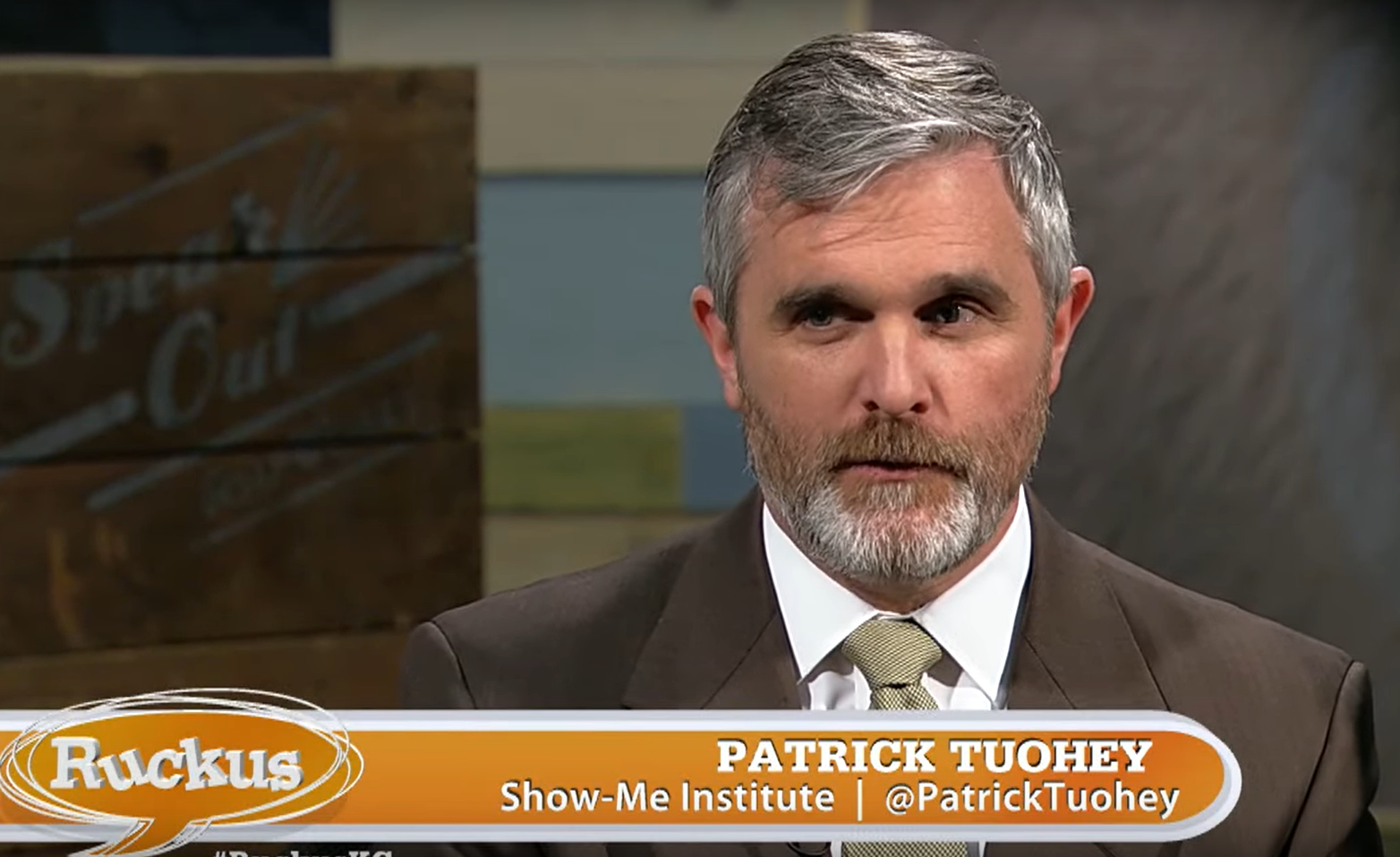
Patrick Tuohey on KTRS

How much money should a municipality be allowed to make from fees and fines?

This morning, SMI’s Patrick Tuohey joined McGraw Milhaven on The Big 550 KTRS to discuss reports that the Missouri Attorney General is asking to be allowed to enforce portions of a 2015 law that Missouri courts initially set aside in 2016. The law at issue “set minimum standards for municipalities in St. Louis County and capped the amount of revenue they could raise in municipal court from traffic cases.” 

LISTEN: https://soundcloud.com/550ktrs/show-me-institute-reinstating-court-caps


Support Us

The work of the Show-Me Institute would not be possible without the generous support of people who are inspired by the vision of liberty and free enterprise. We hope you will join our efforts and become a Show-Me Institute sponsor.

Donate
Man on Horse Charging