Local Kansas City Area School District Sues Jackson County Health Department – for Good Reason?

Big government is once again picking winners and losers. This time it is in the form of enforcement of county-issued guidelines for outdoor sporting events.

Blue Springs School District, a school district in Jackson County, sued the Jackson County Health Department after it was issued a notice of non-compliance with capacity limitation rules for its home opening football game.

What did Blue Springs do wrong? Attendance at the game exceeded the 100-person fan limit set by the county for outdoor events. The county is adamant Blue Springs cannot do that, threatening to ban all fans for the season and force the team to quarantine for two weeks if it happens again.

Blue Springs simply wants to allow for home football players, cheerleaders, and dance team members to give four tickets to their family members and two tickets to visiting team players—totaling 550 fans and 11 percent normal capacity. Yes, this exceeds the 100-person limit, but is the 100-person rule being enforced everywhere throughout the county?

Let’s compare this to the Thursday night opener for the Kansas City Chiefs. The county allowed roughly 16,000 fans, or 22 percent of Arrowhead’s normal capacity to attend.

Double standard? Absolutely. When the order was issued, the county intentionally exempted Kansas City, the city with the highest COVID case numbers in the county. Jackson County wants Blue Springs held at less than 2 percent of its stadium’s capacity while the Chiefs can have 22 percent. Shouldn’t Blue Springs be allowed to have the same percent capacity applied to its stadium?

Due to the limit set by the health department, Blue Springs decided that no visitor fans can attend games going forward. Even worse, with roughly 100 students on the active roster, each player/cheerleader/dance team member gets one ticket to give to their parents or guardians. Imagine a senior who has to choose between their mother, father, or grandparent attending their game. If one person from a “household” can attend, why can’t one or two more?
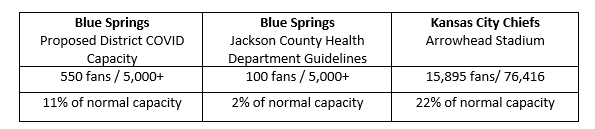
Jackson County defended the 100 person limit (2 percent capacity) for Blue Springs and 15,895 fan limit (22 percent capacity) for the Chiefs by saying, “Just because the Chiefs have the resources to do this in a relatively safe matter doesn’t mean that a high school stadium does.” But is this true? Blue Springs and the Jackson County Health Department developed a plan that health officials deemed safe for the school district to teach thousands of students each day indoors and in-person. The health department said Blue Springs has enough resources for that.

Wouldn’t the school district have enough resources to take a fraction of the people compared to the current school day and place them in a less risky area outdoors? I think so. The Jackson County Health Department should assist Blue Springs in implementing an 11 percent capacity plan instead of threatening to quarantine the players and ban its fans.

New Research Highlights Need to Modernize Transportation Funding

New research from the Tax Foundation corroborates what Show-Me Institute analysts have been writing for years—our transportation funding desperately needs an update.

The Tax Foundation study focuses on funding for America’s highways, and how road usage has been growing while the revenue to maintain them has been shrinking. This is true nationwide and for Missouri.

The bulk of Missouri’s highway funding (and that of many other states) comes from the federal Highway Trust Fund—which is funded by a federal fuel tax that has not changed since 1993. The tax is levied on vehicles that are increasingly fuel efficient. State fuel taxes supplement the federal funding; each state approaches its fuel tax differently. Some index the tax to inflation, some periodically raise it, and still others keep it constant, as Missouri has since 1996, with inflation eating away at its purchasing power.

This funding formula disparity will only get worse as fuel economy improves and no change is made to fuel taxes. In fact, the Highway Trust Fund, which sends money to states for road maintenance, is on the verge of insolvency by the end of next year unless the current funding formula is changed.

The study’s author promotes a charge on highway vehicle miles traveled as a potential solution. This charge would vary based on how much the vehicle weighs to account for the damage it does to the road. As the study notes, this highway formula “gets closer to capturing the externalities and approximating the road maintenance cost of each vehicle.”

In other words, toll roads.

The highway funding situation in Missouri will need to be addressed soon. Travel on Missouri’s interstates has increased 17 percent since 2008, and travel on other Missouri freeways and expressways has increased 20 percent since 2010 (the most recent year for which data for the latter category is available). Conversely, since 2008, the Missouri Department of Transportation’s (MoDOT) overall revenue has decreased by 15 percent, with state fuel tax revenue—the largest state-contributed source of funding—falling 0.5 percent.

Making MoDOT do more with less led to an average of $745 million in unfunded road and bridge priorities between 2014 and 2018. And some of the most traveled roads in Missouri—Interstates 44, 55, and 70—will need to be reconstructed soon.

With these pressing problems, shouldn’t Missouri lawmakers heed the advice of the Tax Foundation report and consider tolling?

It’s Time to Fund Everything for Every Student

One fascinating result of the COVID-19 school shutdown is that parents have taken their children’s education into their own hands. They’re leaving public school districts that are only offering virtual education and enrolling in private schools. They’re sending their children to karate academies or trampoline centers to do virtual schooling there. And, in one of the more interesting twists, they’re starting their own schools.

Micro-schools have been around for a few years, but they served a very specific niche. Now, they’re emerging as another in-person option for those who can find and afford them. According to a recent article in the St. Louis Post-Dispatch, micro-schools are popping up in the St. Louis region. Unfortunately, the micro-schools highlighted are charging between $500–$1,000 per month per student. What about the parents who can’t afford that?

Public school districts could join the effort. They could make space and teachers available to serve pods of students. The state could also join the effort. It could allow parents to access a portion of their children’s state education funding to either pay for attendance at a micro-school or to pool with other parents to create one of their own. We are undoubtedly sending substantial sums of money to public school districts for students who have already left. Allowing the funding to follow the child would change that.

There is a significant risk that achievement gaps between wealthy and poor children will get wider this year. As cool as it is to see parents of means figure out how to get their children the education they need, it clearly creates unequal access. Being trapped in a failing school that can’t or won’t provide the services that students need comes with a higher level of risk this year. We are facing a national education crisis and we should be funding every option for every kid.

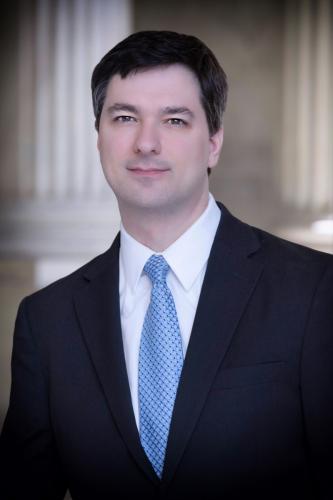
Virtual Town Hall – The National Debt Crisis with Brian Riedl

On September 10, 2020, the Show-Me Institute hosted a virtual town hall featuring Manhattan Institute’s Brian Riedl. Brian discussed the looming national debt crisis in America, fiscal responsibility, economic growth, and more.

Watch the full discussion


Brian Riedl is a senior fellow at the Manhattan Institute, focusing on budget, tax, and economic policy. Previously, he worked for six years as chief economist to Senator Rob Portman (R-OH) and as staff director of the Senate Finance Subcommittee on Fiscal Responsibility and Economic Growth. He also served as a director of budget and spending policy for Marco Rubio’s presidential campaign and was the lead architect of the ten-year deficit-reduction plan for Mitt Romney’s presidential campaign.

During 2001–11, Riedl served as the Heritage Foundation’s lead research fellow on the federal budget and spending policy. In that position, he helped lay the groundwork for Congress to cap soaring federal spending, rein in farm subsidies, and ban pork-barrel earmarks. Riedl’s writing and research have been featured in, among others, the New York TimesWall Street JournalWashington PostLos Angeles Times, and National Review; he is a frequent guest on NBC, CBS, PBS, CNN, FOX News, MSNBC, and C-SPAN.

Back for More Handouts

Government handouts can be a slippery slope for some developers—once they get one, they just ask for more and more. That appears to be the case for developers seeking millions more in public funding through tax-increment financing (TIF) for a project in Lee’s Summit. The Paragon Star sports and entertainment project was already approved for a variety of public subsidies in 2016, and now developers are back for more.

If approved by the Lee’s Summit City Council, this project could receive an additional $18.9 million in development incentives. According to an article in the Kansas City Business Journal, that would bring the total to $74.3 million in public support, which includes $32.3 million from transportation development district (TDD) bonds, $5 million from community improvement district (CID) reimbursements, $4 million in state funding, and $1 million in city funding. That’s a lot of taxpayer money!

This project is a mixed-use sports and entertainment project and it includes volleyball courts, children’s parks, restaurants, and retail establishments. Given the uncertainty regarding when we will return to “normal” use of these types of facilities, is this really where taxpayer dollars should be going?

The timing for this project is bad, but even in different times, it would still be a bad idea. Not only do government handouts give unfair advantages to some developers over others, but research shows that incentives such as these don’t result in measurable benefits for the communities that pay for them. They can end up being a huge waste of taxpayer dollars, which is something local governments really can’t afford right now. The developers for this project have already received more than enough public dollars. Do we really need to give them more?

More Education Options, Please

There was an interesting story from KMOX this week profiling a family who chose a parochial school this year due to the COVID-19 pandemic. When their local public school said that their son would be working on virtual schooling from home all day while they were at work, the family instead decided to send him to a private school that is offering in-person instruction.

Families need options, now more than ever.

It seems perpetually lost in the debate that different people are experiencing the pandemic differently. There are families who need to take serious precautions. They or their child might have an underlying health issue that would make contracting the coronavirus dangerous. They may have frequent contact with elderly friends or family who might be at risk of complications should they catch COVID-19. Allowing them to use virtual education for the duration of the pandemic is the appropriate and fair thing to do.

Other families, however, are making a different calculation. They are looking at research that, at least to this point, shows little risk to children, particularly young children, and are weighing this very small risk against the serious risk of learning loss from a semester or year of low-quality online instruction. The parents might be young and healthy, with little contact with vulnerable people, and believe that they can use in person education safely and appropriately.

I wouldn’t tell either of these families that their decision is wrong, because each has to weigh the risks and benefits that apply to their particular circumstances. But we must always remember to look at both sides of the ledger: the coronavirus absolutely poses risks, but so does a year of lost schooling.

Our education system needs to support families, whatever decision they make. This means having both online and in-person options available to them. We need to support schools that want to open for in-person instruction and make sure that they have the capability to operate safely. If traditional public schools are choosing to delay opening or are opening solely as online schools, we need to support families that want to do something else.

Missouri Tells You What to Do 94,000 Times

Ninety-four thousand is an absurdly large number. Can you imagine doing something 94,000 times? Well, Missouri tells us what we can and cannot do 94,000 times in state regulations. Does that make Missouri seem like a place promoting civil and economic freedom? Does that sound like a state where you want to buy a house, or start a business, or earn your living? To me it doesn’t, and that’s a problem.

The Mercatus Center’s latest version of its State RegData project analyzes state-level regulations by running a program that counts the number of times the words and phrases “shall,” “must,” “may not,” “required,” and “prohibited” appear in each state’s regulations. These words usually translate to regulatory restrictions, as these phrases, when included in regulations, typically tell you what you can or cannot do.

These words appear 93,915 times in Missouri state regulations, which translates to roughly 93,915 regulatory commands in our state. That’s almost 94,000 times where the state is telling you what you can and cannot do!

As you can imagine, some of these 94,000 regulatory restrictions seem inconsequential, unnecessary, and even ridiculous. A retailer may not participate in the sales tax holiday unless more than 2 percent of its merchandise qualifies for the tax holiday. The dental board may not issue any temporary license to practice as a dental hygienist in Missouri, though many other licensed occupations allow temporary licenses. The possession or use of beer bongs is prohibited on some rivers in Missouri but not others. Is this really what the state needs to be regulating? These are just three of the 94,000 instances where Missouri controls the actions of its citizens. To make matters worse, this number only includes state-level regulations; regulatory restrictions can be placed at the county and municipal levels, too.

Regulations are more often than not just red tape that Missourians must fight through to live their lives, and 94,000 pieces of red tape sure is a lot to fight through! Missouri saw some regulatory reduction during the “No MO Red Tape” initiative, but generally bureaucrats are much quicker to add regulations than to take them away. Regulations compound to suffocate businesses and workers, controlling what they can do and taking their resources. Why is Missouri making it harder for Missourians to run businesses, earn a living, and live productive lives?

SMI Podcast: Chris Pope – A New Plan for Medicaid

Listen Here

Read Chris’s full report: A Plan to Make Medicaid Fair, Focused, and Accountable

Chris Pope is a senior fellow at the Manhattan Institute. Previously, he was director of policy research at West Health, a nonprofit medical research organization; health-policy fellow at the U.S. House Committee on Energy and Commerce; and research manager at the American Enterprise Institute. Pope’s research focuses on healthcare payment policy, and he has recently published reports on hospital-market regulation, entitlement design, and insurance-market reform. His work has appeared in, among others, the Wall Street Journal, Health Affairs, US News and World Report, and Politico.

Pope holds a B.Sc. in government and economics from the London School of Economics and an M.A. and Ph.D. in political science from Washington University in St. Louis.​

Support Us

The work of the Show-Me Institute would not be possible without the generous support of people who are inspired by the vision of liberty and free enterprise. We hope you will join our efforts and become a Show-Me Institute sponsor.

Donate
Man on Horse Charging