Teachers Unions Set Their Sights on Micro-schools

Kelly Smith is a very nice guy. On his Twitter profile, he describes himself to his 400 followers as a “Physics nerd, family man, tech entrepreneur, working on the future of K-12 education.” After a few years working in the tech industry, he started a coding club for his kids and their classmates and in so doing found a passion for teaching.

Building on the success of his coding club, he decided to start a micro-school in his own home in Mesa, Arizona. He wanted students as engaged in their normal schoolwork as they were in his coding club. He convinced six of his friends to “enroll” their children and used online resources and a pedagogical model that focused on student engagement and project-based learning to create a nurturing school environment. He loved it. The kids loved it. Their parents loved it. And he realized he was on to something.

That small group of families in his home became the basis for the Prenda Microschools (if you want the whole story, I spoke with Smith on my podcast Cool Schools earlier this summer). There are now more than 400 such schools, each enrolling between 5 and 10 students in someone’s home, in a public library, or a host of other spaces. Prenda was already growing before the pandemic, but social distancing requirements and lackluster responses by local school districts drove up demand.

This growth put Prenda in the crosshairs of the educational establishment. In a bombshell report in the Wall Street Journal, leaked documents show the opposition research that the National Education Association (NEA) has completed on Prenda and Smith himself, and it is wild. The NEA admits that micro-schools are popular, that kids learn well in them, that they solve some of the problems that homeschoolers face, and that some of Arizona’s school choice programs “alleviate some equity issues” as lower-income families can participate.

Perhaps more troubling, the dossier also features Mr. Kelly’s address and a picture of his home.

Let’s be clear. While Prenda is growing, and exciting, it still only enrolls around 3,000 students. In Arizona alone, there are almost 1.1 million public school students. That means that the NEA created opposition research on a school network that enrolls less than one third of one percent of Arizona’s students. Its enrollment is a rounding error in the education system, and yet the NEA went through all of this effort to develop a plan to snuff Prenda out, admitting in the process that it is popular because it is good.

I would love to say that I’m surprised by this development, but I’m not. This has been the standard operating procedure for teachers unions for decades. They brook no dissent. They fight hammer and tongs against every potential option that they do not control. And good people like Kelly Smith get caught in the crossfire.

More to the point, does the NEA in Missouri keep dossiers on private school leaders? On charter school educators? Does the union keep pictures of their houses on file?  Might be worth asking sometime.

The LIHTC Program Is Back Again

Missouri taxpayers are now back on the hook for one of the least effective and most expensive tax credit programs in the country. The state’s Low-Income Housing Tax Credit (LIHTC) program had been dormant for three years, but the Missouri Housing Development Commission (MHDC) recently voted unanimously to revive it. The move breaks one of the first promises made by Governor Parson (the governor sits on the MHDC), who vowed to keep the program shuttered until the legislature reformed it. Never mind the legislature’s failed efforts over the past few years to improve LIHTC. If the program was going to resume without the requisite reforms, why do it now?

Of course, our state is in the middle of an unprecedented pandemic, which has been especially hard on low-income Missourians. But the LIHTC program does nothing to make housing more affordable for those who need a place to live right now. Assuming the MHDC starts awarding tax credits this year, the subsidized housing will still need to be built before it can provide any additional relief for Missourians.

Research has shown that, even in normal economic times, LIHTC is not effective at making housing more affordable. Not only does less than fifty cents of each dollar in tax credits go toward the construction of affordable housing, Missouri’s program also doesn’t increase the supply of affordable housing. For years, Missouri had one of the most generous state LIHTC programs in the country, matching each federal dollar on a one-to-one basis. Yet, in the years after the state match was halted, the number of affordable housing projects across the state remained largely unchanged.

Missouri’s state government is also struggling to deal with the pandemic and facing a serious budget crunch. To keep the budget balanced, the governor has already restricted more than $400 million in state spending. This means that there will be hundreds of millions less in funding this year for things such as education and public safety. And the outlook for next year’s budget isn’t any better.

There’s no doubt that many Missourians are facing housing issues during this unprecedented time. But if our elected officials’ goal is to address this problem, shouldn’t they be searching for a solution that is going to help people now instead of reviving a costly and ineffective program?

St. Louis County Should Find Budget Cuts Before Hiking Taxes

The economic damage caused by COVID-19 has been catastrophic, and families everywhere are scrambling to tighten their belts and make ends meet. The fallout extends to local governments as well, which is why it was surprising to see the proposed St. Louis County budget for 2021 include no budget cuts. According to a St. Louis Post-Dispatch story on the matter:

St. Louis County Executive Sam Page has proposed an $848.5 million county budget for 2021 that includes $4.3 million in pay raises for county employees, a big funding boost for the police department and no job reductions or cuts to services.

The plan called for pulling back spending just 2% from this year’s budget despite a projected 9.5% shortfall in revenue this year from the coronavirus and an abundance of uncertainty about the county’s ability to recover.

But wait—how is the county going to account for the 9.5 percent shortfall in revenue mentioned in the article? Tax increases, of course:

Page told the council in a four-page letter on Friday that the county needed to “identify additional revenues” to sustain existing programs, including increasing the property tax rate either by a council vote or a ballot initiative.

The county could also see a $10 million annual boost in sales taxes, he wrote, if the state Legislature were to pass legislation allowing the state and its municipalities to begin collecting taxes on sales in the state from out-of-state vendors.

Why raise taxes on citizens already struggling in the midst of an economic calamity instead of looking carefully for cuts? In the Post-Dispatch story, a county official is quoted saying that cuts “generated a whole bunch of bad outcomes. So, ultimately, none of those were accepted.”

It’s possible that some service cuts aren’t feasible and really would harm citizens. But the idea that there’s simply nothing in the budget that can be cut doesn’t pass the smell test. We already know one area where the county misuses gobs of taxpayer money: economic development policy.

One does not need to strain to find examples of the county wasting money in this fashion.

Just a few years ago, in a plan to revitalize part of North County, St. Louis County negotiated a lease for the former Northwest Plaza mall that could cost the county up to $77 million. Serious questions were raised about the negotiation process, which led to ethics hearings. A member of the county council has since called the lease “obscenely long and overpriced,” and the county is now enmeshed in litigation while trying to break the lease.

The county also contributed millions to the farcical, doomed-from-the-start Loop Trolley project, which last December financially imploded after barely a year of operation. And the county regularly subsidizes smaller projects that don’t make headlines. Last year, the county and the City of Hazelwood together spent millions in a scheme to redevelop the decaying St. Louis Outlet Mall. Late last year, St. Louis County doled out more than $4 million to HVAC company Johnstone Supply to help it build a new headquarters in Earth City.

Institute analysts have spent years documenting the problems with these projects, which often lack accountability and oversight, allow government to pick winners and losers, and shift risk from private investors to taxpayers. But most importantly: They simply don’t work, frequently failing to deliver promised benefits.

While those mistakes have already been made and the money already spent, the county is taking the wrong approach here. Why should taxpayers entrust a government that has been a poor steward of their dollars with more money? St. Louis County should work harder and more transparently to find opportunities for budget savings before asking its citizens to pony up additional taxes.

Parents Are Taking Control of Education

This has been an incredible school year by a number of measures. Most school districts have rebuilt their education delivery systems. Teachers have been forced to lean on technology whether they wanted to or not. But I believe families have experienced the biggest changes. After a scramble to figure out how to manage a complete school shutdown last spring, they have been dealing with changing plans and poor communication from districts. It’s not surprising that so many have taken things into their own hands and created pandemic pods (small classes outside traditional school districts) for their children.

What is surprising is how pervasive this apparently is. EdChoice has been polling parents since the shutdown last spring, and its latest poll results indicate that a shocking 35 percent of parents now report that their children are in pandemic pods, and another 18 percent are looking for one. Over half of parents, according to this survey, are writing (or trying to write) their own playbook for how and where their children will be educated. This represents a major disruption that is not going to just go away when schools reopen.

Equally surprising, nearly 70 percent of teachers surveyed expressed at least some interest in teaching in a pandemic pod. Teacher frustration seems to be high. They are dealing with mixed signals and many have to swap between teaching in person, recording virtual lessons, and virtual instruction in real time. The thought of just teaching eight or ten students in a home with no district bureaucracy must be tempting.

We are all exhausted by COVID and ready for things to go back to normal. But normal now is everyone wearing masks, touch-free bathrooms, and no hugging. Some of that will go away and some of it will stay. The same is true for public education. Families and teachers are taking ownership of public education like never before. To have some of that stick would be a much-needed step in the right direction.

October 22: Virtual Town Hall with Grover Norquist – Tax Reform and America’s National Debt Crisis

Join us on Thursday, October 22 at 11:00 AM for a special town hall with Americans for Tax Reform President Grover Norquist. Mr. Norquist will discuss tax reform and the looming national debt crisis in America before taking questions submitted by the audience.

REGISTER HERE

Questions can be submitted prior to the event by emailing them to [email protected]

Speaker Bio:

Grover Norquist is president of Americans for Tax Reform (ATR), a taxpayer advocacy group he founded in 1985 at President Reagan’s request. ATR works to limit the size and cost of government and opposes higher taxes at the federal, state, and local levels and supports tax reform that moves towards taxing consumed income one time at one rate.

Chesterfield Quick to Demand More from Taxpayers

Apparently, Chesterfield lawmakers are feeling the financial stress of the COVID-19 crisis and the subsequent economic downturn. In the latest newsletter to citizens, the mayor announced that the city will “put before the voters a very small property tax.” Already? We are still in the midst of this crisis, and Chesterfield is already asking for more money from taxpayers?

Though it’s felt like a long time for those of us working from home or locked in small apartments, we are only six months into this economic episode. It’s difficult to determine how much the economic shutdown will affect yearly revenues after only six months, especially since we don’t know when the economy will rebound. With so much unknown, how can Chesterfield have already decided that it needs a property tax? Even if Chesterfield really does need revenue right now, is this the best time to levy additional taxes on citizens when unemployment remains high and businesses still haven’t recovered?

Is Chesterfield really in such dire need for additional funding? This certainly isn’t the first economic downturn that the city has seen and probably won’t be the last, so why does the city seem so unprepared?  Why not shift some budget priorities around until the economy picks back up?

Cities should practice some fiscal responsibility themselves before they ask taxpayers for more of their hard-earned money. Millions of Americans have had to make financial sacrifices as a result of the pandemic; cities should do the same before reaching into the pockets of taxpayers. Chesterfield is probably one of many cities that will struggle with lost revenue, but it appears to be one of the first in Missouri to try and raise taxes as a result. Hopefully this isn’t a glimpse into the future for all of us; a tax increase is the last thing that people need right now.

It’s Time to Rethink How We Fund Public Education

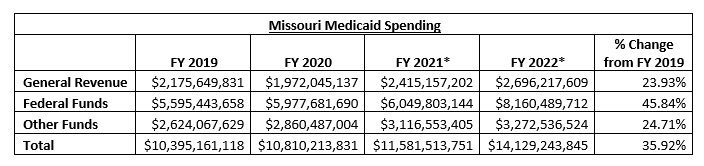
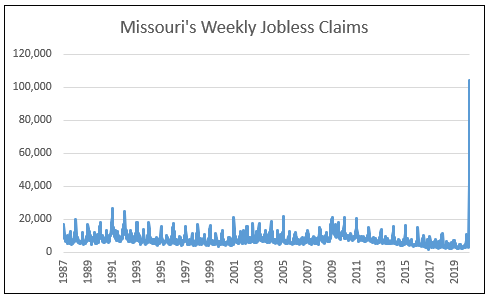
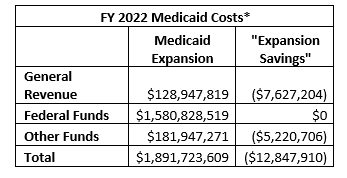
It’s quite clear that we’re facing a series of fights over who gets the dwindling pot of public money in Missouri over the next couple of years. Tens of thousands of Missourians have lost their jobs and will be looking for more government support. And fewer people working means less state income tax revenue. At the same time, we recently voted to expand Medicaid.

So far, public education has been held basically harmless. Regardless of how or where they’re delivering education, school districts can use attendance numbers from either last year or the year before to calculate their state aid. But that won’t matter if there is less money to distribute. There aren’t many places to cut state spending other than public education. Teachers probably won’t get raises and class sizes will increase. There is likely to be an outcry.

One area where there could be a little give is reconsidering the concept of local control. Missouri has 520 public school districts. The average Missouri school district has just over 400 students. That’s a school, not a district. We have 64 districts that had 50 or fewer students in 2018–19. I know that communities feel strongly about their Eagles or their Tigers, but it’s really expensive to have so many separate bureaucracies.

According to the fiscal survey administered by the U.S. Department of Education every year, Missouri had over $360 million dollars in general administration spending in 2016–17 (latest year available). This includes expenditures for board of education and executive administration services and other school district administrative functions. At roughly $400 per student, Missouri is ranked 12th from the top when it comes to general administrative spending.

About half of Missouri’s general administrative spending was for salaries and the other half for benefits. Indeed, the Missouri Department of Elementary and Secondary Education (DESE) reported that in 2018–19, there were 281 district superintendents with salaries (before benefits) over $100,000 and 38 that were over $200,000.

This year, many Missouri students are learning from home in microschools or pandemic pods. Parents are picking up the cost of supplies and even paying tutors to manage online schooling. I think it’s time to start asking if we need to continue to spend over one-third of a billion dollars on bureaucracy, or if it’s time to rethink how we fund public education?

How Many Chances Does TIF Get?

There are so many problems with the City of St. Louis’s tax-increment financing (TIF) program that it would make your head spin trying to list them all. TIF is an economic development tool meant to spur investment in neglected areas by providing some monetary incentives to developers. However, St. Louis seems to be handing out TIF projects and throwing away tax dollars without a second thought. A recent audit of the city’s use of TIF found serious problems. Some of the highlights:

  • The city’s TIF policy “does not clearly define the evaluation process or criteria to be used in project selection.” Without clear criteria, city officials have subjective power to pick which companies or developers receive hundreds of millions in tax incentives. This creates horrible incentives for companies and gives too much power to lawmakers.
  • The city’s policy “does not include effective project cost limits or overall program cost controls.” The city’s TIF program has grown significantly over the years. Limits and cost controls would cap TIF usage, which would help assure that the approved projects have been carefully vetted and that only the best projects are selected.
  • The audit also discovered that “projects were approved with flawed cost-benefit analyses, including overestimated revenue projections.” A cost–benefit analysis is supposed to be completed in the application process and helps to determine if TIF should be awarded. The audit found that of the thirteen projects analyzed, eight had cost–benefit analyses that contained serious flaws or were missing the cost–benefit analysis altogether.

In response to the audit, a city spokesman said that most suggested reforms are not required by state law. Just because something isn’t required by the state doesn’t mean it shouldn’t be done in order to instill fair practices and proper use of taxpayer funds. The problems with the TIF program have been talked about for years, and research suggests that incentive packages like these don’t work. How many chances do the city and this program get? How many times do these problems need to be pointed out before we start to see some real change?

Support Us

The work of the Show-Me Institute would not be possible without the generous support of people who are inspired by the vision of liberty and free enterprise. We hope you will join our efforts and become a Show-Me Institute sponsor.

Donate
Man on Horse Charging