
Ever wonder how many different taxes you pay in Missouri? Or how much tax revenue your city collects? Check out the Show-Me Institute’s new booklet—The 2020 Missouri Tax Landscape:
Taxable Sales Down in Many St. Louis Areas

Most of us know that when you shop, the price on the tag is not the price you pay at the register. Sometimes these prices aren’t even close (especially in Missouri) thanks to sales taxes. With a state sales tax, local sales taxes, and special taxing districts, Missouri governments collect a lot from taxable sales. However, sales taxes are a volatile form of revenue. It can be risky for governments to rely too much on sales tax revenues because they can drop drastically during economic downturns. This article from NextSTL helps illustrate this problem.
The article compares 2019 and 2020 taxable sales throughout the St. Louis area. Most of the St. Louis area saw a decline in taxable sales when comparing the second quarters of 2019 and 2020. St. Louis County taxable sales were down by just over 10 percent, while St. Louis City taxable sales were down by over 25 percent. The image below from the NextSTL article shows the change in taxable sales by zip code. Notably, taxable sales were down 89 percent in the Downtown zip code, 76 percent in the Airport zip code, and 75 percent in the Downtown West and Midtown zip code.
Taxable Sales/Use % Change Apr-Jun 2020 v 2019
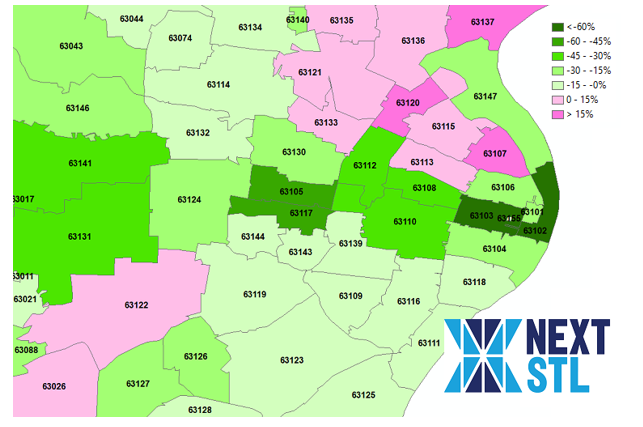
This makes sense—a lot of these zip codes rely on visitors, bar and restaurant patrons, and office workers spending their money away from home. All these things became rarer during the economic shutdown.
So what is one takeaway from the pandemic? Our governments need to take a hard look at how they are generating revenues. If revenues are unpredictable, promised public services can be compromised.
The City of Lake Ozark Should Consider a Local Fuel Tax

The City of Lake Ozark is looking for more funding for road improvements. A local fuel tax could be the answer.
The city claims it needs $3 million to repair an important local road but lacks the funding to do so. The city’s leaders are considering a transportation development district (TDD) to raise money for the road through an extra sales tax, which would effectively subsidize road maintenance via shopping. My colleague David Stokes has already written about why a TDD is a poor remedy for this problem.
Fortunately, there is a better solution—local fuel taxes. Fuel taxes can be an economically sound and fair way to raise money for roads. They ensure that those who benefit from the roads also pay for them.
As the National Surface Transportation Infrastructure Financing Commission has noted, funding roads through methods not related to their use (such as sales taxes) promotes inefficient vehicle and travel choices. This, in turn, leads to faster road deterioration, wasted fuel, traffic congestion, and air pollution. If the sales tax (via the TDD) is a ploy to get tourists to help foot the bill for road maintenance, it should be noted that the same tourists would also pay the fuel tax. However, fuel taxes connect the cost of driving and the cost of using the roads.
Local fuel taxes allow localities to raise money for roads within their jurisdictions. When enacted, an additional fee is added to the price at the pump in a given jurisdiction. And since the Missouri Constitution requires that money raised from local fuel taxes be spent only on road construction and maintenance, it reduces the risk of this revenue being spent on other, potentially wasteful projects.
One potential challenge is that local fuel taxes can be tough to enact. The Missouri Constitution requires that local fuel taxes be passed with a two-thirds majority among voters. If it chooses to pursue it, Lake Ozark would be one of the first localities in Missouri to enact a local fuel tax. Foristell tried to enact one several years ago, but the measure fell just short with 65 percent voter approval. However, it was able to pass a 1 cent local fuel tax the following year.
Ultimately, before sales or other tax increases, local fuel taxes are an option worth considering as a fair solution to the City of Lake Ozark’s funding predicament.
SMI Podcast: Trust and the American Economy – Dr. David Rose
In this episode, Susan Pendegrass is joined by Michael Podgursky and David Rose. Michael Podgursky is a professor of economics at the University of Missouri Columbia, a senior advisor on urban education and economic development at Saint Louis University and sits on the board of directors of the Show-Me Institute. Dave Rose is a Professor of Economics at the University of Missouri-St. Louis. They discuss David’s new book, Why Culture Matters Most.
Listen Here:
Lake Ozark Area Going in the Wrong Direction with Transportation Funding
It is disappointing to read that Lake Ozark leaders want to address legitimate road issues along the heavily used Bagnell Dam and Valley roads with a new transportation development district (TDD). There are many better ways to fund roads in Missouri, including tolling, gas taxes, and property taxes. Another sales tax-based special taxing district is not what the Lake of the Ozarks needs.
A recent state audit of TDDs highlights the problems with these districts. Five of the twelve TDDs mentioned in the report collected incorrect tax amounts. I’ll let you guess as to whether they collected more or less than authorized. (Hint—it was more.) Statewide, 92 percent of TDDs have been formed by developers and were not subject to any votes or public involvement. Not surprisingly, when you allow private developers to raise tax dollars for private purposes (like improved parking lots for their own developments) they are going to act like it is private money, not tax money, and often spend it improperly. Audits on these types of special taxing districts by state auditors of both political parties have consistently found that they frequently violate the Sunshine Law, do not competitively bid out contracts, make errors in tax collections, and more. They are designed in the first place to act like fiefdoms, with little oversight of the tax dollars being collected and spent for private purposes by the developers that almost always dominate the board. The problems with these districts are, in fact, so consistent that they must be considered a feature, not a bug.
This proposed TDD will require voter approval in the April 2021 elections. Seeking voter approval here is, obviously, a good choice. However, only voters who live within the TDD itself can vote on the proposal, not all Lake Ozark voters. I would expect the district to be gerrymandered until it looks like the lake itself in order to limit voter participation and help guarantee passage of the TDD. That is the prior experience in Missouri.
In a news story on the new TDD, supporters cite the “high quality of roads within the Horseshoe Bend Special Taxing District” as an example of why the TDD would be beneficial. The high quality of roads in that district may well be true, but Horseshoe Bend is not a TDD—it is a traditional, property tax-based special road district. The distinctions are important. Special road districts like Horseshoe Bend are subject to voter input, property tax rollback mandates (when assessed valuation increases), and much more comprehensive budgeting and financial reporting requirements. If Lake Ozark residents want better roads along with oversight, transparency, checks, and balances, the creation of a taxing district like Horseshoe Bend is a legitimate option. Other good options include passing a local gas tax to pay for the road improvements or simply raising city or county property taxes to fund the road improvements.
Honesty demands that I admit the Lake Ozark Community Toll Bridge is a TDD and has been successful for the community. In this case, the tolls collected pay for the bonds that built the bridge, and most importantly, the act of driving is connected to the cost of driving. Sales tax TDDs, such as this proposal, do not have that connection.
If people want a new taxing district with questionable dealings, little oversight, and limited voter involvement, then a TDD is the way to go. While Marty Byrde might approve of that, I trust the rest of the residents and taxpayers of the Lake Ozark region do not.
New Poll Shows Missouri’s Educational System in Crisis

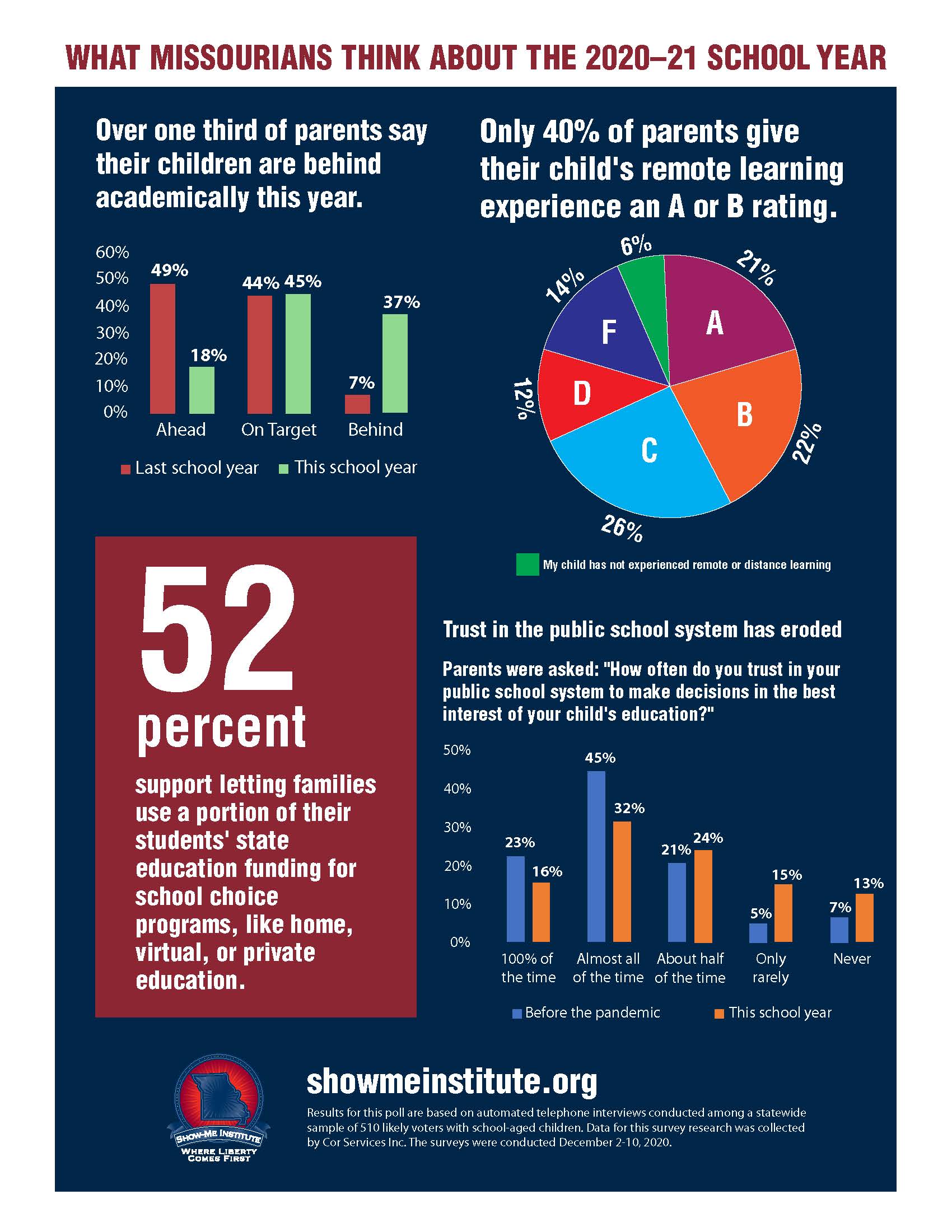
Download the infographic here
Additional Findings
- Missouri students are being left behind academically. A poll released today by the Show-Me Institute reveals that nearly 40 percent of Missouri parents believe their children are being left behind academically this year, compared to less than 7 percent last year.
- Missouri’s limited educational freedom places a high burden on parents. Nearly half (46 percent) of Missouri parents report spending over $250 on school supplies for the 2020-21 school year. A similar number of parents (48 percent) report spending over 10 hours per week helping their children with school instruction this academic year.
- Parents would like other options for their children’s education. Almost half of all Missouri families (47 percent) would change their child’s educational environment for the remainder of the school year if they had the chance.
The poll was conducted by Cor Services Inc. from December 2 to December 10. Researchers interviewed 510 likely voters with school-aged children. Full results are available here.
New Gas Tax Bills Highlight Missouri’s Transportation Needs
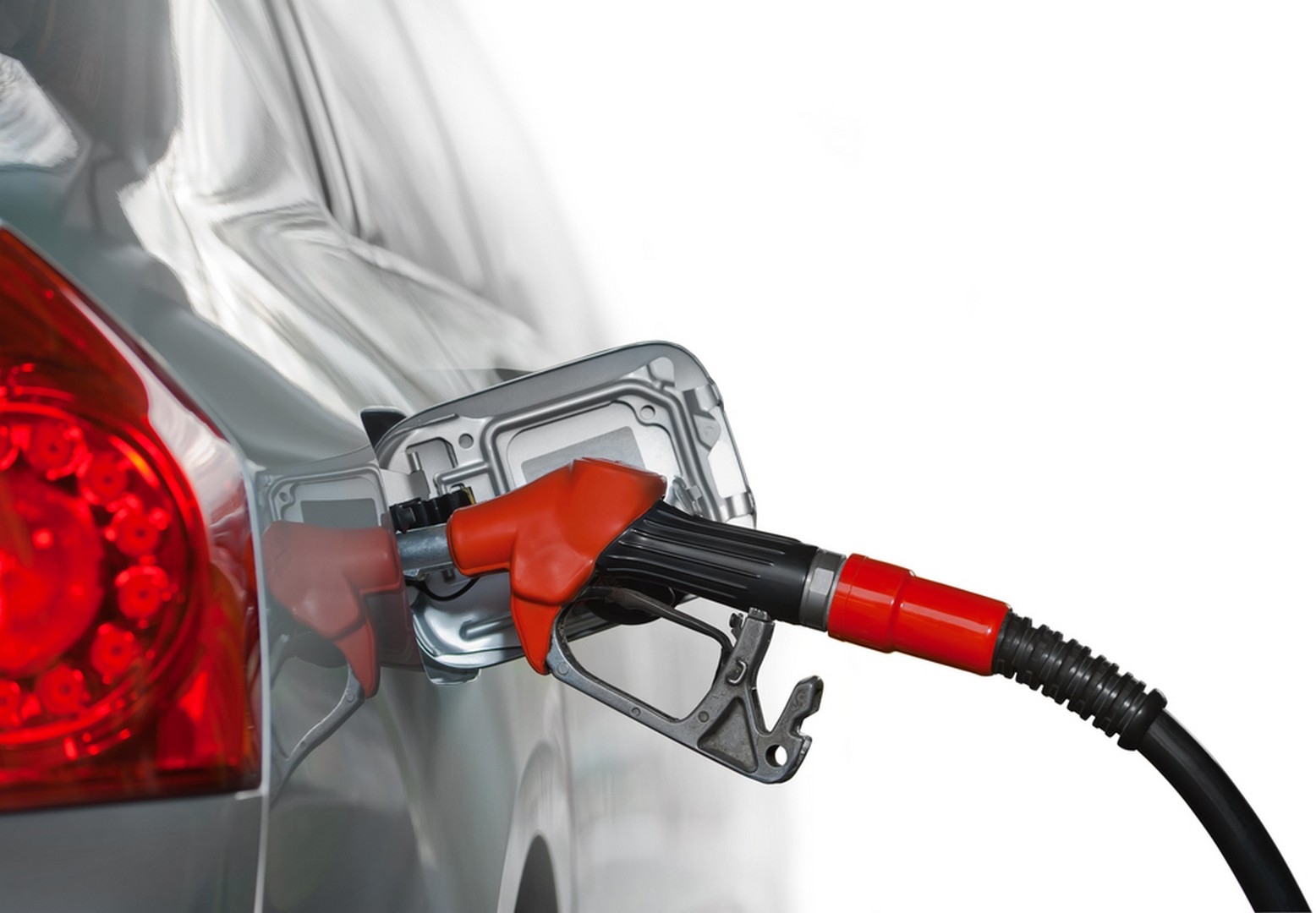
Missouri’s roads are getting some attention from the legislature. Two nearly identical bills that would increase Missouri’s fuel tax by 10 cents per gallon over five years (but through different processes) have been filed in the Missouri Senate. This increase would be carried out in 2 cent increments each year.
Both bills would place the question of raising the gas tax before Missouri voters. One would require a statewide vote to change Missouri’s current law regarding fuel tax rates, and the other would require a statewide vote to enshrine the new fuel tax rates in Missouri’s constitution. Missouri’s fuel tax has remained at 17 cents per gallon since 1996, and a 10-cent increase today would roughly adjust it for inflation since then. However, the full 10-cent increase under these bills would not be in place until 2026, and we can expect further inflation during the extra five years. Still, if our gas tax is five years behind inflation in 2026, that would be an improvement over the current 25-year gap.
The extra funds would provide a boost for Missouri’s roads. The Missouri Department of Transportation estimates that roughly $745 million in high-priority road and bridge repair and maintenance go unfunded each year. The most recent proposal in 2018 to increase fuel taxes by 10 cents per gallon was estimated on the ballot to raise an additional $400 million each year for road and bridge maintenance. The current proposals would likely reach this mark after the full 10-cent per gallon increase is reached after five years.
While voters have rejected fuel tax and road-dedicated sales tax increases in the past decade, research suggests that voters may now be amenable to increasing fuel taxes. A recent report from the Missouri Chamber of Commerce found that 85 percent of Missourians believe more money should be directed to road maintenance.
Specifically, drivers were asked about their support for a 10-cent fuel tax increase to repair Missouri’s roads. The report found that 45 percent of drivers support such a fuel tax increase, but when respondents were informed that it would cost an average driver $5 extra per month, 51 percent supported raising the gas tax 10 cents and adjusting its 1996 levels to current costs.
Ultimately, both fuel tax bills would have to navigate the Missouri Legislature before reaching voters, but the recent support may be the extra boost they need.
A Crisis of Trust

A version of this commentary was published in the Jefferson City News-Tribune.
What a difference a year makes. A year ago, parents across the state of Missouri were likely not even aware that the last week of January is National School Choice Week. In Missouri, school choice—at least from what I can tell from following the state legislature—is exclusively a policy for poor kids in failing urban districts. Suburban and rural Missourians don’t need school choice because their schools are “good.” Rural districts in particular are often described as “loving” their local schools regardless of how they perform. They’re the center, the heartbeat, of the community. What they provide was good enough for my parents and my grandparents, and it is fine for my kids, so the story goes.
Unfortunately, that story fell apart in 2020. Thousands of Missouri students essentially sat out the last couple of months of the last school year, especially in rural districts with technological challenges. This year, as positive COVID tests and the need to quarantine wreaked havoc on school schedules, the number of Missouri students who only had the option of fully remote learning went from around 90,000 in September to 248,000 in December. Blended learning, in which students attend school for a few days a week, and which, as a working parent, sounds like a worst-case scenario to me, peaked at around 300,000 students last December. For reference, Missouri has about 900,000 public school students.
The point is that we are halfway through a school year in which students and families from all backgrounds and all types of communities across Missouri have learned the hard way what it feels like to have only one type of education available, whether it works for them or not and regardless of how often that one type changes. And good will is beginning to slide.
A survey of Missouri parents taken in early December found that over one-quarter of parents would give their child’s remote learning experience this year a grade of “D” or “F.” Parents are worried. Last school year, about half of Missouri parents felt their children were ahead academically and less than 7 percent felt they were behind. Just ten months later, only 18 percent of Missouri parents believe their children are ahead and a troubling 37 percent believe them to be behind.
This concern reflects an erosion of trust in the public school system. Just 47 percent of Missouri parents trust the public school system to make decisions that are in the best interest of their children’s education all the time or almost all the time. Last year, that number was almost 70 percent. Sadly, the percentage of parents who never or only rarely trust the public education system has gone up by 26 points in just one year.
The antiquated system of assigning every student to one, and only one, type of education based on their address has to go. If Missouri wants to rejoin the ranks of states that attract families and businesses, it needs to create a system of education that reflects current and future conditions, not the past. Parents should be able to use public funds to enroll their children in a charter school, a private school, a micro-school, or a virtual school. Parents should be able to access public funds to get the tutoring or educational therapies their children need. Regaining the trust of parents must be earned. It should start with trusting parents first.
Our neighbors get it. Iowa Governor Kim Reynolds has committed to expanding K-12 education options for all Iowa students, including, but not limited to, open enrollment, education savings accounts, and expansion of charter schools. Oklahoma Governor Kevin Stitt has expanded scholarship programs for students with disabilities to include religious schools and used flexible stimulus funds to help parents in need to continue to pay for private school tuition. In addition to having more than 40 rural and suburban charter schools, Arkansas allows students the option to transfer out of failing schools. And Arkansas, it should be noted, is brave enough to call them “F” schools.
For far too long, the Missouri legislature has listened to superintendents and school boards that want to ban any form of school choice happening in their backyard. but parents were put in charge of their children’s education this year. They’ve had some time to consider it. They have concerns. And maybe now the legislature should listen to them.
Will there be an Online Sales Tax in Missouri?
David Stokes joined Gary Nolan on Thursday, January 14 to discuss the possibility of a new online sales tax in Missouri.

