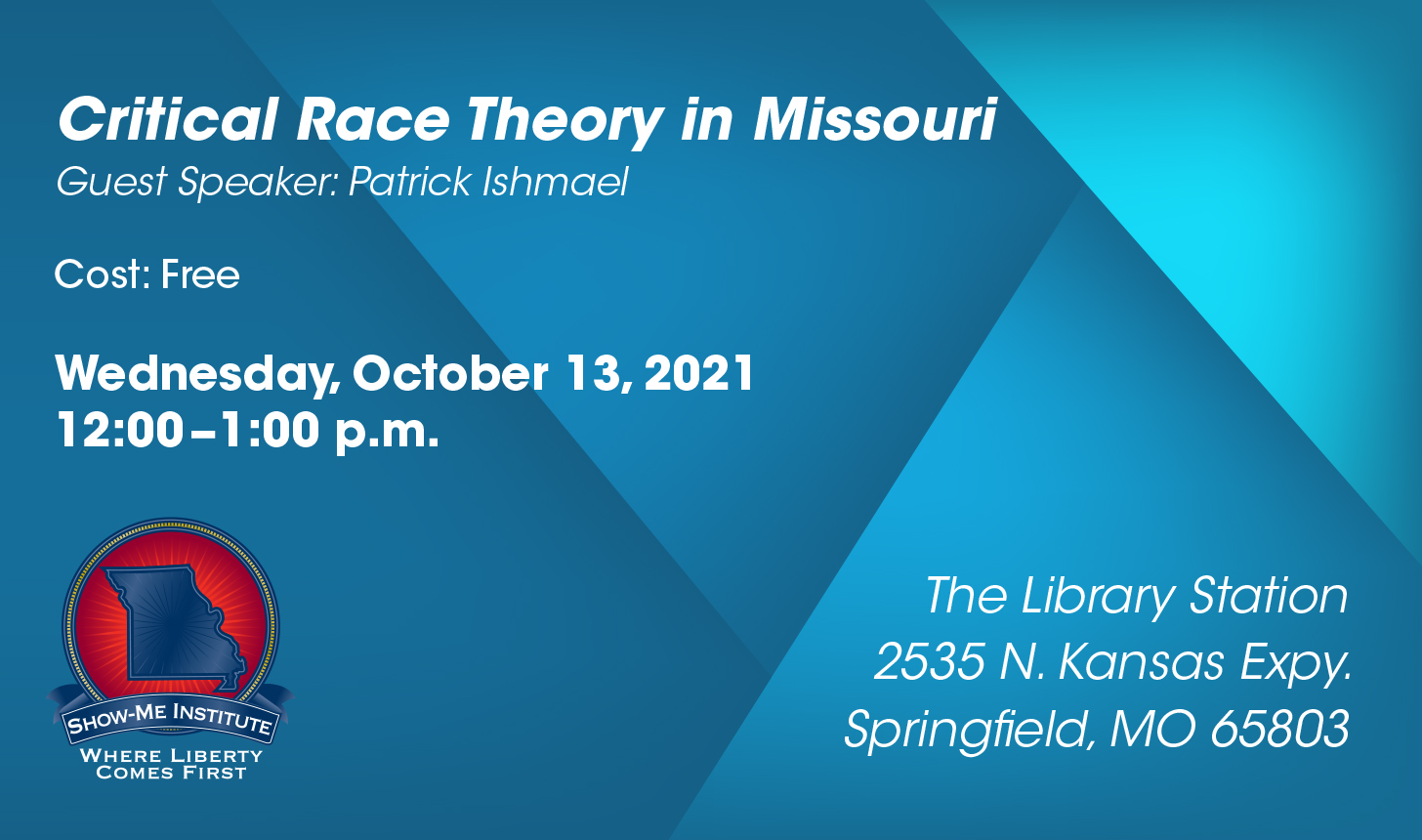
Critical Race Theory in Missouri (Springfield)

Patrick Ishmael, the Show-Me Institute’s director of government accountability, sent Sunshine Law requests to Missouri schools to find out which schools are teaching Critical Race Theory. Parents, students, and taxpayers deserve to know what their schools are teaching. In October, come hear Patrick present the findings of the Show-Me Curricula Project and enjoy some light refreshments on us. Please RSVP to save your spot!

Register

Sponsored by Show-Me Institute and Show-Me Opportunity.

Missouri’s Gas Tax Hike is Coming

Recently, the final obstacle for SB 262 going into effect was cleared, as an effort to put the gas tax on the ballot failed. This paves the way for Missouri to raise its gas tax for the first time in more than two decades. On October 1, Missourians will begin paying 2.5 cents more per gallon at the pump. Then for each of the next four years the tax will increase by another 2.5 cents, eventually reaching an ultimate 12.5 cents more per gallon compared to today.

Last month, I wrote about the many complicated questions surrounding the gas tax bill. The primary question is whether the bill runs afoul of the state’s Hancock Amendment, which is a constitutional amendment that requires tax increases above a certain threshold to be subject to a public vote. Several legislators expressed their concerns with the bill and urged the Governor to veto the legislation. In the end, Governor Parson signed the gas tax into law, indicating he’s not too concerned about the potential constitutionality issues.

Perhaps that’s why the bill’s fiscal note was changed before it was signed into law. Originally, the fiscal note stated, “the net increase in state revenues by this proposal exceeds the limit to revenue growth set forth by Article X, Section 18(e)” (meaning the bill’s tax hike is expected to bring in more revenue than the Hancock Amendment allows). But the updated fiscal note added an important caveat:

However, the calculation under Article X, Section 18(e) is based on the fully implemented impacts of all legislation passed during a session. Therefore, it is unknown at this time whether the cumulative impact of all legislation passed during the 2021 session will be greater than the limit allowed.

What this means is that Missouri will be implementing a gas tax hike on October 1 without knowing whether the law violates the state’s constitution. And if it’s later determined the tax hike doesn’t comply with the Hancock Amendment, the issue will be sent to voters for approval before collections can continue.

It’s an unfortunate situation that state taxpayers will soon be facing, and it’s made worse by the fact that it all could have been avoided if the legislature had simply sent the gas tax hike question to voters as it’s done in the past. My colleague Jakob Puckett has written repeatedly about the inadequacy of Missouri’s current gas tax to maintain our state’s deteriorating roads. But is raising taxes on Missourians without their input, and without knowing whether the way it’s being done is constitutional, the right answer? I, for one, don’t think so.

Podcast: The Future of The Dome, Loop Trolley’s Comeback and Hot or Not in 2022

David Stokes, Corianna Baier and Jakob Puckett join Zach Lawhorn to discuss the possible expansion of America’s Convention Center Complex, the future of The Dome at America’s Center, another attempt at a comeback by the Loop Trolley and which policy topics will be hot in 2022.

Listen on Apple Podcasts 

Listen on Sticher 

Listen on SoundCloud

Electric Vehicle Policy Changes Coming Soon

With Missouri’s gas tax set to rise in October, it may be easy to overlook a mix of policy and program changes that will affect electric vehicle (EV) drivers.

The same bill that raised the gas tax will also raise the annual fuel decal fee that EV owners pay by 20 percent each year for five years. This means that the EV fee will rise from $75 to $150. Lawmakers are increasing this charge because EVs cause wear and tear on the state’s roads (just as gas-powered vehicles do), but EV drivers don’t pay into the state’s road-maintenance fund through gasoline taxes. Show-Me Institute researchers have estimated that the average driver of a gas-powered car in Missouri pays $250 per year in fuel taxes. A $150 fee would still have Missouri’s EV drivers paying only 60 percent of what other drivers (on average) pay. Nonetheless, it would be one the highest fees for EV drivers in the country.

The bill also establishes a new Electric Vehicle Task Force to study ways to ensure EV drivers pay fairly for road maintenance, such as through a per-kilowatt hour charge on electricity used to charge their EV. The Task Force will also attempt to ensure that non-EV drivers do not end up subsidizing EV drivers, as well as study what role actors typically not part of the transportation sector, like electric utilities and the Public Service Commission, play in the process.

The bill slates several government officials and industry representatives to be on the Task Force, and also stipulates that:

The task force may hold public meetings at which it may invite testimony from experts, or it may solicit information from any party it deems may have information relevant to its duties . . . .

I hope the Task force solicits input from ordinary citizens in addition to experts so that their voices are heard as well. The Task Force should also consider what other existing policies might be affecting drivers of both gas-powered vehicles and EVs (specifically, the federal ban on electric vehicle charging stations, gas stations, and nearly all other commercial activity at interstate rest stops).

Getting EV policy right is important. EV drivers should contribute their fair share for road maintenance just like drivers of gasoline-powered vehicles—with neither subsidizing the other. The transportation landscape in Missouri is changing, with more and more EVs hitting the road. Policymakers should remember that government’s role isn’t to promote or hinder the adoption of EVs, but rather to ensure a level playing field.

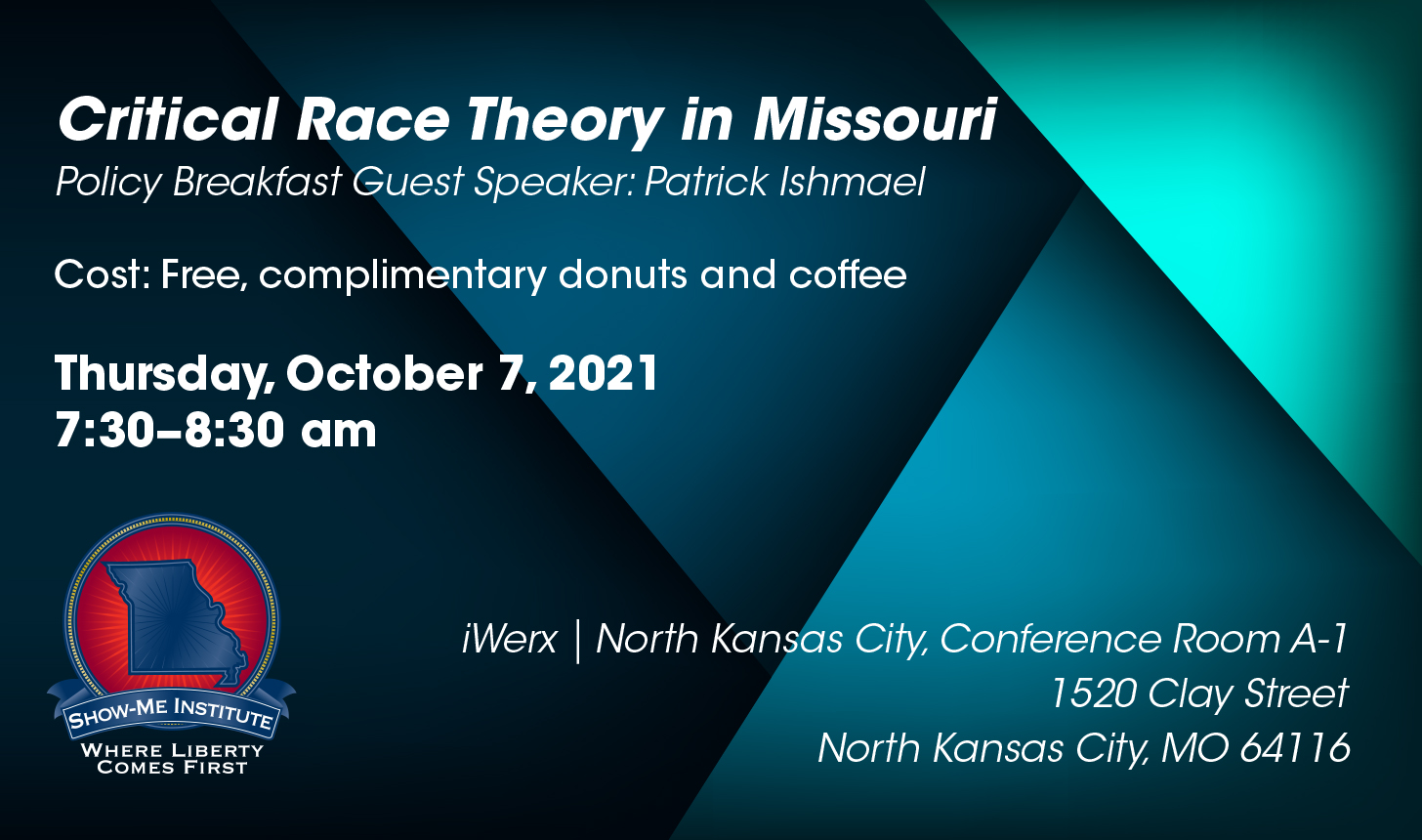
In-Person Event: Critical Race Theory in Missouri (Kansas City)

Patrick Ishmael, the Show Me Institute’s director of government accountability, sent Sunshine Law requests to Missouri schools to find out which schools are teaching Critical Race Theory. Parents, students, and taxpayers deserve to know what their schools are teaching. In October, come hear Patrick present the findings of the Show-Me Curricula Project and get a donut and coffee on us. Please RSVP to save your spot!

Register

This event is brought to you by Show-Me Institute and Show-Me Opportunity

Webster Groves Has Some Decisions to Make

Webster Groves is considering the region’s latest giant, taxpayer-subsidized, “savior” type development. By that I mean the type of mixed-use megaplex that will somehow instantly “save” the city.

The fact that the developers have requested eminent domain should disqualify it from the start. From the article about the proposal (emphasis added):

The developers have asked the city for the power to use eminent domain to force property owners to sell, but said they are not considering it now.

So they want the power of eminent domain, but as of now they say they don’t plan to use it. Until they deal with a property owner who does not feel like selling, of course. Just the threat of eminent domain impacts the entire process negatively.

They also want tax subsidies:

They need approval for $35 million in tax incentives, plus an extra sales tax.

So, a big TIF, plus a CID or TDD (to be determined), so that average people throughout the region can subsidize this development.

I don’t know if there is a real market for new apartments, condos, shops, etc. in this part of Webster Groves. There may well be. But if the project has to have huge tax subsidies and the threat of eminent domain, then I would doubt it.

The TIF commission should deny the TIF and the Webster Groves City Council should refuse the eminent domain and oppose any CID, TDD, etc. Then the developer can talk with the property owners and move forward or not.

The Devil Is Certainly in the Details

The American Rescue Plan (ARP) contains the latest federal stimulus package for public education, of which Missouri is set to receive $1.9 billion. The plan doesn’t dictate how the funds must be spent, in contrast to the education stimulus packages of the Great Recession. It does contain one pesky detail, though. Before funds can be spent, the state education agency, known as the Department of Elementary and Secondary Education (DESE) in Missouri, must engage in “meaningful consultation.” with stakeholders.

As a parent of three, I consider myself to be a key stakeholder in their education. And the guidance from the U.S. Department of Education lists students and families first and second on the list of those to include in the meaningful consultation. Did DESE consult any parents? It’s hard to say, but there is no direct indication that they did. In its application for ARP funds, DESE claims to have involved:

  • The Commissioner’s Advisory Committee
  • The Education Roundtable
  • The Commissioner’s Teacher Advisory Committee
  • “Leaders of education organizations.”

In addition, DESE claims it surveyed all superintendents and over “100 additional stakeholders.”

If by “stakeholders” the U.S. Department of Education meant those inside the education establishment, then DESE nailed it. If, on the other hand, it meant the actual stakeholders—namely families—we may have missed the mark. Not surprisingly, considering who was surveyed, DESE’s application states, “. . . survey respondents indicated support for teachers, particularly in the area of improving teacher pay.”

At least one state is taking this guidance seriously. Governor Ige of Hawaii vetoed a proposal to use stimulus money to give teachers bonuses of $2,000 precisely because the process did not include the consultation of stakeholders. Will Governor Parson do the same if DESE doesn’t reach beyond the education establishment in its decision making?

Dr. Marguerite Roza of the Edunomics Lab at Georgetown University suggests that this consultation clause presents a great opportunity for districts to do “participatory budgeting.” That doesn’t mean making budget meetings open to the public or posting the budget online for review. It simply means actually involving the community in budget decision making. As Roza states: “One question is whether it was ever possible to use a federal rule to change the process by which thousands of districts decide how to spend billions in school funds. Old habits die hard. And, let’s be honest, there are a lot of vested interests when it comes to school spending.”

It’s not about the ABC’s—It’s about the K

In education, as with the economy, recovery from the pandemic is happening at different paces for different groups. In fact, the education recovery, regardless of how steep the upward slope is overall, is already shaped like a “K.”

The downward leg of the K is made up of several types of students, including those who were not able to quickly transition to a virtual education of even modest quality. These students probably sat out the end of the 2019–20 school year and at least part of the following one. Incredibly, as of summer 2021, nearly one-quarter of Missouri students still did not have access to high-speed internet.

The bottom leg also has students—as much as 3.5 percent of enrollment in Missouri—who simply didn’t show up for the 2020–21 school year. We’re not sure where they are or how they’re doing. Finally, we have many students who have simply struggled for the last year and lost critical time in their education—from kindergartners needing to launch, to third graders needing to read fluently, to high-school students heading out into college or careers. These same students are likely among the most disadvantaged to begin with.

Of course, there are many examples of students who thrived last year and are in the top leg of the K. They may have attended private schools that knew tuition-paying parents were not going to settle for online learning for very long. They may have been public school students who found virtual learning to be a great fit. They may be in families that realized how great the homeschool experience could be as kids can work at their own pace with no limits.

It goes without saying that policymakers in Missouri—both the legislature and the Department of Elementary and Secondary Education (DESE)—need to focus like a laser on the bottom leg of the K. We need high-quality diagnostic assessments that will honestly inform students and parents about any academic growth lost to the pandemic. Then, we need to make public funds available to families so that they can find the academic resources their children need, from tutoring, to part-time learning hubs or pods, to private schools. We need to empower parents and fund everything they need.

Support Us

The work of the Show-Me Institute would not be possible without the generous support of people who are inspired by the vision of liberty and free enterprise. We hope you will join our efforts and become a Show-Me Institute sponsor.

Donate
Man on Horse Charging