In a previous post, I highlighted Missouri’s school districts and charter schools with the highest and lowest expenditures per student using data from MOSchoolRankings.org.
Interestingly, the bottom ten spenders had a higher average academic letter grade than those in the top ten. However, many of the top spenders in the state are tiny rural districts with fewer than 50 students. That raised an important question: Would this pattern hold when comparing districts of a similar type?
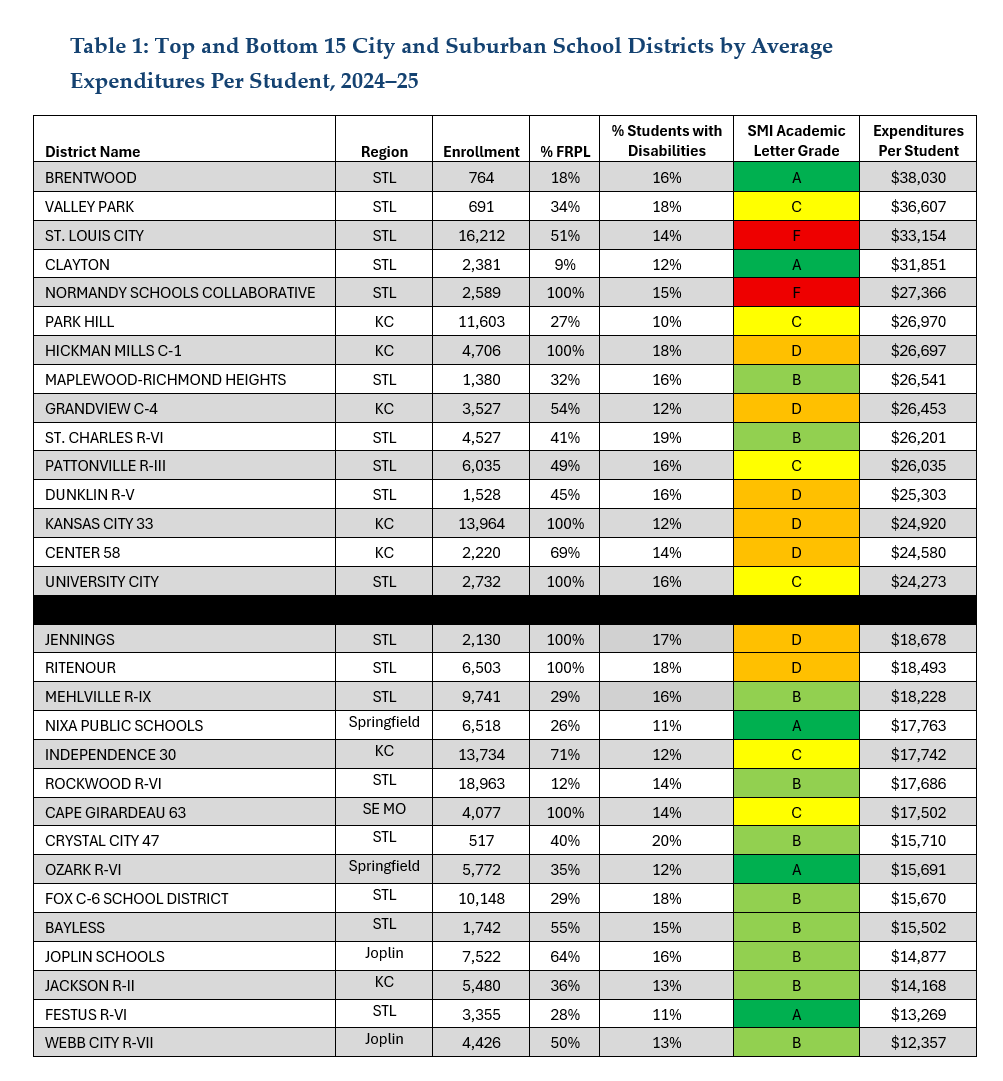
Table 1 begins to answer that question by focusing specifically on suburban and city districts—schools that are far more comparable in size and structure, but still vary widely in student demographics. It should be noted that Table 1 includes non-current spending items like interest and capital outlay (such as constructing a new gym, renovations, etc.).
For reference, in the 2023-24 school year, the average expenditure per student was around $19,500. Of that, about $15,900 were current expenditures and $3,600 were non-current expenditures.
Source: MOSchoolRankings.org
Interestingly, the five highest-performing school districts in the state are split between the highest and lowest total spenders. Table 1 suggests that it is overly simplistic to assume that more money per student automatically leads to better academic outcomes.
Consider Valley Park and Park Hill as examples. Both spend relatively high amounts per student (including non-current expenditures) and serve comparatively lower shares of low-income students, yet neither achieves top-tier academic results. Meanwhile, several lower-spending districts of similar demographics earn strong academic grades.
This does not mean funding is irrelevant, but rather that the process of producing strong academic outcomes is complex and money isn’t everything.
The University of Missouri (MU) recently hosted a lecture by Robert Henderson, who coined the term “luxury beliefs.” These are beliefs that signal status among the affluent while imposing little cost on them, but that burden the poor and marginalized. A common example is the idea of defunding the police: it’s easy to endorse from a safe, well-resourced neighborhood, where the consequences are less likely to be felt personally.
After Henderson’s visit I found myself thinking about school choice, and specifically the debate over charter schools in Columbia. Charter schools are public schools that operate independently of traditional school districts. They have more flexibility in how they educate students, but they’re also held accountable for results. Unlike traditional public schools, they can be closed if they fail to perform or attract students. The data on charter school outcomes in Missouri are unambiguous: Charter schools consistently outperform traditional public schools.
A recent state law change allows charter schools to open in Columbia, but there is vocal opposition locally. This is despite the fact that many district schools perform poorly. Moreover, the first approved charter is operated by one of the most successful Charter Management Organizations in the entire state, Frontier Schools. In the PRiME Center’s 3-Year Growth Report, Frontier has two schools in the top five statewide in terms of promoting academic growth.
Columbia Public Schools has opposed Frontier’s entry (luckily to no avail thus far). Several current and prospective school board members are also opposed, and community forums are full of what I suspect is an angry minority of citizens who don’t want Frontier to open a school in Columbia.
The opposition screams of luxury beliefs.
I wonder how many of the opposing voices send their kids to Battle High School, where of all the students who take Algebra-I, just 7 percent—this is not a typo, 7 percent!—score proficient or higher on the state’s Algebra-1 End of Course Exam. Or how many send their children to Derby Ridge Elementary School, where fewer than 5 percent of 5th graders—again, not a typo—score proficient or higher in mathematics.
How many of those in opposition send their children to any of Columbia’s low-performing schools?
I bet very few, if any.
For families with means, school choice already exists—they can buy homes in neighborhoods with higher-performing schools. Opposing charter schools costs them little. But for families without that option, the stakes are much higher.
What are those families supposed to do?
Why not allow a proven operator like Frontier to offer another path? If you were a family without means, wouldn’t you want that option?
If you’re fortunate enough to send your children to a school you like in Columbia Public Schools, I’m happy for you, genuinely. But don’t stomp on other people’s opportunities with your luxury beliefs.
Public education spending typically comes with a lot of questions. How much are we spending per student? Are some schools spending way more than others? What is that money being used for?
These are all relevant questions, and at the Show-Me Institute, we’ve created a resource to answer such questions: MOSchoolRankings.org
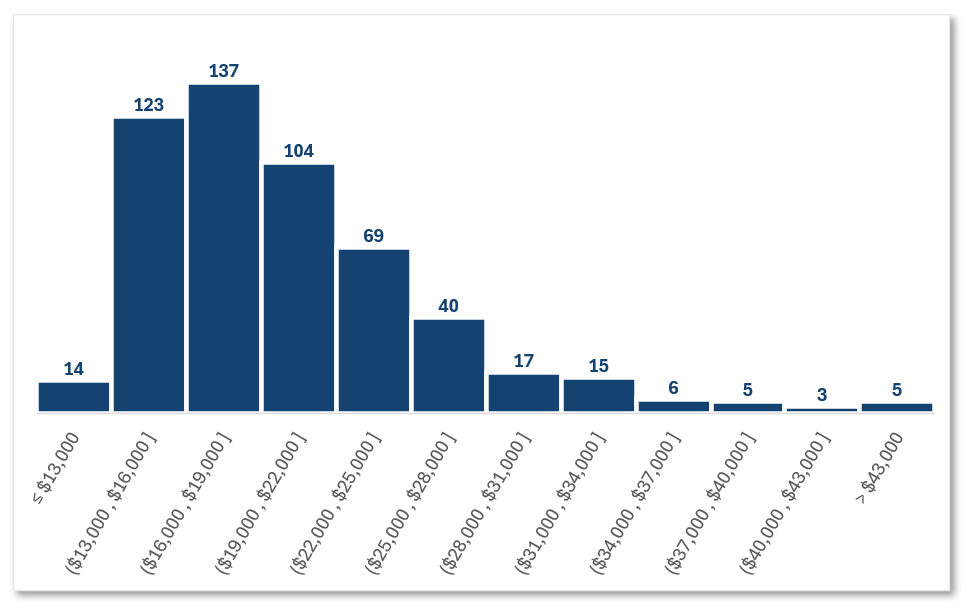
As an example of what these data can be used for, Figure 1 shows how Missouri school districts are distributed across different levels of spending per student. It should be noted that these statistics include non-current spending items like interest and capital outlay (such as constructing a new gym, renovations, etc.).
For reference, in the 2023–24 school year, the average expenditure per student was around $19,500. Of that, about $15,900 were current expenditures and $3,600 were non-current expenditures.
Figure 1: Number of School Districts and Charter Schools Grouped By Average Expenditures Per Student, 2024–25
Source: MOSchoolRankings.org
Most Missouri school districts and charter schools spent between $13,000 and $22,000 per student in the 2024–25 school year, but there are numerous outliers in the data, as shown below.
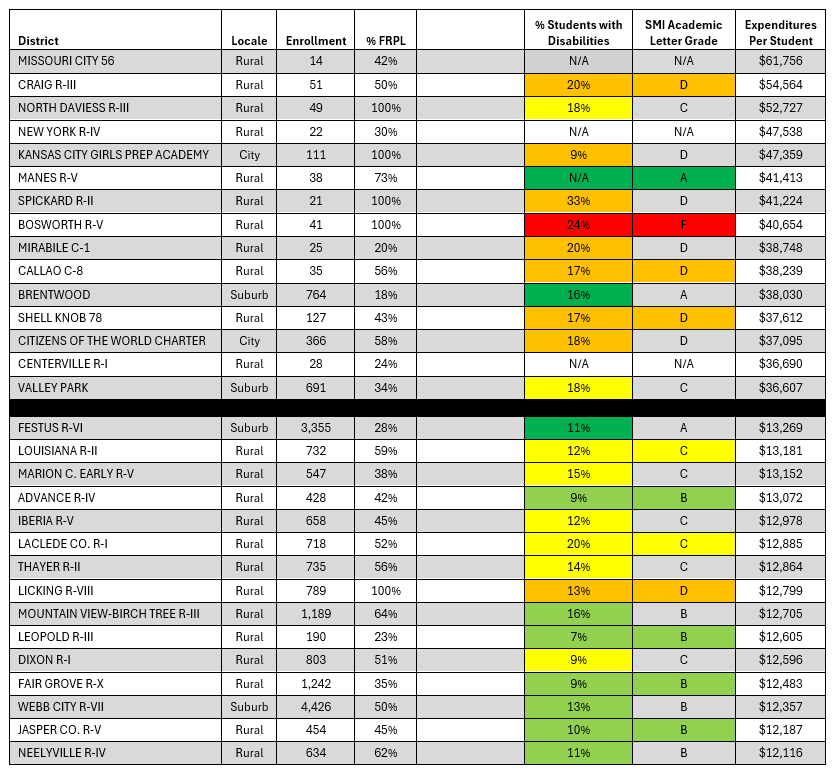
Table 1: Public School Districts and Charter Schools with the Highest and Lowest Average Expenditures Per Student, 2024–25
Source: MOSchoolRankings.org
In Table 1, many of the highest-spending school districts in Missouri are rural, including several extremely small districts, such as Missouri City 56, which enrolls just 14 students. By contrast, many of the lowest-spending districts are also rural, though they tend to be larger and vary more in size.
Missouri’s mean total expenditure per student (weighting each district equally and including non-current expenditures) is $20,406, while the median is $18,934. Even so, there is a surprisingly wide spending range across the state, from roughly $12,000 per student to more than $60,000 per student.
These kinds of statistics are important when evaluating potential changes to the funding formula. To take one small example, Spickard R-II saw enrollment decline from 54 students in 2005–06 to 21 students in 2024–25: a 61% decrease. For state funding, Missouri’s hold-harmless policy guarantees that Spickard R-II receives no less than the state funding it received in 2005–06, even though the district has far fewer students. This likely contributes to why Spickard spent $41,224 per student in 2024–25.
Clear, accessible data are important. And of course, spending is only one aspect of this. MOSchoolRankings.org allows users to go further by comparing districts on academic performance, student demographics, growth, and much more.
The newest demography newsletter from Saint Louis University delivers a jarring wake-up call that regional leaders can no longer afford to ignore. For years, the conversation around St. Louis has been one of stagnation, but the 2025 population estimates from the Census Bureau reveal we have shifted onto a much more dangerous track toward structural decline. While the national birth rate is falling, St. Louis has emerged as an epicenter of this trend, ranking first among the fifty largest metropolitan areas in the percentage decline of births since 2021 (9 percent). We are now in a state of demographic winter where deaths outnumber births, and unlike our neighbors, we do not have a steady stream of new residents moving in to offset the loss.
When we look at our peers in Indianapolis and Nashville, the contrast is stark. Indianapolis has seen a domestic migration gain of nearly 20,000 people since 2020, while Nashville has increased by 89,000. Meanwhile, St. Louis saw over 31,000 people leave for other parts of the country during that same period. St. Louis is heading into a period in which it will carry a much heavier demographic burden of older residents compared to these peer cities, which are successfully maintaining a younger and more sustainable age structure.
Both of these other regions have more childbirths annually than they did just five years ago. But this isn’t just by chance. Indianapolis has aggressively aligned its economic incentives with family needs, requiring companies that receive tax breaks to reinvest in childcare and neighborhood infrastructure. Indianapolis families can also choose between universally available private school vouchers, charter schools, or any traditional public school in the district. Nashville has used Tennessee’s lack of a state income tax to attract high-earning families and has focused on building the kind of walkable, tech-ready neighborhoods that remote-working parents prioritize. Both cities have created an environment where it is easier and more affordable to raise a family, which in turn fuels both natural growth and domestic migration numbers.
St. Louis is currently operating under the outdated assumption that we will always have 35,000 births a year to sustain our schools and workforce. The reality is that we have declined by over 7,000 births annually since 2011, and that number is still searching for a bottom. If we want to avoid a future of shrinking school districts and a hollowed-out economy, we have to stop treating these numbers as theoretical. We must move toward a strategy that makes St. Louis a destination for families again, rather than a place they leave behind.
Last year, the passage of Senate Bill (SB) 4 allowed natural gas plants to raise rates to pay for construction before plants are put into operation, a process known as construction works in progress (CWIP). Companies using CWIP under SB 4 would still be subject to cost caps (by estimated cost and completion date) and a refund mechanism (with interest) if the project is not finished. There was speculation about whether a provision in SB 4 would also allow its usage for nuclear projects.
A recent change to SB 838 would remove any ambiguity; the change explicitly prohibits nuclear energy projects from using CWIP.
But is preventing nuclear projects from being able to use CWIP really a good idea?
Some view CWIP as necessary for new nuclear projects to get a foothold in Missouri. Excluding nuclear from this flexible financing method could either drive up total costs (since loans would bear interest) or even eliminate potential projects altogether.
At the same time, the concerns surrounding CWIP are real and should not be dismissed. Charging ratepayers before a plant is operational raises difficult questions. Should utilities earn a return before delivering a service? Does this reduce incentives to control costs during construction? And what happens if a large, high-risk nuclear project is cancelled (which has happened in the United States before)?
These are not trivial concerns. However, a better solution for Missouri would be to improve the CWIP framework for all energy sources.
SB 4 already includes cost caps and refund provisions, but additional safeguards could further protect ratepayers while still allowing needed infrastructure to be built.
Virginia recently passed CWIP reform, and it instituted additional safeguards that Missouri could also adopt:
Excluding 20% of development costs from CWIP eligibility
Mandatory evaluation of federal funding opportunities from the Department of Energy
Establishing a cap on residential monthly bill increases ($1.40 per 1000 kWh)
Additionally, the Missouri Public Service Commission could evaluate compensating ratepayers appropriately for early contributions and their role in risk-sharing, such as treating CWIP financing more like a bond system.
These improvements could even better protect and reward ratepayers, as well as facilitate needed power plant construction without targeting a specific technology—an effective compromise.
Susan Pendergrass speaks with J.S. Onésimo “Ness” Sandoval, demographer and professor in the Department of Sociology and Anthropology at Saint Louis University, about what the data says about the future of the St. Louis region. They discuss record low birth rates and what they mean for school enrollment, why St. Louis is among the top regions in the country for deaths outnumbering births, how the region compares to Pittsburgh and Cleveland, and why suburbs like Chesterfield and St. Charles are aging faster than most people realize. They also discuss the role of housing supply, school choice, crime, and domestic migration in whether St. Louis can attract and retain young families, and more.
Susan Pendergrass (00:00): Well, certainly not the first time we’ve spoken, Dr. Sandoval. At St. Louis University, you are such a fascinating demographer of the region, and I’ve been following your work as new census data has been released. You’ve been writing about it and creating what I think are really cool mapping tools that folks can look at to see how the St. Louis region is impacted. Thanks for coming on to talk about that. But first I want to sort of expand our view, because pretty sure that I read within the last week that the number of babies born in the United States was at an all-time low. Is that right?
Ness Sandoval (00:35): Yeah, so every year the United States will probably be breaking records. The data coming out for 2025 is a record low, and the data coming out for 2026 is even lower. The first few months of 2026, the provisional data that’s out shows even fewer. And this is what we expected. We call this a demographic shock, because in 2026, whenever you create an atmosphere of uncertainty and fear, rational people do not have children until they understand that their job is safe, there’s not a recession coming, and we’re not at war. When you create this sense of fear, young people do the rational thing and don’t have children. We saw this in 2020 with COVID. We saw this in 2008 with the Great Recession. Anytime there is uncertainty, young people will postpone births. And that’s what we’re seeing. This started in November. We started to see the decline in births, and it’s continued from November, December, January, February. And so this is what we’re going to see.
Susan Pendergrass (01:51): So next year is going to be lower. And when you look at the state of Missouri, I’ve been saying this ad nauseum for years that our K-12 school enrollment is declining and will decline because of that sort of peak in 2008, just before the Great Recession. So our biggest kindergarten class was around 2012, and our kindergarten classes have by and large declined ever since. And so those kids are moving through the system. You can project that we will just have fewer and fewer kids enrolled in our K-12 system in the state of Missouri.
Ness Sandoval (02:06): No, we peaked in 2008.
Susan Pendergrass (02:11): By and large declined ever since 2012. And so those kids are moving through the system. So you can project that we will just have fewer and fewer kids enrolled in our K-12 system in the state of Missouri.
Ness Sandoval (02:24): Yeah, this is true, and we have a pretty good chart. We make these for every city. We’re replacing very large cohorts of children who were born. I have a son who was born in 2007, just before the recession. That cohort that graduated in St. Louis was 40,000 students. The baby birth cohort is now 27,000 students. So that’s just in that one year a 13,000 decline. And it’s going to decline every year for the next 15 to 18 years, because we don’t know what the bottom is yet. It has not reached the bottom.
Susan Pendergrass (03:01): Right. People say where are the kids going? I’m like, they’re not going anywhere. They weren’t born. The St. Louis region, like Clayton is declining, Ladue was, I mean, all of these school districts, I think almost everyone in the county has fewer kids today than they had 10 years ago.
Ness Sandoval (03:07): They weren’t born. Yes, and it’s not just St. Louis County. St. Charles County is experiencing this. There are some parts that are growing, in the Wentzville area, O’Fallon, but if you look at the old St. Charles areas, they’re experiencing decline. Families with children are declining in those areas. We had made an interactive map that I think shocked a lot of people, of seniors outnumbering youth. People could not comprehend this. Like, my gosh, this is not 2000 where youth were dominating these neighborhoods. I live out here in Chesterfield. The entire Route 64 corridor is senior citizens dominating the youth in Chesterfield. People are shocked. More seniors lived in Chesterfield than youth in 2010, and that’s only grown since. This is happening throughout West County.
Susan Pendergrass (04:14): Wow. And your maps actually go down to the zip code, right? You have very granular data.
Ness Sandoval (04:27): Across into Illinois, yes. The only way you can turn this around is young people from across the United States deciding that they want to make St. Louis their home, have a family there, create a business there. This is what I promote. We have to get younger. We really should have a preferential option for families with children. And that’s a hard message for a lot of people because they’re like, wait a minute, we grew from 1970 to 2020. And I’m like, but all of that growth was driven by babies born. Over 1.8 million babies were born. And I tell people, just do the math. 27,000 babies per year times 50. That’s the back of the envelope for what’s coming over the next 50 years. Unfortunately, that’s not what’s going to come. It’s going to be a lot lower than that. People are starting to get it. We’re not going to have 1.8 million babies born over the next 50 years.
Susan Pendergrass (05:33): Yeah, and I think about things like individual school systems building new elementary schools when there have got to be a lot of buildings that are empty. And also, won’t there be more competition for public resources between children and older people?
Ness Sandoval (05:49): Yeah. At my previous job at Northwestern, we did a project on this in one of the suburbs because we were studying seniors. There was a debate about how to spend public money. Was it for transit for seniors or transit for children? This was 2006, and this was the debate happening in Chicago. How do you provide paratransit for senior citizens when that number is increasing? We’re just having this discussion because St. Louis is leading. We’re in the top three of regions. Pittsburgh leads the country, Cleveland is second, and St. Louis is third, tied with Tampa. More people dying than babies born. We simply don’t have the number of babies born for the size of our population. And it’s because we’re a very old region. We’re the ninth oldest region in the country.
Susan Pendergrass (06:58): Yeah, I mean, we used to have 800,000 people in the city of St. Louis, right? And now we’re 280,000 or something.
Ness Sandoval (07:05): Yeah, and I was just looking at the numbers. It is very possible within two years that Kansas City will have more babies born in absolute numbers than the St. Louis metro region. That’s how few babies. I’m talking about the region. Indianapolis is about 700 babies behind St. Louis. Nashville is about 800 babies behind. All of these smaller regions are having lots of babies, and young people are moving there. Your future depends on the number of children born. And when you look at population projections, I kind of know what this looks like. When you fall below Kansas City in number of births, at some point Kansas City will be larger than St. Louis. We can project this out. We’re talking absolute births, not birth rates. We had lots of babies born 10 years ago. We were fine 10 years ago.
Susan Pendergrass (08:09): Yeah, wow.
Ness Sandoval (08:29): We can go back and talk about what happened since 2010.
Susan Pendergrass (08:35): Yeah, please. I’m curious what did happen. I know you call it the death spiral when there’s more deaths than births, but how did we get into this?
Ness Sandoval (08:41): So I moved here for the Great Recession. I moved in 2008 to start my job at SLU. And there was hope when I got here. There was some positive momentum happening. I think the region took it for granted that it didn’t have to do anything. We just have to be St. Louis. We don’t have to do anything. Unfortunately, Nashville came on the scene. Then you started to see regions change. Regions thinking we need to get young. And St. Louis absolutely did nothing. Since I’ve lived here, there’s been a lot of resistance to economic development in the region. Nashville, I think it was the popularity of being young, being pro-development. I went to Nashville to actually look at it, like why are young people there? And I went to Vanderbilt. And I saw this really interesting integration between the city and Vanderbilt University. That does not exist here in St. Louis. Making it a vibrant, cohesive, urban experience.
Susan Pendergrass (09:47): Yeah. Right. Now you step off campus at SLU and you’re in an area you don’t want to walk at night.
Ness Sandoval (10:00): Yeah, and even if it was WashU, right. And then you can talk about the Loop. It never recovered from COVID, traffic is down. I think the region has really struggled to attract young people to stay here and live here.
Susan Pendergrass (10:13): Well, we’ve been looking into the issue of crime in St. Louis quite a bit, and I know it’s down and everyone’s celebrating that fact, but I’m not sure when you survey people and ask how they feel walking alone at night, that it’s changed all that much. Even if the number of murders are down, I don’t know that people feel safer walking alone at night, and that’s got to have an impact on whether you want to stay in St. Louis after you have kids.
Ness Sandoval (10:47): Yeah. I think in the city you move out to the suburbs. The challenge is they work and you live for affordability. So many suburbs are against new development, even though they can develop. We see these debates in Chesterfield, that debate in Creve Coeur, several debates out in St. Charles. They don’t even talk about Jefferson County, because they’re celebrating voting down housing. My point is if you don’t want to build housing, Indianapolis is going to build it. Columbus is going to build it. Nashville is building it. We are no longer in the top 50 in new housing permits in the country. We’re 58th.
Susan Pendergrass (11:34): Why though? Is it because there’s not demand, or is supply being constrained?
Ness Sandoval (11:42): Supply is being constrained. Part of it is, when I speak to people, they say it’s going to hurt my home values. People want supply down. But you understand there’s a consequence to this. And home values are always good in St. Louis. But again, we always say there’s a city that we can look to that’s our future, and that’s Pittsburgh. If you really study Pittsburgh and look at it, you’re like, wow, there’s a lot of things we can learn as a city, and say this is not what we want to be. Pittsburgh leads the country in discounted rates on home sales. When people offer their price, most people do not get the price that they want. It’s a significant discount because the demand’s not there. We are about 20 years behind Pittsburgh.
Susan Pendergrass (12:25): Wow. I think a lot, in what I do, about the educational offerings in the region. Before we were recording we were talking about Texas. Texas, number one, doesn’t have an income tax, and also you can pick your child’s school from the get-go. They have hundreds, if not thousands of charter schools. And now they have a private school choice program that I think 250,000 families apply to. And Missouri has an extremely limited private school choice program, maybe 6,000 or 7,000 kids in the state, and not even the ability within St. Louis County to go outside of these tiny little districts. You can’t even go from Clayton to Brentwood. People really feel strongly about this and fight the idea of opening up the county and letting kids go within the county to any school district, and then the legislature fights it every year. And I’m like, we are just becoming less and less competitive.
Ness Sandoval (13:36): I don’t think people understand. I do a lot of work with schools now. We’re going to lose at a minimum 100,000 children under 15 by 2045. This loss is built into the system based on 27,000 births right now. The numbers are starting to show up in kindergarten. We have a smaller kindergarten class, a smaller first grade class coming in. And so a lot of schools are like, wait a minute, what’s going on? This is just starting. You have another 20 years, because we have these large cohorts that were still born after the Great Recession that are going to be replaced by smaller cohorts coming in. And there is no significant migration of children coming into the region.
Susan Pendergrass (14:28): So there are going to be difficult staffing decisions, and people don’t want to hear it. Like, we cannot continue to hire more teachers.
Ness Sandoval (14:32): You have to close schools. You have to close schools, have to merge schools. I’m doing some work in Parkway. People should not be surprised. Parkway is having meetings this month about what Parkway looks like going forward, and people are discussing consolidation. Rockwood is talking about a 15% decline in 10 years. Go out another 10 years, Rockwood will be talking about school consolidation. St. Charles will be talking about school consolidation in the old St. Charles area, the city of St. Charles. This is coming. Everybody focuses on the city and says the city needs to close schools. But you will see a discussion, I think, between Clayton and Brentwood.
Susan Pendergrass (15:06): For sure. Clayton had 2,500 kids. Now they’ve got closer to 2,000. I mean, that’s teachers, that’s buildings. And I know in Indianapolis, I’ve talked to a superintendent in that area. All parents can pick a public school. And he was like, I had some under-enrolled elementary schools and it was great for me because I put a language immersion program in one to bring parents in. I think the resistance to this idea is all about not wanting kids who aren’t paying property taxes, but I think it’s going to flip. Then you’ll be like, we’ve got to fill these seats. We’re paying the same teacher for 18 seats that we could pay for 22 kids. At some point they’re going to have to start laying off teachers. So I think there are some very difficult decisions ahead that you can see now, and there are things that could be done now, like at least not filling open positions.
Ness Sandoval (16:16): I think universities are seeing this, because many of them are relying on tuition and those dollars are not coming in. A smart university has to make cuts because it doesn’t get any better next year or the following year. There will be fewer students coming in. So universities that want to survive are making necessary cuts to survive.
Ness Sandoval (16:45): Again, we don’t know what the bottom of the birth decline looks like. We just happen to live in a state and a region that has seen a significant decline in children. I keep saying we’re modeling the future for people, either as a good or bad thing. They’re like, we want to be like St. Louis, or we don’t want to do what they did.
Ness Sandoval (17:13): I think a lot of people are starting to understand this. It’s like, we’re letting our children go, and we’re not doing a very good job of trying to keep them here. When you had 1.8 million births, you had enough to let children leave your region, leave the state. You don’t have that luxury anymore. Our models show the region should have anywhere between 1.3 million to a million births coming in over the next 50 years. We hope it’s not a million births, because that means you have an 800,000 decline in your population under 50. Or it’s 1.3 million births, which is only a 500,000 decline. But that’s coming.
Susan Pendergrass (17:43): How does immigration factor into it? Because I remember the last time we talked, you said that St. Louis is not very immigration friendly. And of course, the current national environment is not very immigration friendly.
Ness Sandoval (18:03): Missouri and St. Louis cannot rely on immigration to save it. It’s not a state that immigrants are going to come to in large numbers. They’re going to go to Florida. Miami leads the country. Even though domestic migration has people leaving, international migrants are going there as their top destination. They’re going to Philadelphia, they’re going to New York. We get immigrants who come here, but it’s a very small number, like 6,000 a year. We’re not even in the top tier as a top 25 metropolitan region. And Missouri is not either. So Missouri has to rely on domestic migration.
The data will show that probably for the decade, there will be more people dying than babies born in Missouri. Missouri will start to have from a natural perspective more people dying than babies born. And 91 counties across the whole state will have more people dying than babies born. So Missouri will become dependent for growth on domestic migration.
Susan Pendergrass (19:29): Or do we just accept that we’re not going to grow anymore? What’s the impact of that?
Ness Sandoval (19:33): Again, it’s going to be specific. I do think the Springfield area is going to grow, the Branson area, there’s growth. Part of this is retirement, I think. Kansas City is growing.
Susan Pendergrass (19:42): Why Kansas City more than St. Louis? What’s attracting younger people to Kansas City that is not happening here?
Ness Sandoval (19:49): Kansas City is a younger region. St. Louis is a fairly old region. Kansas City is a lot younger and it has a large Latino population, and that’s the largest growing population in the country, birth-rate wise. Latinos are now the second largest population in Kansas City. They surpassed the Black population, which I think even shocked me, because we thought we knew this was coming, but we thought this was going to be post-2030. The fact that it already happened shows just how many Latinos are moving there. And then you have an exodus of Black residents leaving Kansas City as well as St. Louis. I always tell people, when you have young Black families leave or young Black adults leave, those children ultimately leave too. And so that’s part of the story.
Ness Sandoval (20:48): When young people leave, the children that traditionally were born to those young people are now being born in Charlotte, Atlanta, Houston. The number one challenge for St. Louis and the state is the decline in births. If that doesn’t change, then you’re going to see that decline start to show up in five to ten years in our schools.
Ness Sandoval (21:17): And the private schools will simply go out of business because that’s dictated by the private market. Or they’ll do what many of the Catholic schools are doing. They think, we’re going to have middle school now, or we’re going to be K through 12. But then what about the parochial schools? There’s no growth. They’re just taking children out of other schools and putting them in their school system.
Ness Sandoval (21:45): And so again, I go back to Pittsburgh. Pittsburgh is about how do we manage population decline? The city is growing a little bit, but 100% of the growth in terms of the losses is in the suburbs. And that’s going to happen in St. Louis. When this loss starts to show up in the demographic accounting, most of the loss is going to be outside of the city of St. Louis. It’s going to be in the Chesterfield areas. It’s going to be in St. Charles.
Susan Pendergrass (22:18): So what could be done from a policy perspective? Chesterfield is trying to have this arts and entertainment district. They put in Topgolf and the concert venues. They’re trying to attract younger people there. Is it working?
Ness Sandoval (22:34): It’s not working. I mean, they have the same slight increase. I just posted this yesterday. People are shocked. The growth is in non-family households in Chesterfield. If you look at the new development, I call it downtown West Chesterfield. These are million-dollar homes, very expensive. Very few families with kids are there. These are empty nesters or dual-income, no-kids households. It’s very expensive for young families to get into Chesterfield today, when your entry-level home that was $170,000 in 1980 is $600,000 today. These are the challenges.
Susan Pendergrass (23:23): So build more starter homes?
Ness Sandoval (23:32): You need more entry-level homes. I’m not even going to use the word affordable. You need attainable homes for two incomes. And they can be built. But what I’ve heard is that a lot of cities do not want these homes. They want the $600,000 to $700,000 homes because of taxes. And so there is this tension there.
Ness Sandoval (23:56): Parkway and Rockwood are going to look very different in 30 years. They were very attractive amenities for young families with children. But I look at the data, and my kids are in Parkway. These schools are under-enrolled. You go and objectively look at the classrooms, you’re like, there should be 30 kids in these rooms and there’s 15. It’s great for me as a parent. I’m glad there’s only 15 kids for my fourth grader. One of the classes in Parkway Central, in the middle school, in his math class, there are eight students. I love it as a parent, but as someone who looks at the data, this is not sustainable.
Susan Pendergrass (24:45): Yeah, lots of one-on-one. Yeah. I’m just trying to figure out what would cause a renaissance in St. Louis. It doesn’t feel super safe. It has some great amenities and a great food scene and now MLS soccer. What would it take? Well, number one, you do have the school system problem where the St. Louis public school system is kind of a dumpster fire. So people want to move out if they have small children.
Ness Sandoval (25:32): Yeah, the decision to move out is made within the first three years once the baby’s born. We can see that in the data. When we moved from Chicago, because we lived in the city of Chicago, we wanted to live in the city of St. Louis. I think most people who move from Philadelphia or Boston are living in the city. We thought the city of St. Louis would be offering the same amenities. Because of the Great Recession, I came a year before my family, and we soon realized the city of St. Louis was not the city of Chicago in terms of amenities. And so we ended up in St. Charles. And I think most people make that same decision.
Susan Pendergrass (26:25): Yeah, my husband and I moved right into the city.
Ness Sandoval (26:27): We see it in the data. People are moving into the city from Philadelphia, from Boston, from Houston. But then, like me, if you have children and you’re not going to pay for private school, because that’s a tax in many ways, they’re going to exit out. And then with the Catholic schools closing in the city, there are going to be fewer options.
Susan Pendergrass (26:50): Yeah. But the public transportation is no good. I mean, there are things.
Ness Sandoval (26:57): And it’s interesting. We did see a kind of experiment during COVID. When COVID happened, the Catholic schools in the county opened up. A lot of families wanted their children in face-to-face instruction. So they left the city. They did not stay. So we had kind of a quasi-experimental design there. Education was very important.
Ness Sandoval (27:26): A lot of people left the city because of that and never came back. And that started before COVID. But I think this idea of school choice is something where parents want it. We have enough anecdotal evidence. When Normandy closed, the school system closed, families moved to Normandy to get their kids into Francis Howell. There’s enough evidence to show that families want to make these decisions. The question would be, would Parkway accept all of the students that would want to be in Parkway?
Susan Pendergrass (27:56): Yeah, the law would have to say that they would have to. You couldn’t let them pick and choose.
Ness Sandoval (28:15): Yeah. And so the question is, you have a lot of people who would love to be in Parkway. I gave a talk at Marquette and I was shocked because a good percentage of the students there were saying those public school students, but the parents had left to get out to West County for their children. So the question is, do you just let the private market dictate this? Those who can leave the city will ultimately leave the city and get out to West County.
Susan Pendergrass (28:50): There’s movement out. And I think in terms of domestic migration, to get parents to move in, you can go to our northern border, Iowa. The state pays for private school tuition. Oklahoma to the south, the state pays for private school tuition. Kansas, you can go to any public school in the state. It’s 100% open enrollment. Arkansas is one of the strongest for school choice, both public and private. I think we’re going to be surrounded by it and just have our arms folded across our chest. Because Parkway doesn’t want all those kids coming, or Rockwood doesn’t want all those kids coming. Parents are simply going to move across the border to a state where they can pick any public or private school. I’ve talked to some parents who have reached out to say, I’m thinking about moving to the region, is it true I can’t pick a school? And I’m like, it is true. You cannot pick a school. And I think they’re like, forget it. I’m not going to make this big decision on where to buy a house. I think if we don’t do things that are family friendly, and if we don’t get crime under control in some way, or have a 911 system where when you call somebody responds, I think it’s interesting that St. Louis will become this example for the nation of what a dying city looks like.
Ness Sandoval (30:08): We have three examples today: Pittsburgh, Cleveland, and St. Louis. Tampa is kind of unique because it is a destination for retirees. The Wall Street Journal has an article today on Cleveland, the renaissance of downtown Cleveland. And Detroit too, it’s a renaissance.
Susan Pendergrass (30:29): Wow. What about Detroit now? So St. Louis hasn’t figured out our renaissance yet.
Ness Sandoval (30:49): And to be honest with you, I think it will be hard. I’m not pro anything, but I find this whole debate about the city and county interesting. I’m not from here, so I don’t have this history of growing up here. But I think objectively, when I look at the budget of the city of St. Louis and compare it to Pittsburgh, Pittsburgh is a little bit bigger. It’s got 25,000 more people. But their budget is significantly smaller than St. Louis City’s budget. Part of me wonders, because the city is both a city and a county, it doesn’t have enough people or revenue to operate as both. And this is what’s helping Pittsburgh out. This is what’s helping Cleveland out, because that county revenue is spread among more taxpayers. In St. Louis City, the county functions are spread among a dwindling number of taxpayers. The city probably cannot be a county anymore. There’s just too few taxpayers to provide both city services and county services.
Ness Sandoval (32:08): I looked at these budgets and I’m like, my gosh, why is St. Louis’s budget so much more? I’m talking not a little bit more, a lot more than Pittsburgh’s budget. Pittsburgh is having trouble. And I don’t see the long-term fiscal situation turning around for the city because it’s got to provide all of these services. The tax base is going to decline. The next three years are probably going to see population loss in the city. The numbers just came out in March, but we’ll get the numbers in May. It’ll probably lead the country again in population decline for large cities.
Susan Pendergrass (32:58): Are we still a top 20 city? We’re number one in population decline, but what about in population size?
Ness Sandoval (33:01): We’re number one in decline. Last year, St. Louis City was number one. We’re declining. We’re not in the top 20 yet, but we’re very close. If we go back to 2020, we’re smaller than we were in 2020. The only reason we’re not number one in decline is because we had so many immigrants that offset our domestic migration loss. But this will be an interesting 2030 census, because it’ll be the first time the region will go into a census with more people dying than babies born. In the last census, we had about 75,000 natural growth. We’re looking at about 25,000 to 30,000 natural decline going into this census without any domestic migration. I tell people that this story is just starting. We have 74 years of the century left.
Ness Sandoval (34:18): I’m just trying to get people to move from the mindset that this is 2010 St. Louis. You don’t have 36,000 births anymore. You have 27,000 and it’s declining, one of the fastest declines in the country. Because of it, we’re aging very fast, and so we have to shift. The region has to make a choice that we start to organize our economy around senior citizens. There’s lots of money to be made from senior citizens, but we will never be viewed as Nashville or Austin as a place for young people.
Susan Pendergrass (34:52): Absolutely. That Route 64 corridor is just going to be all retirement homes.
Ness Sandoval (35:04): We won’t be talking about single family homes anymore. We’ll be talking about senior housing. We’ll be talking about a workforce that’s going to work with seniors instead of a workforce for children. And there is money to be made in that economy. I’m not saying that this is a bad thing. But again, we can look at other parts of the country where this transition has happened. Local government spending is being consumed by senior citizens, the healthcare of senior citizens, the paratransit of seniors. Seniors will lose their ability to drive. That cost typically gets covered by local governments. And so you will not be providing buses for children. You’ll be providing paratransit to get seniors to their doctors. Churches will have to think about being accessible to seniors. I go to Church of the Ascension and they are not prepared. At Easter, one of the Masses, one-third of this section was senior citizens in wheelchairs. The churches are simply not prepared for a parish that’s going to be 50% of the population at 70 years old and older. Restaurants have to think about this.
Susan Pendergrass (36:30): Wow, that’s crazy. Well, interesting stuff. I hope you’ll come back and talk about this more. And certainly I’m very interested in reading everything that you write about what St. Louis can do. We need to figure out a renaissance.
Ness Sandoval (36:51): We’ve got to get younger. The kids are giving us a try. They’re coming to school, they’re coming here because they have hopes. We just have not responded the way we need to. A lot of companies are starting to recognize this. I talked to the mayor and said, you need to be a more proactive voice on this. But the region, this is not a city of St. Louis issue. This is a St. Charles issue, a Jefferson County issue, a Chesterfield issue. Most of the people live outside of St. Louis city. The loss we’re projecting is going to come from the suburbs. And that’s what’s happening in Pittsburgh, that’s what’s happening in Cleveland. 100% of the demographic loss is in the suburbs.
Susan Pendergrass (37:21): Yeah. Wow, that’s crazy. Well, fascinating. Thank you so much for explaining it. I don’t want to be depressed about it, but it’s not super optimistic. We’ll find a silver lining. Thanks, Dr. Sandoval.
Ness Sandoval (37:59): All right, thank you very much.
Recently, I wrote about efforts aimed at limiting screen time for instructional use in schools. I outlined how parents in the Los Angeles Unified School District (LAUSD) were pushing for this sort of policy to be implemented in their own district. Now LAUSD, which is the second-largest school district in the country with approximately 600,000 students, has become the first major district to pass a district-wide resolution addressing this issue.
This resolution prohibits students in first grade and younger from using devices and outlines a process for parents to choose to opt their student out of technology use. It also requires LAUSD to develop a comprehensive screen time policy for each grade and subject, set to take effect in the 2026–2027 school year. This decision has gained broad support from parents, many of whom have formed an advocacy group, Schools Beyond Screens, to voice their concerns about excessive screen time.
House Bill (HB) 2230, a bill recently passed by the House, reflects Missouri’s efforts to address concerns surrounding screen use during school. Missouri’s law would be an important first step, and LAUSD’s resolution offers a helpful example of how those concerns can be effectively translated into clear, actionable policy—such as limiting use in early grades or parental choice. A key part of HB 2230 is that it will require each district to develop its own policy. LAUSD’s policy can be a useful guide for Missouri districts.
Last year, Governor Kehoe signed the Missouri Violent Crime Clearance Grant Program into law, creating a mechanism for local police departments to access funds that can be used to improve their ability to solve crimes. Specifically, local law enforcement agencies can use grant funds to hire detectives and forensic investigators, to upgrade technology systems and crime labs, and to develop specialized training for detectives, among other things. Given that nine out of ten motor vehicle thefts in the city of St. Louis go unsolved, this program—which 85 percent of Missourians support fully funding—could prove to be a step in the right direction.
Until recently, however, no funds had been appropriated to the program. The good news is that last week the Missouri Senate recommended allocating $3 million to the program in its budget. In doing so, the senate signaled that it is committed to bridging the gap between passing a law and actually making our streets safer. However, the senate’s action does not make funding for the program a reality. It still must go to the budget conference committee and to the Governor’s desk for a signature.
Here is why funding this program is important. First, there is often a disconnect between what the crime numbers say and how safe people actually feel. While we have seen some encouraging drops in murder rates in our largest cities, Missourians remain skeptical. A survey conducted by Arnold Ventures just months ago found that only nine percent of respondents believe crime is falling, while over 40 percent believe it is rising. Perhaps this persistent fear is driven by the reality that, statewide, only about 38 percent of violent crimes are solved.
Second, helping Missouri police departments solve more crimes can be a more efficient use of tax dollars than simply warehousing the criminals that we do catch. Missouri currently spends over one billion dollars a year on prisons. Of course, we must keep violent criminals locked up to protect the public. But prison sentences are only a deterrent if criminals believe they will be caught. Funding programs that are designed to solve more crimes represents a lower cost approach to reducing crime. People want to live in a safe environment, and that starts with not letting two-thirds of the crimes committed in Missouri go unsolved.
Third, the Violent Crime Clearance Grant program was passed into law last year. If lawmakers were willing to commit to the creation of the grant program, then they should be equally willing to commit to funding it. It is not enough for the Governor and the legislature to say that they want to improve crime clearance rates. They need to put some money toward the effort.
While Missourians should be celebrating the reduction in crime in our cities, we still need to demand that our lawmakers direct tax dollars to making sure that more crimes are solved. Creating a grant program without funding it does not do that. That is why it is important for the full legislature and the Governor to ensure that this grant funding crosses the finish line.
Now that the champagne corks have popped at Crown Center over the plans to build a ballpark there, it’s worth considering what comes next for Missouri and Kansas.
On the Missouri side, Kansas City ordinance 260339, passed on April 9, instructs the city manager to move ahead on all sorts of things regarding the deal. Section 7 provides for up to $250,000 for, among other things, “professional services, including but not limited to economic advisory services, financial advisory services, bond advisory services, legal services . . .”
That means the city is going to seek professional opinions on the deal’s feasibility. Who the city hires will tell us a lot about how committed it is to protecting taxpayers. As one person told me, “if they hire an architectural firm, we’ll know they’re not serious.”
The city has a history of relying on conflicted organizations to conduct studies, as it recently did with the World Cup. In 2016, the city paid CDFA—a trade group formed “to promote the common interest of Development Finance Agencies with respect to public policies and programs”—to measure the effectiveness of Kansas City’s subsidy culture. The laughable conclusion was “each incentive dollar invested generated $3.83 in additional tax revenue.”
In Kansas, taxpayers are still waiting on two things. First, they don’t know how big the STAR bond district will be. Previous reporting was a 293-square-mile district encompassing Wyandotte County and the western half of Johnson County. But it could be much, much bigger to make the deal pencil out. Once the district is set, the secretary of commerce is empowered to make it larger whenever he would like (see page 1) to capture more tax revenue.
Second, taxpayers are also waiting on Kansas to determine the base year, which is the year in which the state sales tax revenue is fixed, diverting every additional dollar within the district to the Chiefs’ developments. You might expect the base year to be 2026, when the legislature endorsed the measure, or whenever the project breaks ground. Or perhaps 2025, when the deal was agreed to.
But the deal actually allows the secretary of commerce to set the base year whenever he wants (see page 22). It could be set at 2015, meaning every state sales tax dollar generated over the amount collected in 2015 would go to the Chiefs.
In a deal this expensive for Kansas, the size of the district and the base year are likely to reignite howls of protest from all quarters.
As elected leaders in Topeka and Kansas City throw themselves self-congratulatory parties, the rest of us are faced with the bar tab. And the hangover.
Support Us
The work of the Show-Me Institute would not be possible without the generous support of people who are inspired by the vision of liberty and free enterprise. We hope you will join our efforts and become a Show-Me Institute sponsor.