Community Improvement Districts Aren’t

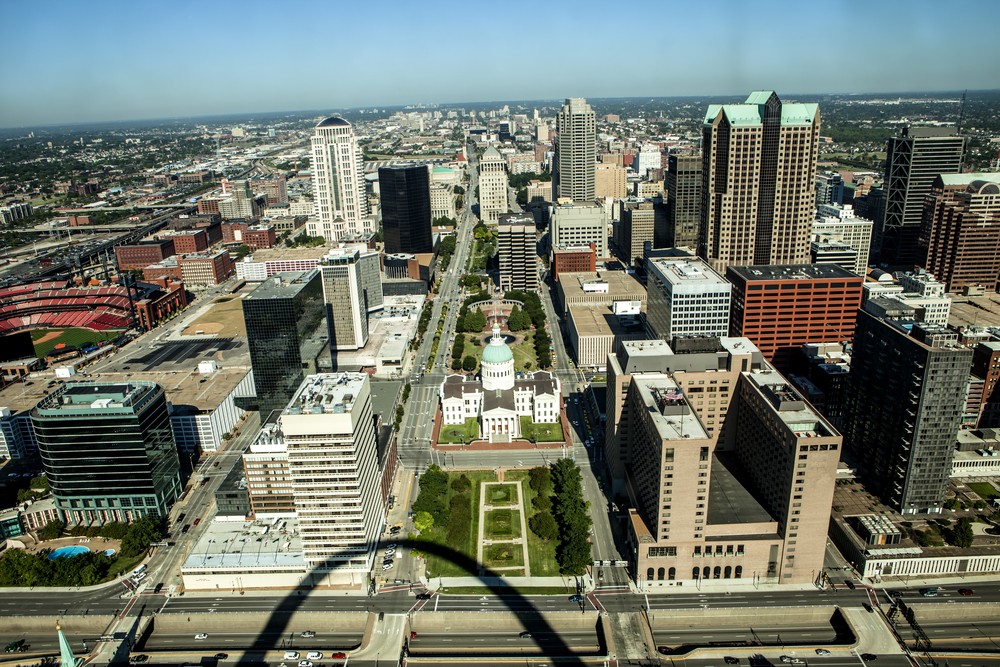
The community improvement district (CID) that funds several programs in downtown St. Louis is having trouble. Big trouble. As in it may-not-continue-to-exist-type trouble. Many people who live and work in the area are not satisfied with how the CID has been operating, and that dissatisfaction is threatening its renewal.

The downtown St. Louis CID has to be renewed at various intervals, and renewal requires the signatures of the property owners within the district. This includes all property—condos, businesses, parking lots, etc. Because this CID actually serves an area where people live (which is one of the good things about it), renewal requires lots of signatures. COVID-related changes and restrictions have complicated this process. In addition, an organized group of downtown residents and property owners has been opposing its renewal.

The downtown CID collects money via special property taxes. If the CID does not get renewed soon, those taxes won’t be on the 2021 property tax bills sent in a few weeks to property owners. That could be the death of the CID right then and there.

What a special taxing district like this CID really forces one to admit is that the local government is failing. City businesses and residents pay property taxes, sales taxes, income taxes, payroll taxes, utility taxes, occupancy fees, business licenses, and more. Yet those taxes are not enough to keep the trash off of the streets and help maintain law and order (the two main uses of the CID funds, along with downtown “marketing”). So the business owners and residents decided to tax themselves more to address some of these issues. Clearly, many of them do not feel that those additional taxes ($3.6 million each year, to be precise) are paying off, and a termination date and renewal process gives a clear path for ending a CID, which isn’t often the case for many taxes.

The problems with these types of special taxing districts have been well documented around the state. While this CID does not share some of the most egregious characteristics of other special taxing districts, it is great to see people fighting back against government that is not serving their needs. That is what this country was founded on, whether we are talking about tea in Boston, or CIDs in the historic Village of Ballpark.

It should be noted that the leading proponents of getting rid of the current CID want to replace it with a new and differently organized CID, but that would require a separate and independent process with no guarantee of success. In any case, downtown property owners may soon see whether those extra taxes they were paying were really worth anything or not.


Policy Lunch: Missouri School Rankings Project (St. Louis)

Missouri schools are failing to teach the core subjects of reading and math, and the most recent test scores show that students are falling further behind. In response to the Missouri Department of Elementary and Secondary Education’s (DESE) failure to perform one of its most basic functions, the Show-Me Institute, in conjunction with Show-Me Opportunity, launched The Missouri School Rankings Project and MoSchoolRankings.org.

On November 18, Susan Pendergrass, director of research and education policy, will present her findings from the Missouri School Rankings Project and give an overview of how to use the website.

Register

Sponsored by Show-Me Institute and Show-Me Opportunity

What’s Coming Is a Tragedy that Historians Will Only Wonder About

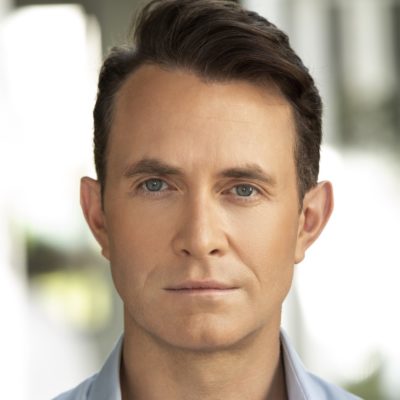
National Review Institute’s Douglas Murray joined The Tim Jones and Chris Arps Show on NewsTalkSTL to discuss the recent shift in American culture, his November 10 event in St. Louis, and more.

Event Information

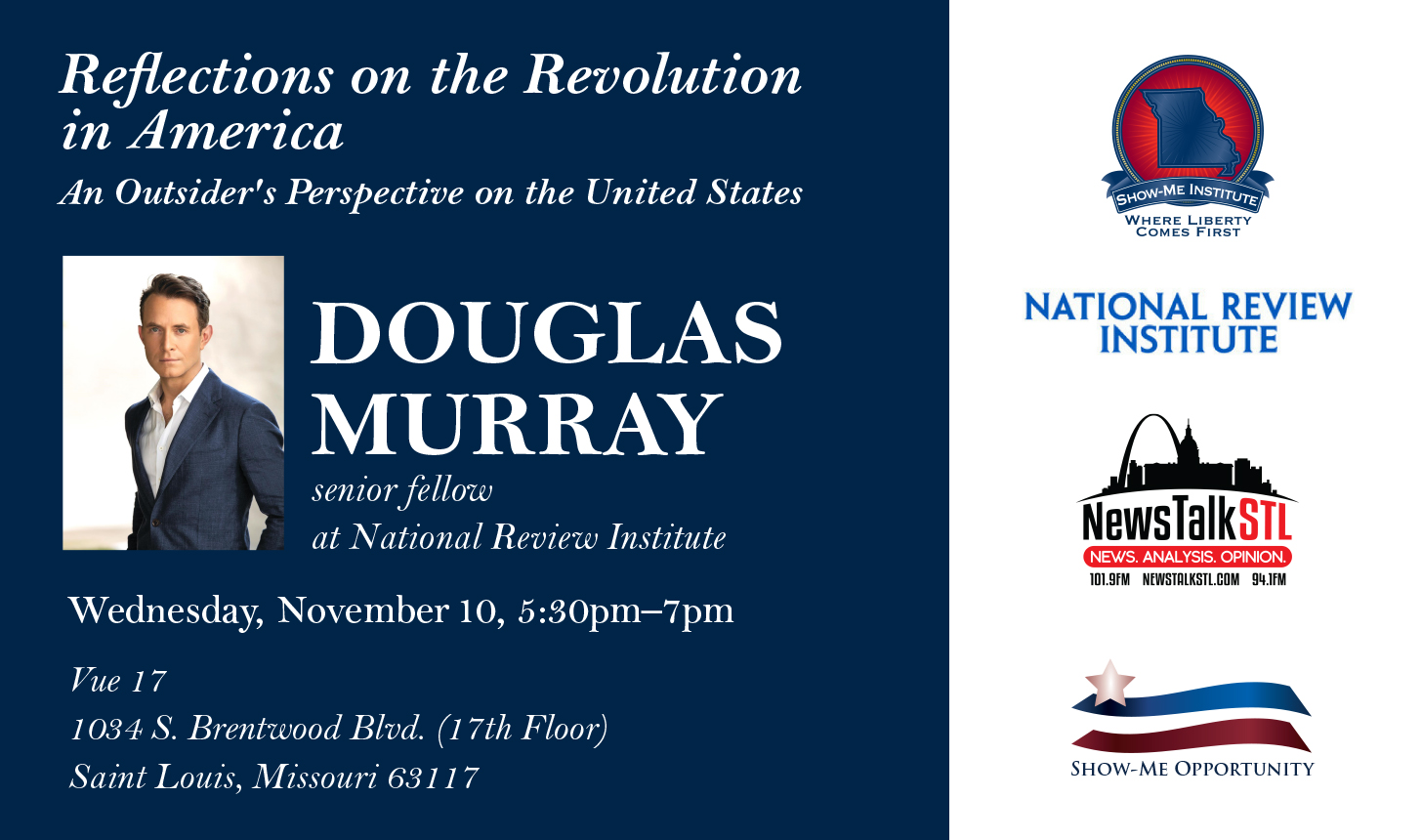
You are invited to join the Show-Me Institute, Show-Me Opportunity, National Review Institute, and NewsTalkSTL on Wednesday, November 10 for a complimentary event with Douglas Murray. Murray will give an outsider’s perspective on the recent shifts in American culture, the culture wars, and the attack on free speech and education. Please RSVP to secure your seat.

Murray is a best-selling author, an award-winning political commentator, and a senior fellow at the National Review Institute. He has written books on neoconservatism, terrorism and national security, freedom of speech, and the rise of woke culture and identity politics. His upcoming book, The War on the West: How to Prevail in the Age of Unreason, explores why in recent history it has become acceptable to discuss the flaws and crimes of Western culture, but celebrating the West’s contributions is condemned as hate speech. 

The reception begins at 5:30 p.m. with hors d’oeuvres and a cash bar. The presentation begins at 6 p.m.

Register Here

More Ways to Listen

Listen on Apple Podcasts 

Listen on Sticher 

Listen on SoundCloud

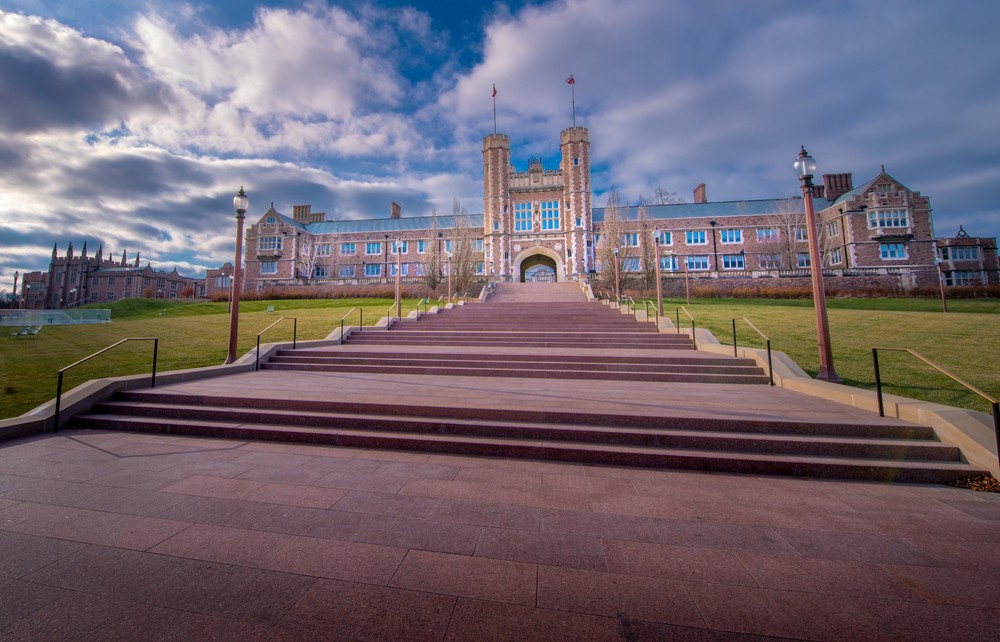
What Should Washington University Do with All of That Money?

Should non-profits pay taxes? Well, as someone who works at a small non-profit and believes in low taxes, I am going to start off with a “No.” But I can admit the question is actually more complicated than that.

A student at Washington University recently opined in his school newspaper that the university should be paying payments-in-lieu-of-taxes (PILOTs) to the cities around the school where it owns property: University City, Clayton, and the City of St. Louis. A complicated question is what to do when Wash U buys homes or apartment buildings within those cities to house students or visiting faculty, and then those properties are removed from the tax rolls because Wash U is a non-profit. From an article in the Post-Dispatch:

To house some of those people, it has purchased many off-campus single-family homes, duplexes and apartment buildings – 11 in Clayton, 53 in the city and 121 in University City.

It also owns several commercial properties – with one of the largest being its 1991 purchase of the old Clayton Famous-Barr for $17.5 million. All those purchases have an impact: The university’s not-for-profit status removes them from the property tax rolls.

The residents in these buildings need police and fire protection, roads, and other public services. When a property is purchased by a university and comes off the tax rolls but still has residents, the cities continue providing services but no longer receive the property taxes. That puts cities in a bind, especially University City and Clayton, which depend more heavily on property taxes than the City of St. Louis. The Wash U writer documents how many other universities pay PILOTS for local services to their cities, including the second-best university in Southwest Connecticut: Yale.

You know who else has written about this issue? Me. I think larger non-profit organizations, such as Wash U, SLU, many senior citizen homes owned by non-profits, and others could be asked to make partial payments of property taxes to cities. As for the City of St. Louis, I definitely think that should be part of a trade-off for eliminating the earnings tax.

Without ending the earnings tax, I don’t think non-profits should be asked to pay PILOTs to the city. (Non-profits are also exempt from the half-percent payroll tax that for-profit companies pay to the city.) Wash U and SLU doctors, administrators, nurses, etc. pay plenty to the City of St. Louis via the earnings tax. University City and Clayton have no such alternative (nor should they). I think partial PILOTs by larger non-profits are a reasonable way to help fund local services so that the tax burden is not unfairly falling on local residents for services used by the non-profits as well.

A Policy Scare Story: TIF

Ghosts and chainsaws can be scary, but is there anything scarier than the misuse of tax dollars? Okay, maybe that’s over the top. But there is something scary about governments giving away millions of public tax dollars to private developers—tax dollars that are supposed to fund schools, police, roads, and critical public services. So yes, tax-increment financing (TIF) should scare taxpayers.

TIF is an economic development incentive tool used to try and spur development. When a TIF project is approved, governments return a portion of a developer’s tax payment back to the developer to help fund the development. It’s a classic case of the government picking winners and losers by choosing which developers receive handouts. This practice is almost always a misuse and waste of taxpayer dollars. Independence, MO, had a particularly frightening experience with TIF.

TIF is often financed through debt bonds. Normally, the increment (the extra taxes generated by a development) is returned to the developer. When TIF is financed via debt bonds, that money is returned to the developer, but the developer then uses those funds to make bond payments. A TIF district in Independence anchored by a Bass Pro Shop was funded with bonds issued by the city. However, when the project failed to meet sales tax revenues projections, the developers couldn’t make the bond payments. Independence lawmakers decided to use $3.5 million from the general fund to cover the shortfall in the bond payment. The city wasn’t required to do this because the bonds weren’t guaranteed, but it did so to “ensure the city’s strong financial credit rating.”

Independence’s bad bet cost taxpayers. Paying the $3.5 million to cover the shortfall and protect the city’s credit rating may or may not have been the right move, but the point is that the decision could have been avoided altogether. Taking money from the general fund to bail out a development that already received tax dollars means even less funding for other critical city services. TIF cases such as these, and other taxing district failures, are policy scare stories. Cities such as Webster Groves that are currently considering large TIF projects need to consider the considerable risks with tax subsidies. Maybe it’s time for lawmakers to end this nightmare for good and stop using TIF to fund private developments.

Here’s a Scary Halloween Idea: Restarting the Trolley

Later this month, St. Louis taxpayers will face a spooky scenario just in time for Halloween. Should the Loop Trolley get another $1.3 million of their money?

The East-West Gateway Council of Government’s preliminary plan is to award a $1.3 million federal grant on October 27 to help restart the trolley (the East-West Gateway already has the federal grant money but is still making final decisions on how to spend it). The trolley has already received $51 million in taxpayer funding but didn’t even last two years because ridership and revenue were less than one-tenth of what was projected.

Members of the East-West Gateway board must remember that this is the same trolley organization that comes back to taxpayers in different costumes every year asking for more candy—er . . . money. Some years the disguise is construction delays; some years it’s money to get more cars on the tracks.

The costumes this year are congestion mitigation and air quality, but these new costumes aren’t any more convincing.

For the trolley to relieve traffic, Delmar Loop shoppers traveling from miles away must stop their cars just short of their destination and take the Loop Trolley for the final two miles of their trip rather than driving the last two miles and parking closer. Shoppers simply haven’t been willing to do this, as poor ridership numbers attest. More to the point, anyone who drove on Delmar Boulevard when the trolley was still running knows that a gigantic train car sharing the road with cars driving and parking only creates more confusion and congestion, not less.

Since the trolley runs on electricity it may in theory improve local air quality, and supposedly the trolley scored well on an East-West Gateway greenhouse gas emissions reductions test. But claiming that the trolley is going to significantly reduce emissions seems questionable. An electric trolley only reduces transportation emissions if it gets people out of their cars. Moreover, don’t forget how that electricity is generated—coal. Given that coal emits much more greenhouse gases than gasoline per unit of energy, the trolley would have to get a lot of people out of their cars to make even a slight difference.

If backers of the trolley really want to start the party again, securing funding from private investors would be much better than handing out tax dollars this Halloween.

Until this happens, however, maybe the most appropriate costume for the trolley is a zombie.

Douglas Murray in St. Louis

You are invited to join the Show-Me Institute, Show-Me Opportunity, National Review Institute, and NewsTalkSTL on Wednesday, November 10 for a complimentary event with Douglas Murray. Murray will give an outsider’s perspective on the recent shifts in American culture, the culture wars, and the attack on free speech and education. Please RSVP to secure your seat.

Murray is a best-selling author, an award-winning political commentator, and a senior fellow at the National Review Institute. He has written books on neoconservatism, terrorism and national security, freedom of speech, and the rise of woke culture and identity politics. His upcoming book, The War on the West: How to Prevail in the Age of Unreason, explores why in recent history it has become acceptable to discuss the flaws and crimes of Western culture, but celebrating the West’s contributions is condemned as hate speech.

The reception begins at 5:30 p.m. with hors d’oeuvres and a cash bar. The presentation begins at 6 p.m.

Register Here

Support Us

The work of the Show-Me Institute would not be possible without the generous support of people who are inspired by the vision of liberty and free enterprise. We hope you will join our efforts and become a Show-Me Institute sponsor.

Donate
Man on Horse Charging