During his State of the State address in January, Governor Mike Kehoe indicated Missouri is opting into the federal government’s new school choice tax credit program. The program resembles Missouri’s MOScholars program. Taxpayers can receive a dollar-for-dollar federal tax credit for donations up to $1,700 annually to a scholarship-granting organization, or SGO, in Missouri. The SGO then distributes scholarships to families in Missouri seeking alternatives to their residentially assigned public schools.
For many families, the scholarships will be used to pay private school tuition. But the potential is broader. At least two public school districts in Missouri already participate in MOScholars, allowing nonresident students to use scholarships to pay transfer tuition; a similar arrangement may be possible under the federal program. Funds could also support homeschooling expenses, tutoring, after-school programs, or enrollment in a microschool (the latter is a fast-growing but loosely defined sector and there is no clear consensus on what defines a microschool). The eligibility criteria are still unsettled.
Non-traditional providers are pushing for few guardrails and minimal regulation, while others argue for stronger oversight and quality controls.
I have mixed feelings. The real value of this program is its potential to expand Missouri’s education marketplace. Competition improves quality in virtually every sector of the economy, and education is no exception. But markets don’t work well when consumers have poor information, so I’d like quality controls and transparency so parents can make informed choices. Here’s the tension: expanding choice and imposing quality controls can work against each other. To illustrate, consider a heavily regulated system in which schools that accept the tax-credit payments must administer standardized tests, publicly report results, and disclose detailed information about their curricula and finances. This level of transparency would reassure policymakers, but the problem is that we cannot force private providers to participate.
And if we make it too difficult (and too costly) to participate, which schools are the most likely to opt out? The answer: the ones that already have plenty of customers without this new program—likely the best schools. And if the best schools opt out, it undermines the value of the education marketplace we’re trying to build in the first place. (This is a complicated problem. See here for a deeper discussion in the context of research that finds negative effects of a voucher program on student achievement in Louisiana.)
I don’t have all the answers, but I hope Missouri lawmakers think carefully about how to strike the right balance, particularly if the federal government gives states meaningful discretion in implementation, which I expect it will. I’d favor a middle-of-the-road approach that requires participating schools to provide straightforward, low-cost information, but without overly burdensome regulations or reporting requirements. I want the best education providers to open their doors to more Missouri students; I don’t want to scare them away.
In terms of education policy, Missouri’s 2026 legislative session was a real dud.
At the outset, there was reason for optimism. Several states—mostly in the South—have implemented literacy and accountability reforms that dramatically improved student outcomes. Our representatives in Jefferson City noticed. There was real momentum behind bringing similar reforms to Missouri.
Governor Kehoe accelerated the accountability effort early in the session by issuing an executive order requiring the Missouri Department of Elementary and Secondary Education to assign letter grades to schools and districts. Soon afterward, lawmakers in both the House and Senate introduced bills mirroring the order’s language.
Lawmakers also introduced literacy reform bills in both chambers. Modeled after successful efforts in states like Mississippi and Louisiana, the proposals emphasized science-of-reading instruction, consistent literacy assessment, and a retention requirement for students unable to demonstrate reading proficiency by the end of third grade. Although literacy reform lacked the governor’s direct backing through an executive order, there was urgency around it just the same.
However, ultimately nothing got done. With the 2026 legislative session behind us, we’re right back where we started. We have no new legislation on accountability or literacy reform.
I attended multiple committee hearings in the House and Senate on both issues. Legislation can fail for many reasons, but one factor stood out above the rest: too many state legislators do not understand how poorly Missouri schools are performing. As a result, they do not act with the urgency necessary to address the problem.
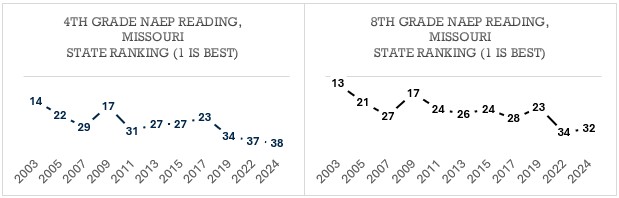
Data demonstrating the poor performance of our schools are publicly available and unambiguous. The best evidence comes from the National Assessment of Educational Progress, or NAEP, which is widely viewed as providing the most credible test data in the country. Here are charts showing the changes over time in Missouri’s national rank on NAEP, in 4th- and 8th-grade reading, since about the turn of the century:
Our 4th-grade reading results are especially discouraging. As of 2024, Missouri ranks 38th among the 50 states, down from the low twenties two decades ago, and 42 percent of Missouri fourth graders score “Below Basic” in reading on NAEP. The lowest NAEP rating level is “Basic.” These children are literally off the chart, and not in a good way.
During one committee hearing, a legislator questioned the credibility of the NAEP data itself. But study after study shows that standardized test performance—and NAEP in particular—is strongly predictive of long-term outcomes. Research links higher NAEP scores to increased educational attainment and earnings, and lower rates of incarceration, arrest, and teen pregnancy. Whatever outcome you care about for our children, NAEP scores predict it.
Notably, the legislator who criticized the NAEP offered no alternative evidence suggesting Missouri students are actually doing well.
Other forms of denial also surfaced. Another representative defended the status quo by noting that his wife is a teacher, and a great one at that. That may very well be true, but individual anecdotes do not change the statewide data.
The bottom line is that too many elected officials fail to grasp the scale of Missouri’s educational decline. Until they do, they will not act with the urgency the situation demands.
Yes, this year’s legislative session featured the usual political infighting and dysfunction. But Missouri lawmakers are fully capable of passing legislation when they decide an issue matters. Their inaction on education sends a troubling message: they fail to recognize the severity of the problem.
Missouri’s children will bear the cost of their continued inaction.
For years, the education establishment in Missouri has relied on a predictable playbook. Whenever state test scores drop or national rankings look bleak, we are told that the data don’t capture the whole picture, or that a new bureaucratic report card will soon show things are turning around. We are urged to wait, to invest more taxpayer money, and to trust the system.
But a newly released look at the numbers from a joint Harvard and Stanford project strips away the capacity for spin. According to the report, Missouri’s reading scores, which declined substantially during COVID, have continued to fall since 2022. We now rank 26th of 38 states (with usable data) in academic growth in math and 28th of 35 states in reading. In both reading and math, Missouri students are more than a half of a year behind where they were performing in 2019 (0.58 grade equivalent and 0.66 grade equivalent, respectively).
The authors point out that the pandemic slide was actually the acceleration of a trend that started around 2013. The pandemic simply poured gasoline on a fire that was already burning.
This scorecard release comes at a critical time for Missouri education policy. Recently, we’ve watched efforts to implement clear, transparent A–F school report cards go sideways in Jefferson City, bogged down by attempts to shift focus away from academic achievement and instead prioritize ambiguous school climate surveys. Fortunately, the governor’s executive order mandating report cards with letter grades will still be implemented.
Similarly, efforts to bring real accountability to early reading were derailed this legislative session. Lawmakers couldn’t commit to rigorously applying the science of reading or to making sure that students who can’t read aren’t socially promoted to grades where they will struggle to understand their textbooks.
If we want to reverse this generation-long decline, we must stop protecting the status quo. The folks in charge of public education need to be held to the highest standards of accountability. Furthermore, we must empower parents with robust educational choice, forcing the state system to compete and innovate rather than take families for granted. If we don’t make changes, we’ll only continue to fall further behind.
Susan Pendergrass speaks with Jacob Light, Hoover Fellow at the Hoover Institution, about his research on how artificial intelligence is reshaping higher education. They explore which college majors are most exposed to AI capabilities, why professors are largely not changing their syllabi or assessment methods despite widespread awareness of AI, and what students are doing in response to the uncertainty. They also discuss whether the backlash against AI on college campuses is real, what previous waves of technological change can teach us about the current moment, and more.
Susan Pendergrass (00:00): Thank you so much for joining us today on the podcast. Jacob Light, Hoover Fellow at the Hoover Institution, talking about something that’s very timely right now in this college graduation season. I’m hearing that all the college students are having a backlash against AI. I don’t know if you would agree with that or not, but I want you to try to explain to people listening what first of all you’ve been looking at in terms of AI in college in general, and also what your findings have been, because I find them to be very interesting and somewhat surprising.
Jacob Light (00:31): Thank you so much for having me. I’m really excited to join the podcast today. I’m an economist who studies how universities respond to different forces of change, whether that be changes in the labor market, changing political conditions, and more recently, changing technology, which feels very central both as a former student and now as an instructor at a university, thinking about how AI is affecting the way that students interact with their courses. My work right now thinks about this problem of AI in higher education in two ways. First, where should we be looking for exposure of higher education to AI? Where do the skills that students are learning to develop in their courses overlap with the capabilities of artificial intelligence? The second strain of the research is how are universities adapting? How are instructors changing the way that they administer courses? How are students changing which courses they take? And how should we look at these movements as indications of how these two sides of this market are responding to this big shock?
Susan Pendergrass (01:39): So to be clear, you’re not just saying that ChatGPT becomes available and all the professors outlaw the use of AI in classes, but more so: are students continuing in 2026 to be taught skills that we know AI can do? And what’s the answer?
Jacob Light (01:57): Yeah, exactly. I think it’s important to contextualize that we teach students many skills that have already been automated. We teach students basic arithmetic and spelling, even though we have calculators and spell check. We have these tools that can perform a lot of the cognitive work that we teach students to do from a very young age, and yet we still think it’s important for students to develop skills in these areas. We still teach students to add and subtract both because those skills unlock higher order cognitive skills and also just because that exercise is useful to students. So what I do in my research is think not just about whether instructors are changing the courses they offer to reduce the weight on things that ChatGPT and large language models are able to do, but if we think it’s important for students to develop these skills even though AI can do them, things like analyzing data or writing essays, then it becomes important for instructors to modify the way they offer courses so that we still get information about how well students are learning to do the tasks that AI can potentially substitute for them.
Susan Pendergrass (03:13): I don’t want to minimize the effort you put into this, because it’s massive. You went through thousands of syllabi to really look at what’s being taught in a very specific way. You also included not just large language model AI but robots, and a lot of the skilled trades. I would imagine that the skills needed 10 years ago have changed now that robots can do a lot of that work. What are you seeing there?
Jacob Light (03:42): For this first part of the project, where I think about how different fields of study are exposed to artificial intelligence, I should say upfront that exposure here doesn’t necessarily mean that every computer scientist is going to have their job completely automated. What I’m thinking about is the degree to which students are able to use AI as a substitute for, or maybe even a complement to, their work in the classroom. The approach I take is to leverage a dataset that I’ve spent many years collecting of course offerings from a large number of US colleges and universities. For about 1,000 schools, I’ve scraped the course catalogs and course schedules, which gives me insight into every course offered at the school over a period of up to 30 years. I see course offerings, enrollment, titles, instructors, and course descriptions. I use these course descriptions to build a sense of what skills and tasks a student develops in, say, an economics class. The exposure measure is the degree to which what a student does in that class overlaps with the capabilities of artificial intelligence. To be very specific with an example: in an economics class, students are often trained to analyze data, use models, and evaluate policy. The intuition for the approach I use is that if we see AI is really good at analyzing data, using models, and evaluating policy, we would think of economics as a field of study that is highly exposed to AI. I think about exposure to AI in two different ways. For the broad capabilities of AI, I glean from patents related to artificial intelligence. I look at the overlap between the tasks that students do in their courses and tasks that AI technology patents say those technologies are capable of doing. And then very specifically at the capabilities of large language models, which I think of as a subset of AI.
Susan Pendergrass (05:21): Yeah.
Jacob Light (05:35): So I look at two measures of what AI can do: the broad range of AI capabilities, which I extract from patents, and then the specific capabilities of large language models. What I find is that when you compare the exposure of college courses to AI versus to previous types of technologies, such as robotics, we see that courses are much more exposed to the things that AI can do than to the capabilities of previous technologies. This is consistent with existing research that suggests highly skilled jobs, the types of jobs that college graduates flow into, are more exposed to artificial intelligence than they were to previous waves of technology. That’s the first order finding. But within college majors, there’s pretty wide variation in exposure, and it differs based on whether we think of exposure to the broad class of AI technologies versus just large language models.
Susan Pendergrass (06:55): What’s the most exposed? It looks like it’s computer science, right?
Jacob Light (07:00): Statistics and data science and computer science are highly exposed majors. Unfortunately, economics is also a highly exposed major. I should say it’s not necessarily a good thing or a bad thing to be exposed. On one hand, there’s a risk that students are not developing the same skills when they have access to these AI tools as they did in a pre-ChatGPT period. But also, we lower the barriers to entry into computer science and economics through the availability of these tools, because everyone’s vibe coding, and also you have bespoke tutors in your pocket that can help you navigate difficult courses and overcome barriers to entry. So it’s not obviously a bad thing.
Susan Pendergrass (07:35): Because everyone’s vibe coding.
Jacob Light (07:53): But to be specific, especially when we think about exposure to AI as represented by the capabilities of large language models, what seems to drive exposure is a combination of fields of study that involve data analysis and generating text. These are the two things we think of LLMs as being very good at. So the quantitative social sciences, economics, political science, even sociology, as well as fields that involve applied data analysis, including statistics and computer science, are going to be the fields where the skills that students develop overlap most with what AI is capable of doing.
Susan Pendergrass (08:31): So are professors changing their syllabi to reflect that? Are they dropping things that clearly could just be covered by AI?
Jacob Light (08:40): That gets to the second part of this project. Having documented that there is this concern that AI overlaps with what we teach students to do in their courses, and that students might be able to substitute AI for their own work, we might look specifically at these highly exposed fields as places where we want instructors to modify the way they teach as a means of ensuring that students are developing the skills they were developing before ChatGPT was released. We read a lot of these articles about blue books being back.
Susan Pendergrass (09:12): Using blue books? I feel nostalgic for the blue books. There’s something almost romantic about writing in a blue book versus clicking buttons on a Canvas quiz.
Jacob Light (09:12): Yeah, I don’t like blue books by the way, but using blue books, yes.
Susan Pendergrass (09:23): But isn’t that just working against an enormous tide? To think that requiring students to write in a blue book is going to force them to not use AI for the exam, but aren’t they using it daily in their coursework?
Jacob Light (09:53): Again, it’s not obvious to me that using AI in their coursework is a bad thing. So much of the work I did when I was a college student was pretty inefficient. I spent a lot of time writing code that didn’t work and writing essays that read very poorly. To automate some of those experiences might allow students to invest more in the types of higher order thinking and learning that are more valuable. But on the other hand, I think I became a better coder because I made mistakes through the process. Now I can distinguish good code from bad code because I’ve written a lot of bad code and I know what my bad code looks like. So we might think that even if we’re not changing the types of skills that students develop in their courses, that we continue to offer economics courses and computer science courses, the way that we assess whether students are learning the skills they need is going to change. There are certain types of assessments, like out-of-class essays and homework, where you just can’t get as much information about how much students are learning, versus in-class proctored exams, participation, and presentations where students have to demonstrate mastery through assessments where you can’t use AI tools. What I do is, for about 20 universities, I’ve collected a panel of syllabi covering both the pre and post-ChatGPT period, and I extract two pieces of information. The first is whether the syllabus has an AI policy or not. The second is the weights that instructors put on different types of assessments, such as half the grade being based on exams and 25% based on essays. I find two interesting things. The first is that following the release of ChatGPT, instructors became very aware of AI. We see a massive increase in the share of courses that have any AI policy, and most of those policies are restrictive of the use of AI. My own syllabus has clear instructions about when I want students to use AI and when I don’t. My students are very compliant and of course listen to everything I say, both when I’m lecturing and in the syllabus. So we see that instructors are aware of AI and think of it as a concern in the classroom.
Susan Pendergrass (09:12): You think they follow that?
Jacob Light (12:24): Sure, great, okay. But the second thing I extract is assessment weights, which allow me to assess whether instructors are changing the way they offer courses in a way that lets them extract more information about how much students are learning. What I find is that despite instructors being very aware of AI, we see virtually no changes in how much weight instructors are putting on the types of assessments where students can substitute AI for their own work, versus assessments like exams and participation where they can’t. We hear a lot about blue books being back. We hear anecdotal stories about how instructors are concerned about students using AI in the classroom. But I just don’t see this in the data.
Susan Pendergrass (13:23): That’s surprising to me.
Jacob Light (13:42): I think what’s interesting and informative is that there are two shocks in pretty quick succession over the last couple of years that push in opposite directions on the information that instructors can get from different types of assessments. During the pandemic, it became harder to offer in-person exams. There was a physical constraint that limited exams. What I see is a shift away from exams and towards homework, a gradual pre-pandemic shift away from exams that sharply accelerated during the pandemic, and that persists even in the years after in-person instruction resumes. We can use that as a benchmark: at minimum, instructors could revert back to the way they were weighting courses before the pandemic. What we see is basically nothing. There are very modest shifts away from homework and other AI-substitutable assessments, primarily essays. We’re slightly reducing the weight on essays and offsetting that with increases in participation and presentations. But we’re seeing very little movement at scale away from the types of assessments where students can substitute AI for their own work.
Susan Pendergrass (14:44): Maybe higher education just moves slowly. It’s an ivory tower. People get entrenched. Some professors use the same syllabus for 20 years. Maybe it just moves more slowly in reaction to this. I know some that are angry about the AI thing, but it’s up to them to figure out how to change it. In terms of what students are doing, how are they reacting to the changes in terms of what they’re choosing as majors? What are you seeing there?
Jacob Light (15:32): Yes, so I track changes in enrollment over the last 20 years using this course schedule data from a large number of universities. Similar to the relatively slow movement on the instructor side, students are moving pretty slowly as well. Despite stories about concerns about the viability of computer science as a major, and after a period of very rapid growth in CS enrollment, we’re only seeing a slight dip in CS enrollment and in other AI-exposed fields of study in the last couple of years. What I can show is that for the first time since around 2005, when CS enrollment began to take off, this current year, the 2025-26 year, we see a slight decrease in computer science enrollment. But it still remains elevated compared to the start of the pandemic and substantially elevated compared to 2010. In a way, perhaps this makes sense, because although there is greater uncertainty around the returns to developing CS skills, CS courses are now easier to take because you have tools that can help you with your homework and tutor you. One of the barriers to entry into CS courses previously was that they were hard, and these tools make more AI-exposed courses easier. I think the risk and the concern is that the same tools that can do your work in the classroom can also potentially do your job, and I don’t think we see students internalizing that risk yet.
Susan Pendergrass (17:12): Even though the Wall Street Journal has a layoff tracker and Meta is constantly seemingly laying folks off, and Amazon as well. We see a lot of thinning of the herd when it comes to software engineers. I just imagine it’s going to change. Is this generation of college students in a weird bind? They’re right between the pre-AI and post-AI worlds, spending a lot of money on college tuition at a time when the future of different types of work is very uncertain.
Jacob Light (17:54): I’m very sympathetic to college students who are navigating uncertainty right now of a form that I don’t think college students have had to navigate previously. During previous technological change, we’ve always looked to universities as the resource that we send people to upskill, with the promise that the skills you develop in college are going to have returns when you enter the labor market. I continue to believe that’s the case, certainly in the short term. But I recognize that the nature of work is changing quite rapidly as new technology can perform some of the tasks that workers are able to do. Economists often conceptualize occupations as a bundle of tasks, and when a new technology comes online, the technology is able to do some of those tasks while the human worker continues to perform others. The net impact on an occupation really depends on which tasks are being automated, and whether that means we need fewer people doing that occupation because the technology can do it for us, or whether the ability of technology to make workers more efficient actually increases the demand for people with those skills because now more firms will benefit from having a single software engineer on staff when it previously would not have been rational for them to have any. There’s a lot of uncertainty right now, and I think it’s difficult to navigate as a 19 or 20 year old.
Susan Pendergrass (19:37): What about this backlash? Eric Schmidt spoke at a college graduation and folks booed him, I think. Even Jonathan Haidt, who is sort of anti-smartphone and screen time. Do you perceive that? You work on a college campus. Do you see that age group wanting to turn away from AI?
Jacob Light (20:02): My perception is that the backlash is to the uncertainty that AI introduces. Many students are eager to use the technology when it makes them more efficient or when it allows them to substitute time they would spend solving problem sets towards leisure and other pursuits. But I’m sympathetic to the frustration that students are feeling, that this investment they’ve made and the promise of opportunity that college has previously offered is now at risk because of the changing technological landscape.
Susan Pendergrass (20:53): I was talking to a lawyer recently about AI and how they use it and how great it is for them. They said basically every lawyer now has their own legal assistant. And I was like, what does that do for legal assistants? Everyone’s got a research assistant, which is great. I use it all the time. But what does that do for people who used to start as a research assistant? It’s obviously changing things. I kind of remember, because I’m pretty old, desktop computers being the thing that was going to kill all these jobs, and it just shifted the market. It didn’t kill anything. It just dramatically increased productivity. I think people have a lot of dystopian views of this, but you sound like you’re a little more on the utopian side, and I think there could be a lot of positives that come out of it.
Jacob Light (21:38): I think that’s right. Economists are not in the business of making predictions generally, and I’d have to give up my PhD if I did. I take some comfort looking at previous waves of technological change, exactly as you said. Computers created more job opportunities than they reduced. Mechanized agriculture unlocked widespread growth in the economy despite reducing some employment in agriculture. My belief, if we take the past as precedent, is that we will see something like that with artificial intelligence as well. Some, perhaps many, occupations will be disrupted. Workers in those occupations will experience difficult consequences of this change. But there will be more and new opportunities available once this technology is more widely deployed. There’s a trade-off, and the transition is messy and painful. But I think on net, the precedent is that new technology is generally helpful for society.
Susan Pendergrass (22:57): AI spits out a lot of bad content and you still need a human, I think, to determine what’s bad and what’s good. I think that’s the skill set within the CS world. You can have AI code five versions of something, but somebody needs to know which one is good. So what do you think about that?
Jacob Light (23:22): I think that’s exactly right. The expertise becomes more valuable. In a way, it’s kind of a bummer that the parts of work where humans maintain their advantage are in evaluating quality rather than in generating. We’ve kind of taken the creative component of work away. I think it creates a less satisfying, perhaps less intellectually stimulating workflow. At this stage, certainly, we continue to need humans with expertise beyond the capabilities of AI to evaluate what AI is producing. I think that points to the crisis that higher education faces: if we are not able to produce these experts because students are not developing the skills we need them to develop in college, then how will we produce the next cohort of experts? Similarly to your point, if we don’t have legal assistants and research assistants who will eventually become lawyers and researchers, then we are not training people to preserve their comparative advantages over these new tools. I think that’s a big risk we face, and it emphasizes the importance of education right now more than ever.
Susan Pendergrass (24:56): So are you going to continue with this, scraping the data and looking at it?
Jacob Light (24:58): Yeah. It’s my maniacal hobby. I started this data collection in February 2020, and a month later the world changed. But I had a lot of free time on my hands, so it gave me something to do. This little hobby of mine became my pandemic hobby. It was my sourdough. This data gives really rich insight into how universities differ in ways that I don’t think researchers have been able to explore previously.
Susan Pendergrass (25:36): No, I think it’s great. That’s really cool. If people want to find out more, where can we find it?
Jacob Light (25:42): I’m a researcher at the Hoover Institution. You can go to my website at jacob-light.com. I’m always eager to talk about this work.
Susan Pendergrass (25:51): That’s fascinating stuff. Well, thanks so much. I’d love to see a follow-up in a year or two. I think it’s really interesting. Thank you so much.
Jacob Light (25:57): Absolutely. Thank you so much for having me.
The administrative tectonic plates in Jefferson City just shifted, leaving Missouri’s education system at an unexpected crossroads. Dr. Karla Eslinger has announced her retirement as state commissioner of education effective June 1, exiting the top spot at the Department of Elementary and Secondary Education (DESE) after only two years on the job. With her deputy commissioner of learning services, Kelli Jones, also stepping down on the exact same day, the Missouri State Board of Education has an opportunity to reshape education in the state.
This leadership vacuum comes at a critical historical moment. Dr. Eslinger’s brief tenure followed a decades-long career as a teacher, local superintendent, and state lawmaker. Her appointment was widely seen as a victory for traditional public education groups who valued her insider, Missouri-native pedigree. But her exit after only 24 months underscores a deeper reality. Steering a massive state agency with a multi-billion-dollar budget through a rapidly shifting educational landscape is an entirely different beast than running a local school district. It also highlights a critical flaw in how our state approaches these executive searches—only looking at the existing educational establishment within our own borders.
By limiting the talent search to familiar Missouri circles, the State Board continually pulls from the same institutional echo chamber. The board now finds itself embarking on a critical executive search. How they approach this selection will dictate whether DESE spends the next few years protecting entrenched institutional interests or boldly executing a transparent, student-centered vision.
The standard bureaucratic playbook for a state-level search is completely predictable. Hire a national firm, gather a generic wish list from traditional education lobbying associations, and recruit an in-state career superintendent whose primary talent is maintaining a steady ship. But Missouri doesn’t need an institutional caretaker. Missouri needs an operational reformer—and we need to look nationwide to find one.
Managing DESE is fundamentally a chief executive role, not a classroom management job. It requires a mastery of data systems, fiscal transparency, and structural modernization. Many of the most successful educational turnarounds in recent history occurred in states that broke the provincial mold. When states like Indiana, Florida, and Ohio overhauled their education departments, they didn’t just promote from within. They searched nationwide for leaders who had a proven track record of dismantling bureaucratic inertia.
To find transformational leadership, the State Board must look outside the standard internal pipeline. For example, they could search for:
A reformer: A leader who has already done the heavy lifting of modernizing data infrastructure or rolling out student-centered funding models in another state.
A policy strategist: An executive from a national, data-driven policy network or foundation with a deep understanding of how to translate legislative changes into ground-level results.
An operational disruptor: A proven executive with a corporate or logistical background who views school systems not as fixed geographic monopolies, but as dynamic service providers accountable to consumers.
The standard interview process for public officials often rewards the candidate who can recite the most educational buzzwords. We’ve all heard them: “holistic success,” “supporting the whole child,” or “collaborative frameworks.” The State Board needs to filter out the talkers from the doers by throwing out standard Q&A sessions in favor of strict, competency-based screening. Finalists shouldn’t just give a speech. They should be handed a blind dataset containing Missouri’s most pressing structural knots, such as our persistent literacy gaps or how to assign letter grades to schools and districts. And they should be required to present a 100-day operational roadmap for solving them.
The next leader of DESE isn’t entering a stable, quiet environment where they can slowly settle in. They are taking the wheel of an education ecosystem where stakeholders are demanding data, accountability, parental choice, and real results. Their primary mandate must be transparency and efficiency. They must be fully committed to dismantling the administrative red tape that the establishment uses to block alternative pathways and protect funding at all costs, even as the number of students in the state declines.
The State Board of Education has a rare opportunity to reshape Missouri’s educational trajectory. We do not need a commissioner whose primary goal is to keep traditional, local interest groups comfortable. We need to run a relentless, nationwide search to find a leader who recognizes that the ultimate accountability in education is owed to parents and to taxpayers.
From all of us at the Show-Me Institute, thank you to all the men and women who have served and continue to serve our great nation. We will never forget your bravery and sacrifice.
Data center headlines have been filling newspapers each and every week. Among the myriad proposed developments across the state, one project in Ferguson stood out.
Ferguson officials recently rejected a tax subsidy proposal that would have granted substantial incentives for a data center project at the former Emerson campus. Specifically, the package included up to 15 years of tax abatements on real estate, personal property, and sales taxes.
Rejecting this tax subsidy for the development was the right decision. I want to stress that the Ferguson City Council did not reject the data center; it rejected the requested tax subsidy only.
For years, Show-Me Institute writers have been noting the problemswith economic development subsidies. Governments should not be picking winners and losers, and data centers are no different.
However, many ignore these arguments and think that using incentives to attract a project could bring substantial jobs, invite tourism, and boost public morale. While maybe (strong emphasis on maybe) some could argue this about other projects, these arguments don’t apply to data centers.
The Emerson Campus formerly employed more than a thousand workers manufacturing automation products and providing engineering services. Modern data centers simply do not require that scale of employment.
At the same time, the concerns over electricity, water, and sound from data centers are well-known.
However, despite this, data centers can still provide a major benefit: significant tax revenue. They can provide so much revenue that local residents could see property tax cuts.
That is precisely why offering large tax abatements for these projects is especially misguided. Along with the cyber and electronic services we all use, tax revenue is the core benefit a data center can bring to a community. If local governments dramatically reduce those revenues through incentives, they are asking residents to absorb a lot of costs with little benefit.
A data center project at the Emerson campus could still be successful and economically beneficial without requiring massive local tax incentives. But too often, Missouri communities negotiate as though they have little to offer unless subsidies are attached.
They should think bigger than that. I wrote a recent op-ed on this very topic.
As debates around data centers continue across Missouri, policymakers should carefully weigh both the benefits and drawbacks these projects bring. Local governments should not rush to give away the primary benefit data centers can provide: tax revenue. Ferguson made the right decision.
Even after reinstating fares, the Kansas City Area Transportation Authority (KCATA) is warning of route reductions because the agency says city funding will fall short of maintaining current service levels. KCATA estimates it needs more than $100 million to preserve existing operations, well above the city’s proposed contribution.
The immediate concern is fewer routes and longer waits for riders. But the larger issue is institutional: KCATA is confronting the long-term consequences of policy decisions that weakened its financial position and eroded confidence among regional partners.
Those problems did not emerge overnight. For years, KCATA relied on temporary funding, emergency appropriations, and optimistic revenue assumptions. Pandemic-era federal aid masked those weaknesses but did not resolve the structural imbalance between operating costs and recurring revenue.
The clearest example was KCATA’s heavily promoted fare-free transit initiative. Supporters argued eliminating fares would improve mobility and reduce barriers for low-income riders. But even at the time, research and the experience of other cities suggested the policy was financially unsustainable.
Fare-free transit eliminated one of the system’s few direct revenue streams while increasing dependence on taxpayer subsidies. Transit fares rarely cover operating costs, but they still provide revenue and impose some fiscal discipline. When federal pandemic aid expired, KCATA faced familiar financial pressures with even fewer tools available to address them.
Acknowledging that reality, KCATA recently announced fares will return next month. Restoring fares amounts to an acknowledgment that the model was not sustainable.
The consequences extend beyond Kansas City itself. Regional transit systems depend on trust among local governments—trust that erodes when the central agency faces recurring fiscal problems.
Some regional governments have already moved to retain greater operational control over their own transit services. In 2022, Johnson County, Kansas, ended KCATA management oversight of its transit operations while continuing limited coordination through the RideKC brand. More recently, several suburban municipalities—including Gladstone, Grandview, and Raytown—have reduced or ended participation in RideKC service.
Obviously, public transit serves a purpose. Many Kansas City residents still rely on buses to reach work, school, and appointments. Like transit agencies nationwide, KCATA is operating in a difficult post-pandemic environment shaped by inflation, labor shortages and changing ridership patterns.
But those challenges make competent governance more important, not less. Municipalities are hesitant to rely on an agency caught in recurring fiscal crises driven by its own policy failures. Fare-free transit generated national attention, but reality eventually intervened.
KCATA’s budget problems are not simply the result of this year’s funding gap. They are the cumulative consequence of years of policy decisions that weakened the authority’s financial position and damaged its credibility.
I’ve argued for years that Kansas City’s lavish subsidies distort the market while failing to deliver on economic promises. New reporting from the Kansas City Business Journal suggests the process itself may be just as broken.
Reporter Thomas Friestad reconstructed negotiations among Kansas City Public Schools (KCPS), PortKC, and Gillon Property Group over incentives tied to Country Club Plaza. The emails, obtained through an open-records request, depict a rushed and opaque decision-making process worthy of public distrust.
The original proposal reportedly included roughly $309 million in incentives over 30 years. KCPS officials objected not only to the size of the package, but also to shifting valuation methods that obscured the true public cost. The district also sought protection for voter-approved bond revenues and more time to evaluate major revisions before approval by PortKC.
That timeline is the real story.
The emails show negotiations continuing until the night before a scheduled PortKC meeting. KCPS officials argued they were being asked to evaluate a substantially revised proposal in just two business days. One consultant for the district described the timeline as “concerning even with the highest level of independent analysis.”
This is a recurring problem in Kansas City’s incentive culture. Complex tax arrangements are negotiated behind closed doors and then presented to affected taxing jurisdictions with little time for meaningful scrutiny. The result is confusion over the true public cost and distrust among taxpayers expected to finance these deals.
Kansas City has seen this pattern before. Similar concerns surrounded the Power & Light District and continue to emerge in discussions over a proposed downtown ballpark. Political machinations routinely take precedence over transparency and accountability.
Notably, KCPS did not oppose subsidies outright. District officials simply asked for clear terms, accurate projections, and adequate time to evaluate a deal that could affect school finances for decades. The fact that negotiators appeared unwilling to provide sufficient time to evaluate the deal speaks volumes.
Kansas Citians have grown understandably skeptical of these taxpayer-funded deals. Too many projects promised economic transformation and delivered little beyond long-term public cost. The Country Club Plaza negotiations are, at best, an example of rushed incompetence. At worst, they suggest an effort to push a massive subsidy package through before taxpayers and public schools could fully evaluate it.
Support Us
The work of the Show-Me Institute would not be possible without the generous support of people who are inspired by the vision of liberty and free enterprise. We hope you will join our efforts and become a Show-Me Institute sponsor.



 From all of us at the Show-Me Institute, thank you to all the men and women who have served and continue to serve our great nation. We will never forget your bravery and sacrifice.