Health Care Price Transparency in Missouri: Part Three

In the first two posts in this series, I examined the confusing world of pricing in health care. What I found was that the majority of Missouri hospitals don’t appear to be complying with federal pricing rules. At the very least, it’s fair to say that if Missourians want access to their health care prices, more needs to be done to achieve greater cooperation from providers.

To boost hospital compliance, Missouri’s policymakers should consider reforms that would work in conjunction with existing federal rules. As Show-Me Institute researchers recommended in last year’s blueprint, establishing state level requirements for health care price transparency (including non-hospital providers) to publish charges for hundreds of shoppable services in a way that most Missourians can understand would represent a significant step forward.

Additionally, no price transparency requirement is effective if the providers charging those prices won’t comply and there is no effective enforcement mechanism. Under current federal rules, hospitals that fail to disclose prices in a comprehensible way can be fined from $300 to $5,500 a day. It doesn’t appear, however, that fines are being imposed. Missouri policymakers may need to consider noncompliance penalties with teeth for providers if they continue withholding pricing information from patients.

Policymakers should also consider ways to make it easier for patients to access and use these prices. States including Florida, and nine others, have taken the issue into their own hands and created online tools that help patients shop for various procedures. Something similar could be done in Missouri.

While greater transparency in health care will not single-handedly fix all the health care problems in Missouri, the hope is that it will take some of the uncertainty and confusion out of the process. Patients deserve clarity, not mystery, when making decisions related to their health. And until patients can be informed consumers of the care they purchase, we can’t expect to keep the cost of medical services under control.


August Ballot Issue Rundown

Next week is primary election day in Missouri. You may have seen some ads for candidates on television, radio, or social media. If so, lucky you.

At the Show-Me Institute, we focus on policy issues, not partisan races. Next week’s ballot is relatively light on policy votes, but there are some interesting proposals before voters nevertheless.

In St. Louis County, there are three charter changes to consider. These changes would establish a salary commission for the county council, give greater protection to whistleblowers within county government, and clarify that county appointments to boards and commissions must be approved by the county council. The last one should not be necessary, as that is the current law, but apparently the current law isn’t enough, hence the proposal to tighten up the wording. I think the whistleblower protections are necessary, and the appointment proposal is much needed as well, albeit unfortunately.

Ferguson and Blue Springs are both considering use taxes. My position on use taxes is that they are fine if they are offset with reductions in other, more harmful taxes. In the case of Blue Springs, the city should use the new money (if the tax passes) to reduce its dependence on special-taxing districts and consider privatizing municipal utilities and golf courses. For Ferguson, a use tax increase could be offset by a lower property or utility tax rate. Either way, if these cities (and others that may have a use tax vote next week) are simply using the use tax as new money, voters should think twice about just granting local governments more money.

In the Holly Hills neighborhood of south St. Louis City, voters are considering a new special business district tax to do things that government ought to already be doing in the first place, such as public security and park maintenance. The existence of this proposal is first and foremost an admission that city government is failing, but creating a new, small, tax-funded agency with limited oversight is unlikely to be the savior supporters think it will be.

Finally, there are numerous school and fire district bond issues and tax increases on the ballot. One that stands out is the proposed tax increase in Hickman Mills School District in the Kansas City area. You can check out the performance of the schools in that district at MoSchoolRankings.org. The school district board is proposing a $1.35 per $100 of assessed value tax increase. That is one of the largest increases I have ever seen. For a $200,000 house in the school district, that is a $513 tax increase. Is that worth it to the parents, voters, and taxpayers of that district? We shall see . . .

Remember, the world is run by the people who show up, so show up.

Broken Approval Process Slows Development

Several disjointed developments in the Cortex and Grove areas of St. Louis nicely encapsulate the confusing involvement of elected officials, appointed boards, and city bureaucrats in city permits and approvals, including both large decisions that should involve elected officials and relatively mundane matters that would best be left to city employees to approve. The Post-Dispatch and St. Louis Business-Journal have both covered the issues closely. To wit:

  • The new Alderwoman for both areas, Tina Pihl (Ward 17) has been more hesitant to grant tax subsidies for projects in her ward. This is a beneficial policy change from her predecessor, and the new Alderwoman deserves credit for this.
  • The quickest way to get tax subsidies in Ward 17 appears to be to agree to make a donation to the city’s new Affordable Housing Trust Fund. This is a terrible policy that reeks of impropriety. “You get your tax deal after my favorite fund gets its money,” is an awful way to run government, and Alderwoman Pihl deserves criticism for this.
  • The St. Louis Land Clearance for Redevelopment Authority (LCRA) board has approved substantial increases in tax subsidies for certain projects in Ward 17 without approval from the Board of Alderman, and against the wishes of the alderwoman. The LCRA took a subsidy package that had been approved by the elected Board of Alderman, changed it significantly, and then approved the larger package of tax subsidies. The LCRA board is completely out of line here and seems to continue to function primarily as a shill for corporate welfare interests. Alderwoman Pihl is correct here in her request that the proposal should go back to the Board of Aldermen, as our game of policy tennis continues.
  • Finally, there are complaints that the alderwoman is moving too slowly in approving various things for her ward and slowing development. Time is money for everyone but the government. The key part here is that some of these projects being held back are over minor issues, such as simple variances, that if the necessary legal conditions are met, should be able to be approved by city departments without the local Alderperson weighing in. From the article:

But for Lengyel — he isn’t seeking tax abatement for the three houses — it was never clear what she wanted. He still has never spoken to Pihl

If a project meets the zoning regulations for the area (or requires only modest variances), and the developer is not asking for any tax subsidies, then why shouldn’t city staff make the approval decision (presumably giving the go-ahead)? Why should the local alderman be involved in the process at all, except in rare instances? In most other Missouri cities, minor permitting issues do not involve elected officials at all. For zoning changes or variances, elected officials would usually just be involved at the end of the process, which makes everything move faster.

The delay in approvals for generally routine matters (which is bad) is being caused by a new alderwoman who wants to be more cautious about tax giveaways (which is good). But the real problem here is the tradition and assumption within the City of St. Louis’s government that a ward’s alderperson is entitled to approve or halt any project, no matter how large, small, unique, or routine the proposal may be. Many of these smaller projects should never go to the alderperson for approval in the first place, and eliminating this unnecessary step is a would benefit the City of St. Louis.

Health Care Price Transparency in Missouri: Part Two

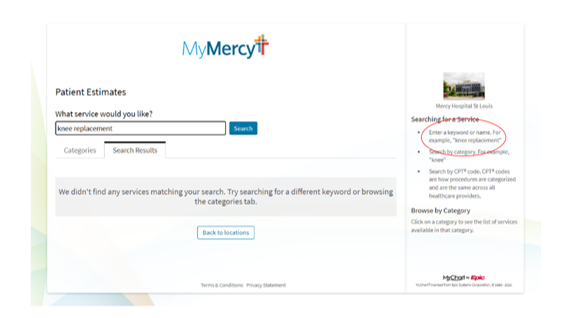
In my last post, I discussed the push for increased price transparency in health care, and why transparency is good for consumers. For example, if you need a knee replacement, you should be able visit your local hospitals’ websites, find a price estimate for the surgery at each hospital, and make an informed decision about where to have the surgery done. I decided to try this out for my usual hospital of choice, Mercy Hospital in St. Louis. I used the online price estimation tool, and per Mercy’s suggestion searched “knee replacement.” Nothing came up:

I decided to try the same thing out at the flagship hospital for four of St. Louis’s major hospital systems. I found that the price without insurance for a knee replacement was $26,122 at Barnes Jewish and $18,766 at St. Luke’s. Using that search term in the pricing websites for both Mercy St. Louis and SSM Saint Louis University turned up no matches. I then decided to broaden my search to every hospital in Missouri.

I used the rules outlined by the Centers for Medicare and Medicaid Services (CMS) to evaluate how “transparent” each hospital’s pricing was. The rules state that each hospital needs to have a consumer-friendly way to shop for common services, as well as a comprehensive list of all services and charges in a digital file. I found that of Missouri’s 164 hospitals, only 47 fulfilled both requirements. That is a compliance rate of just 29%, which, considering the federal rule is a year and a half old, is pretty terrible.

Many of the 47 “compliant” hospitals, such as Mercy, had some sort of online form to estimate prices but, in my opinion, did not make the system all that easy or intuitive to use. Many of these sites would not accept a general term for a procedure, like “knee replacement”, but instead required a technical procedure name or hospital code. Requiring the average patient to have such specific information is not “user friendly.” Likewise, the digital files many hospitals provided are difficult to read unless you have extensive computer software and coding knowledge. The digital file Mercy provided was one of these difficult file types. After spending approximately 45 minutes using code to read Mercy’s file, I found that it was still missing key information CMS requires about negotiated rates between the hospital and insurers.

The bottom line is that Missouri hospitals, by and large, are not following the plain intent of the rules, which makes it difficult for patients to know how much their care will cost and to effectively compare prices. If you would like to try to research the prices of procedures for yourself, I have included an Excel file at the bottom of this post that has URLs for every hospital’s pricing information.


The $20,000 Discount: Municipal Checkbook Hall of Shame

Arbyrd, Missouri is a town of just over 400 people in the southwest corner of the Missouri Bootheel. Many small towns, and not just Arbyrd, have few if any full-time government employees, and often they do not have any digital records. What is unique about Arbyrd is that the city was prepared to charge the Show-Me Institute tens of thousands of dollars to see how it spent taxpayer money.

That’s right. Last week, the Show-Me institute began an updated municipal checkbook project, which entailed obtaining the spending records of every city in Missouri. Every city that had available contact information was sent a request under Missouri’s Sunshine Law. Many cities had data already organized and were happy to share, all of which is available here. Some cities, especially those without already-digitized records, requested a fee before they would gather their data. This is allowed under law, but fees are supposed to reflect only the cost of labor and copying involved, and usually did not amount to more than $100. Arbyrd’s fee was a little more than that. According to the response I received from the Arbyrd City Clerk, our request would “require a significant amount of time and resources to complete and therefore we charge $40 per page with a minimum of 500 pages. This amounts to $20,000.”

Twenty thousand dollars! With no details explaining how a single page of paper could cost $40, Arbyd was prepared to charge us tens of thousands of dollars for information about where the city is spending taxpayer money. This clearly goes against both the letter and the spirit of the sunshine law and was met with a swift reply from Institute staff.

Unsurprisingly, days after our reply explaining that what they were doing violated the Sunshine law and that we would be contacting the Attorney General’s office, Arbyrd backed down. The mayor sent a revised offer, promising a digital copy of their spending information at no charge (we received their information on July 19). As it turns out, Arbyrd’s spending data was available in digital form, but for whatever reason their response to our initial request was to decline to provide it.

The bottom line is that all citizens, not just the most dedicated or persistent, should be able to see how their tax dollars are being spent. Cities should strive to make this information easy to access, without the need to resort to state law. Taxpayers should not have to fight for a $20,000 discount to have transparency in government.

Health Care Price Transparency in Missouri: Part One

What makes health care so different than any other thing you might shop for? Well, it’s different in that you don’t know how much anything is going to cost until after you buy it—it would be like a grocery store without any prices on the shelves. This is obviously ridiculous, so why do we tolerate such practices when it comes to our health?

Health care price transparency was added to the Show-Me Institute’s 2022 blueprint because of its potential to dramatically improve the lives of Missourians. Price transparency arms the health care consumer with greater knowledge about what exactly procedures will cost, what prices insurers negotiate with hospitals, and how the cost of a procedure differs from hospital to hospital. This information should be easily accessible so that someone could do accurate research before ever scheduling a hospital visit.

The main benefit of price transparency is that more information is available to patients, insurers, and employers to aid in decision making. Insurers can use the information to better negotiate prices with hospitals, while patients and employers can use the information to make more informed decisions when purchasing health plans. A price tag attached to a procedure makes it much easier to weigh the costs and benefits of a service, so you know exactly what you are putting in your healthcare shopping cart.

In Missouri, the strictest price transparency rules come at the federal level. Under the guidelines of a Trump administration 2019 executive order, hospitals are required to publish a list of standard charges for 300 common procedures in a user-friendly, shoppable display. In addition, hospitals must publish a complete list of charges in a machine-readable format. “Machine readable” simply means the information can be downloaded off the hospital website into a file format that your computer could understand—like a Microsoft Excel file, as one example. The files need to include the gross charge, a discounted cash price, any payer-specific negotiated charges, and both the highest and lowest negotiated charge for any given service.

While price transparency reforms such as this one are potentially very beneficial for patients all across the nation, there are problems with compliance. The Wall Street Journal reported that, as of last December, many of the nation’s largest hospital systems were not complying with the 2019 rule, without any penalty from the Centers for Medicare and Medicaid Services. In the next post, I take a deep dive into Missouri hospitals and their compliance (or lack thereof) with price transparency rules.

Clerk with a Camera: Municipal Checkbook Hall of Fame

The initial response to the Show-Me Institute’s municipal checkbook Sunshine Law request from the city of Linneus, a small town with a population of less than 300 in north central Missouri, was familiar to me. Even though we had only been receiving emails about our request for less than 24 hours, I had already seen several of Missouri’s smaller cities respond in the same way.

“We don’t have any of our records on electronic format,” the email read. “Everything is done by hand on paper.” I typed up my standard response to this type of email, asking Linneus’s clerk to copy and mail the city’s expense records if she could, and to inform us what she thought the copies, work, and postal service fees would cost so we could make a budget decision before she started working. I assumed that, like several other small towns before, Linneus would send an estimate, I would note it in an ever-expanding spreadsheet, and the case would be left alone until the municipal checkbook team could decide whether we would fund the inquiry.

Linneus’s city clerk, Patricia Brandes, had a different idea. After telling me she didn’t know what the cost for over 100 copies would be at the Linneus courthouse, she sent me one of my favorite emails of the entire municipal checkbook project.

“Maybe I could try taking pictures of them with my phone and email them to you. Would that work?”

That did work. Patricia sent me the cellphone photos later that day, and you can see all 64 of them for yourself in Linneus’s folder on our online drive. Although they may not be as instantly readable as the Excel sheets and PDFs sent in by some of our state’s municipalities, the images still reveal Linneus’s dedication to transparency. Patricia turned in every page of the city’s pen-and-paper operating expense record from July 2021 to July 2022, including amounts paid and names of vendors. What’s more, she was willing to take time to think of a creative, free solution that fulfilled our request, despite the limited resources of a city as small as Linneus. That’s a clear demonstration of the culture of transparency our project hopes to find in all of Missouri’s municipalities, and reflects well on  Linneus’s city government’s commitment to serving the public.

The Suspense Isn’t Exactly Killing Me

I guess we should be concerned that the Missouri Department of Elementary and Secondary Education (DESE) is keeping their district accountability system on hold for another couple of years, but does it really matter? Should we be holding our breath with anticipation as DESE fiddles, once again, with the metrics they use to determine whether school districts in the state are accredited?

Let me put it another way: If I told you that last spring, upon DESE’s recommendation, the State Board of Education reinstated fully accredited status to Kansas City Public School District, where 12 percent of students scored at a Proficient level or higher in math and 25 percent did so in English/language arts (ELA), what would be your takeaway? Would you think any more highly of the district knowing that it has DESE’s seal of approval? Or would you think instead that accreditation must not have much to do with how successful the district has been at preparing students to succeed?

DESE doesn’t appear to be very picky about which schools qualify for full accreditation. The Ferguson-Florissant School District, for example, is now fully accredited despite the fact that only 8 percent of students scored Proficient or higher in math, and 20 percent did so in ELA.

On the other hand, DESE seems to be tireless in its quest to perfect its system for evaluating school districts. It changed the test it uses four times in five years—making it difficult if not impossible to compare student test scores from consecutive years. And now, amid all the upheaval caused by the pandemic, it is replacing the Missouri School Improvement Plan (MSIP) 5 with MSIP 6. It’s an awful lot of trouble to go to just to tweak a system that has consistently accredited 99% of Missouri school districts. And that work will take time—nearly a decade will pass before school districts receive a new accreditation update from the state.

None of this is to say that the MSIP 5 shouldn’t be replaced; the Show-Me Institute has repeatedly pointed out its shortcomings. Under that system, districts needed to get at least 70 percent of their possible points to be accredited. However, there were multiple opportunities for “extra credit”—including all of the points for academic growth—and plenty of non-academic points at play. That explains why accreditation has been so easy to come by, and so far removed from the academic success of students.

Under MSIP 6, academic growth is now officially counted in the point total, but academic indicators still only comprise 48 out of 100 points. Districts can now earn points for creating a Continuous School Improvement Plan. They get points for “reflecting upon current practices and data.” They get points for having the “required documentation.” All of which is to say that districts with troublingly low academic performance are still quite likely to be able to get full accreditation.

But here’s the real kicker: DESE is going to go through the laborious calculations of MSIP 6 for each district, and then it’s going to make an accreditation recommendation to the State Board of Education. The recommendation will be based on the Accreditation Score, but also on “previous department MSIP findings” (whatever those are), on financial status, on statutory and regulatory compliance (whatever that involves), and on the employment of an “appropriately certified” superintendent. In other words, we will have State Board meetings like the one earlier this year that reinstated Kansas City Public Schools full accreditation, and the decision will be subjective.

So it doesn’t bother me that it will be a couple of more years before we are officially reminded of how stubbornly DESE and the State Board of Education refuse to face reality. What bothers me is that Missouri’s accountability system, if you can call it that, is heading in the wrong direction. It is becoming less academic, more watered down, and more about the adults in the system rather than the children in the schools.

Support Us

The work of the Show-Me Institute would not be possible without the generous support of people who are inspired by the vision of liberty and free enterprise. We hope you will join our efforts and become a Show-Me Institute sponsor.

Donate
Man on Horse Charging