A version of the following commentary appeared in the Examiner.
On November 3, voters in Blue Springs will decide whether to institute a use tax in their city. Use taxes in Missouri are simply sales taxes on goods delivered to your home from out-of-state sellers. While a use tax can be a beneficial way to help fund local government, Blue Springs is going about it all wrong. This use tax proposal is poorly structured and will be just another tax increase on residents.
Local governments have been authorized to collect use taxes for a long time—predating the Internet, even—but such taxes were not widely adopted until recently. Collecting sales taxes on an average family’s catalog purchases was a lot of work for very little revenue. The internet has changed that. The Supreme Court’s 2018 decision in the Wayfair case, changes to state law in 2021, and, most obviously, the tremendous increase in e-commerce over the past two decades have combined to greatly increase the need or desire (depending on your point of view) for governments to tax online sales.
E-commerce now makes up over 17% of total sales in the United States according to the U.S. Department of Commerce. For cities like Blue Springs, 17% is a lot of sales not to tax. Expanding the tax base with a use tax, if done in conjunction with reductions of other more harmful taxes, could have been a beneficial change for Blue Springs. But that is not what the city is proposing.
Blue Springs officials have pledged to spend the use tax revenues on street improvements. They likely made this promise—they even put it in the ballot question—because two prior attempts at passing a use tax failed and they wanted to be very specific for voters. I understand the decision, but it is nonetheless a bad policy choice. If Blue Springs wants dedicated revenue for its roads, it should enact a local gas tax (which is legal but admittedly rare in Missouri). Passing a use tax that is completely unrelated to the use of local streets to fund those same streets is poor public policy. Paying for roads with sales or use taxes subsidizes driving by disconnecting the act of driving from the cost of driving. I love driving, but I should pay for it through gas taxes, not a new, higher tax on the laundry detergent delivered to my house.
It is a central tenet of tax policy that a tax base should be as broad as possible. The more expansive the tax base, the lower the rate that must be imposed to fund government functions. A use tax could have been proposed to responsibly expand the tax base and equalize the competition between online and physical stores, alongside tax reductions elsewhere. Imposing a use tax in a revenue-neutral manner is not a new idea. It is exactly how the Missouri legislature addressed this issue with the state’s new use tax law in 2021.
The current Blue Springs property tax rate of $0.5743 is relatively high, especially when you consider that Blue Springs—unlike other comparable cities—does not provide fire service, a health department, or a municipal library. Blue Springs also has a high local sales tax rate. City officials could have pledged to enact offsetting revenue reductions that embrace the positive aspects of the use tax. Instead, they dedicated the new revenue to road improvements, which, while certainly an important function of local government, should not be funded in this manner. This Blue Springs use tax plan is just another harmful tax increase.
This week, many state departments of education across the country are releasing their annual school accountability report cards and performance ratings. These annual releases measure student proficiency in reading and mathematics, graduation rates, and academic growth across districts. Missouri’s should be out in the next month or so and, for the first time, school and district report cards will have letter grades.
While it’s good for state agencies to publish dashboards that track school performance, the question of what is spent to achieve those results (and how) is much harder to answer. The Missouri Department of Elementary and Secondary Education (DESE) has already submitted its budget request of over $8.5 billion for FY 2028, but that request is not directly tied to how Missouri schools are performing.
The current DESE strategic plan tracks just five measurable indicators to be achieved by 2026:
60% of children will enter kindergarten ready to learn
50% of students will score proficient or advanced in English Language Arts (ELA)
94% of students will pursue gainful training or employment
3,850 will be the 3-year average of initial teacher certificates issued
2% of teachers will be retained annually
We can already say for sure that a few of these have been missed. But there is no direct line from the 1,200-page budget request and these targets. Rather, agency appropriations function as automatic baselines in Missouri. Last year’s budget is this year’s starting point (this process is known as incremental budgeting), with only requests for additional monies or to fund new items receiving scrutiny. When state assessment scores stagnate or literacy targets are missed, there is no internal evaluation of program effectiveness. In fact, DESE can request additional funding without proving any past return on investment.
Some states, such as Florida and Texas, directly tie their state budget request to comprehensive sets of performance targets—an approach referred to as performance-based budgeting. Missouri does not use this approach. In a time of increased competition for limited state funds, perhaps it should.
Under Governor Kehoe’s January 2026 executive order, the Missouri Department of Elementary and Secondary Education (DESE) will soon release letter grades for schools and districts based on student achievement. This is an exciting policy development. Missouri families and taxpayers will finally have clear and transparent information about school performance.
Several states where students perform substantially better on national assessments than students in Missouri already use similar letter-grade systems. One early adopter is Florida, which introduced school letter grades in 1999 under the leadership of Governor Jeb Bush.
Bush recently penned an op-ed on the website The 74 reflecting on Florida’s experience. He describes the rationale for school letter grades as follows:
Parents should not have to become data analysts to know whether their children are on track. They should be able to compare classroom grades with objective assessments given by the state, district or school and get a clear answer.
[The transparency of letter grades] can be uncomfortable, but honest information is the first step toward timely help.
The problem Bush describes is that schools often give students grades that are much more favorable than their performance on objective assessments would suggest. This masks academic problems and leaves parents with a misleading picture of how their children are doing. The phenomenon is so common in education that it has a name: the honesty gap.
A letter-grade system for schools, based on objective test data, can help close this gap. But only if the school grades themselves are honest. And this is where Florida’s experience offers a cautionary tale.
The thrust of Bush’s op-ed is that although Florida’s letter-grade system was initially well designed, its value has eroded over time as grading standards have weakened. The same grade inflation that plagues student report cards has spilled over to schools. Today, more than 75 percent of Florida schools receive an A or B, even though only about 40 percent of students meet grade-level academic standards.
It is easy to understand how this can happen. Adults within the education system have strong incentives to push for higher grades. Higher grades make everyone’s lives easier. This is precisely the discomfort that Bush references in his piece. Honest grades sometimes require telling schools, educators, and parents things that they don’t want to hear.
But if we give in to the pressure and award high grades to schools that don’t merit them, the system ceases to serve its purpose. As Bush explains, inflated school grades mean, among other things, that “schools that have real concerns about their student outcomes aren’t being adequately identified for additional supports that could ultimately improve their overall performance.”
Missouri is at the beginning of its letter-grade journey, and Governor Kehoe’s executive order anticipates this problem. It calls for automatically raising grading standards whenever 65 percent of schools earn an A or B. This is a sensible safeguard, but without legislation to codify it, future policymakers could weaken or abandon it.
We would do well to pay attention to states like Florida that have more established school grading systems. We can either learn from their experiences, or we can make the same mistakes ourselves.
You can plug a 1,500-watt space heater into your living room wall without asking anyone. Plug in a 1,200-watt solar panel, however, and Missouri treats you like a small power plant. The two aren’t identical, since the panel can push power back into the wiring. But that difference calls for a safety standard, not a permit process built for commercial grade rooftop arrays.
Under Missouri’s net-metering law, a panel that feeds power into a home’s wiring is a “customer-generator.” Its owner must file an interconnection application with a wiring diagram, wait for the utility’s approval, and have a qualified electrician or engineer certify the installation. Bright Saver, a nonprofit that sells plug-in solar kits, won’t ship them to Missouri until the law changes.
Two bills filed in the 2026 legislative session would have fixed that. House Bill (HB) 2444, sponsored by a Democrat from St. Louis County, and HB 2528, sponsored by a Republican from St. Charles County, are similar. Neither got a hearing as both were referred to committee on May 15, the last day of the session. Meanwhile, nine states passed similar laws built on the same idea.
The bills don’t eliminate oversight; they merely replace a utility’s case-by-case review with national safety standards. They define a “portable solar generation device” as a panel of no more than 1,200 watts that plugs into a standard household outlet, is meant to offset part of the owner’s own electricity use, meets the National Electrical Code, and is certified by Underwriters Laboratories (UL) or an equivalent lab. The device must shut itself off during a power outage so it can’t send current into lines that crews are working on. Utilities would not be able to add their own approvals, fees, or equipment on top of those standards, and they would not be liable for damage the devices cause.
The bills also avoid a lot of fights that surround energy policy. They exempt these devices from Missouri’s net-metering law, which means owners would not be entitled to credit for power that flows back to the grid. There is no tax credit, no rebate, and no mandate. Much of the fight over rooftop solar has been about whether customers who sell power back are paid too much and shift costs onto their neighbors. But that argument doesn’t apply here. A plug-in panel mostly works like an efficient refrigerator, reducing what the household buys. Any surplus it sends back to the grid earns the owner nothing.
The idea is new but not untested. Utah passed the first law in 2025. Its sponsor drafted the language with Rocky Mountain Power, the state’s largest utility, and the bill passed unanimously in both the House and Senate. Maine, Virginia, Colorado, Maryland, New Hampshire, Connecticut, Vermont, New Jersey and California followed suit. New Jersey’s bill passed both chambers without opposition. In Germany, where the devices took off in the 2010s, more than 1.3 million were registered as of May.
The effort is not without detractors. Opponents concerned about safety argue that a device pushing power into a household circuit could, in principle, overload wiring designed only to carry power out. Line workers also need assurance that a house isn’t energizing a dead line during an outage. These are real engineering questions, which is why the Missouri bills require certification and automatic shutoff. UL began certifying plug-in systems in just this way in January 2026.
There are also concerns about cost. A household that buys less power contributes less toward maintaining the energy infrastructure every customer depends on. But this is also true of every family that replaces its light bulbs with LEDs, buys a heat pump, or adjusts the thermostat to use less power. The same logic should apply to plug-in panels. Missouri law already shortens utility review for systems of 10 kilowatts or fewer. A certified small system shouldn’t face a more arduous process because of the shape it comes in. Plug-in solar is simply the easiest place to start.
Certainly, Missouri’s electricity is relatively cheap; our average residential price is below the national average. Bright Saver estimates its smaller kits would save a Missouri household $35 to $69 a year. Missourians can decide for themselves whether that is a good investment, just as they do with every other appliance.
The bills are written, they have sponsors from both parties, and ten states have adopted the idea. These bills should be given hearings in the next session.
Every child deserves access to a public school that fits their learning needs, regardless of where their parents can afford to buy a home. Yet according to Reason Foundation’s newly released report, Public Schools Without Boundaries 2026, Missouri continues to lag behind other states in tearing down arbitrary attendance boundaries.
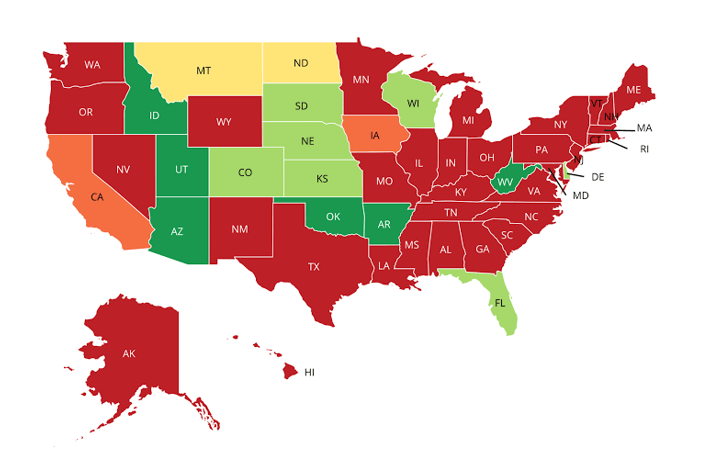
In the 2026 edition, Reason evaluates all 50 states on their K–12 open enrollment policies and notes whether public school districts are required to admit non-resident students when classroom seats are open. Once again, Missouri earns an “F” grade (marked in red on the map below), failing to guarantee either mandatory interdistrict or intradistrict transfer options.
Missouri’s continued resistance to open enrollment is increasingly stark when looking across state lines. Surrounding states have embraced reform to empower families:
Oklahoma and Arkansas receive A’s (dark green), maintaining robust, mandatory statewide open enrollment laws where dollars follow students and districts can only deny transfers for legitimate capacity reasons.
Nebraska and Kansas earn solid B grades (light green), showing that open transfer policies can, in fact, be implemented across rural and suburban communities.
Iowa recently strengthened its open enrollment policies to expand parental options.
Meanwhile, Missouri sits alongside Illinois, Kentucky, and Tennessee as a red wall of residential assignment. Opponents often claim that interdistrict open enrollment causes wild enrollment swings or collapses rural school districts. Yet a recent Show-Me Institute study cited directly in Reason’s report demonstrates otherwise. Interdistrict open enrollment in multiple states caused no widespread volatility, mass closures, or sudden migrations.
Public schools are funded by taxpayers to educate the public. It is time for Jefferson City lawmakers to dismantle residential boundary restrictions and give Missouri children the same freedom enjoyed right across our borders.
Susan Pendergrass speaks with Jim Epstein, director of the documentary Escaping Venezuela and executive editor of Reason magazine, about the film, the rise of Hugo Chavez, what happened to Venezuela’s grocery stores and oil industry, and more.
I’m so looking forward to this conversation. Thank you so much for joining us, Jim Epstein, from Reason magazine, and most importantly, the director of a movie that was just released called Escaping Venezuela. And I just have to tell you right at the top here, I absolutely found it to be so compelling and, full disclosure, cried at the airport scene. So I don’t know if that’s what you’re going for, but it worked on me. It was amazing.
Jim Epstein (00:21)
Thank you. It is what I was going for, but I’m glad it worked out, yeah. Thank you.
Susan Pendergrass (00:26)
I don’t think that many Americans have any connection to the experience of having to leave the country they were born in and grew up in and that they identify with, and having their family separated from them. You just presented it in such a compelling way. And before we talk about the movie, how long did you spend making this movie?
Jim Epstein (00:45)
Oh my God, Susan, so long, so long. Yeah, and
Susan Pendergrass (00:47)
Like so many things happened during it. Like you were in real time.
Jim Epstein (00:53)
I made a lot of rookie mistakes. There were points where it seemed like I was writing a Russian novel and not making a film. I was following, you know, there’s a family at the center of this film, but I also spent a lot of time with a couple of other families too. And there were so many things that happened in Venezuela during this stretch of time, very important things that I just had to cut out of the film. But of course, unfortunately, I didn’t realize that at the outset. So my editor and I constructed these elaborate scenes, and then at a certain point we pulled them out of the film. So there’s a lot on the cutting room floor, some of which is actually gonna show up on our YouTube channel, Reason, fairly soon. But you asked about the timeline. What happened is I started this film right before COVID. And then I shot a couple scenes, set it aside, and then during the pandemic, we couldn’t really travel. Nothing was really happening. So I worked on other projects. I used that time to get my Spanish skills up to snuff for what I needed to do interviews and so forth. And then as the pandemic was winding down, we picked it up again.
And it was kind of a slow burn for a long time. I don’t know if you have a project where your friends say, “What have you been working on?” And you’re kind of embarrassed to say, “That’s, yeah, that’s still that documentary.” “Really? Still, huh? Okay.” You know, it’s like the documentary or the book that’s never gonna get finished.
Susan Pendergrass (02:25)
Yeah, your opus. Yeah.
Jim Epstein (02:26)
You know, and yeah, in the end we all need deadlines. And what happened on January 3, 2026, was that the US government did this crazy
Susan Pendergrass (02:36)
Bananas.
Jim Epstein (02:37)
military operation, went in, captured Nicolas Maduro, and suddenly Venezuela was in the news in the way it hadn’t been before, and I thought, this is my moment, I must finish this film, and I did.
Susan Pendergrass (02:45)
Okay. Get it out.
Was it dangerous to make for you personally?
Jim Epstein (02:53)
Well, the film was not dangerous because I’m really telling a story. I’m not telling a story about contemporary Venezuela during the making of this film. When I started it, I was told, do not go there, because there are criminal gangs that will kidnap you for ransom. It is not safe for an American to be in this country. And then actually the economic situation became so dire that the criminals sort of left. The crime problem reduced a little. And then the issue was actually that the government will kidnap you and trade you for American prisoners, which happened. So that was unsafe. It did not happen to me, but that was a reason why I wasn’t
Susan Pendergrass (03:33)
That happened to you? Okay, yeah.
Jim Epstein (03:38)
going to Venezuela. My story that I’m telling is really like an archival story. It’s about what happened in Venezuela starting in the sixties and seventies and through the Chavez years. So it was not dangerous. I went to the Mexican border, but nothing was dangerous there. We’re going to Venezuela. Germania, the film’s narrator, and I are actually planning a trip to Venezuela in December where we’re gonna make another maybe 25-minute documentary about the country since January 3. And that’s not going to be risky because things have changed to some degree there, and we could talk about that. It’s kind of a complex situation.
Susan Pendergrass (04:14)
Yeah, I want to.
Jim Epstein (04:16)
But yeah, no, there was no real danger in making this film.
Susan Pendergrass (04:19)
So then you release it this month at a time when socialism is cool again, right? So you have this film about the utter collapse of a country that was doing quite well in the sixties and seventies. The utter collapse of that country, I guess due to socialism. I want to talk about the movie specifically, but I’m just thinking in terms of timing. And now we have a number of candidates in the United States that are just proudly socialist.
And people are into it. And what do you think, after working on this film for so long, what’s your take on that?
Jim Epstein (04:52)
So the timing worked out in that sense as well. Just to clarify, the film, when you say “released” is a tricky word. I mean, we’re hosting some screenings. We had one in New York last night.
Susan Pendergrass (04:59)
Okay.
Jim Epstein (05:02)
It’s not available for streaming yet, and people can go to reason.com/escaping and we’ll give an alert as to when you can stream it. The world of documentary distribution, particularly for a very libertarian film, is a whole topic unto itself that we probably don’t want to get into. But in terms of the timing, yeah, absolutely. And you know, I live in New York City and we have a socialist mayor, and there’s a scene in my film where Hugo Chavez is at a grocery store holding food up. And we recently had a very similar scene in New York of Mayor Mamdani holding bananas up because the city is opening some government-run grocery stores.
And you know, I don’t think the United States is about to turn into a socialist country in the way Venezuela was. However, there are a lot of specific policies that are actually being implemented in cities that were tried in Venezuela and led to catastrophe. So there are actually a lot of policy lessons that Americans can learn from Venezuela. And you know, at Reason we sort of see the DSA and some aspects of the MAGA movement as being similar. This sort of horseshoe effect. And there are also parts of the film, such as where Hugo Chavez pulls a broadcaster off the air because he doesn’t like their coverage, which is somewhat reminiscent of Trump. So I think it’s also relevant to some degree.
Susan Pendergrass (06:31)
Yeah. 60 Minutes. Yeah.
Jim Epstein (06:35)
Relevant in that sense as well, yeah.
Susan Pendergrass (06:36)
Yeah, so oftentimes, well, in the last six months when Pew has released polls and Gallup has released polls and Cato has released polls showing a more favorable view of socialism and a less favorable view of capitalism, I’ve talked to folks who are generally from the baby boomer generation, like, my God, do they not know what happened in Venezuela? Do they not know what Stalin did? My reaction has been, no, I don’t think they do.
Right. I don’t think the schools are teaching it well. And I don’t really think people do know. So I will say I learned a lot from your film as well, but I think just tracing, because this is kind of the recent past. This isn’t Stalin a hundred years ago. We are talking since the year 2000, Venezuela has essentially collapsed. So can you just take us quickly through, I mean, I believe that my opinion is a lot of their Achilles heel is the oil that they have underneath Venezuela, right? But can you take us through how Caracas went from this thriving modern city to basically a third world country?
Jim Epstein (07:33)
Sure, yeah, and I appreciate that that was your takeaway. I think more than anything, what motivated me to want to make this film was, when I started, there was this mass migration out of Venezuela. A quarter of the country, eight million people, fleeing. And to me it was absolutely clear that this should be a potent symbol of socialism’s failure. This was the direct result of this grand experiment in socialism started by Hugo Chavez.
And that was not the way it was being interpreted in the media. It was, look at the mismanagement, or look at, you know, an authoritarian government. And I felt that, you know, to truly honor the tragedy of what these victims are going through, we need to learn something from this experience and put this into context. Now, Venezuelan history is fascinating and long and complex. And in 1998, a populist socialist president by the name of Hugo Chavez was elected in a free election to become the president of Venezuela. And he is the man responsible for the catastrophe that ensued. He was very closely aligned with Fidel Castro. A lot of people believe he was a Cuban spy. And he was effectively bringing Cuban-style socialism to Venezuela, which he did, effectively.
Now, of course, the story does not begin with Chavez. And I do touch on some earlier aspects, which is that Chavez was elected because the country was in a terrible place in the 90s. Starting in the 80s, too, actually, there were years where the economy was contracting, growth had stopped. And in the film I tie it back to a president of Venezuela in the 1970s by the name of Carlos Andrés Pérez, who nationalized the oil industry, tripled the size of government, and corruption just skyrocketed. It was just this idea at the time that Venezuela’s oil riches could be centralized in the hands of the state and used to catapult Venezuela into becoming this first world powerhouse. And it was an experiment in central planning that failed miserably. It didn’t fail as miserably as Chavez’s socialist revolution did, which went much further. But it was really that change that began in the seventies that set the stage for what would happen with Chavez.
Susan Pendergrass (10:13)
So then, before Chavez got elected, we get to the eighties, this End of History and the Last Man period where the Berlin Wall comes down and countries are moving away from socialism and Marxism towards more liberal democracies. And in the film anyway, you go, Chavez is like, no, we want to bring the wall back and we reject that premise and we’re gonna be the best. So he just says “socialism” so much. He’s just like, socialism, the socialism, man, the socialism. He really leans in hard. Yeah, yeah. He really
Jim Epstein (10:41)
“Socialism was never really tried.” He uses that famous line. Yeah.
Susan Pendergrass (10:46)
leans in on it. Why do you think that message resonates so much with people?
Jim Epstein (10:53)
Yeah, I mean
Susan Pendergrass (10:54)
I think it’s kind of intoxicating, right? You’re gonna have free government, I mean, I’m sorry, free health care and free housing and free childcare and everyone’s gonna have a job and have an income. You know?
Jim Epstein (11:03)
Absolutely. I mean, if you go back to Venezuela in the late 1990s, where there had been this stagnant growth and there was a lot of inequality, there were people who were living a high life, very much like a first world life of luxury, and then there were people living in these shanty communities that you see dotting the mountainsides of Caracas, in desperate poverty.
Of course, everything Chavez did ended up making that situation far worse. And we have more inequality than we ever did before in Venezuela. It’s profound now. So the socialism made that problem far more severe. However, if you go back to the nineties and you look at this issue, you can understand how people would logically think, well, the wealthy people are taking all the oil money and we’re getting shafted. And of course, that’s not how economies work. The problems in Venezuela were actually indicative of central planning, effectively. But some of the ideas, these classically liberal ideas about free markets and how they lead to prosperity, are somewhat counterintuitive and hard to convey. So if you have a brilliant populist politician like Chavez, who was just this singular political figure because he was both a master communicator, he looked like no other president of Venezuela looked before. He grew up in a house with a dirt floor. He had dark skin. He did not look like these tall, handsome, slick, European-looking presidents that you’d seen in the past in Venezuela. And yet he was also an intellectual who was extremely well read and thought in these grand terms about what had happened in the Soviet Union and the fall of the Berlin Wall, and saw himself as this historical figure who was going to revitalize the socialist movement after the fall of the Berlin Wall. And through a movement that was called socialism for the twenty-first century, we’re gonna do it right this time. It didn’t work out that way.
Susan Pendergrass (13:23)
So let’s go to the grocery stores, all right, ’cause that is being floated by Zohran Mamdani. It’s happening.
Jim Epstein (13:29)
More than floating. Yeah, they’re underway. Yep.
Susan Pendergrass (13:33)
Let’s step through what happened when Hugo Chavez created their own grocery stores and set the prices. How’d that go?
Jim Epstein (13:39)
So yeah, this was one of Hugo Chavez’s missions. He had a series of missions. It’s called the Misión Alimentación. It was like a mission food mission. And what he did was he took over, nationalized a lot of private grocery chains, and started a chain called Mercal. There was actually later a few other government grocery chains as well, and the idea was, we’re gonna sell food at basically the price that it takes to manufacture. We’re gonna take the profit out of grocery items, and therefore it’s gonna become much cheaper for the people to come and buy food. It’ll just lead to a more dignified life for the poor because you won’t have these voracious capitalist store owners who are trying to make money off of a basic thing like food for your family, a can of tuna fish or, you know, rice and beans. And it didn’t go as planned. Of course, people who understand the grocery business know that there are extremely low profit margins in the grocery business. What happened with the government-owned grocery stores is the same thing that happened with all the industries that Chavez nationalized, which is that they became heavily politicized, run by incompetent political operatives who had no idea how to actually run a grocery store. When prices are set below the market clearing rate, what happens is people line up and buy everything off the shelves. So it’s like a basic economics lesson in real life.
Susan Pendergrass (15:23)
Sure.
Jim Epstein (15:24)
And unfortunately there were human lives at stake here. So you had, you know, people loading up pantries. You’ve seen images of pantries just packed with food. You had people carrying groceries across the border to Colombia and reselling them at the market price. You had a phenomenon
Susan Pendergrass (15:41)
That kills me. Yeah.
Jim Epstein (15:43)
called bachaqueros, who were black market sellers who would buy up everything and then sell at the market price through a black market. In later years there were these social media networks, WhatsApp networks, where you’d put your grocery order in secretly via WhatsApp to get the food. Because these grocery stores, there was nothing on the shelves after a while. That’s what happens when you set prices low. So now Chavez, who wasn’t getting the results he wanted, tried to impose fines, prison sentences. There’s a scene in the film where he says, “I’m sending the military to the street to enforce this rule.”
And it’s one example of how socialist policies, people ask me why does socialism lead to authoritarianism? And there’s a couple answers to that question, but one of the answers is because the plans don’t go like the government thinks they will. So in order to correct for that, there’s gonna be another government intervention. And then when that doesn’t go as well, there might be another government intervention. It’s a phenomenon that the Austrian economist Ludwig von Mises talked about, which is another government intervention, another government intervention, and that sort of is the road to serfdom, so to speak.
Susan Pendergrass (17:00)
Well, I loved how Carlos, the man you followed, who I want to talk about, said that there’s greed in capitalism and there’s greed in socialism. It’s just which system is better at handling that greed, whether it’s the invisible hand or the hand of the government. And I think it’s clear, but you know, it’s such a good example of how it falls apart. I mean, the oil industry fell apart. That I am not clear on. I understand the mechanism was government takeover, but how did they get from a functioning oil industry to a nonfunctioning oil industry?
Jim Epstein (17:32)
Right. So the oil industry was actually nationalized in the 1970s, long before Chavez. But they did it in a way where the oil company is called PDVSA, and it was called a state within a state. So it was this powerhouse state-owned company with all of these legal protections between the company and the executive branch, because they realized that you didn’t want the president running the oil company, you wanted the technocrats running it. And that’s how it went. And PDVSA had issues, but it was not a disaster. You had highly capable engineers and people in charge. So just because it was state-owned didn’t mean that it would necessarily turn bad. However, what the formation of PDVSA did do is it set the stage for what was going to happen inevitably, which is a president like Chavez who would come along and say, “Hey, I want to launch all these social programs. I want to fix, you know, all this inequality in the country. And look at this giant pot of money. I need direct access.” So one of the first things he did in office is break down that barrier between the state-owned oil company and the executive branch. So the oil revenues become just a personal piggy bank for him, that he can write blank checks, whether it’s financing a Hollywood film or paying for heating oil in the South Bronx, which he did as a publicity stunt. There were no controls on Chavez’s use of that money. However, one thing they weren’t doing was reinvesting in capital maintenance in the oil industry. So the industry starts to fall apart.
Also, a lot of the highly capable engineers and executives within the oil industry did not like what was going on. They went on strike and Chavez fired them. I think it’s about 17,000 who were let go. So you had this loss of expertise, this decline in quality. And it doesn’t happen immediately. You know, when you stop reinvesting in something, it’s sort of fine for a while, but over time, oil output just begins to collapse and there were deadly accidents. And it’s gonna take, you know, maybe a decade to rebuild because of the negligence of what took place.
Susan Pendergrass (19:59)
So then Hugo Chavez gets cancer and dies, and Nicolas Maduro replaces him. And was he worse?
Jim Epstein (20:08)
Yeah, he was worse in the sense that he was what you might call the mafia stage of socialism, which I think happens inevitably. We see it in a lot of countries, we’ve certainly seen it in Cuba. At first, Maduro was trained in Cuba, he was a socialist, and in fact when he first comes to power, he sort of doubles down on Chavez’s socialist policies. But he wasn’t an intellectual, and ultimately, ideologically, he was just more of a petty criminal who was gonna enrich himself. He and his wife were going to basically build a mafia organization to enrich their friends and connections and put their family members in positions of power. So Chavez was a dangerous figure who is primarily responsible for the catastrophe in Venezuela, but he did have a set of guiding ideas.
And Maduro, because he was a petty criminal, he really took the country much more in the direction of the authoritarian dictatorship that we ended up seeing, where they captured people, they tortured people, they had targeted murders. There’s a terrible case of a city council member in Venezuela who was outspoken against the regime, had just been in New York speaking at the UN, trying to get attention for the situation, comes back to Caracas, is picked up at the airport, killed, and his body’s thrown out the window. There are so many cases like that of just, it’s a mob. It’s
Susan Pendergrass (21:39)
The Supreme Court, right?
Jim Epstein (21:40)
a criminal organization. At one point in the film, I tell the story of an attempt by the opposition to appoint a legitimate Supreme Court, because Maduro had co-opted the Supreme Court. And then Maduro declares that he’s gonna seize all their property and throw them all in prison, which he begins to do. And then it connects to my story, because the Mora family, who are the protagonists of the film, end up helping those justices escape the country.
Susan Pendergrass (22:11)
‘Cause he was always a part of the political opposition, or Carlos Mora was brought into the political opposition to Maduro.
Jim Epstein (22:18)
Yeah, Carlos Mora was really not a political character at all. He was a businessman who ran an apparel business with his wife and was living a quiet and prosperous life in a border town called San Antonio del Táchira, which is right near the border with Colombia. And what he found, he was eventually contacted through a cousin of his who is political, who actually is associated with María Corina Machado. His cousin helped to bring him into these operations where he would help people escape. And what Carlos was really bringing to the table is that it was a small town and he was this beloved figure. Carlos, you just walk around, even New York, with Carlos and he’s striking up conversations right and left. Everyone in this town knew him. Went to high school with him, et cetera. So including the border guards. So if Carlos went to the border, no one asked him to show an identification. “Hello, hello,” you know, and then he would just walk right on through. So what he realized is that if there were people like the Supreme Court justices who were not allowed to flee the country, they’d had their passports taken away, the guards were looking for them, Carlos could get them through because of his contacts, and that is really what he and his family brought to the table, and how he ended up getting involved in politics.
Susan Pendergrass (23:43)
And ultimately going to prison or being picked up and tortured.
Jim Epstein (23:46)
Ultimately imprisoned and tortured, and then makes his own escape. Yeah.
Susan Pendergrass (23:52)
To Miami, as so many Venezuelans have done.
Jim Epstein (23:55)
Yeah. That’s right.
Susan Pendergrass (23:56)
And so then, as you mentioned, ten months ago, the United States grabbed Nicolas Maduro and his wife. They are sitting in a jail cell, as I understand it, in New York City. And there was an opportunity to then replace Maduro with, is it María Corina Machado, who won the Nobel Peace Prize? Correct me.
Jim Epstein (24:15)
Yes, well, yeah, like everything in Venezuela, it’s so complicated. María Corina Machado, who did win the Nobel Peace Prize, is the leader of the opposition movement and someone who would be elected president of Venezuela hands down if there were a free election. Trump has sidelined her, and there’s a big battle over her fight to return to Venezuela right now. But yeah, so
Susan Pendergrass (24:43)
So instead
Jim Epstein (24:44)
right now, instead, we have Delcy Rodriguez, who was a member of the Maduro criminal network, ran the secret police, was in charge of a fake congressional body that sought to displace the legitimate one. I mean, her brother is also a central figure, Jorge Rodriguez, in Chavismo. So she now, there have been some positive reforms, and she realizes that if she doesn’t want to end up in a jail cell next to Maduro’s, she needs to make some movements towards releasing political prisoners and lightening up on the political repression we’re seeing. But this is still a dictatorship, and I think what many observers think, and what I agree with, is that she’s sort of waiting it out. When Trump leaves office, who knows if the next administration will have any interest in what’s going on in Venezuela. So maybe there will never be elections. What they’re paying lip service to is the idea that this is a transition period, elections are coming, we need to do it in a managed, safe way. I hope that that’s true. But
Susan Pendergrass (25:58)
Yeah.
Jim Epstein (25:59)
don’t count the Chavistas out. They’re like, you know, mice and cockroaches, really hard to definitively get rid of. And they’re smart, and we’ve constantly underestimated them. So there’s a lot to be worried about.
Susan Pendergrass (26:16)
So I just think that this is such a fantastic example in recent times, since the year 2000, of yet one more experiment in socialism, right? This is not the first experiment whatsoever. This was going to be the one that worked, according to Hugo Chavez. And you can see that now Venezuela, like I said, or you’ve pointed out, is a third world country, more or less.
It is a little surprising to me that people continue to romanticize this idea that with socialism it’s just a matter of getting it right. Like, it’s been tried, but we haven’t found the right way to try socialism. Does that surprise you?
Jim Epstein (26:52)
I think it’s to some degree a mystery why people still use that word. We’re talking, whether you want to call it communism or socialism, this Marxist ideology, I think there’s convincing evidence that it led to an estimated hundred million deaths in the twentieth century.
Susan Pendergrass (27:12)
Sure.
Jim Epstein (27:12)
So why is it acceptable in polite society? You can’t go around calling yourself a fascist. So why can you get away with calling yourself a socialist? And I think it’s because socialism is an idea that has always been popular, most popular among the intellectual class and within academia, and people don’t learn their history. You know, when Soviet history is taught, it’s not clearly taught that it was an experiment in Marxism and in state ownership of the means of production, and that it turned out to be a disaster. So unfortunately, because of that ignorance, we have to relive this nightmare. And something that I try and show in the film is just to convey the human cost. I mean, there are millions of stories. Carlos’s story is emblematic, but there are many people who were tortured, many people who were murdered, and even more people who saved for retirement, worked hard all their lives, and are now penniless in their old age with food insecurity because their savings were wiped out by inflation, or they built businesses, or they are working in delivery or in restaurants, even though they are doctors and lawyers in Venezuela. And it’s easy to look past them and look past that tragedy and not notice it, particularly if you don’t speak Spanish, if you don’t know the history. And I think that’s what I’m trying to do with this film, is to highlight this tragedy and explain why it happened so that we can learn from these mistakes.
Susan Pendergrass (29:00)
Yeah, I think people, you know, health care’s extremely expensive in this country, and for a lot of folks who even have health insurance, if they break an arm or have a car accident, God forbid, get diagnosed with cancer, they’re gonna have medical bills they can’t pay. And I think that that is troubling to people in such a wealthy nation. So then when politicians who are socialists say we’re gonna have free health care, they’re like, if that’s socialism, sign me up, you know? And then without knowing the consequences of those kinds of decisions and where they lead to. And again, what I think is so great about this film is we don’t have to try it again. We can see this. You can see what happened in Venezuela. And it, you know, I don’t know if people like Hugo Chavez are born or created when they get into a position of power, but you can see what happens when the wrong person
So socialism leads to authoritarianism and almost leads to tyranny, right? Like, it’s hard to break that.
Jim Epstein (29:58)
I absolutely agree. And I
Susan Pendergrass (29:59)
It’s not the right person.
Jim Epstein (30:00)
like your example of health insurance because it’s an example of a system that has a lot of problems. The health care industry in the United States has a whole lot of problems. A lot of those problems are actually tied to the fact that it is in no way a free market system. It’s distorted in all kinds of ways. The US government pays more than half the health care bills in the United States. It’s a heavily regulated industry, more regulated than any other industry. We have this third-party payer system through our tax system where consumers are shielded from feeling the actual costs of the things that they buy. And yet, if you ask the average Joe, this is a market-based system, and all the problems of health care have to do with the free market. So that’s, I think, another answer to your question of why are socialist ideas so seductive? It’s a misunderstanding. In the same way that in Venezuela in the 1990s, so many of society’s problems were a result of government intervention in the market, and yet it was understood, and Chavez certainly depicted it, as the failure of free market capitalism. Thus, we need more socialism and more socialism in order to fix it, which, needless to say, misdiagnoses the problem.
Susan Pendergrass (31:20)
Well, I think a lot of folks are gonna wanna see your movie. Do you have any sense of when it will be streaming?
Jim Epstein (31:26)
So I hope soon. I hope so. Yeah.
Susan Pendergrass (31:29)
Whatever that means.
Jim Epstein (31:31)
It’s such an interesting and sort of new thing to me. You know, I work at Reason and almost all the work I’ve done at Reason goes out on YouTube, which I love. And so this is a little different. This film may end up on YouTube. We’re trying to sort it out. If you do a screening or a festival, you’re also prohibited from having it online streaming. So the timing is very difficult. However, if people are interested in this film, what I hope they’ll do is go to reason.com/escaping. There’s a redirect page. Put your email in there. As soon as it’s available, I promise we’ll let you know. And yeah.
Susan Pendergrass (32:10)
It’s fantastic. I really enjoyed it, and thank you so much for making it. It was fantastic. And thanks for joining us.
Sometimes I stop and think about all the wonderful things we take for granted in our lives. Cars. Indoor plumbing. Heating and air conditioning.
But my favorite example is the grocery store.
Modern grocery stores are amazing. You can walk into one virtually any time and find an incredible selection of fruits, vegetables, meats, snacks, treats, and drinks. Out of season? No such thing. Want strawberries in January? No problem.
Grocery stores are so amazing that it’s hard to believe no one is in charge. How do they manage to have all the things we want, all the time? Who coordinates the farmers, food processors, truckers, and store owners to make this happen?
The answer, of course, is no one. The invisible hand of the free market takes care of it for us.
And it does a spectacular job.
Consider a thought experiment. Suppose that tomorrow, every grocery store on Earth disappeared. To keep this hypothetical from getting too morbid, let’s assume we all have a stockpile of emergency protein paste to sustain us in the meantime.
How would we get our grocery stores back?
More specifically, which system would you trust to bring them back the fastest, with the best selection and lowest prices: the free market or a government central planner?
I’ll take the free market every time.
Imagine what would happen. With grocery stores gone and everyone growing tired of protein paste, the demand for fresh food would be enormous. Prices for whatever food was available would rise, creating powerful incentives for people to figure out how to get more food to consumers.
Farmers and food processors would be eager to sell their products. Entrepreneurs would start buying food from them and finding ways to get it to customers. Roadside stands would pop up. Trucking companies would pivot toward food delivery, bringing truckloads of food into cities.
Someone would open a small store on short notice. Then another store would open. It would offer better prices. Another would offer more selection. A fourth store would stay open later. Successful stores would expand, and others would imitate them. Before long, we’d have supermarkets again, stocked with an astonishing variety of products.
No one would have designed the system. No one would have needed to. Millions of people, each pursuing their own interests, would have collectively rebuilt something remarkable.
Now imagine putting a government agency in charge of the same task. I don’t know exactly how that would go, but I wouldn’t want to bet my lunch on it going well.
Of course, markets aren’t perfect, and governments have an important role to play. But it’s worth appreciating just how much of our everyday prosperity comes from people responding to prices, competing for customers, and finding ways to make things better.
We take grocery stores for granted because they’ve always been there for us. But the extraordinary abundance they provide is no accident. It’s the predictable result of a system that rewards people for figuring out how to give others what they want.
With a functioning free market, grocery stores are inevitable. And that’s a pretty amazing thing.
In 2013, Mississippi ranked 49th in the country in fourth-grade reading, according to the National Assessment of Educational Progress (NAEP). By 2024, it ranked 9th. Over the same period, Missouri fell from 27th to 38th. What drove Mississippi’s gains, and what can Missouri learn from Mississippi’s success and Florida’s approach to educational freedom?
Brenda Talent, CEO of the Show-Me Institute, moderated the discussion. The panelists were Douglas Carswell, president and CEO of the Mississippi Center for Public Policy; James V. Shuls, senior fellow at the Show-Me Institute and research faculty at Florida State University; and Cory Koedel, director of education policy at the Show-Me Institute. The panel discusses third-grade reading retention, phonics-based instruction, teacher preparation, school choice, and leadership’s role in implementing reforms, followed by audience questions.
Compared to 2015, the Springfield Public School District (SPS) today has:
4% fewer students
6% more teachers
61% more administrators (principals, assistant principals, program directors, etc.)
SPS has demonstrated a pattern of hiring more teachers and, especially, more administrators, even as student enrollment has declined.
If SPS operated today with the same number of teachers and administrators it employed in 2015—when it served more students—it could afford to give every teacher in the district a $7,500 raise. If SPS had held staffing at its year-2000 level, each teacher could receive a $14,000 raise.
Springfield is not alone. In our new report, “Missouri’s 21st Century Public School Personnel Boom,” we examine statewide trends in student enrollment and teacher and administrator staffing. We also provide a free interactive dashboard that lets users see these trends for any school district or charter school in Missouri.
Zooming out from Springfield, we find that since 2000 Missouri’s public schools have hired 13% more teachers and 35% more administrators while student enrollment has fallen by 4%. That amounts to approximately 8,000 more teachers and 1,500 more administrators serving 36,000 fewer students.
At the same time, the average Missouri teacher salary, adjusted for inflation, has fallen by 10%. As in Springfield, we calculate that if Missouri school districts had emphasized pay increases over expanding staff, current school budgets could support substantially higher teacher salaries. Instead, districts have consistently chosen to hire more teachers and administrators.
As a result, Missouri’s student-to-teacher ratio has fallen to just 12 students per teacher, well below the national average of 15. The number of students per administrator has fallen from 220 in the year 2000 to 156 today.
Our report documents what has happened: school-district staffing is up, while student enrollment is down. The harder question is why.
We consider three possible explanations: (1) students are needier than they used to be and require more support, (2) schools have come to perceive students as needier, even if this is not true, and (3) regulatory and administrative expansion is pushing hiring, some of which is likely duplicative and inefficient.
The evidence gives us reason to doubt the first explanation. For one, there is no consistent evidence that students are objectively needier today than in the past. Poverty rates, for example, are commonly used as a proxy for student need and are lower today than they were earlier in the 2000s.
The timing of the personnel boom also raises questions about this explanation. Staffing growth has been persistent throughout the 21st century and does not correspond neatly to factors that might plausibly have made students more difficult or expensive to educate. For instance, smartphones have created new challenges for schools, but the personnel boom began well before smartphones became ubiquitous among school-aged children.
This suggests that the other two explanations are more likely. Schools may have broadened their conception of what constitutes student need and what schools should do to address it—a phenomenon psychologists call “concept creep.” And the ever-expanding education bureaucracy creates more work, which requires hiring more workers to do it, even if the work is not productive. The latter explanation seems particularly relevant to the growth in school administrators.
All of that said, we are researchers, not school officials, and our report does not give a definitive explanation for the personnel boom. We hope it starts a conversation among the people who can provide such an explanation.
In Springfield, that conversation should begin with some straightforward questions: Why has administrative staffing increased by 61% since 2015 while student enrollment has declined? And given the tradeoffs involved, is continuing to expand staffing the best use of SPS resources—or should more of those resources be directed toward teacher salaries and other priorities?
Support Us
The work of the Show-Me Institute would not be possible without the generous support of people who are inspired by the vision of liberty and free enterprise. We hope you will join our efforts and become a Show-Me Institute sponsor.