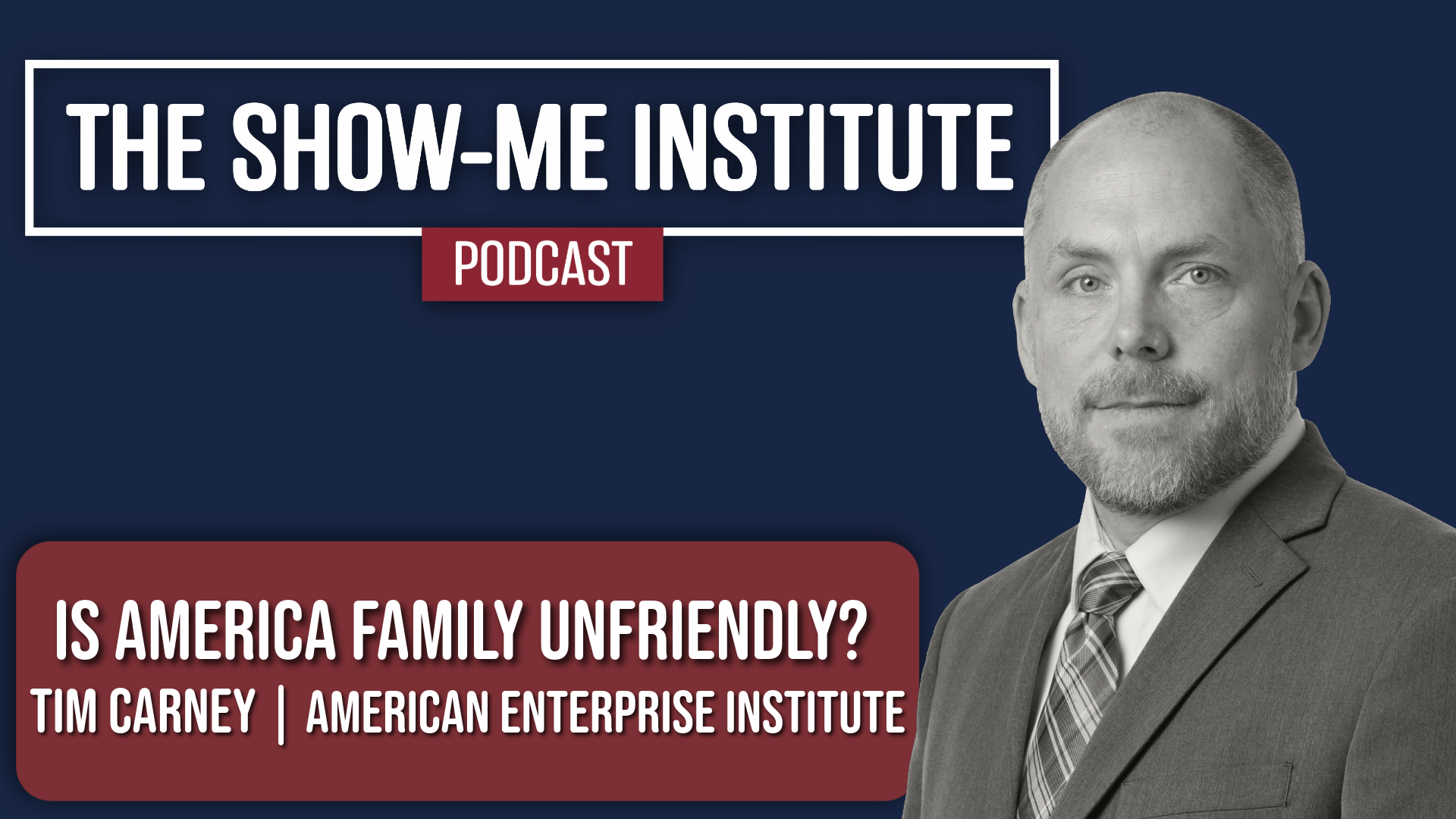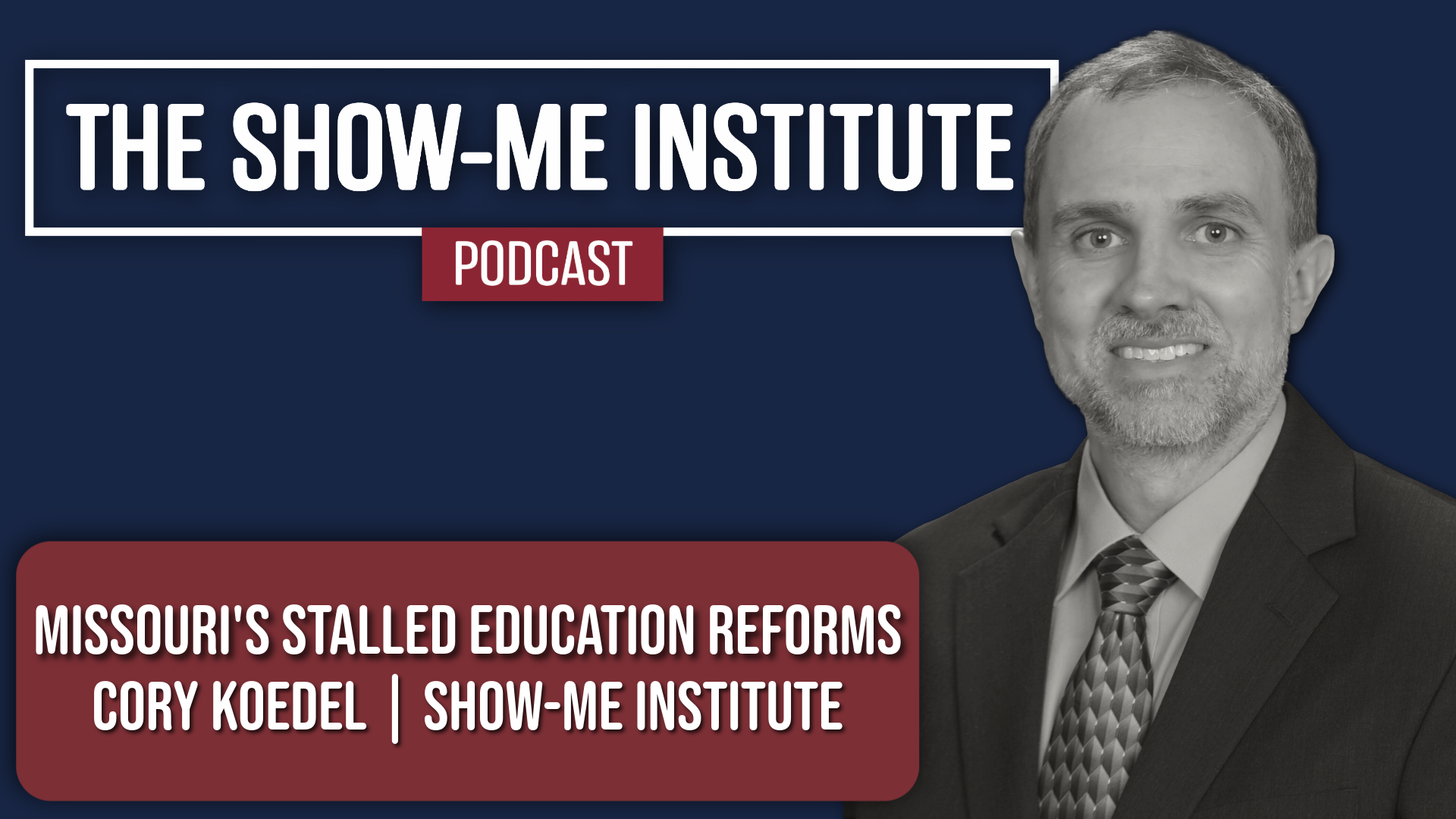
Susan Pendergrass speaks with Cory Koedel, director of education policy at the Show-Me Institute, about Missouri education policy following the 2026 legislative session. They discuss the governor’s A to F letter grade executive order, why literacy legislation failed to pass, leadership turmoil at DESE, Show-Me’s latest Report on the effects of open enrollment, the case for expanding charter schools in Missouri, and more.
Episode Transcript
Susan Pendergrass (00:00): Not for the first time, we’re going to be talking to Dr. Cory Koedel of both the Show-Me Institute and Mizzou. Thanks for coming on once again. You and I sort of slogged through the legislative session together with other folks week by week. I am not the first person to say it’s like Lucy holding the football for Charlie Brown, where every year I’m a little optimistic that something’s going to really happen and things are just
Cory Koedel (00:07): Thanks for having me.
Susan Pendergrass (00:27): looking good early in the session, and then it seems to fall apart. What do you think happened this year in particular? What’s your take?
Cory Koedel (00:35): Well, I agree with you. I was optimistic going in. I think the governor set a great tone. Before we start talking about all the negatives, because ultimately I think it was a dud, I think the A to F letter grade executive order was a really good thing and I don’t know how
Susan Pendergrass (00:50): Can you explain what that is?
Cory Koedel (00:51): Yeah, so the governor in January issued an executive order that is going to require the Department of Elementary and Secondary Education to give A to F letter grades to all schools and districts. This is something a lot of successful states do. We’ve written before here at the Show-Me Institute about how the report cards that DESE puts out are kind of a number dump. There’s no use, it’s hard to learn anything from them, people don’t understand what the report cards mean, and they’re effectively useless. This is going to end that. There’s going to be good, transparent information about school performance in a way that everyone understands what it means. And the executive order lays out that the information to be used is based on student achievement. So that was a really great thing.
Susan Pendergrass (01:33): But it kind of threw a rock in the pond, right? It did for me anyway, which is to say I didn’t know this was going to happen. I’m guessing that some folks at DESE, either before it happened or when it happened, were a little taken aback that they had this now huge item on their to-do list. And then ironically, or maybe this made sense to everybody else, the legislature decided to take up A to F letter grades, and I felt like that took a lot of their attention.
Cory Koedel (01:58): Well, I think there’s some sense of that. They were following the leadership of the governor, and an executive order is not a permanent thing. It can be rescinded by the next governor. And if there is momentum behind this to codify the executive order in legislation, I was supportive of that. I think, and this is where the negative comes in, ultimately the legislature just could not get anything done this session. There was this issue, and the other big thing that had a lot of momentum was literacy policy, and that also failed. The legislature just couldn’t get out of its own way. But we still have the executive order, and that’s an important thing this year.
Susan Pendergrass (02:33): And when you say the literacy policy, just tell folks what that is.
Cory Koedel (02:36): Yeah, sure. There is growing recognition that test scores in the country have been pretty bad, and there’s a handful of states that are bucking the trend. There’s a small handful of things those states are doing that seem to be important, and one of them is based on literacy: teaching literacy the right way, which means using phonics instead of a method called three-cueing that encourages kids to guess at words and has been debunked. So focus on phonics, and then the other thing is demanding that kids can read by the end of third grade. What that means is you give them a literacy-focused assessment to figure out if they can read, and if they can’t, you retain them in third grade. We had some literacy legislation that had those elements in it, and there was a lot of support for it in Jefferson City, but ultimately it could not get done.
Susan Pendergrass (03:27): And one thing that is happening from legislation a year or so ago is that in addition to St. Louis County, St. Louis, and Kansas City, basically Boone County, in the middle of the state where Columbia is, where you live, was written into a law that would allow Boone County to get charter schools sponsored by something other than the local school board, which has to be the sponsor everywhere else in the state. There is one charter school opening in Boone County and another one trying to open, one that’s been approved by the state board, and that seemed to come into play at the end of the session, right?
Cory Koedel (04:02): Are you referring to the stance by a senator that essentially any education legislation would have to come with a repeal of the rule that allows charter schools in Boone County? Yeah, I think
Susan Pendergrass (04:15): Yeah, like one senator derailed all kinds of things. Reading, and more. Doesn’t that surprise you? Like one senator can throw off the whole thing.
Cory Koedel (04:25): Well, this is an area where I’m not a political expert. I don’t pretend to be. I’m learning on the job. But it sounds like we have this really strong filibuster rule in the Senate that allows this. As someone who doesn’t like big government as a general principle, I don’t mind that it’s hard for government to get stuff done. But it is very frustrating when there’s a policy, literacy in particular, where there’s overwhelming support. Everyone wants our kids to read. Anyone who looks at the data can see how bad it is. And then a small handful, even a single person, can just derail the whole thing. Yes, it’s very frustrating.
Susan Pendergrass (05:02): That’s crazy. But there are things happening outside of the Missouri state legislature that give us some opportunities via the executive branch. Just bring us up to speed on what’s happened over at DESE.
Cory Koedel (05:17): Well, there’s a lot of turmoil at DESE right now. The Commissioner of Education resigned last month, as well as one of the number two people there. I don’t want to be speculative about things I’m not sure about, but I will say there is a recording of a highly contentious meeting with the school board
Susan Pendergrass (05:28): Do we have any idea why? Frustration or
Cory Koedel (05:42): the month before the resignation occurred, and that would be quite a coincidence. We have essentially an entirely new school board since the governor came in, with the governor appointing a bunch of people, and they’re behaving very differently than the school board has behaved in the past. For me, I feel bad for the folks involved. Change is always hard. But things have not been going well in our schools in Missouri, so
Susan Pendergrass (05:51): Mm-hmm.
Cory Koedel (06:09): I think the change is needed, and the school board is pushing for it.
Susan Pendergrass (06:13): Yeah, they’re much more active than they’ve been in the past. Not activists, but the prior school boards changed by one or two people here and there, and they were kind of a rubber stamp to what DESE did and didn’t really push back.
Cory Koedel (06:29): Yeah. I wouldn’t use the term activist. It’s rubber stamp versus genuinely holding DESE to task on the things DESE is supposed to be doing. That’s what I see as different.
Susan Pendergrass (06:36): Existing. Yeah. So I interrupted you. You said the commissioner resigned, and
Cory Koedel (06:49): what I viewed as kind of the second in command stepped out as well. And the school board president, who had been on the school board for a long time, also resigned. So we’re going to have entirely new leadership at the top for state education policy.
Susan Pendergrass (07:04): How do you recommend that the Board of Education go about finding someone to replace the Commissioner and Deputy Commissioner?
Cory Koedel (07:11): Well, I think a national search is important. Missouri has been pretty comfortable just promoting from within and keeping things as they are. I do think we need real change. The biggest quality this person would have is that they would be aspirational. I don’t think we’ve had aspiration at the top of DESE or the school board for a very long time. Someone aspirational who is willing to go in, acknowledge hard truths, because I think that has been lacking here, and then set out a serious, feasible vision for how to get to where we want to go.
Susan Pendergrass (07:47): Yeah. Because ultimately our kids graduate from our schools and go out into the world. They don’t just stay in Missouri, right? The idea that we can just do things how Missouri has always done them and not worry about what other states are doing is something that needs to be put aside, in my opinion.
Cory Koedel (08:10): Yeah, and just beyond that, the test data are pretty overwhelming that our kids just aren’t learning as much anymore. If we were a business, we’d say we can’t keep running our business like this, this is not working, and we would change. We need to have that mentality here as well.
Susan Pendergrass (08:26): One thing that’s been floated the last several legislative sessions, at least four or five, often by the same person, is an idea that many states have. It’s kind of a gateway to letting kids pick any public school they want within their district or outside of their district, which is called interdistrict choice or open enrollment. That has come up routinely in Missouri. We have not done it. Kansas, our neighbor, has done it aggressively. Oklahoma as well. And there are folks in the state for whom this is the one and only issue, the one thing they want more than anything else: for kids to be able to pick any public school. There’s pushback on that from superintendents and people within the system who say we won’t be able to manage the kids moving all over the place, the money moving all over the place, schools will have to close, the small rural ones especially, and it’s going to cause major upheaval if we allow open enrollment. You’ve just written a paper on this. What do you say to that claim?
Cory Koedel (09:33): Yeah, so this all started when I was giving testimony down in Jefferson City. As you mentioned, open enrollment comes up at least recently every legislative session. This session was a little quiet because the legislators were focused on the letter grades and literacy, but in prior sessions it’s been quite prominent. The testimony against open enrollment, the first-order thing they talk about, is the disruption this is going to cause, both in terms of operations, like how are we going to handle
Susan Pendergrass (09:40): Right.
Cory Koedel (10:00): this huge influx of kids, and then finances. My initial reaction when I was listening to this testimony was that it didn’t sound like that would happen as extremely as they were implying. And then I went and looked, and there’s really not much evidence on it. We collected data from five states that have implemented open enrollment policies. We picked the states to be informative about Missouri, kind of nearby, but they also have different levels of the policy. Some states have very expansive open enrollment policies, like Oklahoma. Some states are pretty restrictive, where the districts don’t have to participate and can exclude kids for whatever reason they want. So there’s a whole range of these programs. We pulled together five states that differ on dimensions that allow us to see some of this, and we looked at what happened to enrollment across districts when open enrollment was implemented, looking five years forward. I thought the claims I was hearing in the testimony were probably overstated, but I was a little shocked at how little we found.
Susan Pendergrass (10:56): Sure.
Cory Koedel (11:06): There’s really no evidence of any disruption caused within the first five years that you can see statistically. One thing to keep in mind is that school districts experience enrollment fluctuations every year for all kinds of reasons. This stuff is moving up and down, people are moving around, there’s a big group of ten-year-olds in an area for whatever reason, all these kinds of things are happening all the time. Open enrollment happens, and you can’t really see anything changing beyond the normal fluctuations that districts already experience. The result was a little stronger than I thought it would be in the sense of just nothing being there, but it really made me think that this whole disruption claim is a non-starter.
Susan Pendergrass (11:45): Yeah, I often hear, what about the buses, we’re going to be driving these kids all over the place. And there is this idea that there’s going to be a magnet pulling kids from the low-performing schools to the high-performing, wealthy schools. That has never even been part of the legislation. It’s always been if you have an open seat, and districts can say how many open seats they have at what grade in what schools, and parents can apply to have their child fill that open seat. There’s never been a scenario where it’s completely open and people are crossing all over the place. That is true in some places like New Orleans, which is a hundred percent charter school, where kids aren’t zoned at all and it seems to function. But the doomsday scenario, and the rurals especially claiming they’re going to have to close, did you look at school closings too?
Cory Koedel (12:40): Yes, and on school and district closings, there’s really nothing happening there. Those just aren’t very common events. They weren’t very common before open enrollment was implemented, and they aren’t very common after.
Susan Pendergrass (12:42): Yeah. Right. Although we have some tiny school districts in Missouri. So where do you stand now? If someone pushes for it, it’s not going to bother you because it doesn’t really do anything?
Cory Koedel (13:01): Well, I want to back up and talk a little bit about something you mentioned. There are two extremes here. The people who are most against open enrollment are either in the camp of, essentially, I am a taxpayer in a wealthy district and our district is great, and everyone is going to come and overwhelm us as soon as this is allowed. But there’s no basis for that, because as you indicated, no well-defined
Susan Pendergrass (13:05): Yes, please do.
Cory Koedel (13:27): policy would allow that to happen. It’s always if you have capacity, and local people get first priority. That policy is just built not to allow that. I also think it’s true that the people living in areas with the best schools overvalue them by the fact that they live there. They’re all wound up about school quality. It doesn’t mean everyone else everywhere is just dying to beat down their door and get into their school. They don’t care as much. And on the flip side, you have the claim that these low-performing schools are going to get bottomed out, emptied out, and have to close, and everyone will leave. There’s also a lot of evidence that there’s not a lot of leaving out of those districts anyway. My bigger issue with that is, what exactly are you holding on to here? You’re a big believer that a terrible school should just be able to exist forever? I don’t understand that. But even ignoring my personal view that it’s not so bad if a terrible district closes, people just are not fleeing en masse. The people who really want to go to better schools, the system’s imperfect, but they already aren’t living near the really bad schools. There are ways they can get around that. There’s just not this strong push and pull on both sides like people imagine.
So in principle, open enrollment is a good policy. In states that have it, maybe a little over 10 percent of kids participate in some states. In most states it’s mid single digits, like five, seven, eight percent. That’s a decent amount. It’s a nice feature that kids should be able to choose their school if they want to and if there’s space. Our paper really shows it doesn’t do much harm. The school system can handle it, so why not do it? I will say, proponents of open enrollment, there’s a little bit of a double-edged sword here, where it doesn’t look like it’s some market-shifting mechanism that just upends the school system and creates a super-efficient market, because most people do stay local and just go to their local school. So it kind of dulls my enthusiasm for it if you want to put it that way. It’s not the first thing I would want to do to make our school system more efficient from a market perspective. But it’s a nice policy, we should have it, and it’s not causing harm.
Susan Pendergrass (15:28): Yeah. I think all the conversation around it, and not this year but the year before, in the 2025 legislative session, some of the lower-performing districts were like, okay, if I vote for this, we have to carve out my district so kids can’t leave, which is absurd. Because we’re low performing, the kids will want to leave, so carve out the low performers and lock the door, make sure the kids have to stay. That’s crazy. But I think it’s created a general disdain for the idea of letting kids pick a public school rather than being assigned to one. Because you and I have also worked on this issue: by law, if a school is designated as persistently dangerous, kids are supposed to be able to leave. Missouri doesn’t identify any persistently dangerous schools, but federal law says if a school is persistently dangerous by definition, kids are allowed to leave. And in many states that have letter grades or some other rating system, kids in the lowest-performing schools are allowed to leave. If you go to an F school, they can’t make you stay. You can pick another public school. My concern is that in Missouri there’s such a strong distaste for the idea of public school open enrollment that we’re not even considering it in those extreme cases.
Cory Koedel (16:57): Yeah, I think you’re right. It kind of boggles my mind, because I don’t think anyone is anti-kid. If you found some kid and said, look, your school is really dangerous, somehow people talk themselves into that being an okay policy because they’re worried about the school itself or the adults. For me it’s just like, look, these kids, this is it for them. The kids in our schools today, this is their shot. We can fix our schools and make them better tomorrow, but for the kids today, this is what they have, and
Susan Pendergrass (17:05): No, I don’t even.
Cory Koedel (17:30): why are we trapping them in terrible options? They may choose terrible options, and I think that’s harder. If they want to do that, I feel like we have to let them. But if families want to choose something better, why aren’t we helping them do that when we have the space? There’s plenty of slack in the system in this regard. There can be open seats at a better school and you have these kids who want to go there. Why not
Susan Pendergrass (17:36): Mm.
Cory Koedel (17:54): fill those open seats and make for a more efficient system.
Susan Pendergrass (17:57): Minnesota in 1989 said you can go to any public school. I don’t think they’re known for it. I don’t think people think, wow, I have to get to Minnesota, I can pick any public school. The idea was just that you pay your property taxes to a public school district, but your child could attend any public school. They did not see massive movement. I think if I remember correctly, in the early days, parents of children with IEPs would often shop around for what they believed to be the best school to serve that IEP. And parents in low-performing schools tried to move to higher-performing ones. But people who are born and grow up in Minnesota are just used to this idea. In Missouri it just seems so foreign that folks have a hard time accepting it. What about the money? Immediately people are like, what about the money? How will that ever work? If I’m paying my property taxes to have my kids in this school and somebody comes along who didn’t pay the property taxes, they can’t go there. I just find that to be frustrating.
Cory Koedel (18:56): Yeah, we were going to talk about the money. The reason we didn’t end up talking about the money much is that the money through open enrollment flows through the kids. And there just weren’t big changes in enrollment, so it’s not going to change the money.
Susan Pendergrass (19:06): The kids weren’t moving. Yeah. So, theoretically, when it comes to school choice, kids have the option of virtual public school open enrollment, private school choice through scholarships usually, and charter schools. What’s next for you? If open enrollment is sort of a meh, we have an ESA program that just seems to be growing in its own way. We’re up to ten to fifteen thousand kids.
Cory Koedel (19:33): Yeah. The federal tax credit is what’s really giving that a boost.
Susan Pendergrass (19:37): It could potentially explode it, yeah. We’re at like ten to fifteen thousand kids, I think. One to two percent, something like that. And charter schools, we have gotten nowhere in Missouri. Almost nowhere.
Cory Koedel (19:48): Almost nowhere. We have them in Boone County now.
Susan Pendergrass (19:52): Almost nowhere. I mean, honestly, not much further than twenty-five years ago when the law passed. It was Kansas City and St. Louis. It’s still pretty much Kansas City and St. Louis. Now we have Boone County, one school, but that’s something. What do you think can be done to convince Missourians that charter schools are something every family should be able to pick if they want to?
Cory Koedel (20:17): Yeah, I feel like this is the biggest missed opportunity in Missouri right now. I say that partly because we have good evidence from national studies of charter school effectiveness that our charter schools are effective: kids learn more during the year in charter schools than if they go to the traditional public schools. They work. There are a lot of people who are against school choice fundamentally because of public dollars going to private providers. I’m not in that camp, but I understand the argument. But that’s not an argument against charter schools. Most charter schools are public schools. Why not have this higher-quality option that is also a public school and has to take everyone who applies? Why not have that option available for families where their zoned public school is not effective? It’s really hard for me to understand.
Susan Pendergrass (21:03): Tell me why not. What do you get from folks? Because I’ve been in these committee hearings too, and the stuff I hear is like what you just said: they’re not public schools, they can turn kids away, they don’t have to take kids with special needs.
Cory Koedel (21:17): Well, here in Columbia, where we have the new charter school and hopefully will get some more, the public school district is fighting really hard against it. Their argument is very vague, but it essentially comes down to the claim that the charter school is going to take money away from the traditional public school district and they won’t be able to educate children effectively anymore. That doesn’t make any sense because the charter school is educating those kids, and if the charter school is no good, no one has to sign up. No one gets forced to go there. If the traditional public school district is doing such a great job, no one will go to the charter school. It’s no big deal. The whole thing gets circular and frankly doesn’t make much sense to me. But it is kind of effective. There are a lot of people who quickly get into the circle-the-wagons mentality, that it’s the outsider enemy and we can’t have it. There’s certainly that sentiment around town here.
Susan Pendergrass (22:10): Yeah, and similarly, they’re not ubiquitous everywhere, but there are many states where, you know, we had an employee from Minnesota who said, well, what do you mean you don’t pick your school, because she grew up in a state where charter schools had been around throughout the state. In some states, I think half of all charter schools are sponsored by local school boards. In some states, the state education agency charters all the charter schools, like Texas. They’re not seen as the enemy to keep out. It’s a portfolio approach. They’re just not seen as the bad guy the way they are in Missouri. Do you have a plan to help people understand why charter schools can be a good option? Where do we go? Do you go to the state board, the legislature, local school boards? I’ve had people reach out to me throughout the state saying, how come we don’t have charter schools? I’d love a classical charter school in Joplin, and I’m like, you have to start working on your local folks.
Cory Koedel (23:12): Yeah, the resistance of our local school boards to charter schools is very strong and consistent. As you mentioned, nationally a lot of public school districts sponsor charter schools and approve them. I will say in places like California, they have that model and a lot of charter schools opened in cities when enrollment was growing. Then enrollment started falling and now the circle-the-wagons mentality comes back and the public school district says no more charters, we can’t let you take our
Susan Pendergrass (23:19): Yeah. Sure. Mm-hmm.
Cory Koedel (23:45): students. So those pressures do come up in other places. In Missouri it’s kind of been a more stable, steady pressure against. My view is that the inability of local school boards to operationalize this tells me that the state charter school commission should be able to approve these charters statewide. That’s the solution to this.
Susan Pendergrass (24:08): The state charter school commission. Mm-hmm.
Cory Koedel (24:10): State Charter School Commission, thank you. They should be able to approve these charters statewide. That’s the solution to this.
Susan Pendergrass (24:18): What we’ve talked about at the Show-Me Institute is, if you go to your local school board and they say no, you can appeal it and have the state charter school commission step in. I think that’s exactly right, and that would be a great model. We’ll see if it ever happens.
Cory Koedel (24:33): Yeah, but why doesn’t it ever happen? The fact that it’s never happened makes me think that’s not a truly viable path.
Susan Pendergrass (24:41): It’s not right now. It would have to change the law.
Cory Koedel (24:44): So you’re saying you ask the local first. If they say no, then the state can step in. That’s the law you want, that’s how you want the law to change.
Susan Pendergrass (24:47): Yes. I think so, because the local school board would figure, if we don’t do it, they’re going to do it. So maybe we want to control it. Because in a lot of places the local school board wants to have a handle on it. They are the sponsor, they review the performance every few years, and they have some control, and that’s why I think they do it. But in this case it would essentially be very similar to going straight to the commission. You go to the local school board first and give them the option. If they say no, then go to the commission. And the state charter school commission doesn’t approve every charter school either. They turn them down. What we’ve learned over the last three decades is that you need to start strong to stay strong. There’s no more get a storefront and fifteen kids and just be scrappy and make a go of it. You need a high-quality charter school. And Missouri, I should say, has had many charter schools closed.
Cory Koedel (25:23): It’s hard to get approved.
Susan Pendergrass (25:43): And that to me kind of proves the model. If you’re not performing well, you close. Well, we’re probably going to have to come back and talk about this some more, this charter school conundrum in Missouri. But for now, open enrollment, we don’t need to sweat it. And we’ll just cross our fingers for the 2027 legislative session. Thanks, Cory.
Cory Koedel (26:04): Yep. Thanks for having me.
Produced by Show-Me Opportunity