Hey! Hey! Hey! Hey! Pay for Your Own Stadium

Yesterday I wrote about an interview I did with KMBC 9 on the Royals’ latest announcement that they had new renderings and “economic impact” details for their new proposed stadium. What makes the subject especially contentious among civic leaders is that the Royals are debating between two sites in the region—one in downtown Kansas City in Jackson County, and one in the inner-ring suburb of North Kansas City in Clay County. The Royals didn’t announce any news on that decision this week, which will likely be made at the end of September when the season ends.

That said, I should make and reiterate a few points about the Royals’ stadium issue, now that it’s back in the news.

There is a bit of deja vu here, of course; about this time in 2022, I was talking about a potential move for the Chiefs, whose lease at the Truman Sports Complex ends when the Royals does. But the takeaway now with the Royals is the same as it was with the Chiefs—sports teams should pay for their playthings themselves. The Royals may be the kings of Kauffman, but when it comes to sovereign action in the real world, public officials should reject spending tax dollars on anything but legitimate responsibilities of government. Subsidizing sports teams isn’t one of those responsibilities.

Show-Me Talks Royals Stadium Move on KMBC

This week, the Kansas City Royals unveiled their latest renderings for two potential new stadia sites—one in Kansas City proper, and one in North Kansas City, which is a different municipality. They also unveiled some new figures for what the team believes will be the “economic impact” of both the construction and operation of the ballpark, wherever it might be. As our readers might have already guessed, the magnitude of that number starts with a “B,” as in billions. The team is essentially promising taxpayers that “all of your wildest dreams will come true.”

I had the opportunity to sit down with Jackson Kurtz at KMBC Channel 9 in Kansas City after the Royals finished their press conference and give him my views on the situation. I’ll have more to say on the Royals tomorrow, but in the meantime, here’s the story we were a part of that ran earlier this week.

Problems with Paperwork

If they knew they didn’t have to, would anyone do paperwork?

Over the past few months, I’ve talked a lot about Missouri resuming its Medicaid eligibility redetermination process. In short, during a three-year pause on eligibility checks, Missouri experienced enormous Medicaid enrollment and cost growth. Today, more than 20% of all enrollees are likely ineligible for the program, either because they make too much money, have coverage from their employer, or have moved out of state. This means that Missouri is wasting upwards of $120 million each month footing the bill for health coverage for people who aren’t qualified to receive it.

Missouri’s Medicaid agency is now two months into processing redeterminations and enrollment has finally started dropping, albeit slowly. Recent reports from both national and local news outlets are attributing the enrollment decline to “paperwork issues.” In my opinion, this characterization is incredibly misleading.

States classify anyone who fails to respond to a renewal application as being removed from the program for “procedure reasons.” This is being referred to as “paperwork issues” by some. This is in contrast to the other classification of individuals removed from the program—those who were “determined ineligible.” The problem is that if the state never hears back from an enrollee after repeated attempts to confirm their eligibility, they can only be removed from the program for “procedure reasons” because there wasn’t enough information to determine their eligibility one way or another. Calling all failures to respond to the state Medicaid eligibility checks “paperwork issues” misses a key point.

Someone who knows they no longer qualify for coverage is incredibly unlikely to go through the effort of filling out and returning the Medicaid renewal application. For years, individuals on essentially every welfare program (including Medicaid, Supplemental Nutrition Assistance Program [food stamps], and Temporary Assistance for Needy Families) have been required to inform the state when something changes that would make them ineligible for services, but they rarely do. Recently, the Congressional Budget Office estimated that more than 5 million Medicaid enrollees nationally are currently enrolled in private health coverage, meaning states are losing billions providing coverage to individuals for whom it’s completely unnecessary.

Most Medicaid rules are biased toward recipients maintaining continuous coverage, which may sometimes be a good thing, but for many people, Medicaid is a resource they only need temporarily. No one is saying that eligible Medicaid enrollees should be removed from the program, but even if that does happen, they’re still effectively covered because the federal government will cover up to three prior months of health costs once they’re determined to be eligible again.

Removing Medicaid recipients who don’t provide evidence of eligibility is a necessary act of fiscal prudence—an act of prudence that, prior to three years ago, was standard, federally mandated operating procedure.

There’s no getting around the fact that more state tax dollars being spent on ineligible Medicaid enrollees means less money for other state spending priorities, such as education and infrastructure. If Missouri’s elected officials ever want a chance at reining in Medicaid’s runaway spending, scrutinizing the program’s rolls must remain part of the equation, and occasional drops in enrollment must be normalized as simply par for the course.

A State at Risk: Education in Missouri

In 1983, the Reagan administration released the results of a nationwide evaluation of America’s education system in a report titled A Nation at Risk. The findings were frightening—so much so, the report stated, that “if an unfriendly power had attempted to impose on America the mediocre educational performance that exists today, we might well have viewed it as an act of war.” A “rising tide of mediocrity” was declared a threat to America’s future.

It’s been 40 years since the report was issued and, in the following decades, Missouri’s education system has struggled to keep its head above that rising tide.

It’s time for our leaders to act.

Missouri Students Are Sadly Still Struggling

Recently, DESE released the preliminary results of the 2023 Missouri Assessment Program (MAP), and the results were bad enough to upset the Missouri Board of Education. One member stated, “These numbers are not impressive. They are kind of depressing because nothing changed.” I share these same feelings; it is sad to see over half of our students fail to adequately grasp foundational concepts.

Missouri, along with many other states, is struggling to bounce back to pre-pandemic achievement levels. In Missouri, scores have mostly recovered in math, but our English/language arts (ELA) scores have declined.

Here is a brief overview of the preliminary 2023 MAP results.

Mathematics took a bigger initial dive but has largely bounced back to its pre-pandemic levels. All cohorts of students (3rd grade, 4th grade, 5th grade, etc.,) have gradually recovered in mathematics and had a higher average score in 2023 than they did in 2021. On the other hand, only Missouri 5th graders had a higher average score for ELA in 2023 than they did in 2021. Interestingly, ELA scores are actually decreasing rather than recovering (hopefully the new LETRS program can help).

Particularly concerning are 3rd-grade and middle-school ELA levels, both of which are still much lower than pre-pandemic levels. For 3rd graders, scores slumped in 2021. Even as kids returned to school full time, scores have not increased—but have remained completely stagnant. Missouri’s 6th graders have actually had their scores decrease steadily for four straight years, with scores decreasing even before the pandemic. Compared with other grade cohorts, Missouri 6th graders have the biggest loss between pre- and post-pandemic scores. Additionally, our state’s 7th graders have had their scores drop lower every year since 2021 (8th graders dropped in 2022 and remained steady in 2023). Our middle schoolers are not rebounding from the pandemic, they are actually struggling even more in ELA.

We need drastic actions to address this education emergency. Missouri’s Commissioner of Education claimed that the teacher shortage is impacting student learning as positions are filled with substitutes or left vacant entirely. I agree that there is a teacher shortage in Missouri, but it’s concentrated in specific schools and subject areas. We need major change. Allowing school districts to offer bonuses or higher salaries to recruit and retain high need positions could help fill these roles and make the education system more responsive to the market.

These scores are concerning, but I am hopeful that these “deflating” results might motivate our legislators and districts to bring more freedom and innovation to education in our state.

20 Missouri Districts Get the Green Light to Try New Assessment System

New beginnings are in the air in Missouri. Some families are sending their children off to college for the first time. Some students will be starting at a new school very soon. Twenty* Missouri school districts are seeing changes too, as a new adaptive standardized testing system—the Demonstration Project—was just approved for these 20 districts by the State Board of Education effective this school year through the 2025–2026 school year.

*Affton, Branson, Center, Confluence Academies, Fayette, Lebanon, Lee’s Summit, Lewis County, Liberty, Lindbergh, Lonedell, Mehlville, Neosho, Ozark, Parkway, Pattonville, Raymore-Peculiar, Ritenour, Ste. Genevieve, and Shell Knob

The Demonstration Project is a formal trial implemented with the goal of determining whether the Missouri Assessment Project (MAP) (which tests at the end of the year) should be replaced with an individualized and continuous system. I have discussed the details, benefits, and concerns with this project in two previous posts. If this new system sees success, Missouri could try to incorporate it statewide.

What will change for students this year?

Students in these 20 districts will be tested more frequently—three times in English/language arts (ELA) and three times in math (45 minutes for each subject), and the assessments will be on a computer. Students should know that it is an adaptive test, meaning the test will change in real time based on the responses—if a student misses questions, the test offers easier questions and vice versa. For a test taker, this means one cannot afford to make any careless mistakes. On traditional tests, all questions are weighted equally, so if one accidentally marks bubble C instead of bubble B, it will count as one mistake. However, if one accidentally picks bubble C or carelessly forgets to flip the sign on a negative number, the adaptive test will count it wrong and think the student cannot do harder problems since one of the easier problems was missed. Therefore, students should double check their work, because a careless mistake on the wrong problem can tank their score.

Students in these 20 districts will also take the MAP this year. The federal government mandates that every district in a state participate in a uniform standardized test. The MAP is a federally approved and mandated test, so any exemption from taking the MAP would have to come directly from the federal government. These 20 districts have requested a federal waiver, and we will see whether it is accepted or not.

What will change for parents?

The results of these student assessments will return quickly via an online form, and there will be a detailed breakdown of each student’s strengths and weaknesses (here is an example of adaptive test results). A dashboard will also be designed to report annual performance targets and goals. Page 29 of this report shows a sample dashboard. A parent should be able to access information relating to their district via the dashboard.

Hopefully this new trial will yield success that can help us find better ways to teach and assess our students.

Podcast: Innovation, Education, and Homelessness

David Stokes, James Shuls, and Avery Frank join Zach Lawhorn to discuss “innovation waivers”, the school choice movement internationally, the search for a location for a homeless shelter in St. Louis, and more.

Listen on Apple Podcasts 

Listen on SoundCloud

Produced by Show-Me Opportunity

Pluralism in Education with Ashley Berner

Susan Pendergrass speaks with Ashley Berner about the importance of pluralism in education, how different countries think about pluralism in education, and more.

Dr. Ashley Berner is Director of the Johns Hopkins Institute for Education Policy and Associate Professor of Education. She served previously as the Deputy Director of the CUNY Institute for Education Policy and as an administrator at the Institute for Advanced Studies in Culture, University of Virginia.

Listen on Apple Podcasts 

Listen on SoundCloud

Produced by Show-Me Opportunity

Where Are the Students?

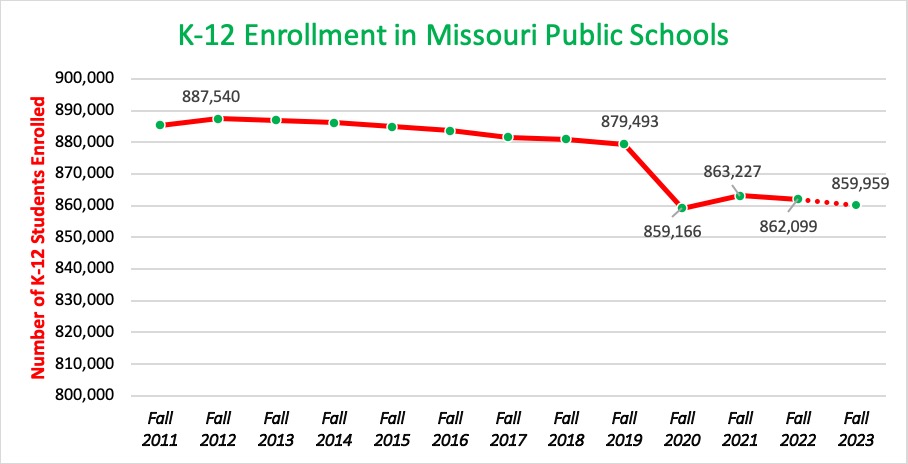
In addition to declining enrollment, public education in Missouri has another serious problem—chronic absenteeism. Schools have been reopened for two years, but many students have not returned to the classroom with consistency. As pointed out in a new study by Thomas Dee of Stanford University, this post-pandemic chronic absenteeism threatens post-pandemic academic recovery.

Chronic absenteeism in this case means missing 10 percent or more of the school year—about 18 days in Missouri. Dee reports that from the school year before the pandemic (2018–19) to the year after (2021–22), Missouri’s chronic absenteeism nearly doubled, from 13 percent to 24 percent. That means nearly one quarter of our students, or just under 200,000 students, missed a potentially damaging number of days of school.

While Dee’s study only includes those two time periods, DESE data indicate that chronic absenteeism had already been on the rise in Missouri.

It’s unclear why absenteeism has been growing in Missouri, but it’s a serious problem. Missing a significant number of days can impact math and reading achievement, social–emotional development, and discipline. It is also associated with an increase in risky behaviors outside of school. Missouri leaders should be addressing this problem as the crisis that it is.

Support Us

The work of the Show-Me Institute would not be possible without the generous support of people who are inspired by the vision of liberty and free enterprise. We hope you will join our efforts and become a Show-Me Institute sponsor.

Donate
Man on Horse Charging