The State of the Conflict in Ukraine with Jim Geraghty

On April 23, 2024, at the Kansas City Public Library Central Branch, Jim Geraghty, Fellow at National Review Institute and National Review’s senior political correspondent, discussed his two reporting trips to Ukraine. Geraghty delved into the broader implications of the conflict and its significance for the United States.

Geraghty writes the National Review’s widely read daily “Morning Jolt” newsletter and appears on the magazine’s weekly “The Editors” podcast. He also co-hosts two podcasts and has authored eight books, including “Heavy Lifting” with Cam Edwards and “Voting to Kill.”

This event was co-sponsored by Show-Me Institute, National Review Institute, the Kansas City Public Library, and Show-Me Opportunity.

Listen on Apple Podcasts 

Listen on SoundCloud

Watch a video recording of the event here.

Produced by Show-Me Opportunity

House Voting on Corporate Income Taxes

Recently, the Missouri House passed a bill—House Bill (HB) 2274—that would gradually repeal the corporate income tax. HB 2274 would cut the current corporate income tax rate from 4% to 3% on January 1 and would continue to make cuts by a percentage point every year until abolishing the tax entirely in 2028.

Getting rid of the corporate income tax has many benefits, chief among them is raising Missouri’s GDP growth rate. Countless studies have found that corporate income taxes are economically harmful. Missouri ranks 26th in the United States for GDP growth, and eliminating this tax would make Missouri a more competitive, pro-growth state. While eliminating the corporate income tax would mean giving up the $900 million in revenues that the tax raised in 2023, some of the lost revenue would be offset by higher sales and personal income tax revenues owing to stronger economic growth. Moreover, the gradual nature of the phase-out would ease the transition.

Cutting the corporate income tax rate will also lead to business growth. A 2016 peer-reviewed article in the American Economic Review found that a 1% cut in a state’s corporate income tax rate leads to a 3–4% growth in the number of establishments over a 10-year period. The study found that a lower corporate tax is also good for increasing entrepreneurship. Missouri will become more attractive to both new and existing businesses with the elimination of the corporate income tax.

Another study found that a little more than half of the total incidence of corporate taxation falls on consumers through higher product prices, with capital owners bearing only 20% and workers bearing the remaining 28%. The Tax Foundation reports that, because corporate income taxes make it more expensive for businesses to invest in technology and equipment, eliminating the tax can increase efficiency which would generate higher revenue for companies. A tax cut will enable companies to not only increase wages but also create new jobs. If Missouri’s policymakers want to increase overall economic growth, HB 2274 is a step in the right direction.

Differentiated Teacher Pay in Senate Bill 727

Several years ago, I was invited to give a guest lecture to a group of STEM educators seeking a doctoral degree. My task was to share with them ways in which my work in education policy overlapped with their world. My key point that night was that we need to change how we pay teachers. It was a point I have been making since the release of my 2012 report, “The Salary Straitjacket: The Pitfalls of Paying All Teachers the Same.” Now, if Senate Bill (SB) 727 is signed by the governor, one of those recommendations from that paper may finally come to pass.

Teachers in nearly every school district are paid by what is called a “single salary schedule.” This is a system that pays all teachers, regardless of subject matter expertise or teacher demand in that district, the same amount. These schedules generally provide raises based on years of experience and graduate degrees.

When I spoke with that group of doctoral students, I presented a hypothetical situation of a local business. When the business attempted to hire, they received numerous applications for one type of position and very few for another. I asked them what they might do to attract and retain people in that harder-to-staff position. The answer was clear—pay them more.

This is the very situation we have in public schools. Some positions may get few, if any, applications. These include subjects such as physics or, in some instances, special education. Nevertheless, school districts fail to use one of the key levers they have to attract and retain these teachers—pay. Instead, everyone is on the same salary schedule.

In that 2012 report, I argued that school districts could place teachers in hard-to-staff subjects at a higher level on the salary schedule. SB 727 followed that recommendation completely. The bill states: “The board of education of a school district may include differentiated placement of teachers on the salary schedule to increase compensation in order to recruit and retain teachers in hard-to-staff subject areas or hard-to-staff schools.”

When I joined the Show-Me Institute’s Director of Education Policy Susan Pendergrass on a recent podcast to discuss SB 727, I said there were things in the bill that people would like and other things they would not like. Allowing districts to differentiate pay for hard-to-staff subjects is a sensible policy that everyone should like. Of course, it would be even better if we could pay teachers based on everything they bring to the table, including their performance, but this is a step in the right direction.

Missouri Needs a Taxpayer Bill of Rights, SB 727 and Metrolink Expansion

David Stokes, Elias Tsapelas, and Avery Frank join Zach Lawhorn to discuss:

– The need to update Missouri’s tax and expenditure limits (the Hancock Amendment)
– The passage of SB 727, the education reform bill, by the Senate
and House
– Metrolink expansion, and more

Listen on Apple Podcasts 

Listen on SoundCloud

Show Links:

Find tickets for the April 30 event in Columbia, MO here. 

Read Elias’ new report here. 

Read Avery’s blog on SB 727 here. 

Read David’s blog on the Metrolink project here. 

Produced by Show-Me Opportunity

MidAmerica Airport and MetroLink Deserve Each Other

They used to be two empty ships passing in the night, but now MidAmerica St. Louis Airport in Illinois and St. Louis’s MetroLink system will finally connect, to the great joy of nobody but local politicians and contractors.

These two deserve each other. Let’s examine the usage projections that were used to convince taxpayers to approve funding(and various extensions).

Projected passengers for MidAmerica Airport, back in 1997 when the airport was built? Two million.

Plog Research Inc., one of the consultants for the MidAmerica project, estimates 2 million air passengers will be served by the Downstate airport.

Actual passengers in 2022? 163,000. (And trust me, they celebrated that wildly.)

Projected MetroLink ridership after the construction of the cross-county MetroLink extension? 80,000 daily boardings in Missouri alone by 2025.

Actual daily boardings in Missouri in 2023? 16,700.

Public agencies habitually overstate ridership and understate costs to justify these massive projects of all types. High-speed rail, anyone? 

It is worth noting that the current five-mile MetroLink extension to the airport in Illinois cost $98 million, while the proposed MetroLink extension in St. Louis, which is also five miles long, is estimated to cost $1.1 billion. A billion-dollar difference for the same length of route. To paraphrase Everett Dirksen—himself a son of Illinois—a billion here, a billion there, pretty soon you’re talking real money.

It is great that we can finally connect two massive transportation boondoggles that don’t take anyone for a ride but taxpayers.


Transparency Stalled

It ain’t over ’til it’s over, but the chances Missouri’s general assembly takes action on healthcare price transparency in 2024 are getting smaller by the day.

At the end of January, I traveled to Jefferson City to deliver testimony on House Bill (HB) 1837, and at the time it seemed like the state’s legislature had finally decided to make healthcare price transparency a priority. HB 1837 is a bill that, among other things, codifies the federal government’s healthcare price transparency rules into state law, and was the first of its kind to receive a public hearing in Missouri. But since that hearing it has yet to receive any further attention from policymakers.

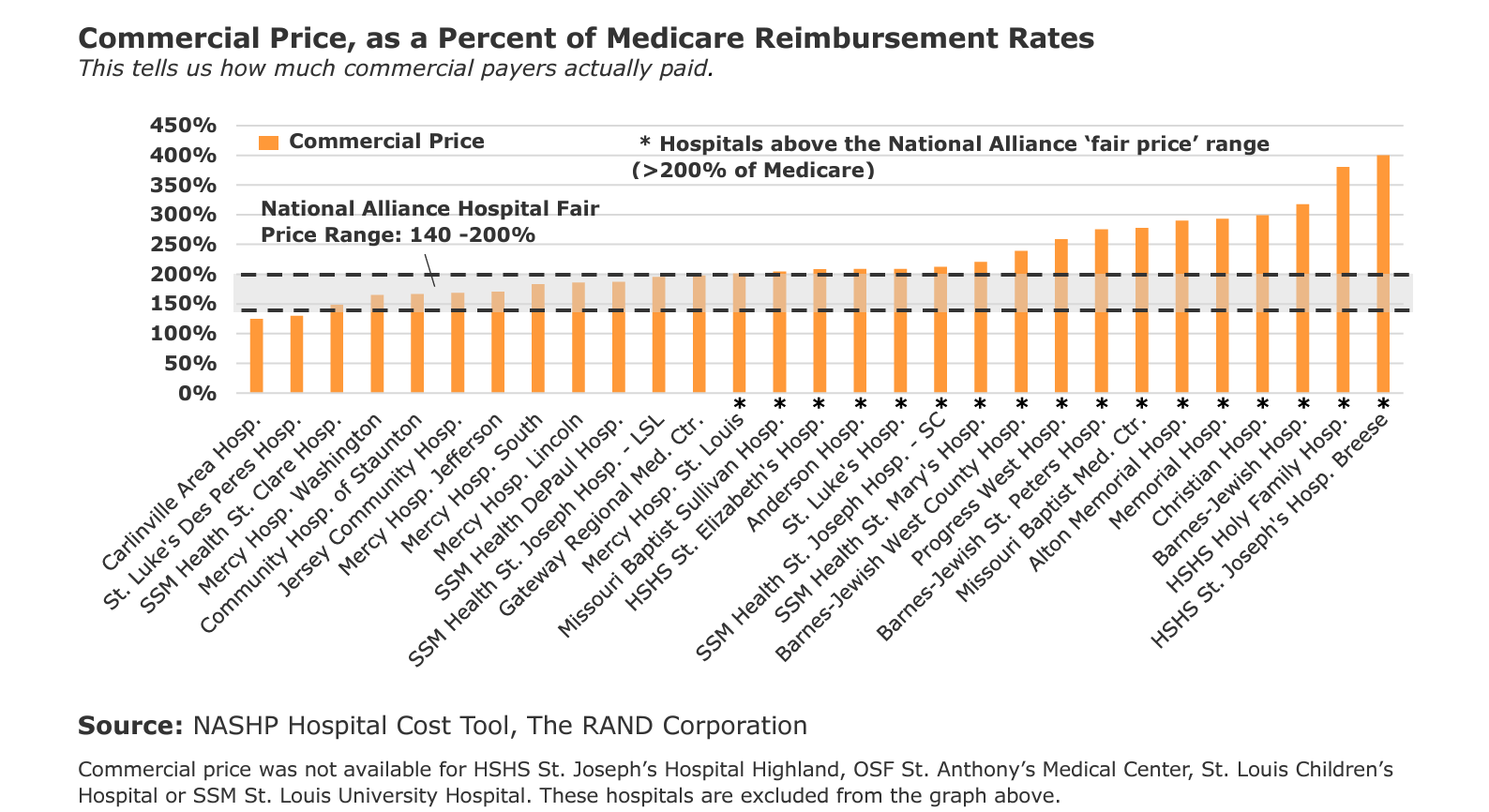
As my colleagues and I have written numerous times, Missouri desperately needs healthcare price transparency. And despite the federal government requiring hospitals to publish their price since 2021, fewer than 40% are complying nationally. That’s where HB 1837 comes in.

In addition to codifying the federal requirements into state law, the bill provides new protections for patients who receive health services in Missouri without being adequately informed of the prices beforehand. If patients aren’t told how much a procedure is going to cost before they receive it, there’s no way for them to plan for the expense, shop for a better deal, or even change their mind about the procedure altogether if the price is more than they can afford at the time.

HB 1837, which is modeled after legislation that became law in Colorado a few years ago, would shield patients from debt collection efforts by hospitals that aren’t complying with the required price transparency laws. Patients who find out they were overcharged would also have recourse for financial restitution (a way to get some of their money back).

With Missouri’s legislature, it’s always difficult to know why a bill stopped advancing, but one thing that was clear from the hearing on HB 1837 was that hospital lobbyists were vehemently opposed to it becoming law. The opposition claimed that complying with the transparency requirements would be too expensive. In fact, the cost is one of the primary reasons the federal government cites for not currently punishing noncompliant hospitals. But these requirements have been in place now for more than three years, which is more than enough time for hospitals to budget for this.

Given how confusing and expensive our healthcare system is, Missouri patients can’t afford to wait any longer for hospitals or the federal government to act. Healthcare price transparency would be a real win for Missourians in their battle against ever-rising healthcare costs. There’s still about a month left in the legislative session, so it’s still possible that our general assembly could push healthcare price transparency across the finish line this year, but at this point, I certainly wouldn’t hold my breath.

Support Us

The work of the Show-Me Institute would not be possible without the generous support of people who are inspired by the vision of liberty and free enterprise. We hope you will join our efforts and become a Show-Me Institute sponsor.

Donate
Man on Horse Charging