What’s Old Is New Again? “New Building” in Aerotropolis Legislation May Not Actually Mean “New Building”

We’ve talked at length about Emerald Automotive and how it would not have to use an airplane or export a widget to receive Aerotropolis tax credits, but would businesses like Emerald Automotive even have to construct a “new building” to get the public’s money?

A close reading of the Aerotropolis legislation reveals that the “new building” requirement for Emerald Automotive-type warehouses is ultimately a “new occupancy permit” requirement, since a “new building” is defined in the bill as:

a new structure or building for which a certificate of occupancy was issued on or after July 1, 2011 for commercial activity, including fixtures and equipment;

There is no definition of what constitutes a “new structure,” and if read by properly omitting the “new structure or” section, the definition of a “new building” could literally be construed as “a new building is a new building,” or even “a new building is a building.” This legislative ambiguity sows the seeds for real shenanigans if the bill were ever signed into law. Is a “new building” one year old? Five years old? Ten years old? More? Does the applicant for the tax credit have to be the first tenant of the building?

The only unambiguous requirement, then, is the requirement of a “certificate of occupancy,” which is a permit mandated for businesses in both new and old buildings. In fact, in Saint Louis City a commercial occupancy permit is valid until:

  • The business changes;
  • The business owner changes; or
  • The property’s use changes.

If one of these elements changes, a business owner has to apply for a new occupancy permit. Does that make the structure a new building? Of course not. Therein lies the problem. Why did the author of the Aerotropolis legislation make the “new building” requirement so ambiguous that businesses moving into existing buildings could meet the tax credit’s “new building” requirement?

The building trades in Saint Louis may think the Aerotropolis legislation means that $300 million in tax credits will be going toward new construction projects in the region. There are ample reasons to believe that’s not the case.

And one more thing: We’ve talked about the ever-changing jobs estimates for Aerotropolis made by the proposal’s supporters. How do you create “18,468 construction jobs” almost two-thirds of all the jobs promised — with legislation that doesn’t require new construction (and thus new construction jobs) for tax credits to be issued on a “new building”?

Milton Friedman and Ronald Reagan: An Enduring Relationship

Early in the morning on July 29, 2011, Wall Street Journal columnist John Fund spoke to a large and enthusiastic crowd at the downtown branch of the Kansas City Public Library. The topic was the relationship between Milton Friedman and Ronald Reagan, and the positive effects on the national policy that Friedman's influence and Reagan's actions bestowed. The talk was in celebration and remembrance of Milton Friedman, and coincided with other talks around the nation also sponsored by the Friedman Foundation for Educational Choice. July 31st would have been Milton Friedman's 99th birthday.


In July 2010 E-mail to NCBE, Tyson Executive Saw “Very Little Opportunity” in Beef Export Plan

Note: Tyson Foods is the largest exporter of beef from the United States

In response to an e-mail from the National Center for Beef Excellence, Roel Andriessen — Tyson’s senior vice president of international sales — stated his views on a Saint Louis beef export hub bluntly: beef is not eligible for export to China, and air freighting beef and pork to the country was “unlikely” to be a successful business model. (emphasis mine)

From: Andriessen, Roel
Sent: Tuesday, July 13, 2010 4:21 PM
To: Ricketts, Rex E.
Subject: RE: National Center for Beef Excellence NCBE and China Hub Commission

At this moment, I see very little opportunity for the following reasons:

1. Currently, US Beef and Beef VM products have no access to the China market (BSE related). It is uncertain if and when US-China negotiations for Beef access will be concluded.
2. Currently, US Pork (muscle meat) is unable to compete with cheap Chinese pork. China has a domestic oversupply situation that is unlikely to disappear soon.
3. US Pork frozen VM items that are shipped to China typically are very cheap and the vessel versus air freight economics would not work.

Although we do not specialize in this type of business, opportunities for air freighting Beef (and to a lesser extent Pork) would have to come from niche business for the upscale Hotel and Restaurant sector that would take high end quality cuts, once market access for Beef has been established and / or US Pork cuts are economically priced.

Sorry not to have a more positive outlook for this project but this is the current state of the China market as we see it today for our business. Things can always change but, also based on experiences in other markets for US Beef and Pork, airfreight seems unlikely for this business

Regards, Roel

Original, as received from the China Hub, is below.


Why are key proponents of this legislation making beef one of the main arguments for Aerotropolis when not only is beef ineligible for export to China, but it turns out that the biggest player in the U.S. beef export business told the NCBE as much? That Mr. Andriessen panned the air freighted beef-to-China idea raises even more questions about the feasibility of the project, even if beef weren’t barred from export.

And as for the NCBE itself, I’m not sure what’s worse: that this “national beef center” would choose to release its “study” after the special session, or that the NCBE — closely connected to the University of Missouristood by for the last year without correcting the public record on this export-beef-to-China meme. The NCBE is directly subsidized by the Missouri Agriculture Small Business Development Authority for the China Hub project and is further associated with investigators at the University of Missouri. When were taxpayers going to get the straight story on beef?

For previous posts on the NCBE “mystery meat” study, see here and here.

Property Assessments and Taxes in the News

As people in Saint Louis County continue to appeal their assessments, the city of Blue Springs on the other side of the state is considering a proposal to raise its property tax rate in response to declining assesments. This is the perfect time for us to release a major policy study and an op-ed on property taxation, with a closely related case study and video coming online in a few days.

I admire the people throughout Missouri who fight for their rights to a fair assessment. That doesn’t mean the counties are always wrong, although given the problems in Jackson County you might assume they are. I also admire the people who stand up in cities like Blue Springs and argue for government cuts instead of property tax increases. I’ll readily admit the fact that the proposed increase is small, but if taxpayers and voters acquiesce to every tax increase just because they are small, they will see a lot of small tax increases.

So the NCBE’s “Mystery Meat” Study Won’t Be Published Until… After the Special Session?

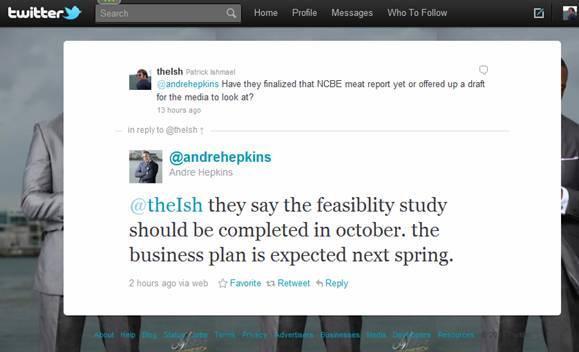
We reported yesterday on the National Center for Beef Excellence’s Beef Study That Wasn’t, and last night KMOV reporter Andre Hepkins, who’s been covering the NCBE “meat feasibility” story since last week, sent along this latest development concerning the Beef Center’s elusive meat report:

The legislative special session — assuming it is called — will probably take place in September, which means independent researchers won’t get to see, let alone test, the fundamental assumptions in this “feasibility study” until long after a $360 million vote is taken on the issue.

Truly absurd. Taxpayers deserve better than this from their community and political leaders. Much, much better than this.

What’s Wrong with Aerotropolis: Kingmaker Provision

In this video, Show-Me Institute policy analyst Audrey Spalding tells of a little-mentioned portion of the proposed Aerotropolis legislation. This provision would grant new authority to the mayor of Saint Louis and the Saint Louis County Executive, allowing them to dictate who could receive Aerotropolis tax credits — which amount to over $300 million dollars of potential development subsidy.


Join the fight for liberty in our state. Become a Show-Me Institute supporter.

Hey National Center for Beef Excellence, Where’s the Beef?

Last week KMOV reported that a “non-profit agency” commissioned by the Midwest China Hub Commission had conducted a study about export opportunities from a proposed “Aerotropolis,” and determined that “shipping meat from Lambert [Airport] to China is feasible…” (emphasis mine).

The Midwest China Hub Commission hired the National Center for Beef Excellence to examine how much beef and pork could be exported to China via Lambert. The NCBE says a China hub at Lambert could send up to 11 million pounds of meat to China.

The news report in its entirety:

We’ve discussed again and again how beef is ineligible for export to China. The NCBE’s use of the word “meat” is nondescript enough to suggest beef can be exported without admitting that it can’t, and when “beef” is evoked specifically in KMOV’s discussion here, it’s always in the context that it “could” mean “big bucks” for the state, presumably in the same way that someone “could” make a lot of money distilling bathtub alcohol if it were legal to sell it. That’s a crafty way for the NCBE to announce its findings without spilling the beans about beef, but it doesn’t really add anything to the conversation on Aerotropolis.

Then there’s the question of the study itself: Namely, where is it? We asked the China Hub Commission about getting a copy of the NCBE report, and in about a day we’d received in the mail a stack of various, unpaginated NCBE documents that related to the China Hub, but did not include anything that looked like a study or that supported the substance of the news reports about it — namely, that 11 million pounds of meat could be exported to China after lawmakers passed the Aerotropolis legislation.

So far, no one else we’ve asked has been able to find the report, including those who covered it. Where, precisely, is this study? If nobody has a finalized copy or even a draft copy of what was reported, why… was anything reported? Or better yet, how was it reported?

There were some very revealing details that we did find in that pile of China Hub documents, however. More on that shortly.

So, Does This Mean Taxpayers Will Own Half of Stifel Nicolaus’ New Building?

For Saint Louisans, it’s a Good News/Bad News/Worse News sort of situation. The Good News? One of the region’s big employers, Stifel Nicolaus, is expanding its operations downtown and buying its building. So far, the situation sounds very good indeed. The Bad News? It means that Stifel won’t be moving into Ballpark Village, a development headache that’s plagued the downtown area for years.

The Worse News? It looks like taxpayers could end up paying almost as much for Stifel’s new business plan as Stifel is.

In this case, according to the application, Stifel is seeking $2.8 million in Build Missouri Bonds, a state program designed to defray the cost of expansions. That request will go before the Missouri Development Finance Board next week.

The company also plans to apply for $2.6 million in Missouri Quality Jobs tax credits, which reimburse companies that create jobs paying above-average wages.

Stifel predicts the average new employee will earn $65,000 a year.

From the city of St. Louis, it plans to request a $15 million allocation of federal New Markets Tax Credits, which translates into $3 million in equity for the project. Stifel also will seek property and earnings tax breaks worth $5 million over 10 years, and up to $500,000 a year in breaks on other local taxes — though Stifel agreed to make payments to St. Louis Public Schools.

Much of that aid, including all the state incentives, are dependent on Stifel actually creating the jobs it is promising. All of it, after expenses are counted for, will amount to $17.1 million in public financing for the $35 million project. The rest will come out of Stifel’s pocket.  (Emphasis mine).

“The rest will come out of Stifel’s pocket.” Thankfully.

The Post-Dispatch’s Bill McClellan highlights the contradiction at play here.

Of all the businesses that ought to understand the business of business, it’s Stifel. It’s a brokerage and investment banking firm. The people who run Stifel profess a belief in capitalism.

Except, of course, when it comes to their own affairs. Risk and reward? Nonsense! No investment without incentives.

Well, fine. I can understand the sentiment. If you can get public money, why not get it? What I can’t understand is the way the public always goes along with this stuff.

Just two days ago, David wrote a blog post about how some young entrepreneurs are looking for government assistance to get their businesses off the ground. Unfortunately, it seems they learned the wrong lessons from their predecessors.

Support Us

The work of the Show-Me Institute would not be possible without the generous support of people who are inspired by the vision of liberty and free enterprise. We hope you will join our efforts and become a Show-Me Institute sponsor.

Donate
Man on Horse Charging