Missouri’s TIF Infestation

If I got to pick it, the slogan for my beloved home state of Missouri would be: “Missouri: We’re In The Middle.” Most ways you look at it – geography, politics, various standard-of-living measures – we rank in the middle of the states. Sure, there are exceptions. We are low on occupational licensing and excise taxes, and high on meth (in more ways than one… well, actually, just in one more way than one).

One thing on which we rank very high is the use of Tax Increment Financing (TIF). This excellent paper on TIF, by Randal O’Toole with the CATO Institute, ranks Missouri third in total and fourth per capita in the sale of TIF bonds from 2005 to 2010. (See page 12 of the paper for the table.) This is not something of which to be proud.

TIF is common in Missouri. Right now, we have more ongoing applications than I can keep track of. The city of Columbia wants a giant TIF for its downtown area.  A TIF is being sought for a section of St. Charles, even though the main landowner of the area in question is a tax-exempt educational institution. Just a few months ago, Kansas City approved a gigantic TIF for the city. Developers are seeking a TIF in Shrewsbury that will do nothing but continue the rearranging of the deck chairs for retail in Saint Louis County. From the Patch story on that proposal, if I may be so bold as to quote myself:

David Stokes, a policy analyst with the Show-Me Institute, said what he heard was “just a terrible economic fallacy.”

“Of course it’s just preliminary, but from what I can tell it is just another example of the economic issues the East-West Council of Governments supported in their report two months ago, which is that every city is doing something to support their own little city, but it’s killing our county’s economic base, and it’s hurting the region,” Stokes said. “It might benefit Shrewsbury in the short run but seems it’s just going to be another type of TIF development that’s going to hurt our region.”

“Maybe if it can’t be done without public dollars, maybe it just shouldn’t be done,” he said.

The problems in these cases is the cities, not the counties. In fact, St. Charles County Executive Steve Ehlmann, along with his predecessor, Joe Ortwerth, have been strident in opposition to TIF in that county, to their great credit. Also to his credit, Saint Louis County Executive Charlie Dooley has recently taken the lead in opposition to these TIFs – he really gets it that a few cities are helped but the entire county is hurt. And Jackson County Executive Mike Sanders at least sued to get more equal representation on the Kansas City TIF commission.

But, even though they have instituted county TIF commissions in Saint Louis and its currounding counties, the insane rule still applies that city councils can override the TIF commission with a supermajority vote. So, the city council for the 15,000 people of Bridgeton gets to override the Saint Louis County TIF Commission and determine tax policy that will affect the one million people of Saint Louis County. I totally support county TIF commissions, but the part of the law that allows city councils to override the TIF commission with just a supermajority vote is insane. They should not be allowed to override it at all. Lot’s more to come on this issue in the coming weeks and months. And this time, I mean it.

The Moberly Mirror: Pressured For Asking Too Many Questions About Tax Handouts

A Show-Me Institute supporter contacted me last week to relay the story of the Moberly Mirror, a small newspaper that says it was pressured to close in 2010 for asking too many questions about tax handouts for a development project in Moberly.

This is no rumor. What makes this story even more depressing is the fact that the reporters at the Mirror were right to ask questions: The development in question made big news recently when it left the city of Moberly on the hook for nearly $40 million in debt. This story is an especially relevant warning, because tax credit supporters have recently been touting absurd job creation and business investment numbers as a sign that the state should create more development subsidies.

During mid-2010, state and local officials raced to close a deal with Mamtek, a company that promised to build a factory that would produce SweetO, an artificial sweetener. According to the Mirror, $7.6 million in Missouri Quality Jobs tax credits and $6.8 million in Missouri BUILD tax credits were promised to the company, as well as $2 million in Community Development Block Grant funds, $800,000 in funding for job training, and $368,000 for job training.  The city of Moberly kicked in, too, providing nearly $40 million in bonds, and $500,000 in grants and services.

The total came to nearly $50 million in promised state and local tax dollars.

As is always the case with these things, a large press conference was held. In July 2010, Missouri Gov. Jay Nixon spoke to a large crowd about the Mamtek deal.

“And SweetO is about to make Missouri’s economy a just a little bit sweeter, too,” Nixon said then. “Because Mamtek will be creating 612 new jobs and investing $46 million in capital.” He repeated: “612 jobs, they’re investing $46 million.”

Understandably, the Mirror was curious about the promises touted. As editor Janet Morales wrote, the Mirror wondered about the employment numbers and asked whether it might make more sense to use an existing vacant facility instead of building a new one.

But answers were less than forthcoming. Morales wrote that Mamtek wouldn’t answer her question, and directed her to the local Chamber of Commerce. Morales writes that the “[executive director of the chamber] told me not to ask questions or Moberly could lose the Mamtek company.

In the fall, Morales writes that she was informed that area merchants had been told about the Mirror‘s “investigation,” and that they were warned not to advertise with the Mirror. Seeing that businesses were no longer interested in subscribing to the Mirror and that the paper would soon close, the Mirror decided that it might as well investigate the Mamtek deal in its last month.

Some of the Mirror’s unanswered questions and concerns sound strikingly familiar to our questions regarding the Aerotropolis subsidies. Why were there conflicting job estimates? Where were the supporting documents? Why was there such a rush to get the deal approved? Proponents said that their Chinese business interests were involved, but the Mirror was unable to locate them, or anyone who was familiar with Mamtek’s operations in China.

As I already noted, this story does not have a happy ending. The Mirror is gone, though it still hosts the Mamtek story on its homepage. A nearby paper, the Marshall Democrat-News, covered the Mirror‘s closure, noting that Marshall had also considered the Mamtek deal, but considered the public support requested for the project too great. The executive director of the Marshall-Saline Development Corporation told the Democrat-News that “…Moberly offered them $15 million and took (Mamtek) off the market. That was part of the deal. I wouldn’t do that. I wouldn’t ask the city to do that.” He added “I’m not sure it’s legal.”

It now appears that the city of Moberly is on the hook for the nearly $40 million in bonds it issued for the project. And, sadly, it appears that state and local officials have not heeded the Mamtek warning. There is still an effort to expand tax incentive deals in Missouri.

Some critics of the Show-Me Institute have dismissed our concerns about the Aerotropolis tax credits because, sometimes, tax credit deals and public partnerships “work.” Well, a broken clock is right twice a day. There will always be successes. The question is, what level of failure are we willing to pay for in order to attain those successes? Sometimes, in public policy matters, failure is a rarity. But it has been well-documented that tax incentive deals frequently do not deliver the results that were promised.

So, I wonder, how many Mamtek-type failures are tax incentive proponents willing to trade for the chance of success?

Health Insurance Exchange: Level One Establishment Grant – Project Narrative


Health Insurance Exchange: Governor’s Letter in Support of Establishment Grant (June 28, 2011)


The End of Aerotropolis Subsidies?

A real spendthrift – even one newly resolved to be thrifty – cannot walk through a shopping center without stopping in a check-out line at least once. He will fasten on some trinket and congratulate himself for not blowing a much larger sum of money.

It is in that spirit that lawmakers in Jefferson City are now looking at the proposed legislation calling for creation of a “Midwest China hub,” or “Aerotropolis,” at Lambert-St. Louis International Airport.

According to newspaper reports, the legislature is prepared to scale back or totally eliminate $300 million in tax credits intended for owners of warehouses and real estate in and around the airport, while retaining $60 million in subsidies to encourage freight forwarders to route international freight through Lambert.

If so, that represents real progress – and a greater responsibility on the part of our lawmakers, including some of the prodigals who call themselves fiscal conservatives. However, while the final numbers are uncertain, talk of finding other means to funnel tax credits to Aerotropolis demonstrates a continuing blind spot on the part of legislators.

The question is: Why should the state of Missouri put up any money for Aerotropolis unless it supports the public good in some clear and identifiable way? Where is the justification for taking $60 million out of the pockets of Missouri taxpayers and giving it to unseen and unknown freight forwarders located in other cities around the world?

No one has advanced the slightest evidence that Missouri farmers or businesses have suffered a loss of exports – to China or anywhere else – because of inadequacies in the current transportation system.

Whether it is in shipping tools, pharmaceuticals, or frozen meat, there are fast and efficient means for Missouri exporters to reach key destinations around the world.

Supporters of Aerotropolis confuse economic incentives and competitive advantage. Yes, we can give taxpayers’ money to freight forwarders – the socalled travel agents of cargo – to offset obvious disadvantages in routing cargo through Lambert, which has no regularly-scheduled passenger or cargo flights to destinations outside North America. But that’s just asking people to take your money for doing something that doesn’t make any sense.

The real irony in the Aerotropolis saga is that our politicians and lawmakers – joined by business lobbying groups in St. Louis and Jefferson City – want to use taxpayers’ money to help Chinese carriers compete against U.S. carriers. In its eight-page economic impact report, the St. Louis Regional Chamber and Growth Association noted that “China has determined to grow their market share in air freight from 15-20% to 50%” in the transport of Chinese-made goods. Do we really want to help the Chinese government reach one of its objectives at the expense of our own carriers?

Our lawmakers may think that they should leave something on the table for the special interests that have lobbied long and hard for the Aerotropolis legislation.

But $60 million is not some trinket that a spendthrift might pick up upon leaving a store. It is taxpayers’ money and it is equal to the median household income in Missouri multiplied 1,300 times. Here’s a novel idea: Why not return the $60 million to Missouri taxpayers?

Andrew B. Wilson is a fellow at the Show-Me Institute, which promotes market solutions for Missouri Public Policy.

Some Facts About Tax Credit Programs in Other States

The St. Louis Post-Dispatch reports that the Missouri Legislature is attempting to create tax credits that could be awarded up front  – that is, before the promised economic activity occurs.  David Kerr, director of the Missouri Department of Economic Development (DED), the state agency that stands to benefit from this proposal, calls the expanded power “a vital tool that we don’t have today.”

But the idea of awarding tax credits up front should give everyone else pause. We know that tax credits have a dismal track record at delivering on results promised (state audit reports and independent analysis have shown this). So why expand the DED’s power to award tax credits?

The argument is that if Missouri doesn’t award tax credits, other states will, and as a result will encourage companies to leave Missouri and take their jobs and economic impact to other states. Though the argument sounds plausible, we have to consider the facts.

Missouri already issues hundreds of millions in tax credits each year. During fiscal year 2010, Missouri issued more than $400 million in tax credits. To what benefit? According to the state auditor, tax credit programs cost more than predicted, and the DED was frequently overstating job claims and investment estimates related to tax credit awards.

Texas doesn’t award nearly as much as Missouri does in tax credits. The Post-Dispatch reporter, Tim Logan, writes that tax credit programs are “big in Texas.” However, the fund he cites is the Texas Enterprise Fund, which has pledged $439 million in credits to companies since 2003. Though Texas uses tax credits, the program Logan cites pledged over an eight-year period as much as Missouri pledged in a single year.

In fact, according to the state’s “Tax Exemptions & Incidence Report,” Texas tax credit programs offer a relatively small amount in tax credits for job creation. For example, Texas’ “Refund for Job Creation in an Enterprise Zone” awards a maximum of $5,000 for companies that can show that they created at least 10 new jobs.  In its report on tax exemptions, Texas notes that the revenue cost of that program is “negligible.” If we look at Missouri, the state issued nearly $15 million in “Quality Jobs” tax credits during fiscal year 2010. Tax credits may be big in Texas, but they are really big in Missouri.

We might be winning the bidding war with Kansas. Legislators point to businesses that move from Kansas City, Mo., to Kansas City, Kan., when tax credits are promised. But, according to Kansas’ recent Tax Expenditure Report, the state’s tax credit expenditures for development and services are about $200 million. Missouri may be giving away about twice as much tax revenue to favored industries and companies than Kansas.

Furthermore, Missouri has a more favorable tax climate than Kansas. The Show-Me Institute collects and posts tax data for all 50 states to help people compare tax burdens among states. According to that data, about 23% of Missourians’ income goes to taxes. However, 26.5 % of Kansans’ income goes to taxes.

In short: When it comes to taxes, Missouri is already competitive, compared to Kansas. We should continue to lower our tax burden for all, in order to entice more businesses and individuals to move to this state.

If tax credits result in growth, Michigan would be an economic powerhouse. It is not. Every time I hear a legislator or reporter question whether tax credits are needed to move industry to a state, I can’t help but think of my home state. Michigan awarded more than $1 billion in tax credits last year to just a few auto companies. In fact, the governor’s report on tax exemptions estimates that more than $33 billion in tax exemptions are awarded each year in the state. And, what exactly does Michigan have to show for that much in tax credits and other awards? Not a lot.

Look, tax credits don’t guarantee growth. What they do guarantee is that many pay a tax rate that is too high so that the favored few can get a tax break.

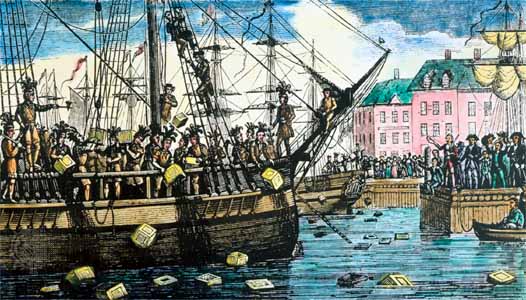
The Boston Tea Party and . . . Targeted Tax Credits?

I don’t think any American schoolchild escaped this lesson from civics class: On the night of December 16, 1773, in response to Parliament imposing new taxes on tea, a group of colonists from Boston boarded a number of ships in the harbor and threw the newly-taxed tea overboard in protest against “taxation without representation.” This is a great lesson for children to learn, after all — as Daniel Webster and John Marshall agreedthe power to tax involves the power to destroy. It’s also an easy lesson with which to sympathize. If taxes make things we buy more expensive, we lose out. According to Wikipedia:

The protest movement that culminated with the Boston Tea Party was not a dispute about high taxes. The price of legally imported tea was actually reduced by the Tea Act of 1773.

Wait, what?

Let’s go back a bit. For years, the British East India Company enjoyed a monopoly — granted by the British crown — on importing tea to Britain. Because the American colonies were under British rule, this also meant that all their tea had to come from the East India Company — first imported to London, then shipped to America by a third party. At the time, Britain had high import tariffs, which raised the price of all East India Company tea. Colonists could buy Dutch tea smuggled into the colonies  much more cheaply because it never touched a port with high tariffs. In 1773, Parliament passed the Tea Act, which allowed the East India Company to import tea to the colonies duty-free. Suddenly, all the people who imported tea to the colonies, legally and illegally, were priced out of the market by a competitor that received special government favors. Some of the people on the boats in Boston Harbor the night of December 16 were concerned about overreaching government authority and a pattern of abuse, but lots of them were smugglers or legal shippers who were rebelling against the loss of their livelihood to a government policy that favored one business at the expense of others.

Here’s another quote from Wikipedia:

In 1772, legally imported Bohea, the most common variety of tea, sold for about 3 shillings (3s) per pound.[33] After the Tea Act, colonial consignees would be able to sell it for 2 shillings per pound (2s), just under the smugglers’ price of 2 shillings and 1 penny (2s 1d).[34]

So the colonists got their tea cheaper than before. Where’s the problem? Well, in addition to the problem of taxation without representation, competing businessmen lost out under the new tariff regime. There were other losers as well — namely every British citizen who paid higher taxes because the East India Company had this duty-free dispensation.

My co-workers at the Show-Me Institute have talked about targeted tax credits before. Targeted tax credits are just one way that governments pick winners and losers in the marketplace. When this happens, the logic of the market is overturned and almost everyone suffers — except those the government selects to receive its largess. It’s easy to point to these people and conclude that the tax credit was a success, but maybe that’s because the injured parties so seldom throw a historic party to make their plight known to the world.

China Law Blog on Mamtek: “[T]here are some lessons to be learned”

Looks like the Mamtek story that Show-Me Institute Policy Analyst Audrey Spalding wrote about on Friday is already getting some play on the West Coast. If you’re unfamiliar with the Mamtek saga, a primer (Emphasis mine):

A company that promised 600 jobs and drew Gov. Jay Nixon to Moberly to announce $17.6 million in state aid is in financial trouble and could potentially stick the city with payments on a $39 million bond deal.

Mamtek International Ltd., a company with Chinese and American ownership, planned to make sucralose, a zero-calorie sweetener at the facility. The $65 million deal, ballyhooed at the start by former Gov. Bob Holden, chairman of the Midwest U.S.-China Association, was put together in 73 days last year and was supposed to include $8 million in private investment.

Moberly issued $39 million in bonds to build the Mamtek factory, buy and install the equipment and take care of other items necessary for the company to begin production. It was supposed to have put 116 people to work — perhaps as early as late last year, according to early reports — and double that employment within 18 months.

China Law Blog is a website operated by Harris & Moure, pllc, a law firm based out of Seattle, Wash., with a China law practice. China Law Blog’s Dan Harris highlighted Mamtek’s troubles on Thursday, telling readers that “[m]any many months ago, I got a quasi-anonymous email from someone in Moberly, Missouri” regarding the Mamtek project. After a series of back-and-forth emails with the tipster, Harris determined “that the odds were that this deal would prove disastrous.”

As it turned out, the deal did prove disastrous. So what happened? According to Harris (Emphasis mine):

First, it appears that got overly excited about the possibility of getting Chinese money. It appears it fell prey to the classic “China is rich. We want money. Therefore this is a good deal” syndrome. Second, it appears nobody conducted adequate due diligence. Were the very valid suspicions of my e-mailer ever checked out? I doubt it. I have no idea if my e-mailer ever raised her/his suspicions with City Hall, but having dealt with governments, I can only imagine how they were treated. Can you say groupthink? Third, the deal was rushed. The Columbia paper noted how it all went through in “73 days, far less than the six months or more usually needed to conclude such a deal.” Rushing a deal does not mean it will fail, but it certainly increases the chances.

Governments are responsible to the people for the public money they spend and the public credit they extend. Especially in a down economy, governments will oftentimes risk a little — or more likely, a lot — of both to get the “jobs, jobs, jobs” flowing. The problem, of course, is that governments have a terrible track record of picking economic winners and losers. Unfortunately for the city of Moberly, that’s a lesson residents now know all too well.

Department of Economic Development Organizational Flow Chart (2011)


Support Us

The work of the Show-Me Institute would not be possible without the generous support of people who are inspired by the vision of liberty and free enterprise. We hope you will join our efforts and become a Show-Me Institute sponsor.

Donate
Man on Horse Charging