Government Infrastructure Costs Are Out of Control

A version of the following commentary appeared in the St. Louis Post-Dispatch.


We have all seen the television ad where the man walks into the sandwich shop and orders bread but nothing inside of it because that’s all he can afford. “Everything is so expensive these days,” he says.

That may well be how many Americans are feeling, but I only wish that were true for our government. The price tags for government’s infrastructure “improvements” are becoming astronomical, and at some point we have to recognize that this isn’t an unfortunate fact of life. The high cost is a choice, not a requirement.

Let’s start with the high-speed rail disaster in California, which was originally approved in 2008 for an estimated cost of $33 billion; the current estimate is $135—for a system that won’t have anything completed until the 2030s at the earliest. Actually connecting Los Angeles and San Francisco, as promised, is many more years away. All this for a system that hasn’t laid any track 15 years after it was approved.

It doesn’t have to be this way. In Spain, they built an entire 2,500-mile system of high-speed rail for $62 billion. That’s obviously a lot of money, but it got them an entire, advanced rail system for less than half of what California will spend for two routes at best.

Unlike high-speed rail, elevators have been around for a long time. There is nothing fancy about an elevator. Yet in New York City, a project to replace 70 elevators at transit stations cost taxpayers $5.5 billion, or about $80 million per elevator. Elevators for subways may indeed be more expensive than in office buildings, but in Germany they have managed to hold the cost to less than $10 million per elevator per transit station. Something is deeply wrong with how we fund government infrastructure in America.

Closer to home, St. Louis County is considering several options for its governmental complex in Clayton. The most expensive and most comprehensive plan—which includes replacing the main county administration building with an entirely new building among other projects—is estimated by the county to cost around $600 million. If that sounds preposterous, it should. The key part of that proposal—the new administration and public safety building in downtown Clayton, is estimated to cost $250 million for a 190,000-square-foot building. (This doesn’t even include the cost of demolishing the existing buildings.)

Currently, a 21-story residential tower has been approved by the city for downtown Clayton. It would have 299 units, some retail space, and over 300,000 total square feet. What is the total estimated cost of that project? $106 million. This residential tower would be significantly larger than the new county building, yet it would cost approximately $150 million less. Based on cost per square foot, the proposed county building is almost four times as expensive.

In Robert Caro’s book The Powerbroker, about Robert Moses, the autocratic boss of New York city and state infrastructure projects for four decades in the mid-20th century, Caro spent an entire chapter detailing the way Moses employed various interest groups to get his projects going, no matter the cost. Moses had support from a wide cross-section of interest groups because he made sure that they all made money from his projects. Construction companies, contractors, labor unions, consultants, banks, law firms, the list goes on. If any politicians started opposing his projects, there was an orchestrated campaign of pressure from all these groups to get it approved. The people who benefitted from these enormous expenditures benefited greatly and quickly. The taxpayers or commuters who paid more than they should have did so in small increments over time via higher taxes, tolls, or other fees, but they didn’t feel the higher costs all at once. So the taxpayer shakedown has continued on to the present day.

In simpler terms, the developer of the high-rise in Clayton is spending its own money to build it, where St. Louis County officials are not. The county is spending taxpayer money, obviously, and when you do that in Missouri’s largest and richest county you can get away with spending a lot of it. Taxpayers aren’t going to revolt over an extra $50 a year in taxes spread out over 365 days of sales tax on purchases or mixed in at the end of the year with a dozen other property taxes on their bill. This is why you end up with a proposal for a new county building that costs four times more (per square foot) than a new, private building nearby.

Addressing this overall problem is going to be extremely difficult. Every option for change involves cutting off someone else’s golden goose. For now, let’s just hope St. Louis County government doesn’t put the New York Transit Authority in charge of the new elevators. Then it’s going to really get expensive.

Protections from EV Charging Station Mandates—for Some

At the end of the most recent legislative session, the Missouri legislature sent House Bill (HB) 2062 to the governor. While this bill has numerous issues, it does have a silver lining—increased protections against electric vehicle (EV) charging mandates.

Certain municipalities, such as the City of St. Louis, have mandated that if certain residential and commercial businesses engage in new constructions or major renovations, they must install, maintain, and operate EV charging stations on their own dime.

HB 2062 would provide statewide exemptions for churches and nonprofits from EV charging station mandates. But what about everyone else?

As I have written before, these types of mandates are an unnecessary government intrusion into the free market. All businesses should be protected from EV mandates—not just churches and nonprofits.

At the local level, the City of St. Louis has also included some exemptions from its mandate. Businesses that the city council has determined a visitor wouldn’t typically stay long enough at to warrant charging their vehicle are exempt from the mandate. Currently public-level charging is exceptionally slow (which is part of the reason why installing them is wasteful), but what happens when charging improves and people use charging stations during shorter stops? Will many of these businesses no longer be exempt?

A stronger version of a state law with more than just narrow exemptions would render these concerns at the municipal level moot. While it’s nice to see protections from these mandates offered to some, shouldn’t those protections be extended to all businesses in our state?

One Education Policy That Could Use Some Momentum for Next Year

For the fourth consecutive year, open enrollment (allowing students to enroll in any public school in the state, regardless of where they live) has died in the Senate after passing through the House. This is a policy that Missouri needs. My colleague, Susan Pendergrass, outlines here what an ideal open enrollment policy would look like.

But why has it been so difficult to pass open enrollment?

Apparently many legislators (particularly those in rural areas) are fearful that students would leave their school districts given the opportunity. It’s true that there are students who would change their schools. Some students will transfer out, and some students will transfer in. A mass exodus, however, is unlikely.

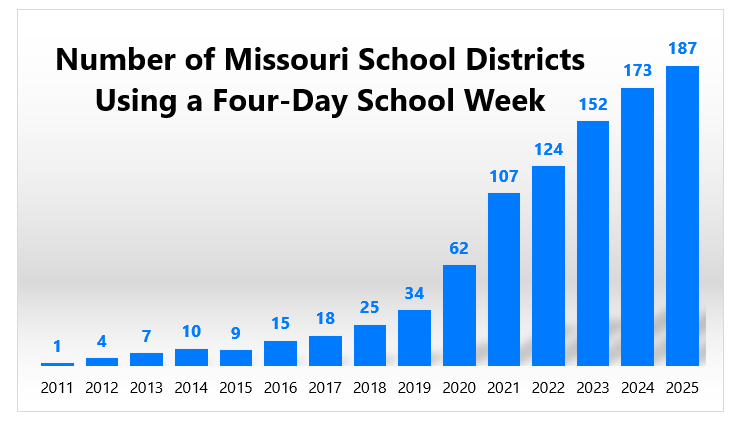
Parents often have sentimental attachments to the place they grew up in—they want their children to be able to experience all the same things they did. Strong attachments can help strengthen the community that supports the district. But these sentiments aren’t shared by everyone. Maybe someone is being bullied or struggling because the class size isn’t right for them. Or maybe families would prefer a five-day school week instead of four. Wouldn’t school districts improve if everyone who was there wanted to be there?

A professional advocate for “Rural School Advocates of Iowa” argued that open enrollment had bolstered rural districts in the state, as many students prefer smaller class sizes and sports programs that give them a better chance to get playing time. Perhaps additional studies on the effect of open enrollment on consolidation rates and enrollment trends could be useful in further addressing this concern.

There have also been reservations about the actual process of districts accepting students. Will districts only accept the best students from other districts? The best version of an open enrollment policy includes mandatory open enrollment. That means districts are not allowed to pick and choose students.

But what about special education students? If districts are required to accept all students, what if a district does not have special education staff on hand—will it be forced to make room?

There are already special education students in Missouri who live in districts without adequate resources to teach them. With open enrollment, I believe parents with special needs students would be more likely to choose a district with an adequate special education program.

As I was researching viewpoints on this issue, I came across an interesting story. A superintendent from a district in Minnesota was lamenting the lengths the district had to go to in order to retain students. The district created a new program that helps students with their post-graduation careers and allows them to earn certificates when they graduate.

Isn’t this what competition is supposed to do? Competition forced this district to create a new program that helps students with their careers after graduation. The desire to attract students to districts breeds innovation. Open enrollment can improve schools and increase options for students and families. Next year, I hope it finds the momentum it needs.

New AEI Report Challenges Gloomy Views of Worker Pay

Years ago I delivered testimony on the minimum wage to the Kansas City Council. After my remarks, a councilwoman asked about a chart showing worker productivity rising while wages remained stagnant. A video of that testimony and my written response to her question is available here.

I think of that again because a new report by the American Enterprise Institute’s Scott Winship, “Understanding Trends in Worker Pay over the Past 50 Years,” addresses the fallacy of that chart and the broader claim that productivity and wages have not grown apace. Contrary to claims from some on both the political left and right, who argue that pay has stagnated despite economic growth, Winship presents evidence that overall compensation has grown in line with productivity when correctly measured.

The analysis begins by correcting misconceptions about wage stagnation. Winship shows that median worker pay, though not rising as dramatically as some top earners, has increased significantly when considering total compensation rather than just hourly wages.

Winship also addresses the discrepancy in pay growth between different groups. He notes that women’s pay has increased more rapidly than men’s over the past several decades.

Winship suggests that instead of accepting a gloomy narrative of failing capitalism or deteriorating worker conditions, policymakers should focus on boosting productivity and enhancing skills among middle- and working-class Americans.

The report paints a more optimistic picture of American workers’ pay trends relative to productivity over the past fifty years. While there are opportunities to enact policies that could improve workers’ economic mobility, they must be built on the solid understanding of wages that Winship advances.

Let’s Just Get Rid of Personal Responsibility for Everyone

It is hard to overstate how seriously the City of St. Louis appears to be leaning into just giving other people’s money away. I’m sure I’ll be mocked for stating that it appears the goal of city leaders is to remove the last vestiges of personal responsibility for lower-income city residents and put everyone on the dole, but a quick review of recent policy decisions at city hall leads me to that conclusion.

Let’s recap. In 2015, the city passed its ridiculous source-of-income rule that requires landlords in the city to accept housing vouchers. Keep in mind that most housing vouchers involve the Section 8 program, where participation is voluntary. But in the city, and in four other towns in Missouri, you are required to participate.

The other actions are all more recent. In recent months, city leaders have:

The only silver lining to all of this is that the current city leadership is so poor at municipal administration that these programs are only going to “help” a small number of people. It’s almost as if the political message behind them is more important than the programs themselves. (In these cases, that is a good thing.)

This expansion of the local welfare state is the last thing St. Louis needs to turn itself around.

So Predictable

For almost a year there have been dire discussions of a coming “fiscal cliff” in public education spending. What is this doomsday fiscal cliff you might ask, and why is it going to happen? Simply stated, it is the expiration of federal stimulus funds that were sent to states during the COVID-19 pandemic. The pandemic emergency has ended and, therefore, at some point, so will the emergency spending. Or, as described by the chairman of the Missouri Board of Education in a recent article, “you have a lot of federal authority deleted.” Huh? So, naturally, the drumbeat has begun for big asks of lawmakers to appropriate state funds that will make up the difference.

Let’s look at this with a clear head. The chart below shows Missouri state and federal revenue for public education, adjusted for inflation, from before the pandemic through the recently approved budget for the 2024–25 school year. In 2017–18, there were just under 920,000 students in pre-K through 12th grade in Missouri and the state legislature appropriated a total of $5.8 million (2023 dollars) from the general revenue fund and other state funds. The federal government kicked in another $1.3 million, largely for the Title I program for low-income students, the IDEA program for students with disabilities, and the school lunch program. Last year, even after the recovery from the pandemic enrollment drops, we had about 25,000 fewer students—a trend that is expected to continue. Yet, the legislature’s appropriation was about $500 million more than seven years ago.

The cliff is in that green hump at the top of the graph. Like a hike in the mountains, if you do a lot of climbing, you’re going to have to descend at some point to get back to your car.

So, is it obvious that we need a special session to get a “mother of all supplemental budgets” for education? Only if you believe that spending can only ever go up. Missouri, like many states, has a persistent trend of declining enrollment. Is it reasonable to think that we can only ever consider level or increased spending on public education?

Release Those Records, Kansas City!

According to documents received from Clay County through an open records request, the Royals suspended negotiations regarding a new stadium on January 16 to “work through a competing opportunity in Jackson County.”

Two Clay County Commissioners, Jason Withington and Scott Wagner, as well as Jackson County Executive Frank White, stated publicly that Kansas City—which sits in Jackson County—made a significant offer over and above the Jackson County sales tax that changed the course of those negotiations.

What was that offer?

We don’t know. Similar open records requests to Kansas City were denied citing ongoing negotiations. Clay County leaders initially denied requests as well. However, the Clay County Commission was made aware of the records request and the dubious claims made to keep those records closed. On February 22, the commission agreed to release the documents.

The Kansas City Council should follow suit. As I wrote to all the members of the Council on April 15:

The City denied my records request (R012348-030124) relying on an understanding of Missouri statutes that allows for sealed bids to be closed. But the negotiations with the Royals were not the result of any bid responding to a city-issued RFP or RFQ. They were more likely similar to any negotiations for incentives that go through the EDC—which are all public documents. Even if they were sealed initially, the vote itself is a clear sign that those negotiations are ended. The documents are public.

Please exercise your legislative authority by directing the city to release these term sheets, any related documents and their various iterations over time. The April 2 campaign was dogged by a lack of transparency—the measure’s defeat is a clear signal that Kansas Citians should know more, not less, about these negotiations.

I’ve received no responses to that email. There is no indication that the city is in any ongoing negotiations. And even if it were, there is no reason to keep the prior negotiations secret.

When Do Summer Breaks Start for School Districts Across Missouri?

Many families may be beginning to wonder if their children’s school gets out earlier or later than everyone else’s. With summer break on the horizon (some schools are actually already on break), let’s look at summer breaks for Missouri public school districts by the numbers.

*Statistics are based on a self-compiled compilation of calendars. If snows/sick days have shifted the last day of school, they are not accounted for.

**Kairos Academies, Clarksburg C-2, Clarkton C-4, Crocker R-II, Eldon R-I, La Salle Charter School, Mark Twain R-VIII, New York R-IV, Premier Charter School, The Biome, Thornfield R-I, and Union Star R-II are not accounted for.

Skyline R-II was the first district to start summer break, on May 1. Hazelwood and Ferguson-Florissant will be among the final districts to go on break on May 31.

Based on the projected last day of class, if you are a St. Louis kid, you are probably getting out later than everyone else. Of the 15 traditional school districts (non-charters using a five-day school week) that end classes May 28 or later, 11 of them are in the St. Louis area. These St. Louis–area schools are Ferguson-Florissant, Hazelwood, Clayton, Ft. Zumwalt, Parkway, Wentzville, Ladue, Maplewood-Richmond Heights, University City, Mehlville, and Riverview Gardens.

How long do most summer breaks last in Missouri?

*Based on the projected number of days, we rounded the district to the nearest week. For example, a district with an 81-day summer would be coded as “12 weeks.”

**In this estimation we assume districts have the same first day of school as 2023-2024, and then subtracted that number by two. In 2020, Missouri mandated that Missouri public schools’ first day of school cannot be before a certain date. In 2023-2024, it was August 21st. For 2024-2025, it will be August 19th, two days earlier.

As the above figure displays, the average summer break is a little over three months for Missouri students. The shortest summer break is roughly 10 weeks, while the longest is around four months at 16 weeks. The rural districts (enrollment in parentheses) of Fairview R-XI (493), Glenwood R-VIII (218), Howell Valley R-I (209), Junction Hill C-12 (193), and Richards R-V (343) all have nearly four-month summer vacations—with May 2 as their last day of class, and August 21 as their first day of class in 2023–2024.

Interestingly, the districts that have the shortest summer breaks all tend to be St. Louis–area districts, with Ferguson-Florissant and Hazelwood having the shortest breaks. Along with these two, Clayton, Ft. Zumwalt, Parkway C-2, Wentzville, Ladue, University City, Mehlville, Riverview Gardens, Affton, Bayless, Brentwood, Francis Howell, Orchard Farm, Rockwood, and Valley Park all have estimated summer breaks under 90 days.

How do these statistics differ amongst various types of schools?

The above figures are known as a box and whisker plot. The vertical line (whiskers) represents the full range, while the box represents the middle 50 percent of responses. Any statistical outliers are noted as dots, the horizontal line is the median, and the “x” is the mean.

As shown, rural schools on average have much longer summer breaks than their suburban and city counterparts. Additionally, most of the longest breaks in the state are rural—of the 50 longest summer breaks in the state, 47 of them are rural districts. While this may be reflective of the bygone days when most rural children worked on farms, Institute analysts have conducted research that found rural high school students may have fewer opportunities and lower rate of college readiness than their suburban counterparts.

Another important takeaway from these figures is the difference in break length between charters and traditional schools. Charter schools have an average (mean) summer break of 84 days, versus 92 for four-day school week districts and 94 days for traditional five-day school week districts. In Missouri, charter schools serve high proportions of disadvantaged students and shorter breaks may be a good use of charter school flexibility.

Do longer summers hurt students? Summer learning loss is a well-documented phenomenon. However, there are debates about the actual extent of achievement loss. Regardless, it is interesting to see the variability across the state and to consider if there could be academic implications.

Support Us

The work of the Show-Me Institute would not be possible without the generous support of people who are inspired by the vision of liberty and free enterprise. We hope you will join our efforts and become a Show-Me Institute sponsor.

Donate
Man on Horse Charging