On October 22, the Show-Me Institute released the following recommendations for bringing Missouri government spending under control.

On October 22, the Show-Me Institute released the following recommendations for bringing Missouri government spending under control.
I attended a screening of the KCPBS documentary “A Tale of Three Cities” on Tuesday hosted by the Kansas City Chamber of Commerce. (Full disclosure: I appear in the film twice, but only briefly.) It was a good conversation, and panelists included the police chiefs for both Kansas City, Missouri, and Kansas City, Kansas, as well as people working with ex-offenders or those at risk of offending.
The screening came just as Kansas City announced another city-sponsored initiative to deal with crime, Kansas City United for Public Safety (KCUPS). It is not yet clear how this group will differ from the previous similar collectives such as KC Nova, the Violence Free Kansas City Committee, KC Common Ground, and Jackson County’s COMBAT. Somehow this group expects to succeed where others have failed. KCUPS had meetings, published a plan, and held a press conference, so it is as real as any anti-crime effort in Kansas City.
The leader of KC Common Ground, Klassie Alcine, was at the screening and gave an interview to Jonathan Ketz of FOX4 KC. Her answer when asked how much money would be needed to address crime in Kansas City? “Billions.”
I have been writing about crime, policing, and criminal justice reform at Show-Me Institute for years. I do not present myself as an expert and I am quick to admit these issues are complex. Kansas City has gotten where it is because of years of bad decision-making. The road ahead will be difficult, slow, and expensive.
But anyone who is remotely aware of Kansas City’s history knows that we spent billions on public education and have little to show for it. We spend millions each year on anti-crime programs through the county COMBAT program without even trying to measure their impact. Kansas City shoppers are also taxed to fund an economic development fund for the city’s poverty-scarred east side. That includes a publicly subsidized grocery store recently suffering high crime.
The people of Kansas City are generous, perhaps to a fault. One more effort to address crime that looks and sounds like other failed efforts needs to do better than leading with a price tag. Tell us what you want to do and give us reasonable goals and the ways you are going to measure success. Anything less seems like asking taxpayers to throw good money after bad.
Rarely do my predictions come through as quickly, starkly, and ironically as they are in Jackson County right now.
Last year, Jackson County passed the senior property tax freeze. I have testified against these plans across the state. In many of these comments, I have pointed out that it is extremely troubling to create a system where people (i.e. seniors) will vote on property tax increases they won’t have to pay. As I said in one of my testimonies:
Similarly, this bill will lead to the troubling issue of people voting on property tax increases that they themselves are not subject to. The single best aspect of property taxation is that it focuses the costs of local services on the people who pay for those services. . . . Instituting a system where people vote on property taxes they won’t pay breaks that beneficial connection. It dramatically alters the voter calculation if seniors are voting on property tax increases they are immune to.
Now, Jackson County has placed a property tax increase on the November ballot. So, as I stated, senior citizens in Jackson County will be able to vote on a property tax increase they won’t have to pay. But it gets even better. It isn’t just any property tax increase—it’s a property tax increase to create a new fund for senior services in Jackson County. You can’t make this up. The county has proposed a new tax to fund benefits for senior citizens that senior citizens get to vote for but won’t have to pay for. What rational senior citizen won’t vote for this tax? All the potential benefits, none of the potential costs. It’s simply ludicrous.
I said before that:
“This bill is every bit as much of a tax increase on non-senior citizens as it is tax relief for some senior citizens,” Stokes said.
I had no idea of just how right I was going to be, unfortunately.
When considering the costs of running a school, we may think of items like teacher salaries, classroom technology, textbooks, and tutoring services. It seems natural to assume that instructional expenses would dominate school budgets. However, statewide trends over the past decade reveal an interesting story. Instructional costs have been decreasing as a proportion of overall spending, while expenditures on student support and non-instructional services have steadily risen. In fact, student support services are now on the verge of overtaking instructional costs in Missouri.
Classifying Missouri Public School Spending
The Department of Elementary and Secondary Education (DESE) classifies spending as:
Instructional costs include salaries and benefits for teachers, aides, and specialists. It also covers instructional materials (paper, microscopes, software, paint brushes, sports gear, etc.), professional development, and standardized testing materials.
Student support services cover (but are not limited to) salaries and benefits for counselors, psychologists, social workers, nurses, behavioral specialists, and college-preparatory specialists. It also covers costs for mental health services, plus behavior and outreach programs. Administrative, transportation, and food service costs are also classified under this category.
Non-instructional/student support costs in Missouri cover a wide variety of services, such as early childhood instruction, afterschool programs, adult education, and purchases with bonds.
The figures below show how costs have shifted in Missouri over the last decade, as well as changes in staff numbers.
Figure 1: Share of Total Expenditures in Missouri Public Schools by Type, 2013–2023
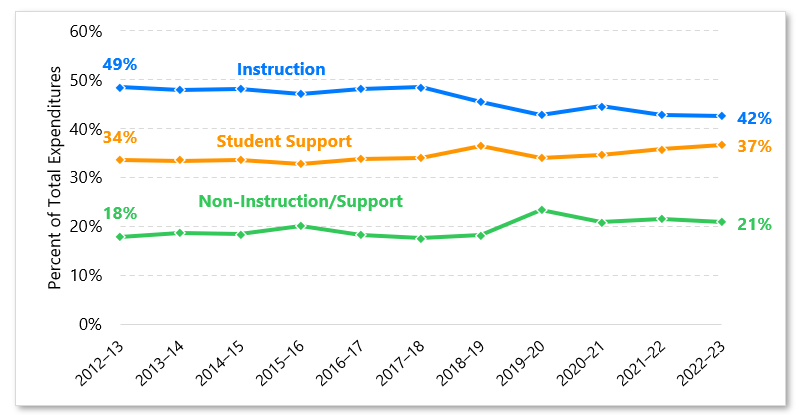
Figure 2: Number of Missouri Public School Students and Teachers
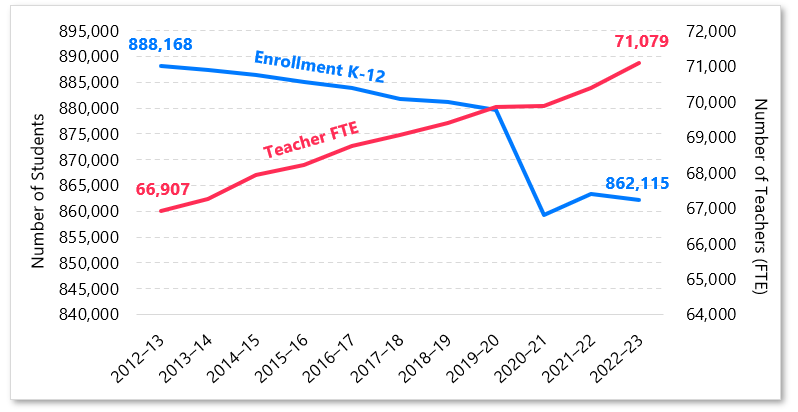
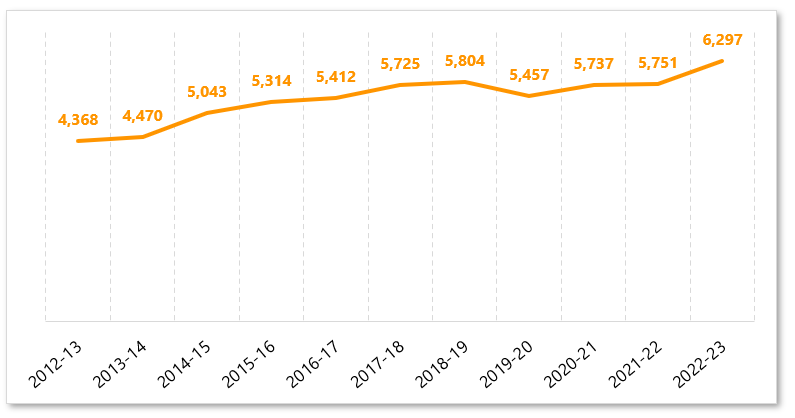
Figure 3: Total Number of Staff: Student Support Services
Source: Department of Elementary and Secondary Education (DESE)
The 2018–19 school year marked the first large decrease in the share of instructional costs in total expenditures, and it has decreased further since then. If the trend continues, spending on student support services in Missouri may soon surpass instructional spending.
Figure 1 is even more fascinating when considering that the total number of teachers has continued to rise in Missouri, with student enrollment decreasing in the same time period. Even with 26,000 fewer students than in 2012–13, there are around 4,000 more Missouri teachers and 2,000 more student support staff (as of 2022–2023, the most recent data).
The trends emerging from Missouri’s public school spending raise important questions about financial priorities and the need for increased educational transparency. Are funds being used to improve classroom instruction and foster better learning environments? Once DESE releases financial data for the 2023-2024 school year, it will be interesting to see whether this downward trend continues.
As a resident of the Wentzville School District, I recently received a copy of the district’s 2023–24 annual report. The well-designed, 16-page document highlights the district’s growing work-related pathways, new construction projects, expanded early childhood programs, and academic performance. The report also contains a two-page spread on the district’s finances and spending. The report declares the district’s property tax rate “remains the lowest it has been in more than 10 years.” It also explains where the district is spending money, with 84% of operating funds being spent on salaries and benefits.
There is one key piece of information left out of the report—how much the district actually spends. The report tells residents the district spends $1,718 less per pupil than the state average on operating expenses, but it does not tell us that amount.
While it is understandable for organizations to want to put their best foot forward, this lack of transparency is a real problem. Taxpayers should know how much their schools are spending. Unfortunately, districts and the state make this information hard to find.
That is why the Show-Me Institute created MOSchoolRankings. In addition to having detailed academic data, the site provides detailed financial records for every school district in the state. In 2023, Wentzville spent $15,759 per pupil in total expenditures. That means roughly $390,000 is being spent on a classroom of 25 students. Want to know exactly where those dollars are being spent? The website breaks these expenditures down by program, providing the most granular level of analysis in the state.
The annual reports sent by districts are not meant to be a detailed accounting of performance and spending. They are promotional materials designed to paint the district in a positive light. There is nothing wrong with that—organizations should share their successes. Taxpayers who want more information, however, should have access to it.
With ongoing reports about St. Louis Public Schools’s (SLPS) finances, I was interested to learn that SLPS had created nine new administrator positions. Below are just a few examples:
These funds could have been used on a number of (I’d argue) more useful items, such as supplying instructional materials to students or hiring tutors. This raises larger questions: how are Missouri districts spending their money, and where can taxpayers find that out?
My colleagues, James Shuls and Susan Pendergrass, have both lamented the difficulty of using state resources to evaluate districts spending and performance. The weakness of Missouri’s Sunshine Law also allows districts to skirt citizens’ requests for information by charging exorbitant prices.
With this dearth of available information, it is difficult for people to know how money is being spent. To meet this need, the Show-Me Institute annually updates MoSchoolRankings.org, which provides an in-depth look at the educational performance and financials of school districts and charters.
Using MoSchoolRankings
The Department of Elementary and Secondary Education (DESE) posts each district’s Annual Secretary of the Board Report on its website. These financial reports are compiled and are the source for MoSchoolRankings.
Individuals can either search for districts or find them on an interactive map. The data include, but are not limited to, math proficiency, ACT scores, enrollment, revenues, locale, website, phone number, demographics, average teacher salary, expenditures per student, and a ranking system for all districts.
With multiple years available, individuals can use MoSchoolRankings as a springboard for further research. For example, consider the below table created from data on MoSchoolRankings.
| St. Louis Public Schools | 2021–2022 | 2022–2023 |
| Care and Upkeep of Building Services | $22.6 million | $47 million |
| Board of Education Services | $2.3 million | $8.8 million |
Noticing the large changes in spending in just one year, an individual could highlight these categories and look further into the exact spending (such as receipts for which goods and services were purchased).
The image below displays how the website looks in practice, using the North Kansas City 74 School District as an example.
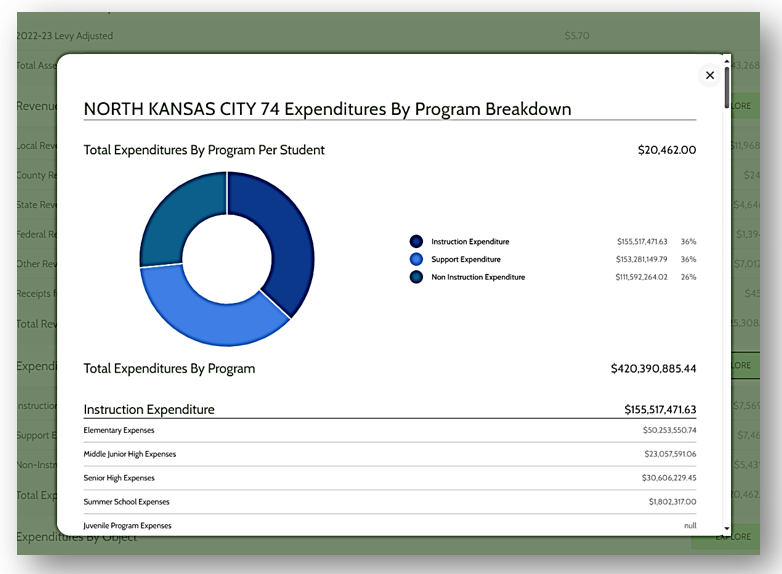
MoSchoolRankings.org will remain essential for shedding light on our state’s student performance and district finances. However, Missouri still needs to improve the accuracy and accessibility of state reporting in order to allow parents to hold districts accountable. Increased transparency could help ensure that school districts prioritize spending on classroom instruction and student success.
A version of the following letter was published in the Kansas City Star.
On November 5, voters in Platte County will decide on a new “children’s services fund” tax. The proposed quarter-cent sales tax will fund mental health services for children. We all want to help kids, right? It may at first glance seem to be an easy choice, but Platte County citizens should think twice before supporting this new tax.
Politicizing charity is a dangerous road to go down. So is creating another, obscure taxing district with little oversight. The established children’s services fund in Lafayette County provides a useful case study for those problems. The fund had operated for years with almost no oversight. Those operating it routinely engaged in improper activities, including funding charities that were affiliated with board members and funding a private business that wasn’t a nonprofit. After a whistleblower called attention to these problems, the state auditor investigated and referred the fund to authorities.
If voters pass this tax and create this fund, will some kids benefit? Of course. But entangling philanthropy with politics, creating a new taxing agency with limited oversight, and making charities dependent on government are not the best ways to go about helping kids in Platte County.
In this episode, James V. Shuls speaks with David Stokes, Director of Municipal Policy at the Show-Me Institute, about his recent report, A Free-Market Guide for Missouri Municipalities. They discuss the benefits of applying free-market principles to local governance.
Produced by Show-Me Opportunity
In my previous post, I discussed how the shuttering of coal energy in Missouri could create problems with energy prices and reliability. In this post, I will discuss a potential solution to the reliability problem.
What does a reliable electric grid even mean?
The Federal Energy Regulatory Commission defines grid reliability as:
“The provision of an adequate, secure, and stable flow of electricity as consumers may need it. In other words, when you flip the light switch, the lights turn on. The grid remains functional even during unanticipated but common system disturbances.”
Essentially, there needs to be a sufficient and secure amount of dispatchable power plants supplying electricity to consumers. Dispatchability is an energy source’s ability to be “dispatched” to the grid’s consumers whenever they need it. Intermittent energy sources, like wind and solar, are not dispatchable, as they are not continuously available for consumers when they need it.
Missouri’s retiring coal plants are consistent and dispatchable, and to maintain grid reliability, they should simply be replaced with similar plants—such as nuclear or natural gas.
But what about battery storage for intermittent sources?
The presence of energy storage does not make wind and solar any less intermittent. They are still intermittent, but it’s possible battery storage could help alleviate this problem.
Globally, battery storage is rapidly rising, and costs are decreasing. These trends should bolster the effectiveness of renewables—but the sheer amount of energy the United States uses is daunting. The Mackinac Center notes that the United States is set to add 191.6 gigawatt hours of battery backup systems between 2022 and 2026. This is a ton of storage. However, in 2021, the United States used 4,116,000 gigawatt hours of electricity in 2021 alone. Per calculations from the energy analysis group Doomberg, that nets out to 24 additional minutes of battery backup storage added over that five-year period.
Additionally, the International Energy Agency noted the difficulty of providing the materials for a mass battery and renewable expansion at scale. Compared to total mineral demand in 2020, it projects a need for six times as many total minerals for a “net-zero by 2050” scenario.
What’s a policy that could help boost grid reliability?
Last session, House Bill (HB) 1753 passed through the Missouri House but failed to make it to the floor in the Senate. This bill outlined that, prior to the closure of an existing power plant, there must be:
The retirements of functioning power plants should not be done in haste. HB 1753 would have helped pump the brakes on an energy transition that seems to be barreling out of control. Even if you believe that renewables should be the primary energy source, there should be a highly dispatchable and reliable source backing them up.
Commissioner Mark Christie of the Federal Energy Regulatory Commission (FERC) noted:
I think the United States is heading for a very catastrophic situation in terms of reliability. . . .The core of the problem is actually very simple. We are retiring dispatchable generating resources at a pace and in an amount that is far too fast and far too great, and it is threatening our ability to keep the lights on. The problem is not the addition of wind and solar and other renewable resources. The problem is the subtraction of dispatchable resources such as coal and gas. . . . A nameplate megawatt of wind or solar is simply not equal in terms of capacity value to a nameplate megawatt of coal or gas or nuclear.
Renewable construction is good—it can bring development and diversity to the generation portfolio—but dispatchability needs to be emphasized, and an intermittent source should not be our backbone. We do not need to make the transition away from coal more convoluted than it is. HB 1753 would have protected energy reliability for Missourians. This policy should be given stronger consideration in the 2025 legislative session.