Part Five: The Smallness Of The Potentially ‘Hip’ Core

In Part Four, I wrote about how the number of jobs in Saint Louis’ “central core” fell dramatically in the last decade. The Brookings Institution found that in the 3 miles surrounding Saint Louis’ business district, the city had lost almost 28,000 jobs from 2000 to 2010. Of the job growth the region did experience, those jobs predominantly materialized far outside the city center.

Kansas City feels Saint Louis’ pain. Like Saint Louis, Kansas City has undertaken a series of urban redevelopment plans of its own that, again, have focused on attracting the “hip” class to the city center, oftentimes with significant tax incentives. And as has become commonplace, the hip have come, but the jobs have not.

A report released […] by the Brookings Institution said that in 2010 just 16.9 percent of the area’s jobs were in the core, defined as within three miles of Kansas City’s downtown. That’s down from 20.5 percent in 2000.

Dragged down by the Great Recession, the raw number of jobs in the central core also shrank from 180,000 in 2000 to 140,000 in 2010, according to the study.

For areas between 3 and 10 miles from the city center, the number of jobs also dropped. But between 10 and 35 miles from the central business district? As in Saint Louis, the total number of jobs rose — and in Kansas City’s case, they rose significantly.

The chart below, created by the Kansas City Star, tells the decade-long tale.
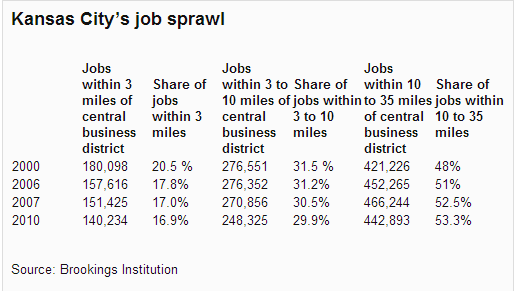
Indeed, all of the regions in Kansas City were buffeted by the Great Recession. Notably, the 10- to 35-mile band was still shy of its intra-decade high as of 2010. But the downtown Kansas City job figures tell a pretty unambiguous tale: jobs have been falling in Kansas City’s central core. Like Saint Louis, population in downtown Kansas City rose over the decade, but . . . (emphasis mine)

. . . new residents hadn’t translated directly to job creation in the core by the time the Brookings information was compiled.

Since then, “we’re seeing some small businesses locate in the Crossroads and the like, but they don’t employ that many,” said Jeff Pinkerton, economist at the Mid-America Regional Council. “And we haven’t had any major employer move downtown recently.

“The fact is that jobs follow rooftops, and housing is growing in the suburbs.”

As has been explained before, “the hip crowd” does not typically have much in the way of jobs coattails. Unfortunately, it seems, Saint Louis and Kansas City know this all too well.

A Strong, Pro-Growth Tax Bill

In the high-stakes arena of legislating, the Missouri Senate and House are going heads up. In March, the Senate drew a pair of fives with Senate Bill 26, its version of substantive tax reform. It is a decent hand, but the House just one-upped the upper chamber.

House Bill 253, “The Broad-Based Tax Relief Act of 2013,” would eventually create a 50 percent deduction for pass-through entity income and cut the corporate income tax rate in half. Moreover, HB 253 ends up costing less in revenue. According to the Committee on Legislative Research-Oversight Division, the estimated revenue shortfall that would occur once HB 253 is fully implemented comes to $364 million. That is less than the $438 million in lost revenue that the state expects to occur if SB 26 were to be fully implemented.

I think HB 253 is a superior tax proposal to SB 26. Importantly, HB 253 cuts more in the areas that will produce the biggest immediate and long-term growth benefits. For its part, SB 26 creates a 50 percent deduction for pass-through income and reduces both the corporate income tax by .75 percentage points and the individual income tax rate by two-thirds of a percentage point over five  years.

Business income, i.e., profits, are the returns to capital owners after labor is paid. There is a strong academic basis for believing that taxes on capital, which business income is, are among the most economically damaging a taxing entity can impose. It is good that both SB 26 and HB 253 seek to enact cuts in these taxes. However, from a growth perspective, bigger business income tax cuts would better enhance the returns to capital owners and should be preferred to considerably smaller across-the-board cuts. HB 253 does this.

If legislators want to pursue a more ambitious proposal, they could also leverage the state’s tax credit liabilities against the tax that is left over after HB 253’s cuts. Combining HB 253 with the provisions of SB 120, which passed the Senate in March, the state could set out a course to enact further reductions in business income tax rates. Something to consider.

Part Four: The Smallness Of The Potentially ‘Hip’ Core

As I have reiterated many times during this series, Missouri’s taxpayers have ample reason to be skeptical of whether “hip” developments, often fueled by tax incentives, are producing valuable dividends to the state and region. But let’s focus on just Saint Louis’ downtown area for a moment longer. As I observed in Part Three, Saint Louis’ downtown population rose from about 4,000 people in 2000 to about 7,000 people in 2010. But what happened to the net number of jobs downtown during that time?

In a study published last week, the Brookings Institution found that Saint Louis’ “central core” — which Brookings defines as the 3-mile radius around a city’s central business district — lost almost 28,000 jobs between 2000 and 2010. That is the equivalent of almost one-in-six jobs disappearing from the downtown area in one decade. Areas just a bit further outside the central core fared similarly. Between 3 and 10 miles from the city center, the Saint Louis region lost almost 39,000 jobs.

The only area that saw growth in Saint Louis was the 10- to 35-mile ring, which gained a paltry 572 jobs. The math is not in hip developments’ favor, despite what some consultants might say.

But the math also makes another conclusion inevitable: that Saint Louis’ central core — the area where the “hip” development disproportionately predominates — lost employment market share to its outer-ring rival between 2000 and 2010. Today, only 13 percent of Saint Louis’ regional jobs are in the central core, about half the national average; meanwhile, more than 60 percent of the region’s jobs are between 10 and 35 miles away, compared to the national average of 43 percent. Saint Louis is now the fifth-most decentralized city in the country in terms of regional job distribution — behind only Detroit, Chicago, Atlanta, and Philadelphia.

While the resident population in downtown Saint Louis has grown, the number of jobs in the 3-mile ring around Saint Louis’ central business district has actually fallen. And again, all the while, the overall population of Saint Louis city has declined. This does not sound like an urban development plan that is working. City centers were built to facilitate commerce. In Saint Louis, that commerce appears to be bleeding out into some of the furthermost stretches of its region.

But Saint Louis is not the only major Missouri city experiencing a job drain. Stay tuned.

Didn’t We Do This Already?

Despite my young age, I will admit that I have a pretty bad memory. That is why I am meticulous about organizing everything and recording notes so I do not lose track of what I have done. When I do forget, I simply search back through my notes and files — problem solved. Call me crazy, but I did not think I was unique in doing this.

Well, Jefferson City City Council members just decided to hire an outside party to complete an in-depth study of transportation system needs and resources. But a couple of years ago, the city hired a $150,000 consultant to do just that. The mayor aimed to justify a new study, suggesting that things have changed enough to warrant a new study. Yet, when asked whether he had reviewed the last study’s recommendations, he said, “It’s been a long time … I don’t want to go there today … I plan on it.” How does he know a new study is needed, if he does not even know what the last one said?

Apparently, many city council members were not even aware of the previous study. I would think a review of that one is necessary before they, or the mayor, can decide what action needs to be taken next. As Bill McClellan has pointed out in some old St. Louis Post-Dispatch columns, we are not doing anyone any favors (besides consultants) when governments pay for expensive studies that sit on the shelf, only to be duplicated again after they are lost under a layer of dust.

The cost of a new consultant was not mentioned in the article, but the city should evaluate the previous study and other options before throwing money into something that may simply reproduce previous work. I have to wonder, is there no one who works for the city (perhaps the Transit Division director) who is capable of making transit recommendations?

The Emperor’s New Airport

At a recent Kansas City Transportation and Infrastructure Committee hearing, Aviation Department Director Mark VanLoh walked the committee through a slide show featuring lots of exciting computer graphics of an airport that does not exist and likely never will. VanLoh said the images were merely “conceptual;” no architect is bound by them. Yet several news outlets have picked them up to illustrate what the proposed terminal could look like. This future airport is as real as the fabled emperor’s new clothes.

Why is fanciful airport art an issue? Kansas City officials argue that we need a shiny new terminal because we are losing market share to other airports in the region, such as Branson, Mo., and Wichita, Kan.

On KCPT’s Week in Review program (comments begin at 5:07), Scott Parks of KMBZ 98.1, in a courageous act of honesty, questions the whole concept of a city “losing flights” to another city. He says:

Maybe I struggle against this panel mentally. I don’t understand how Kansas City is losing flights. Airlines are a business. If people want to fly to Kansas City for business, for pleasure, to visit family, whatever, they’re going to fly to Kansas City. I heard the argument this week that we’re losing flights to Columbia, we’re losing flights to Branson, we’re losing flights to Wichita. Well if I live in Seattle and I have family that lives in Kansas City, I’m not flying to Wichita and then driving three hours to Kansas City. I don’t understand how flights that were supposed to be coming to Kansas City are now going to Wichita or Branson.

The conversation immediately moved to the cost of security and Kansas City International Airport (MCI); no one addressed Parks’ concern.

Just like the old ministers in Hans Christian Anderson’s “The Emperor’s New Clothes,” Parks states the obvious — doing so almost apologetically. But he is exactly right. If proponents want to argue that the airport is unattractive as a hub — a place where people make connections to other flights but not itself a destination — a shiny new terminal will not address that problem. It will only exacerbate the problem if it results in higher costs to airlines who are already being lured elsewhere with cash.

Week in Review was rife with those same slick computer-generated images that were shown at the transportation committee meeting. Those images are meant to appeal to emotions. The Kansas City Star reported that the aviation department has contracted with an outside public relations firm for $117,000. Are presentations to the Kansas City Council and the public already focused on selling slick and colorful images rather than answering substantive questions? The city council’s committee hearing suggests the answer is “yes.”

Kansas City Mayor Sly James has called for an “adult discussion about the facts,” and that is good. But he and others on the City Council have yet to make their case that the Emperor is not naked.

It Is Called ‘Fact-Checking,’ Rolling Stone, And You Should Try It

Let’s cut to the chase. Matt Taibbi of Rolling Stone magazine has jumped on the American Federation of Teachers “blacklist bandwagon.” As it turns out, the Show-Me Institute’s work on public union pensions and public union policy generally has made us a national bête noire of the Left.

Of course, Taibbi knows his role in that game and plays it as best he can. But I would like to know his source on this nifty factoid (emphasis mine):

Dan Loeb isn’t the only hedge fund manager aligned with groups like Students First, the Manhattan Institute, or local anti-benefit lobbies like the Show-Me Institute (created by billionaire Rex Sinquefield to campaign against defined benefit plans in Missouri) . . .

Oh? And what actual evidence, Matt, do you have for the assertion that the Show-Me Institute — now close to a decade old — was founded for the purpose of “campaign[ing] against defined benefit plans”?

We’re waiting.

But while we wait, Matt, I did want to tell you that I found your investment advice remarkable, compelling, and ironic (emphasis mine):

A lot of teachers and public sector workers would do just as well to just dump their money on some plain-vanilla S&P index and not pay obscene tax-sheltered fees[…]. Not only would the returns probably be a wash or close to it, but retirees at least wouldn’t be stripping themselves of their biggest asset – the political power their money represents.

That is excellent advice. And you know who helped invent the first S&P index fund? Rex Sinquefield, of course. But you knew that, right?

Right?

Stokes on KWMU – Veolia Contract Would Benefit City

Innovation comes from the private sector. You don’t have to be a radical capitalist to agree with that simple truth. For example, a private inventor, not a government water company, devised the water meter. St. Louis residents will benefit from the proposed consulting deal with a private company to improve the city’s water division.

In putting together a team of officials working to improve water services, Saint Louis Mayor Francis Slay deserves credit, not criticism. When an agency such as the water division, which has been doing something for a long time, seeks ways to improve, they need to look outside the organization for new ideas. Anything else is an exercise in futility.

The team the mayor established collected many water consulting bids and chose the French company, Veolia, to advise the city. The contract calls for a $250,000 consulting fee. Depending on which suggestions the city chooses, Veolia would then be paid more to help enact the improvements.

This is not privatization. Trust me, I wrote the study on privatizing the city water division and I wish this was privatization. It is not. This is a simple consulting deal. The city would still own, operate, and maintain every part of the water division. All this proposal calls for is tapping into the private sector expertise to improve water service. That will benefit everyone, and should be embraced, not attacked.

Opponents of this proposal are applying the shotgun approach in their fight: objecting to everything possible. This includes irrelevant issues like Veolia’s work in the West Bank and Israel and cherry-picking a few Veolia city contracts that failed and ignoring the many that have succeeded. Veolia has been effectively providing comprehensive water services in Oklahoma City and Edwardsville, Ill. — to give just two Midwest examples — for many years. Those cities have routinely renewed their Veolia contracts.

This contract has nothing to do with privatization, but the absolute objection to private water from some is still strange. Private water companies have been serving the one million people in Saint Louis County for a century. Do you recall all the scandals and controversies about private water in the county? Neither do I.

But it is scandalous that the city water division has never put in water meters. I am not blaming current leadership — this should have been mandated 50 years ago. The lack of water meters encourages waste, inefficiency, and is unfair to consumers. When the city raises water rates, residents have no effective way to react. Businesses, which have water meters in the city, can respond to price hikes by reducing usage to save money. as AB InBev recently did. City residents deserve the same ability to benefit from conservation.

City residents who use less water have long subsidized heavy water consumers. If you choose to sprinkle your lawn like you’re a zealot at Masada, wallowing in abundant water to purposely taunt the suffering Romans legions in the scorched desert below, that’s fine. But you should pay for it, not your neighbors.

The consulting deal with Veolia will result in many different ideas for better water delivery. People, businesses, and governments all benefit when they seek advice from knowledgeable parties outside their normal circles. The objections to the contract are an example of scattered ideology trying to stop practical steps for general improvement. The Veolia contract will improve water service in the city, and that will benefit us all.

Support Us

The work of the Show-Me Institute would not be possible without the generous support of people who are inspired by the vision of liberty and free enterprise. We hope you will join our efforts and become a Show-Me Institute sponsor.

Donate
Man on Horse Charging