Columbia Says No To A TIF

There was very big news out of Columbia, Mo., Monday night. The Columbia City Council shot down a large Tax Increment Financing (TIF) proposal in a 5-2 vote. The list of TIF rejections in Missouri is, unfortunately, short. Hopefully, this is the start of a trend, not just in Columbia but around the state.

The Columbia city manager and mayor had proposed an enormous TIF district covering large areas of downtown. The idea was that the TIF on several new, very large student housing developments would pay for infrastructure improvements that most people seem to agree downtown Columbia needs. In general terms, this TIF proposal may have been better than most, but that is like saying Mao was better than Stalin. Just because this money would have — at least in the proposal — gone toward infrastructure does not justify passing a TIF that would have enormously changed the tax make-up of downtown Columbia for up to 23 years and put the other taxing districts at a severe disadvantage.

Sometimes it takes political leadership to argue for tax and fee increases. In following this debate, it seemed as if just giving the new developments a subsidy and then using that subsidy for infrastructure was the easy way out. That is how warped we have become in Missouri. Subsidies such as TIF, Enhanced Enterprise Zones (EEZ), etc. are so common that they have become the rule, not the exception. Let there be no doubt about it: If this TIF proposal had passed, then subsidies like it would have become standard for everything in Columbia. And heavy use of TIF and other subsidies would be very bad in the long run for Columbia, just like it has been for the Saint Louis and Kansas City areas.

If there are infrastructure needs in downtown Columbia, they can fund improvements the same way they were funded for a century: bond issues and fee increases, with any new developments paying the full share of tapping into the system. Better yet, privatize the water and electric utilities and use that money to fund necessary improvements. Whatever you do, don’t count on subsidies to do the work that leadership should do.


Raising The Minimum Wage Will Cost 500,000 Jobs

The Show-Me Institute has talked a lot about the negative effects of raising the minimum wage. In his two policy studies for the Show-Me Institute, David Neumark found that an increase in the minimum wage likely would reduce employment among low-skilled workers. Yesterday, the non-partisan Congressional Budget Office (CBO) released a study detailing the estimated economic impact of the federal government raising the minimum wage. The CBO found that raising the minimum wage to $9 an hour would eliminate 100,000 jobs by 2016. If the minimum wage is raised to $10.10 an hour, 500,000 jobs would be lost. On the other hand, the report also found that overall real income would increase by $2 billion and between 300,000 and 900,000 people (a huge range) could be lifted out of poverty.

Helping people get out of poverty is a good thing and if these estimates are correct, an increase in the minimum wage could help do that. However, the question is, does this fact compensate for the large number of people who would lose their jobs? Possibly, but raising the minimum wage is not the only way to help combat poverty. In fact, while it might help some poor families, it also would give a pay increase to many suburban teenagers and students while costing jobs for the very people it is designed to help.

In his 2012 policy study, Neumark mentioned the Earned Income Tax Credit (EITC) as a possible tool to increase the incomes of low-wage workers. The CBO report found that, “To achieve any given increase in the resources of lower-income families would require a greater shift of resources in the economy if done by increasing the minimum wage than if done by increasing the EITC.” In other words, the costs associated with raising the minimum wage greatly exceed the costs of expanding the EITC. This is true because many minimum wage workers are not from low-income families. On the other hand, the EITC only goes to low-income families. Even proponents of raising the minimum wage admit that the minimum wage is a “blunt instrument” for helping low-income families. Missouri should consider establishing a state EITC alongside the federal one.

The new CBO report projects that raising the minimum wage could help some people get out of poverty at the cost of hundreds of thousands of people losing their jobs. If policymakers want a way to combat poverty, there are more effective means to doing so, including expanding the EITC.

Kansas City Streetcar: Tax Now, Answer Questions Later

Kansas City Mayor Sly James told a meeting of streetcar opponents a couple of weeks ago that the effort to save the trolley trail — a band of green space running through the city once dedicated to a streetcar but now used for walking and bicycling — is misinformed because:

There’s multiple options, three or four of which have nothing to do with the trolley trail; won’t touch it, won’t run on it, won’t use the lines on it.

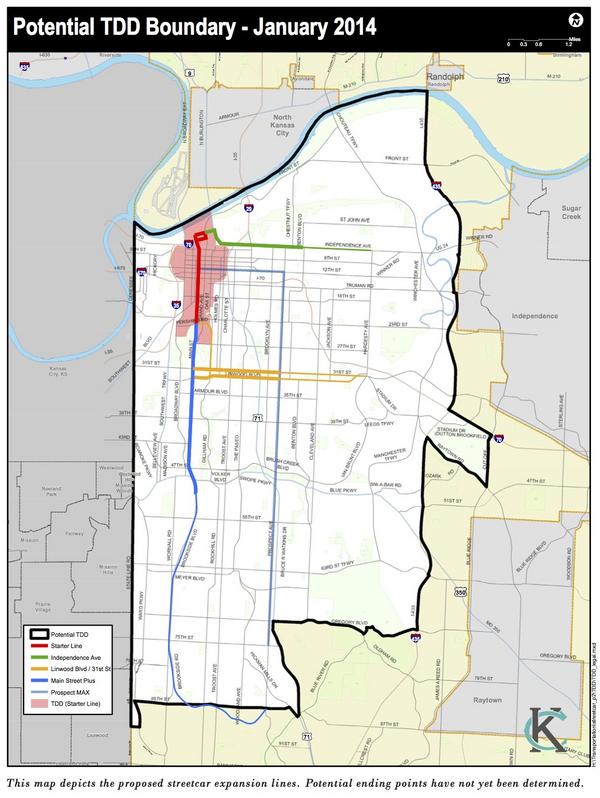
The problem for residents and businesses is that no one will tell them what those “multiple options” are, so they are left guessing. The Kansas City Business Journal has published a map of where the rail lines will be laid, approximately, but this is just a broad route. The “multiple options” the mayor speaks of seem to be only a series of cross-section cartoons of what a rail might look like on the road, or on the trail, or in a mixed setting. For all the reality it represents, it might as well include subway tunnels or Clay Chastain’s gondolas. It is not a route and it is not binding on the city. (Note that in the bottom image they just extended the graphic out into the left margin to insert a third turning lane, in effect increasing the land available to them. You can’t do this in the real world.)

Kansas City voters are being told to vote to increase their sales and property taxes now and discuss what it is going to pay for later. And what comes later could easily include eminent domain, dead-end neighborhood streets, bulldozed neighborhood parking lots, railroad crossing gates placed over every street that the route crosses, and the destruction of green space all along the route. No one knows.

Amid such little transparency, it is understandable that voters do not want to give City Hall broad power. If transportation planners want support for their plans, they should come to voters with a complete proposal, not non-binding — and physically impossible — “options.”

Privatization Can Benefit Missouri Taxpayers

As first appearing in the Springfield Business Journal:

When I was growing up, I regularly played golf at the Forest Park municipal golf course in Saint Louis. Later, in my high school and college years, I noticed that the quality of the course was improving, a lot. This happened at the same time (late 1980s) that the city of Saint Louis outsourced the management of the golf course to a private company. As that outsourcing, or privatization, of the golf course has continued, the quality of the course has continued to improve. I doubt you would find one golfer familiar with the course before and after who thinks the outsourcing of its management and operations did not significantly enhance it.

That same type of story is repeated throughout Missouri. Good government need not be big government and the public sector does not have to provide public services in every case. There is a role for private delivery, often regulated, of public services in Missouri. In many cases, the private sector can deliver those services more affordably and at a higher quality than the government.

In fact, Southwest Missouri is home to one of America’s most enterprising privatization projects. The Branson Airport is America’s only fully private commercial airport. In a capitalist system, not every business attempt succeeds, and the Branson Airport may yet fail. (I hope not.) But if it fails, private investors will be out their own money, unlike Mid-America Airport in southern Illinois, where local governments have had to continually fund that little-used white elephant.

On the other end of the spectrum is City Utilities (CU), Springfield’s municipal behemoth. Missouri’s other large cities are primarily served by private utilities. Those private utilities pay taxes, face more regulations, earn a return on investment, and still charge comparable rates to CU. Springfield needs to consider following the example of Florissant, Mo., a decade ago, and divest itself of its public utilities.

Research has shown that privatization works best when the driving force is pragmatism, not ideology. Politicians and voters can still debate about what services should be provided as part of the eternal debate over the role of government in our society. But privatization is more about how those services are provided, not whether they should be. Unless you genuinely believe that as many people as possible should be on the public payroll, like the big city political machines of yesteryear, then a government service that you depend upon or care about likely can be addressed with privatization.

There are certain roles that should always belong to the government, such as police powers, and never to the private sector. Furthermore, the role of government regulation in many privatized public services is important, such as regulation of private utilities. Finally, in some instances, such as animal control, private partnerships with non-profit groups may be preferred to for-profit companies. Whatever way you look at it, there are numerous examples, such as Cox Health operating ambulance services in Christian County or the existence of private libraries in Taney County, where privatization can provide better services at lower costs for Missourians. Just play golf at Forest Park to see the evidence.

David Stokes is the director of local government policy at the Show-Me Institute, which promotes market solutions for Missouri public policy.

Ambulance Service An Example Of Privatization’s Benefits

As first appearing in the Southeast Missourian on 10 Feb, 2014:

When I was growing up, I regularly played golf at the Forest Park municipal golf course in St. Louis. Later, in my high school and college years, I noticed the quality of the course was improving, a lot. This happened at the same time (late 1980s) the city of St. Louis outsourced the management of the golf course to a private company. As that outsourcing, or privatization, of the golf course has continued, the quality of the course has continued to improve. I doubt you would find one golfer familiar with the course before and after who thinks the outsourcing of its management and operations did not significantly enhance it.

That same type of story is repeated throughout Missouri. Good government need not be big government, and the public sector does not have to provide public services in every case. There is a role for private delivery, often regulated, of public services in Missouri. In many cases, the private sector can deliver those services more affordably and at a higher quality than the government.

Ambulance service is one area where Southeast Missouri is a leader in the privatization debate. In much of Missouri, government agencies provide ambulance services. However, in Cape Girardeau and Butler counties, ambulance services have long been privately provided. Government operation of ambulance service in most other parts of Missouri leads to a constant pressure to increase taxes and spending. In fact, voters in St. Charles County (outside St. Louis) rejected an ambulance tax increase in 2013, only to see the exact tax increase planned again for 2014. Those private ambulance companies in Southeast Missouri are serving the community just as well as a government agency could, and taxpayers are benefiting.

Research has shown privatization works best when the driving force is pragmatism, not ideology. Politicians and voters can still debate about what services should be provided as part of the eternal debate over the role of government in our society. But privatization is more about how those services are provided, not whether they should be. Unless you genuinely believe as many people as possible should be on the public payroll, such as the big city political machines of yesteryear, then a government service you depend upon or care about likely can be addressed with privatization.

There are certain roles that should always belong to the government, such as police powers, and never to the private sector. Furthermore, the role of government regulation in many privatized public services is important, such as regulation of private utilities. Finally, in some instances, such as animal control, private partnerships with not-for-profit groups may be preferred to for-profit companies. Whatever way you look at it, there are numerous examples, such as the ownership and management of Maramec Spring Park near St. James by the private, not-for-profit James Foundation, where privatization can provide better services at lower costs for Missourians. Just play golf at Forest Park to see the evidence.

David Stokes is the director of local government policy at the Show-Me Institute, which promotes market solutions for Missouri public policy.

Show-Me Institute Presents: Missouri Transition Costs And Public Pension Reform

The Show-Me Institute has talked about the need to reform public employee pension plans so they are financially secure and more attractive to potential hires. However, some public pension reform opponents believe that closing these plans would be risky and result in added transition costs.

In our new policy study, “Missouri Transition Costs and Public Pension Reform,” Andrew Biggs, a resident scholar at the American Enterprise Institute, addresses these concerns. Biggs argues that “claims of transition costs are at some times, overstated and, at other times, entirely mistaken.” After reading the study, you will find that fears about supposed transition costs are no reason to stop efforts to move public employees into an improved pension system. Please give it a look.

Missouri Needs Fewer Legal Restrictions On Nurses

couple of important bills will be considered in a Missouri Senate committee next week involving Advanced Practice Nurses (APRNs, or nurses with particular advanced nursing degrees and certifications). Currently, Missouri has unnecessary legal impediments to allowing them to serve patients without a doctor’s supervision. The fact is that many parts of rural Missouri have limited access to doctors and hospitals, and allowing nurses to fill that void is a sensible, low-cost way to serve many (but not all) of rural Missouri’s medical needs.

The two bills would address these needs by loosening the restrictions on APRNs so that they would be more able to open clinics and otherwise serve patients without the unnecessary supervision (in most cases) of doctors. Yes, there are issues that nurses need to refer to doctors, but I trust nurses to be able to know that difference. Opponents of these measures would have us believe that nurses will all of a sudden start doing major medical procedures without these restrictions. (That’s not a straw man argument; I’ve heard opponents say that at prior hearings on related issues.) I trust that nurses will know when to bring in doctors and refer out patients. In any case, the choice in rural Missouri is usually not between an APRN and a doctor. It is between an APRN and no medical care.

I hope these bills allowing nurses to have more freedom and authority to serve patients are given serious consideration. I think they would be a positive change for health care in our state.

Half Percent Tax Cut, 100 Percent Gimmick

When I caught wind yesterday that a “deal” was afoot between the Missouri governor and a senator to reduce Missouri’s taxes, I was pretty excited. Yes, the legislature has disappointed us repeatedly before. Yes, the governor has been very bad on the tax reform issue.

But hope springs eternal. So when the “big announcement” came down about the agreement on the tax cut, the response from pro-growth types could be best summarized in one word:

…Huh?

If lawmakers agree to fully fund Missouri’s public schools and rein in spending on the state’s biggest tax credit programs, Gov. Jay Nixon said Thursday he would be willing to sign a tax cut bill.

The framework of a potential deal comes after negotiations with Sen. Will Kraus, a Lee’s Summit Republican sponsoring tax cut legislation. …

According to a release issued by the governor’s office, Kraus intends to put forward legislation reducing the top individual income tax rates by .25 percent effective only after the K-12 foundation formula is fully funded and only after $200 million in revenue growth. The legislation would provide an additional .25 percent reduction effective after legislation is enacted to reduce low income housing tax credits to $110 million annually and historic preservation tax credits to $90 million annually.

If you’re completely not serious about cutting taxes to boost growth, a fraction of a percent cut in one tax might sound like pretty good politics. But in reality? It would do practically nothing in terms of substantive growth, to say nothing of the prerequisite spending that would be necessary for the cuts to take effect. (Which is to say nothing about the illusory tax credit “reform,” which stops short of adequately cutting two hugely wasteful programs and might also leave hosts of other ineffective credits untouched.)

Lots more spending for practically no tax relief? Some deal. Missourians deserve better than a gimmick like this.

Separate Facts From Straw Men In Debate About Kansas City Airport

A recent editorial published in the Kansas City Star asks the people of Kansas City to separate facts from emotion in the debate about adopting the Aviation Department’s $1.2 billion new terminal plan for Kansas City International Airport (MCI). However, the writer at the Kansas City Star would do well to avoid straw men in writing about the debate.

The editorial claims that critics who oppose the “new, as yet undesigned, terminal” are chanting a “everything-is-OK mantra.” First, if we are concerned about facts, while the design of the airport is far from final, the new terminal plan is not some blank slate. The design is a centralized terminal where Terminal A now is located, with plans for at least 37 contact gates, a new parking garage, and new facilities. These plans are readily available, and I encourage the writers at the Star to read them. The estimated cost is more than $1.2 billion, necessitating issuing airport revenue bonds, which requires a public vote. That chance to vote on whether the proposal is funded is the reason for the public discussion in the first place.

Second, who has the “everything-is-OK mantra?” Some oppose the new terminal plan because they find the current layout convenient. Others criticize the plan because its expense will reduce MCI’s competitiveness and financial health. That is not the same as thinking that the airport does not require any upgrades or repairs. The editorial does not name any group that says this, instead constructing a straw man to lambast.

After attacking phantom critics, the Star editorial draws a false equivalency between Southwest Airline’s statements on why it chooses to fly out of a certain airport and a consultant’s (Frasca & Associates) opinion about why Southwest does that. Southwest Airlines transported the most passengers in the U.S. last year and provides 3,700 flights per day. It is also the largest carrier at MCI. Frasca & Associates is a consulting group that the city hired. Their opinions about the airline business are not equal. The facts are that building a $1.2 billion new terminal without expecting any real increase in demand for flights will make MCI the most expensive medium hub airport in the country. Airport users will have to pay for this honor, through higher airport fees, reduced airline service, or higher ticket prices.

Separating facts from emotion is important in any debate, but so is separating facts from logical fallacy. The question is not whether we plan for the future, but whether the $1.2 billion new terminal plan is acceptable. Many might argue that making MCI a convenient, competitive airport is more important than making “it over to impress future guests.”

Come to think of it, is vanity an emotion?

Support Us

The work of the Show-Me Institute would not be possible without the generous support of people who are inspired by the vision of liberty and free enterprise. We hope you will join our efforts and become a Show-Me Institute sponsor.

Donate
Man on Horse Charging