

Saint Louis, Meet the 325 Plan

As we have written many times before, Missouri is rapidly running out of the necessary funds to maintain, much less improve, the state highway system. In response to the growing problem, the Missouri Department of Transportation (MoDOT) has come out with a draft proposal on how it will operate in lean times. The proposal is dubbed the 325 Plan, to denote the construction budget ($325 million) MoDOT will have to work with by 2017.

The heart of the 325 Plan is separating a primary state highway system that is necessary to connect Missouri’s communities from a secondary system. That primary system, about 8,000 miles of the state’s 34,000 miles of highways, will be kept in the condition they are in today. The remaining miles will receive less-than-adequate maintenance and will deteriorate over time.

Should the 325 Plan be implemented, it would be bad news for Saint Louis City and County. That is because the plan prioritizes the highway connections between, and not among, Missouri’s communities. Very heavily trafficked highways like Lindbergh, Gravois, Route 340, and parts of Manchester Road will not be part of the primary system because they carry mostly local traffic. All told, only around 55 percent of Saint Louis City and County’s state and interstate highways (by route mile) would receive primary system funding. The map below shows the area’s state highways and what portion would be in the primary system under MoDOT’s 325 Plan.

325

The obvious absence of US 67 (Lindbergh), despite the fact that it is both a US route and carries more than 20,000 daily vehicles (along with more the 2,000 trucks) along much of its length, in favor of rural highways that carry only hundreds of vehicles has led some to describe the plan as anti-urban and a political move to spread the pain wide. Whether or not this charge is merited, MoDOT’s declining construction budget was always going to mean tough choices and deteriorating roads in much of the state. That’s a situation to avoid, and one that can be avoided if the state modernizes the user-fee base that has funded the highway system for decades.

Kansas City Embraces Baristanomics

Streetcars, entertainment districts, new airport terminals, Republican confabs, Super Bowls, creative-class millennials, and convention hotels all have grabbed headlines in recent months in Kansas City. Certainly they are evidence that city leaders think they can spend, spend, spend their way into wealth. But they are also evidence that Kansas City has embraced something my colleague at the Show-Me Institute dubbed “Baristanomics.” Baristanomics is the theory that lifestyle spending can revitalize an urban economy.

It doesn’t work.

Richard Florida first proposed the idea that cities need to attract the so-called creative class in order to survive. His prediction was not borne out by time. But like all good economic theories, zealous adherents aren’t swayed by plain evidence. Here in Kansas City, leaders still talk about attracting this creative class with streetcars despite the fact that the evidence tells us that even the millennial-age cohort is no less likely to own cars than their peers in past generations. They act the same way any group does: They move to regions that offer jobs.

A study of successful innovation hubs even demonstrated that among those that have been successful there is no winning government strategy—success does not lend itself to a simple formula.

Boosters of Baristanomics point to the slight growth of downtown residents to show the success of the city’s profligate spending. As another high rise is proposed for downtown—and subsidized with taxpayer dollars—the high availability no doubt will drive prices into the basement. Laying aside the question of whether such modest growth is worth the huge cost to taxpayers, it is clear that Baristanomics has not produced the jobs necessary to keep people downtown. Downtown residents commute out of the core for work—something that writers elsewheredubbed Urban Inversion. Basically, Kansas City is turning itself inside out.

Without jobs—baristas, hotel concierges, and restaurant staff notwithstanding—any measure of success will be short lived if Kansas City isn’t attracting jobs. In fact, the growth of residential development is coming at the cost of commercial and industrial growth potential as one-time office buildings and warehouses are converted into trendy lofts. Furthermore, many of those living spaces were built or renovated with tax abatements or subsidies that will make them much less attractive in 25 years when they end.

Cities do not form around coffeeshops and large entertainment venues. (If they did, where is the development around the Truman Sports Complex? There are barely hotels over there.) People generally live where they work, and if Kansas City continues to be an unattractive place to build a business, all the hip speakeasies and entertainment subsidies will amount to nothing more than curious finds for future archeologists.

Poorly Done EDC Survey Does Not Justify Massive Streetcar Expenditure

With the 2.2-mile, $100 million-plus Kansas City streetcar line now under construction, city planners and officials are busy attempting to justify this massive expenditure and a future expansion. There is no way to make the case for streetcars in terms of transportation. They are slower than walking in many traffic conditions and an order of magnitude more costly than ordinary buses.

But streetcar proponents rarely make the argument that streetcars improve mobility. Instead, they argue that streetcars, somehow, create “livable communities” and boost economic development. As what constitutes a “livable community” is unclear, streetcar proponents rest their arguments on streetcars enticing developers to Kansas City.

So the residents of Kansas City are subjected to report after report of just how much money the unfinished streetcar line is bringing the city. The only problem: Even the most rudimentary investigation of the “evidence” for streetcar development reveals serious flaws. In their zeal to prove the impact of the streetcar renaissance, city planners have included plans that predated the streetcar, businesses that are just relocating within the Transportation Development District (TDD), and even an unfunded Broadway Bridge rebuild. They’ve even dropped the ball on the basic arithmetic.

But for all the flaws in these reports, none has been as methodologically flawed as the most recent effort put forth by the Economic Development Corporation of Kansas City (EDC), the lobbying arm of six statutory KCMO redevelopment agencies. Its report claims that the streetcar has generated more than $600 million in economic development and created more than 1,000 jobs.

The EDC came to this conclusion based on the results of a voluntary survey (with less-than-objective response recovery tactics, as KCBJ reports) sent to downtown developers. While that survey had six questions, only one actually asked about the streetcar’s impact on development. It is as follows:

2. To what degree was your location decision influenced by the planned streetcar line?

5 – Major positive influence – The planned streetcar line was a primary factor.

4 – Positive influence – The planned streetcar line was one of the major factors.

3 – Somewhat positive – The streetcar was thought of as a positive amenity but not a major influence on your decision.

2 – Neutral – The streetcar was taken into consideration, but played no major role.

1 – Negative – The planned streetcar was seen as a negative factor.

Notice that the language of “Major positive influence” allows for the streetcar to be just one of multiple primary factors, so that we do not know if the streetcar was actually the deciding factor. What is really relevant, but left unasked, is whether these developments would have located downtown, or better yet, anywhere in the Kansas City metropolitan area without the streetcar. If the answer to that question is “yes,” the streetcar has not created anything but higher taxes and a traffic impediment.

Thoughts on Gov. Nixon’s State of the State Address

The president’s State of the Union address is always filled with lots of pomp and formality. It’s the closest thing we have to a monarch addressing Parliament. On Wednesday evening, we had the mini version of that same spectacle when Gov. Nixon gave his State of the State address at the Missouri Capitol. In it, he outlined his priorities for the upcoming year. You can watch the speech here or read a transcript here.

There were some appealing aspects to his speech, like his thoughts on how to address our transportation infrastructure. Gov. Nixon stated:

One option is a toll road on Interstate 70. The Highway Commission’s recent report showed that this approach could make I-70 better and safer … and free up tens of millions of dollars for other roads around the state. Trucks and out-of-state vehicles that do the most damage to I-70 would have to pay their fair share. That deserves serious consideration. Here’s another option: the gas tax. Missouri’s gas tax hasn’t gone up a penny in nearly 20 years. It’s the fifth-lowest in the nation.  With gas prices as low as they are now, this is worth a very close look.

Kudos to Gov. Nixon for at least considering user fees as a way to finance transportation in the state. My colleague Joe Miller has written extensively about the benefits of tolling and how gas taxes are a better way to fund roads than the sales tax. Tolling is a fair way of financing improvements to Interstate 70 because it can be done in such a way as to get much, or even most, of its revenues from commercial vehicles, which cause the most damage to our roads and highways.

However, not everything in Gov. Nixon’s address was good policy. The governor still insists on expanding Medicaid.

Now I’d like to talk about another challenge … but an even greater opportunity: Strengthening and reforming Medicaid. Let me remind you, a lot has changed since last year. Since I stood here last year, Missouri taxpayers have sent $2 billion to Washington. Those dollars are being used right now, in other states, to reform and improve their Medicaid systems. That’s 2 billion Missouri taxpayer dollars.  And this year, there’s another $2 billion at stake. If we keep standing still, that’s $4 billion Missourians will have lost to other states by the end of this year. Across the country, people are moving past the politics.

To help you decipher politico speak, when the governor talks about reforming Medicaid, he really means expanding Medicaid. Show-Me Institute Senior Analyst Patrick Ishmael has done a tremendous job explaining why expanding Medicaid is a bad idea. Not only would it strain future Missouri budgets by adding billions in new spending (Medicaid already takes up 22 percent of Missouri General Revenue expenditures, up from 17.5 percent just 10 years ago), but the program doesn’t work. The poor should get decent health care; Medicaid fails on that front.

Gov. Nixon raises the point about Missouri taxpayers sending money to Washington, and by failing to expand Medicaid, other states get to spend our money. This is also false. Patrick lays out why this claim is wrong in his most recent Forbes piece. First, Missouri is a net recipient of federal tax dollars. This means that Missouri gets more in federal aid than it sends out in tax dollars. Also, the money for Medicaid expansion is not like some large pie that gets distributed to the states that participate in the expansion. Each state has its own allotment of money to help pay for expansion. If the state doesn’t expand Medicaid, the money isn’t reallocated. That’s why you are seeing the overall cost of Medicaid dropping. Fewer states are signing up for expansion, and thus the actual cost growth of Medicaid is falling below what was projected. If the money was being redistributed, actual cost growth would be closer to projections.

Gov. Nixon’s speech was a mixed bag. The legislature should feel free to ignore the bad ideas. I hope, though, that the good parts mentioned above do more than just receive serious attention. There are serious issues in this state that need addressing, and we need pro-market solutions.

Show-Me Now! Bring The Great Depression To Your Classroom

Are you a high school history teacher? If so you may want to invite us to your school for a presentation on the Great Depression. The presentation is about 25 minutes long followed by a question and answer session with the students. Please call the Show-Me Institute at (314)454-0647 or email [email protected] with any inquiries.


For Education, It’s More of the Same

In Wednesday night’s State of the State address, Gov. Jay Nixon doubled down on the same education initiatives that have gotten us nowhere—increased funding, mandated standards, accountability tests, strong tenure laws, smaller class sizes, increased teacher salaries. This has been the strategy for the past 20 years, and it hasn’t worked.

Since 1992, per-pupil spending in Missouri has increased nearly 40 percent in inflation-adjusted dollars. Missouri has had state-imposed learning standards since 1993. We’ve participated in No Child Left Behind mandated testing for more than a decade. Teachers are given an indefinite contract after five years, making it difficult to remove even an ineffective teacher. In 2014, there were approximately 13 students to every one teacher. The average teacher’s salary is nearing $50,000, with a 14.5 percent match on retirement contributions and benefits that far surpass private-sector counterparts.

More of the same is not going to propel Missouri forward.

Allowing charter schools to enroll students across district boundaries, creating opportunity scholarships, reducing mandates—these are the types of policies that will create an ever-improving educational market. These are the types of changes we need.

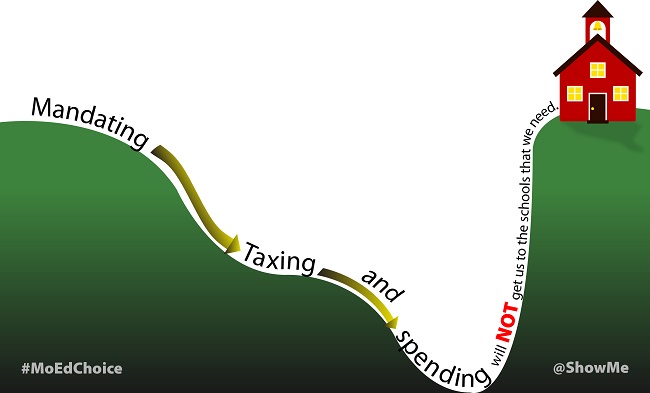
If we truly believe that “education is the key to the economic future of our state,” as the governor suggested, then we need to re-think our policies and re-imagine what it means to have a quality public education system. Mandating, taxing, and spending will not get us to the schools that we need. We need policies that enable school leaders to be change agents who empower parents with educational options.

Saint Louis Ridesharing Update: MTC Still Dragging Its Feet

Ridesharing has had a bumpy ride in the Saint Louis area. The Metropolitan Taxicab Commission (MTC) strictly regulates the number of cabs, the prices they can charge, and even minutiae like the color scheme of taxis. It is a regulatory system marked by parochial, top-down control. So when Lyft began operating in the metropolitan area without the permission of the MTC last year, the official response was hostile. Police ticketed Lyft drivers, and the company was forced to cease its Saint Louis operations.

The bright spot for residents hoping to use ridesharing was Uber’s entry into the Saint Louis market. By negotiating with regional power brokers, such as Mayor Slay and the MTC, Uber was able to secure regulatory changes that would allow it to operate its expensive black car service, which launched last October.

Unfortunately, the relaxation in regulation was only very slight, and the MTC still firmly regulates taxi operations in the Saint Louis area. For example, the MTC only allows Uber to act as a dispatch service for MTC-licensed premium sedans, the number of which the commission has limited (initially the MTC added only 26 new vehicles to accommodate Uber). The MTC also passed restrictions to ensure that Uber Black uses only premium sedans and charges premium prices, lest they compete with normal cabs.

Notwithstanding the subsequent undersupply of Uber vehicles, Uber claims significant demand and wishes to expand its black car service and begin operating UberX, the company’s true low-price ridesharing service. But unlike cities across the country (including Kansas City and Chicago) the MTC has not shown the inclination to make the large-scale regulatory changes that would open the way for innovative ridesharing companies or create a more robust taxi market.

In a city where officials ceaselessly talk about attracting businesses and innovators downtown, it is shocking that they are unwilling to reduce regulations in order to make the city an easier place to work and play. If Saint Louis is going to experience sustained revitalization, it is going to come from being a leader in fostering new businesses, like ridesharing companies, that residents choose to patronize. It will not come from splashy, taxpayer-funded development schemes that regional leaders repeatedly propose.

Open Collective Bargaining at Monarch

In October 2013, the Monarch Fire Protection District implemented a new approach to collective bargaining with the union representing rank-and-file firefighters. Rather than hold meetings on pay, benefits, time off, and work rules behind closed doors, the board of the fire district decided to make these meetings open to the public.

With open collective bargaining, any citizen, journalist, or Monarch employee interested in the process could show up to a meeting and see the demands made by the union and the board. In theory, this process would keep demands in check, tactics civil, and allow the public to see how government decisions are made.

One might think that a more transparent process for determining how a government entity delivers services and spends taxpayer money would be welcomed by all; however, it appears that the union did not like the arrangement.

“The union lawyer tried stunts to close the meetings to the public,” says Jane Cunningham, one of three members of the fire district board.

According to Cunningham, when collective bargaining was held behind closed doors, it was easy for the union to get whatever terms they wanted in the contract. In essence, the union was able to exert complete control over the fire district because it had majority control of the board and could collectively bargain without public scrutiny.

No one would suggest that private-sector collective bargaining should occur in public forums. That’s because the terms and conditions of private employment are, well, private. But the public has an interest in what public employees are paid, both because taxpayers are picking up the tab and because the right balance of compensation is important to getting good service without being overcharged.

Now that open collective bargaining is in place at Monarch, it appears that the union is no longer getting exactly what it wants in collective negotiations, and community interests are being better served.

Will other government entities open their collective bargaining negotiations? Only time will tell. For now it appears that Monarch is taking a step in the right direction with this innovative approach to government transparency.

At the time this story went to print, the firefighters union had not responded to our request for comments.

Level the Playing Field for Uber and Taxi Companies Through Deregulation

02_lyft_arrive
Kansas City, Mo., heavily regulates its taxicab industry. As we detailed before, the city limits supply (to 500 cabs), manages pricing, and even stipulates what drivers may wear. These types of limitations have resulted in a stagnant and oligopolistic cab industry, ill-prepared to deal with well-capitalized and innovative competition.

Enter Uber, Lyft, and other app-based ridesharing companies. Kansas City’s stringent taxi regulations are not well designed for new technology or the use of personal vehicles for transportation on which these companies rely. When Lyft entered the Kansas City market without receiving city hall’s permission, officials filed injunctions and accused Lyft of endangering public safety.

Since that time ridesharing has made some progress in the City of Fountains. Uber, with the blessings of city hall, launched its black car service and UberX in the second half of 2014. While the process has encountered a few problems (some UberX drivers are still being ticketed over regulatory issues), the city has shown flexibility. Lyft was even allowed to operate until it voluntarily suspended operations on October 24, 2014, to await possible regulatory changes.

Those changes might be close at hand. The city is in the process of reviewing all of its taxicab policies, and proposed changes include modernizing regulations, removing some barriers to entry, relaxing requirements for vehicle inspections, and easing requirements for vehicles’ commercial insurance. That Uber and Lyft drivers do not carry primary commercial vehicle insurance has often been a cudgel used to attack these ridesharing companies, despite evidence that suggest over-extensive insurance does not protect public safety.

Adopting a “trust but verify” system toward ridesharing companies is a step forward for Kansas City, but that spirit should also include traditional taxis. When Kansas City allowed UberX, a direct competitor to taxi service, to offer services under “livery vehicle” regulations (designed for limousines and premium sedans), it essentially created a two-tiered market: the highly regulated traditional taxis vs. the less regulated Uber. That puts cabs at a distinct disadvantage and may mean they are driven out of the market. Putting cabs out of business through overregulation is not progress, any more than regulating ridesharing out of Kansas City would be.

Instead, Kansas City officials should use this opportunity to stop micromanaging the taxi business and limit itself to requiring taxis to carry adequate insurance, perform background checks, and pass vehicle inspections. A truly open for-hire vehicle market could accommodate both high-quality traditional taxis alongside innovative business models; and that would provide the greatest benefit to the residents of Kansas City.

Support Us

The work of the Show-Me Institute would not be possible without the generous support of people who are inspired by the vision of liberty and free enterprise. We hope you will join our efforts and become a Show-Me Institute sponsor.

Donate
Man on Horse Charging
