Show-Me Now! Transparency for Government Unions

Did you know that government union employees get taxpayer funded leave which can be used for partisan activities? While union release time is often to attend conferences or other activities, a recent report from the Competitive Enterprise Institute highlights how unionized government workers in Missouri have misused the practice. They conclude that greater transparency is needed.


The 411 on a CID in the B70

Some business leaders in Columbia want more attention for their slice of town. To do that they are getting together to create a new community improvement district (CID) for the Business 70 Loop. This sounds innocent enough. However, CIDs are just another example of the alphabet-soup taxing districts that increase tax rates to fund new services for a questionable public purpose.

CIDs are independent taxing districts created to collect sales and property taxes and spend money to improve an area in a variety of ways, including beautification and infrastructure. There are two primary problems with CIDs. The first problem is transparency. The auditor’s office has consistently found deficiencies in reporting and documentation for these districts.

The other issue with CIDs is their lack of a cap on property taxes. Under the current proposal, the CID would levy an additional 47 cents per $100 of assessed value of property taxes on top of what people/businesses already pay. However, there is no statutory language preventing the CID from increasing property taxes further. An extreme example is when a CID in the Lake of the Ozarks levied an additional $4 per $100 of assessed value. I’m not saying this proposed CID will have taxes go up that high, but there is nothing stopping such an increase from happening except the restraint of the CID board.

Given these problems, what is the compelling reason for establishing a CID, especially since the area is already seeing redevelopment? As the Columbia Tribune states:

He also cited Miller’s 2012 purchase of the old Commerce Bank building at 500 Business Loop 70 W., Head Motor Company’s recent upgrades and his own redevelopment of the Parkade Center as examples of the type of redevelopment he would like to see along the corridor. Further east, Business Loop 70 boasts a newly remodeled Burger King and renovated McDonald’s.

“We’re starting to see redevelopment occur, and we want to make sure we have pro-redevelopment policies in place,” Burnam said.

If this article tells us anything, it appears that legal restrictions on renovating existing lots are the problem. Maybe proponents should work on fixing the regulatory environment instead of raising taxes.

CIDs have serious issues and should only be undertaken without serious safeguards in place, if at all. The Business Loop in Columbia might not be a paradise, but is it so blighted that the only thing left to do is establish a CID? Color me skeptical.

Saint Louis Metro Ridership Up, but MetroLink Ridership Down

The latest data released by the national transit database shows the continued, albeit slow, recovery of transit ridership in the Saint Louis area. The annual moving average of MetroLink and MetroBus ridership had their most recent peak in October 2008, before sharply declining in the recession.

But since the recession, transit ridership has been on a steady recovery. Continuing that trend, from January 2014 to January 2015, Metro increased passenger trips by 1 percent. This increase has encouraged leading regional transit advocates, who call for more investment in transit and even a new North-South MetroLink line in the city.

However, the growth in Metro’s ridership should be taken in perspective. For one, ridership is still well below Metro’s prerecession peak of 58 million (reached in October 2008). As of last January, total annual ridership stood at just 47 million trips.

In a bit of irony, while transit enthusiasts are generally rail focused in their plans to improve Saint Louis’ public transportation, buses, not rail ridership, have accounted for the increased transit ridership in the past year. MetroLink ridership actually decreased in 2014 by some 200,000 riders. With total annual monthly ridership more than 30 percent below its prerecession peak, it is reasonable to conclude that rail ridership in Saint Louis has not had a recovery.

Graph_STL_transit

In short, Metro ridership is increasing, but the growth is slow and prerecession highs are far from being matched. In addition, most of the recovery in ridership has occurred on MetroBuses, not the MetroLink. There may be many reasons for wanting to expand transit (and even rail transit) in Saint Louis, but spiking transit demand is not one of them.

Should School Districts Be Too Small to Fail?

When an individual gets financial support from the government, we call it an “entitlement.” When a large business gets tax breaks, we call it “corporate welfare.” However, when a small school district cannot afford to keep its doors open without significant support from the state, we call it an “issue of local control.”

Right now, there are 191 districts with 350 or fewer students enrolled. These districts get less than half of their funding from local sources, 46 percent on average. The rest comes from state (44 percent) and federal (10 percent) sources. The smallest district in the state, Gorin R-III, for example, has just 19 students enrolled. The district raises just 38 percent of operating expenditures locally, while 54 percent comes from the state. Then there is Plainview R-VIII, enrollment 81. With the low tax rate of just $2.9123 per $100 of assessed valuation, Plainview raises just 28 percent of the operating funds locally, while 63 percent comes from the state. In all, 141 of the small districts receive less than half of their funding for operating expenses from local sources.

These districts are able to exist because of generous state support. Specifically, the state legislature sets aside $15 million for school districts with fewer than 350 students. This is in addition to the funding that comes through the state’s foundation formula for K-12 public schools.

In my last post, I discussed House Bill 1292 and asked if school consolidation was an issue of local control. I received a couple of comments that said it was. Maybe they are right. Maybe it should be a local decision to join with a neighboring district. Whether these small districts should receive additional state funding, however, is not an issue of local control. It is an issue that all taxpayers and all state policymakers should have a say in.

Should school districts be too small to fail? That is, do small school districts deserve extra financial support because they may close if they do not receive extra funding?

I am completely sympathetic to arguments of local control. However, I’m concerned too many claim local control only when it suits them. It certainly seems contradictory to claim sovereignty, while going hat in hand to state taxpayers for additional funds.


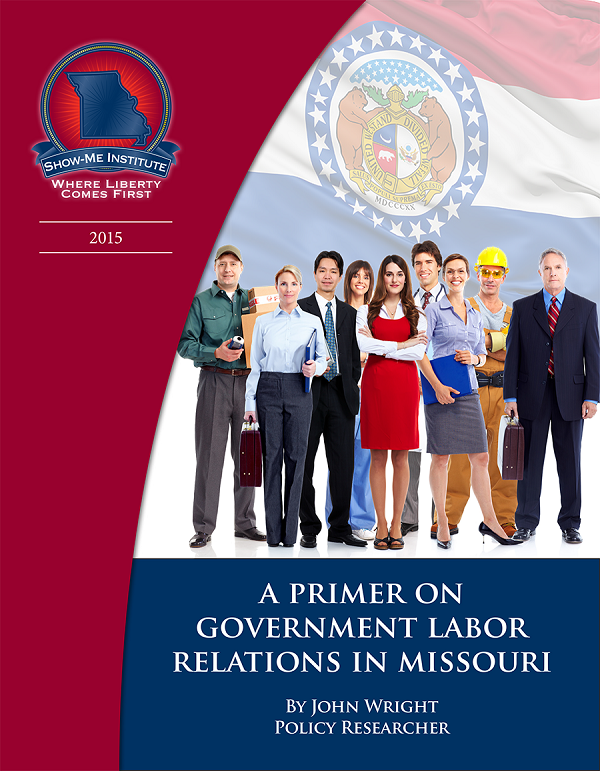
A Primer on Government Unions

From the 2011 Wisconsin Capitol protests to Illinois’ recent executive order banning agency fees for state workers, government labor relations are headline news in recent years. Missouri is no different: In 2007 the Missouri Supreme Court threw out 60 years of precedent with the landmark Independence case that gave government workers the ability to collectively bargain with the government.

To help the public better understand this complicated but increasingly important issue, we published a guide to government unions in the Show-Me State. Find it here: A Primer on Government Labor Relations in Missouri. The primer explains:

  • The basics of government collective bargaining;
  • The legal framework in which government unions collectively bargain with government entities, such as school districts, cities, and the state itself;
  • A survey of the types of government employees subject to union representation;
  • An overview of the common practices of Missouri’s government employee unions;
  • And much, much more.

For more information or if you have any questions about this primer, please contact me at the Show-Me Institute.

Show-Me Institute Presents: Pension Reform in Missouri

Hawley

It’s not news that Missouri’s pensions are underfunded. In fact, they’re an economic ticking time bomb that could leave taxpayers on the hook for billions. Unless we want taxpayers to get stuck with the bill, these pensions need to be reformed. However, there are legal barriers that might stand in the way of any reform effort. These barriers have been difficult to determine . . . until now.

Yesterday, the Show-Me Institute released a new policy study titled, “Pension Reform in Missouri.” The study’s author, Erin Morrow Hawley, sets out the legal framework that will govern pension reform in Missouri. In analyzing the statutory provisions related to Missouri’s public pensions, questions arise:

  • What interests are protected?
  • May the general assembly modify pension benefits retroactively? Prospectively?
  • What about contribution increases or decreases?

This study analyzes the statutory provisions related to these inquiries and sets forth a variety of pension reform measures that may be possible under Missouri law.

With the need to reform pensions becoming more acute every year, it is vital that any reform effort be able to successfully address the legal issues that might arise. With this new study, doing so has become much easier.

Airline Revenue Guarantee Could Make Touchdown in Branson

branson_airport

Branson Airport (BKG) made news in 2009 when it became the nation’s only privately constructed and operated commercial airport. Unfortunately, in large part due to poor timing, passenger levels were far below expectations and the project has been in financial trouble for the last couple years. The airport’s problems trebled when Southwest decided to halt service to the market last year.

Stripped of its only major airline, Branson Airport management has been trying to lure new service. To do that, the airport plans to use $1.5 million of private money and $500,000 of public money (courtesy of Taney County) to create a revenue guarantee for prospective airlines. If an airline agrees to serve Branson Airport and fails to turn a profit, this guarantee will make up the difference.

We’ve seen the use of revenue guarantees before in Missouri, notably at Columbia Regional Airport. The Columbia region provided a revenue guarantee to American Airlines, which prompted Delta Airlines (who was already serving the airport) to end service. In essence, publicly funded airline revenue guarantees take the risk of providing airline service from the private sector and give it to taxpayers. This is a questionable use of public resources, and it subsidizes air travel.

Even though Branson Airport is a private operation, a revenue guarantee would not be the first public support it has received. The city of Branson has paid a set amount to the airport for every out-of-town passenger that it has brought in, and Taney County helped the airport secure initial financing. With the airport on the verge of financial collapse, and the county now preparing to subsidize commercial air service, the question becomes whether the public should be invested in bailing out this private venture. Especially with nearby Branson-Springfield National Airport (SGF) growing briskly in the last couple years, it may be in the interest of the taxpayer to let the airport sink or swim on its own.

Audit the Kansas City Public Schools

We actually went back about eight years and found that there was over $25 million paid in stipends either unapproved, unauthorized or improper. I have to say, with all the money paid in stipends, the district would not be in the condition it’s in if it were under control.

This quote comes from the late Missouri State Auditor Tom Schweich, in remarks about his report on the St. Joseph School District. In the same story, Schweich reported, “There were significant other problems with payroll, overtime hours, summer school credits, nepotism issues and other questionable spending.”

The St. Joseph District is not alone in wanting to spend more money. The Kansas City Public School District has been putting “trial balloons” in the air for some time seeking to increase the taxes that fund schools. Many education advocates want to spend more money on teachers and in the classroom. But in Kansas City, the amount spent per student, approximately $16,000 per pupil per year, is already very high. The likely problem, as highlighted by Schweich’s audit in St. Joe, is that the money is often not making it to the classroom; it is being eaten up by administrators through bad policy and perhaps even fraud.

In his 2011 audit of the Kansas City School District, Schweich found lots of similar problems. According to a story by KCTV:

The district could not account for $4 million in food costs and student incentives, repeatedly failed to competitively bid projects and monitor contracts, has excessive overtime and failed to properly oversee its closed buildings, the audit found.

The state audit said a principal at Lincoln College Preparatory Academy made $58,000 in unauthorized purchases and cash withdrawals. Jamia Dock is no longer at the school and has been charged in Jackson County Circuit Court with stealing more than $25,000 in district funds. She has pleaded not guilty and the case is still pending.

The Kansas City School Board was also faulted for repeatedly violating the Missouri Sunshine Law.

Schweich’s 2011 audit grade for KCPS was “Fair,” of a four-point scale including “Excellent,” “Good,” “Fair,” and “Poor.” According to the auditor’s office, most of these findings assume that district spending numbers are correct, which means they don’t do the time-consuming work of digging into expenses. Even still, for Kansas City to score in the bottom half is an indictment.

Many parents and teachers want to see more money making it to the classroom. As Schweich’s comment at the top of this post suggested, efficient money management means that more money can be made available where it matters most. If the Kansas City School District wants to build trust with parents, teachers, and taxpayers, they should invite a thorough and recurring examination of their books and remain transparent in all their expenditures.


classroom

Speakers’ Series: King v. Burwell: Can the President Rewrite the ACA Without Congress?

In this Speaker Series on Economic Policy presentation, CATO Director of Health Policy Studies, Michael Cannon, discusses the King v. Burwell case that is currently before the U.S. Supreme Court. In examining this topic, Cannon poses and answers the question: can the president rewrite the ACA without Congress?

Support Us

The work of the Show-Me Institute would not be possible without the generous support of people who are inspired by the vision of liberty and free enterprise. We hope you will join our efforts and become a Show-Me Institute sponsor.

Donate
Man on Horse Charging