Collaboration and Competition

On Friday afternoon, Ronald Garan Jr., a retired U.S. Air Force colonel and NASA astronaut, addressed about 40 students at a charter school in Kansas City, Mo. His talk featured plenty of pictures and videos of his time aboard the Space Shuttle Discovery and the International Space Station. Garan’s talk was about cooperation and collaboration to solve the world’s challenges.

Garan_v2I had the opportunity to visit briefly with Garan after the talk. I wanted to know how he squared the principles of collaboration and cooperation with competition. After all, everything that made his career in the space program possible was accomplished through competition—whether a space race between nations or a bidding process among companies seeking to sell products to the U.S. government. That is when Garan distinguished between proper competition and destructive competition.

Proper competition gets us better good and services. It comes from having an even playing field; the company with the best product wins. A destructive competition does not bring us those things because it often lacks the necessary rigor, data, and transparency.

Without rigor and data, good intentions fail. To make his point, he offered an example from his experience working with developing countries. An organization might have a splashy website and a compelling celebrity endorsement. The company may show off the new wells they put in place, but if no one is focusing on whether those are working properly the whole effort is wasted. Garan said, “Sometimes there is too much emphasis on the new and shiny and not the tried and true.” No one wants to watch a TED Talk on the same old ways of doing things, he suggested, even if those ways are the most effective.

Therein lies the real lesson: Open yourself to rigor, data, and transparency. For governments it means fostering the productive competition that leads to legitimate innovation and improvement. For the taxpayers it means not getting caught up in new things simply because they are new; value what works, even if it is less flashy. And always make sure that government is transparent.

Can Normandy Be Saved?

Normandy (2)

They say those who forget history are doomed to repeat it. To better understand the seemingly intractable problems in the Normandy Schools Collaborative, I decided to head to the St. Louis Public Library newspaper archives to see what folks had written about Normandy in the past. I found this:

Hire more minority teachers, revamp the high school curriculum, improve discipline.

Sound familiar? These suggestions are quite similar to the comments Normandy’s most recent superintendent, Ty McNichols, made in 2013. In fact, what I found in the archives was written by former Normandy Superintendent Bruce A. Smith in a 35-page report about the status of the school district in 1988.

“Everything here is fixable,” McNichols had said. “It takes time. It can’t happen overnight. But it can be fixed.”

Nearly 30 years after Smith’s report, we seem to be no closer to improving the Normandy School District. The same old tactics will not lead to a better result.

A recent report from the Thomas B. Fordham Institute points toward a more stark strategy—closing low-performing schools.

In School Closures and Student Achievement: An Analysis of Ohio’s Urban District and Charter Schools, researchers found that school closures have positive impacts on student achievement. Three years after schools closed, displaced students from urban districts, on average, gained 49 cumulative days of learning in reading and 34 cumulative days in math, relative to the comparison group.

The authors of the study also found that students who were displaced after a closure typically ended up in a higher-quality school. Fifty-nine percent of traditional public school students and 68 percent of charter school students transferred to higher-quality schools.

The evidence presented suggests that if policymakers are concerned about student achievement in low-performing schools, they should shut down those schools, instead of wasting more time, money, and patience trying to fix them. Resources then could be redirected toward starting new schools or expanding the capacity of existing higher-performing schools.

After decades of proposed “fixes,” are further attempts to improve Normandy Schools Collaborative misguided? Is closing down the district and allowing the students to be absorbed by neighboring districts the solution policymakers should really be thinking about?

These tough questions need answers. But one thing is certain, if we want to get serious about saving Normandy students, perhaps it’s time we stop trying to save Normandy schools.

Even AFSCME Opposes the Stadium “Boondoggle”

During an American Federation of State, County and Municipal Employees (AFSCME) lobbying event to push an across-the-board pay increase for state workers, I heard a good bit of rhetoric from the government union about “fighting for pay.” Fearful that AFSCME views their fight for pay as a fight with the taxpayers, I publicly asked who they are fighting against. The response surprised me:
maztwitter

Jeff Mazur, AFSCME executive, claims that the union’s fight is with politicians who would rather spend money on corporate welfare, such as tax credits and publicly funded stadiums. I’ve written favorably before about AFSCME’s opposition to corporate welfare, and a publicly funded football stadium is corporate welfare at its worst. I’m glad more people, including labor organizations, are seeing the stadium proposal for what it is.

Kansas City Embarks on New Bad Idea

Kansas City government is going into the grocery store business near 31st Street and Prospect Avenue on the east side. According to the Kansas City Star:

City manager Troy Schulte said the city will spend $950,000 to buy the existing strip mall and parking lot from its current owners, then another $11,050,000 to demolish the empty grocery store that now sits on the site. The city will borrow the money for the project, then repay the loans with projected taxes generated by the development and a special one-cent sales tax collected at its stores.

The city will lease the property to Sun Fresh for $10 a year, but will not provide any subsidies for operating the store.

That last sentence made me laugh: The city will spend $12 million to buy and build the place and charge the tenant $10 a year—but there won’t be any operational subsidies, as if rent isn’t an operational cost.

The problem is that the people who make a living running grocery stores by investing their own money do not think this is a good idea. If they did, the original grocery store might not have remained vacant for 10 years and the proposed grocery store wouldn’t need such a steep subsidy. Taxpayers are underwriting it because it is not a good idea.

Even the Kansas City Star editorial board is skeptical, offering, “The project is a financial gamble for taxpayers.” They concluded, “History shows that a lone project can’t really lift up an entire community. It takes a much bigger effort to do that.” This is true, according to an NPR story last year:

“The presumption is, if you build a store, people are going to come,” says Stephen Matthews, professor in the departments of sociology, anthropology and demography at Penn State University. To check that notion, he and colleagues from the London School of Hygiene and Tropical Medicine recently surveyed residents of one low-income community in Philadelphia before and after the opening of a glistening new supermarket brimming with fresh produce.

What they’re finding, Matthews says, is a bit surprising: “We don’t find any difference at all. … We see no effect of the store on fruit and vegetable consumption.”

It really isn’t surprising. If there was a demand for fruits and vegetables, someone would be providing them. But the demand isn’t there, even when shiny new stores are built.

Once again, Kansas City leaders are embarking on an expensive and ill-considered campaign using public dollars that does not address the real underlying problems. When it fails, the city and its residents will be no better off than before, just poorer. And the infrastructure, crime, and education issues that really need to be addressed will be that much worse.

grocery

Lambert Officials Admit: Market for Cargo “Disappeared” Post-Aerotropolis

lambert

Four years ago, the Show-Me Institute came out strongly against plans to spend upwards of a half-billion dollars to turn Lambert-St. Louis International Airport into an “Aerotropolis.” The plan revolved around the idea that Chinese cargo shipped through Saint Louis could be profitable—but only if the government subsidized it to the hilt. As our readers know, the project died not once but twice that year, and has died each year it has been introduced since.

It’s a good thing it kept dying too, as a story from the St. Louis Post-Dispatch showed last week.

In September 2011, a China Cargo flight carrying 80 tons of manufactured products landed at Lambert and was greeted by dignitaries from across the region. But airport officials said that market disappeared amid a downturn in international cargo. [Emphasis mine]

Imagine if Missouri had committed to the Aerotropolis project and then, poof, the market “disappeared”—which of course assumes it was ever really there. Taxpayers would have been left holding the bag.

The admission about Aerotropolis was part of a larger article about a lease just signed for a new “Mexico Hub” at Lambert, a story my colleague Joe Miller has already detailed. Lambert’s director, Rhonda Hamm-Niebruegge, says that the airport “is not paying a penny” for the new project, and if true, it’s a very good thing. At a time when its passenger traffic is down, the last thing Lambert should be doing is speculating on real estate, especially given its track record.

However, it’s not clear whether the Mexico Hub developer will try to draw on existing government subsidy programs to advance the project. An airport project at Lambert fully financed by the private sector seems very good; the concern is whether this project is too good to be true. One would hope that state and local officials would be chastened after the Aerotropolis debacle if they’re considering handing out tax incentives, whatever their scale.

I certainly hope the Mexico Hub project can move ahead on its own merits and without taxpayer money. Cargo markets have “disappeared” before, and taxpayers shouldn’t be on the hook if history repeats itself. We’ll keep you posted.

Shocking Support for Taxing Bed and Breakfasts

Bed & breakfasts (B&Bs) have a long history in this country. To many they are associated with comfort and an antique ambiance. To the taxman they are a prime opportunity to raise revenue.

Last week, the St. Louis Post-Dispatch reported that Saint Louis bed & breakfast owners are upset over the city assessor’s decision to assess their property (or at least the part used as B&Bs) as commercial properties. I can understand why these owners would be upset. According to the way properties are assessed for property tax purposes, if B&Bs were even partially assessed as commercial properties, the owners’ property tax bills would go up substantially.

I sympathize with any business owner that is facing a higher tax bill. However, I do not oppose this change. Saint Louis is doing the right thing here. If a property is engaged in commercial activity, the city should assess it as a commercial property. The situation is trickier with people renting rooms through airbnb. These lodgings are not necessarily full-time establishments, and so some mechanism needs to be in place to make sure they don’t get a tax advantage compared to traditional B&Bs.

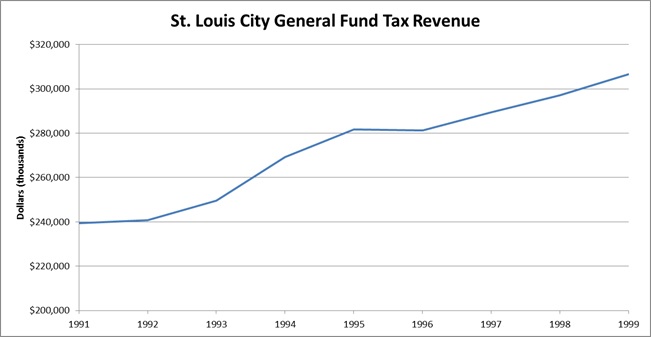
Having a large property tax base is important. It’s especially important in Saint Louis because it can serve as a way to reduce (or even eliminate) the earnings tax. The Show-Me Institute released a paper arguing that the earnings tax could be replaced by a two-tier property tax (this differs from a traditional property tax in that the two-tier approach taxes the land more heavily than any improvements on the land). Even if the city sticks with a traditional property tax system, a wider base can generate more revenue to offset any reductions in the earnings tax.

Paying more in taxes is never fun, but low taxes for some shouldn’t come at the cost of a hollowed-out property tax base.

No, Transparency Benefits the Academy

University_of_Missouri_-_Memorial_UnionMizzou Professor of Spanish Literature Michael Ugarte recently wrote an op-ed published in the Columbia Daily Tribune where he voiced his opposition to a bill that would require public universities to post course information online.

From Ugarte’s commentary:

[T]he reason I’m against SB 465 is that I don’t trust the motivations of those who are proposing it. It’s a bill with an agenda that goes far beyond a desire for transparency. It provides an opportunity for those determined to question, debunk, attack and diminish the pedagogical and research projects of university professors. I don’t think the effects will be positive; rather, we will have more of the same: animosity and lack of understanding.

As someone who has written on and testified in support of curriculum transparency for Missouri’s public universities, I can tell you that my motivation for supporting proposals like this comes from a conviction that public universities—and all public institutions—should be candid and open with the public about their affairs. Members of a public university should abide by the same transparency laws as everyone else who works in our public sector.

My motivation for supporting this bill doesn’t stem from a desire to “question, debunk, attack or diminish” the university, but I find it odd that a scholar would view someone questioning his work as a problem. Scholarship thrives on debate and challenges. As a student at Mizzou, you can bet I questioned my professors. They questioned, attacked, and debunked me right back. And I got a great education because of it.

I disagree with Professor Ugarte’s contention that an open academy will breed animosity and lack of understanding between it and the rest of society. On the contrary, I believe an open and honest discourse is the way you build trust and understanding. And there’s no reason why open and honest discourse can’t involve questions, debate, and, yes, sometimes even debunking.

Support Us

The work of the Show-Me Institute would not be possible without the generous support of people who are inspired by the vision of liberty and free enterprise. We hope you will join our efforts and become a Show-Me Institute sponsor.

Donate
Man on Horse Charging