

Missouri Senators Bob Onder and Joseph Keaveny talk about the recently concluded legislative session.
How Will the Convention Hotel Help Taxpayers?

Let’s assume for the sake of argument that the planned convention hotel in Kansas City does increase convention business. How much more convention business will the city need to repay the investment? No one is saying.
 The Power & Light District plan was put together by City Manager Wayne Cauthen, and it was done largely out of the sight of the public. It was too late to make changes when the subsequent city manager, Troy Schulte, told us that in order for the Power & Light District to be self-sustaining, as voters were promised, “You needed Plaza-level holiday-level sales every day of the year.”
Seeking to avoid that same mistake, the 2010 convention hotel effort received lots of scrutiny, including reports from consultants and financiers. Bill Lucas, then president of the city’s hotel steering committee, said, “We’d about have to double our convention bookings” to make the hotel feasible. The project did not go forward because people were skeptical we’d make the goal.
This time the city is rushing a vote on the project to meet an arbitrary political deadline. There are no reports from consultants; no reports from financiers. One councilmember even complained about the short time available to make a decision.
While no one is saying how much convention business will have to increase to repay the investment, consider the impact of TIF giveaways to developers:
- Visitor money spent in the convention hotel itself won’t help us, as we’re giving all the taxes generated from those sales to the developers through Tax Increment Financing (TIF).
- If convention visitors wander to the Power & Light District for dinner and drinks, they’ll pay a high tax rate, but the city is already giving that tax money to Cordish through their TIF. The city won’t see much from it.
- If visitors head north to the River Market, the same will apply—we’re giving at least half of the tax revenue there to the developers.
- Maybe they’ll ride the streetcar. The streetcar will be free, so we won’t see any tourism dollars there (although it appears visitors who stay at the convention hotel will be paying 1 percent to the streetcar Transportation Development District).
- Maybe visitors will go to Country Club Plaza. That will be great, but half of the tax revenue generated from their purchases will go to the developers named in the Plaza TIF.
Therein lies the problem with Kansas City’s frequent use of TIF; we’re hollowing out our tax base. We claim that these developments will help the city, but in order to get the developments, we give away the tax revenue. Kansas City will likely need to more than double our convention bookings to make this financially sound, but no one is saying. This is no way to run a city.
The Streetcar’s Economic Development Shell Game

Despite the fact that all serious economic research on streetcars indicates that they do not drive economic development, Kansas City streetcar supporters keep providing misleading or contradictory numbers. They’re at it again.
 Just after we published a post lampooning claims about economic development downtown, the Kansas City Star upped the ante by publishing a list of developments along the streetcar line.
The Kansas City Star continues to update an interactive report that displays about 79 downtown projects totaling more than $1.7 billion that either have been announced, are in progress, or have been completed since the start of 2012, with the exception of some major civic projects.
Meanwhile, Sandy Smith over at NextCity provides us with more made-up numbers on the impact of streetcar development, quoting Downtown Council CEO Bill Dietrich:
“Since we began construction on the line, $900 million of new investment is coming into town,” he says. “We’ve been surveying the people creating these new developments and asking them how much the streetcar was a factor in their thinking. We found that about $250 million of that figure represents developers who said that either they would not be here without the streetcar or that the streetcar was important in influencing their decision to invest.” (According to the city, the latest numbers now total $1 billion in new investment, with $381 million owed to the streetcar.)
So there you have it. Kansas City streetcar supporters keep coming up with conflicting numbers from $250 million to $1.7 billion and everywhere in between. The serious research still remains: Streetcars do not drive development, unlike the myriad subsidies such as those given to Centric and 1914 Main.
Charter Schools Are Not the Enemy

As first appearing in Education News:
We all love to have enemies; not real enemies, just the kind that make us feel better about ourselves. For example, sports are more enjoyable when our team goes up against their rival—think KU vs. Mizzou or Chiefs vs. Broncos. In politics, it’s the same. We rejoice when our candidate or party defeats the opponent. There is something about having enemies that gives us the sense that our side is superior and that our cause is just. Lambasting someone else as the enemy is an easy way to secure support for one’s cause, and this is exactly the tact taken by those who oppose the expansion of charter schools—charter schools must be stopped or they will destroy public education.
Missouri’s current controversy surrounding charter schools stems from the legislature’s attempt to “fix” the interdistrict school choice bill, which allows students to transfer from unaccredited school districts to accredited ones. Lawmakers inserted a provision into the transfer fix that would allow for the further expansion of charter schools in Saint Louis and Jackson counties. In response, the editorial board of the Kansas City Star wrote, “This wrongheaded idea should never have gotten as far as it has.” You see, the editorial board sees charter schools as a punitive measure—as the enemy.
The truth of the matter, however, is that charter schools are not the enemy of public education; they are but a means for ensuring every child has access to a quality public education. Along with members of the educational establishment, the Star’s editorial board has bought into the “us versus them,” charter versus school district mentality. Those who support quality educational options for every student should reject this notion.
Charter schools are free public schools that serve primarily disadvantaged students who lack the ability to move to better school districts or to pay for private school tuition. Charter schools are not a cure-all. Just as there are good and bad district schools, there are good and bad charter schools. The beauty of charter schools is that they allow bad schools to close and they allow new, innovative schools to take root. Studies, including the “National Charter School Study 2013” by researchers from Stanford University’s Center for Research on Education Outcomes, consistently show that charter schools are improving over time as higher-performing schools become more established and weaker schools close. Most importantly, charters offer parents trapped in failing schools an alternative.
There should be no “us versus them” when it comes to the type of school a student in Missouri chooses to attend. Whether a child is in a traditional public school, a public magnet school, a public charter school, or even a private school, the only thing that matters is whether that child is receiving a quality education. Indeed, we should be hawkish at fighting against failing schools in any sector.
There may never be room under one tent for Chiefs and Broncos fans. There is, however, room in the big tent for all those who support quality educational options for every student.
James V. Shuls is an assistant professor of educational leadership and policy studies at the University of Missouri–St. Louis and a fellow at the Show-Me Institute.
What to Do With Vacant School Buildings
 Public school systems are tasked with a tremendous responsibility. Not only do we expect them to educate our children, but we also expect them to be good stewards of the tax dollars we give them. To do this, a school system must make sure buses are running on time, nutritious meals are prepared for students, teachers deliver effective instruction, and students are supported in safe environments. These, of course, are just some of the obvious responsibilities of a school system. Urban school districts, such as Saint Louis and Kansas City, have a unique problem to deal with—vacant school buildings.
Like most urban school districts, Saint Louis and Kansas City have had declining enrollment for decades. They are also facing stiff competition from charter schools, which enroll 29 and 42 percent of all public school students in each respective city. This has left each district with more than 30 vacant school buildings. Vacant buildings are a problem for the district and the community. The cost of maintenance can be a drain on resources, diverting dollars away from the classroom. The buildings can also become an eyesore for the community, inviting vagrants and illegal activity.
In my latest paper, “Vacant School Buildings: An Examination of Kansas City and Saint Louis,” former Show-Me Institute intern Abigail Fallon and I explore this complex issue. Unlike most areas of education, little research exists on vacant school buildings, and few claim to know how to handle these properties. While there may not be a definitive answer on what should be done, we argue that school districts should be more intentional about divesting these buildings or putting them back to productive use. To that end, we offer some possible solutions, namely, that these buildings should be made available for lease or sold to charter schools.
The bottom line is that school districts must become more diligent in dealing with this problem.
Ridesharing: Game Changing for Carpooling and Transit?

As we’ve discussed before, carpooling is the second most popular way of getting to work in Missouri (behind driving alone). However, the use of carpooling has been in steady decline over the last couple decades. Today, 9 percent of workers use carpooling to get to work; in 1980 that number was almost 20 percent.
Transportation experts speculate that slow changes in the way people live and work have driven the decline. More Missourians once lived and worked in centralized geographic areas, reflecting the needs of a manufacturing-based economy and the means of the working class. The dispersal of jobs, residences, and increased ability to afford personal vehicles has made carpooling less attractive. While the decline in carpooling in Missouri may be primarily due to structural changes in the U.S. economy, its renaissance may come in the form of app-based technology created by ridesharing companies like Uber and Lyft.
Services like UberPool and Lyft Line, now offered in test markets around the country, promise to create instant app-based carpooling. Riders request the service (at a steeply discounted price) and may end up sharing their ride with others heading in roughly the same direction. This means that riders do not need to find people to share the ride with or do not need to be going to and from the exact same locations as someone else in a carpool; it can be set up automatically.

If this type of technology were to roll out in Missouri cities, it’s possible to imagine tremendous benefits for residents. On-demand carpooling could allow Uber and Lyft to operate like super-efficient jitneys (small private buses with ad-hoc routes) rather than traditional taxis or carpools. Ridesharing companies have been accused of being yuppie-based transportation, but app-based carpooling (with its much lower pricing) has the possibility of greatly increasing mobility for the disadvantaged, especially those who live in areas where reliable mass transit is difficult, if not impossible, to access. In essence, app-based carpooling has the possibility of boosting not only carpooling, but transit (albeit privately operated) usage as well.
UberPool and Lyft Line represent just some opportunities that new business models can provide for Missouri cities. Yet, in Saint Louis and Kansas City, the attitude toward new ridesharing companies has been and continues to be reflexively hostile. If both cities can remove regulatory barriers, residents will be able to benefit from these new services, and ones as yet undeveloped.
You Cannot Be Serious!
You gotta love Los Angeles, but when I read stories about what officials there might be planning with their minimum wage increase, my blood really starts boiling. Below is the key portion of the story:
Labor leaders, who were among the strongest supporters of the citywide minimum wage increase approved last week by the Los Angeles City Council, are advocating last-minute changes to the law that could create an exemption for companies with unionized workforces.
L.A.’s unions want to be able to offer lower wages for potential employers yet force non-union workers to be paid the higher “minimum wage.” That means if employers want to avoid L.A.’s planned wage hike, they would be forced to do business with organized labor.
For unions, the “exemption” seems to have another selling point—to get jobs with these cost-conscious employers, non-union workers would be forced to join the union.
Naturally, many L.A. labor leaders love the idea.
“With a collective bargaining agreement, a business owner and the employees negotiate an agreement that works for them both. The agreement allows each party to prioritize what is important to them,” [Rusty Hicks, a labor leader in Los Angeles,] said in a statement. “This provision gives the parties the option, the freedom, to negotiate that agreement. And that is a good thing.”
In fact, minimum wages go directly against this concept. With minimum wages, the government gets to decide whether mutually beneficial agreements between businesses and employees are in fact good enough. And in the case of the exemption proposal, the labor union essentially is inserting itself between employees and employers, undermining both parties’ “freedom . . . to negotiate that agreement.”
Employees don’t necessarily want or need labor unions acting as a middleman and negotiating on their behalf. Usually, individual employees are their own negotiators.
Raising the minimum wage brings with it some negative consequences, like lost jobs and damaged earnings potential. But if jurisdictions do increase the minimum wage, everybody should be forced to abide by them, and that includes labor unions.
Convention Hotel Justification Built on Fiction
Kansas City Mayor Sly James has announced an effort, long discussed at City Hall, to subsidize a convention hotel downtown. Part of the justification for this expense is the need to attract more conventions to Kansas City, despite the fact that the convention industry is already crowded and in decline.
In Kansas City’s case, justification for this expense is also built upon a fiction. When the effort to bring the GOP convention to Kansas City fell apart last year, the Kansas City Star reported a local consultant urging coworkers on the convention bid to stay on message:
“Nothing negative,” one public relations consultant wrote. “The reason given for the decision should be a lack of downtown hotels. Period. Please stick to this messaging. . . . Let’s all take care of one another. We’re still a team.”
Reporter Dave Helling revisited this argument recently. In the email exchange, another person responded:
I couldn’t agree more. Thanks for reminding us all to stick together. The only thing I would add is a lack of downtown hotels IN CLOSE PROXIMITY TO THE CONVENTION SITE.
It appears everyone fell in line. In Helling’s story about Kansas City’s elimination from hosting the GOP convention, written as soon as the decision was announced and before he received the internal documents mentioned above, he wrote that there were several reasons being offered:
Kansas City’s relative lack of enough high-quality hotel rooms close to the Sprint Center.
The city’s potential struggle to raise $60 million for the event.
Poor rail transit.
That same story goes on to detail the politics included in the GOP’s decision, including this telling part:
“The competition was tough,” said Brenda Tinnen, chairwoman of the Kansas City Convention and Visitors Association. “There are politics involved in these decisions. . . . I’m not sure that there was any one thing that said, ‘OK, this city is better than that city.’”
Tinnen is likely correct. There always are many reasons a convention does not come to a city. It is rarely the case, as some in Kansas City government want us to believe, that conventions are lost because of any one thing. But that is what we hear from the “team” of consultants, government officials, and public relations professionals.
Taxpayers should be wary. Such expensive decisions should be based on sound policy and economics, not a mere fiction promulgated by some on the convention “team” who write about the need to “take care” of one another—whatever that means.
Cheap Rent: A Saint Louis Advantage
Recently, I talked to a financial advisor (who did not live in Saint Louis) about whether I should buy property. To get a sense of whether owning or renting was my best way forward, the advisor asked, logically: “How much do you currently pay in rent?” I replied with my current monthly rent, after which there was a pause, and then the advisor responded: “OK that [the rent] is not realistic.”
Not being from Saint Louis, the advisor did not know that almost unrealistically cheap rent (from the rest of the country’s perspective) is readily available in the region. In fact, Saint Louis was just named the most affordable major city in the country for recent grads by Trulia Trends (“investigators of unconventional house hunting trends”).
Their analysis showed that a recent grad in Saint Louis would on average make just under $26,000, allowing them to afford almost 20 percent of units in Saint Louis. How expensive can it get in other cities? In Portland, Oregon, the median wage of recent grads is under $19,000, which would allow them to afford about 0.1 percent of rental units available. Following close behind Portland, in terms of unaffordability, are Riverside, Orange County, and Miami.
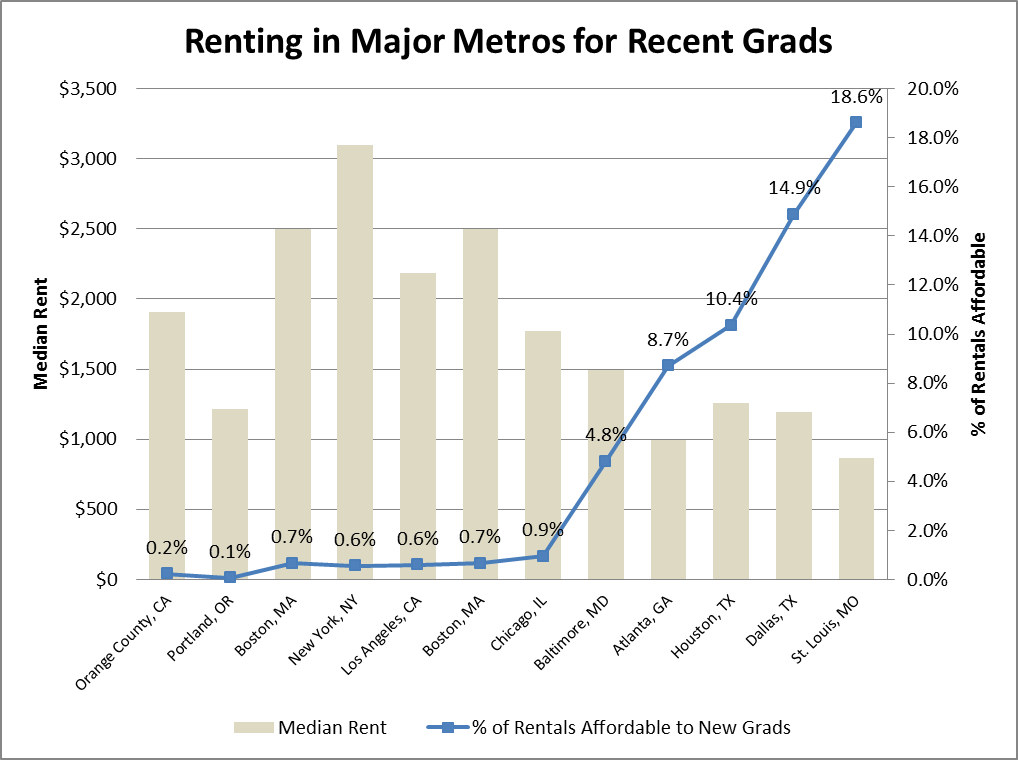
One might assume that the relationship here is one of growth and desirability. Saint Louis, with relatively low growth, is not as attractive as the fast-growing Portland or Miami. But economic growth is not the whole story, because following Saint Louis on the list of affordable metros are some of the fastest-growing metropolitan areas in the nation, including Houston, Dallas, Atlanta, and Phoenix. Most likely, multiple factors, including desirable weather and urban containment policies (of which Portland has been a very prominent example), are important in making a city unaffordable for young people. Put simply, it takes capped supply along with high demand for rent to become unattainable for the average grad.
As things stand, Saint Louis is in the opposite situation from cities like Portland or Boston, in that there is plenty of supply but not a whole lot of demand. That puts Saint Louis in a good position to attract startup businesses and startup graduates from more expensive metropolitan areas. However, if Saint Louis is to gather momentum in attracting businesses, it should keep a positive regulatory attitude toward new building and avoid restricting supply through urban containment.
