Branson Firefighters Unionize

Last week, Branson firefighters voted 17-7 in favor of unionizing. After the State Board of Mediation finalizes the results, the union is expected to begin negotiating with the city in the hopes of winning an agreement that will set fire department policies, such as compensation and work rules. This may be good news for the 17 firefighters who chose the union to act as their representative, but how this affects the people of Branson remains to be seen.

The city of Branson has a choice in how it will conduct negotiations with the firefighters union: It can keep the citizens of Branson in the dark and meet with the union in closed-door sessions, or it can open the doors to its collective bargaining sessions and allow citizens and the media access to these meetings.

Open meetings like this are important because taxpayers and people who depend on city services need to be informed about what their government is doing. The transparency of open meetings leads to accountability. However, when the public is kept from meetings between government officials and government unions, government often acts in a way to benefit itself to the detriment of the taxpayer.

If Branson decides to hold collective bargaining sessions in open meetings, it will be in good company. Both the Monarch Fire Protection District and Columbia Public Schools already hold open collective bargaining sessions with their employees.

To put it simply: Branson citizens have a right to know how their city and fire department operate and where their tax money is being spent. When the city of Branson and the firefighters union begin negotiating a labor agreement, the city should keep the doors open. This will help ensure that citizens of Branson are well served by their newly unionized fire department.

Missouri’s Bridges: Are They Falling Apart?

As we’ve written many times before, the Missouri Department of Transportation (MoDOT) is facing a serious funding problem. If something is not done soon, MoDOT will no longer have enough funds to keep the state’s highways and bridges in a state of good repair. The emphasis for this post is on bridges, a subject that MoDOT officials often lead with when they promote measures that would increase the department’s revenue.

A likely reason for MoDOT’s focus is the fact that the condition of state-controlled bridges ranks poorly compared to other states. Congestion may be low and road pavement tends to be smooth, but Missouri is among the bottom tier of states when it comes to the number of bad bridges. MoDOT claims that 2,000 bridges in the state are “structurally deficient and functionally obsolete.” Bridge closures, like the recent emergency shutdown of MO 291 in Kansas City, also receive significant media attention.

However, the claims that Missouri’s bridges are in crisis is somewhat misleading. Missouri has an extensive state highway system that includes not only the high-profile bridges across major rivers, but also many lightly used bridges that cross small streams. In other states, the latter usually belongs to counties or municipalities instead of the state transportation department. In Missouri, these numerous small bridges greatly add to the list of structures in need of repair.

To illustrate this fact, let’s consider MoDOT-controlled bridges in a condition listed as poor or worse in the National Bridge Inventory, of which there are 735. As the chart below demonstrates, the majority of these bridges are lightly traversed (less than 1,000 vehicles per day). In fact, less than 4 percent of bridges in poor or worse condition have daily traffic that exceeds 40,000 vehicles a day.

1. Frequency refers to the total number of bridges in a range of daily traffic, like the total number between 0-1,000 vehicles per day. 2.Cumulative % refers to the percentage of poor quality bridges that have traffic levels at or below the designated range.
Caption: 1. Frequency refers to the total number of bridges in a range of daily traffic, like the total number between 0-1,000 vehicles per day.
2. Cumulative % refers to the percentage of poor quality bridges that have traffic levels at or below the designated range.


Looking at the location of bridges, we can see that the vast majority of structures in poor condition are located in rural areas away from major highways, which in other states would be the responsibility of county or local governments:

Bridges_map

This demonstrates that the low-traffic bridges are in the worst shape; they are in most danger of closure if the “325 Plan” goes into effect. It is unlikely that a major, well-trafficked highway will have to shut down after a piece of the bridge crushes a school bus, as some alarmists have envisioned.

When we take away the many small bridges that do not see much traffic, Missouri is left in the same position most states are in: a few dozen ailing bridges that need attention. As for those small local bridges, it might be best if over time MoDOT returns those routes to the control of local governments, who can better perform a cost/benefit analysis on reconstruction proposals.

Kansas City’s Reverse Robin Hood

The poor in Kansas City face a double hit: We are generally a high tax city, and development policy ignores the poorer east side. To make matters worse, the taxes in the poorer part of the city are higher than they are elsewhere. Aldi-map-w-taxesThe map to the right shows a portion of Kansas City from Crown Center to the north, Waldo to the south, State Line Road to the west, and Interstate 435 to the east. The location of the three Aldi grocery stores are marked with a shopping cart. The sales tax charged at each location—gathered from shopping receipts and Jackson County—is listed next to each store.

The Aldi in Gladstone, Missouri, just outside the city limits to the north, is not shown on the map. It charges only 4.725 percent sales tax. Again, that was no surprise because Kansas City is generally a high tax city.

The stores in Waldo and East Brookside to the south both charge 5.85 percent sales tax. The Aldi to the north, supposedly in the middle of a food desert but definitely in the poorer part of town, charges 6.35 percent sales tax.

The reason for this higher rate is the Independence Avenue Community Improvement District (CID), which collects an additional .5 percent tax on top of the existing sales tax. This means that the tax rate on unprepared food such as groceries is 6.35 percent; for restaurants it is 11.35 percent. According to their website, the purpose of the CID is:

to provide for enhanced and reliable improvements, security, services and activities, such as general maintenance of public areas, continued efforts to address area beautification related issues, as well as other concerns within the Independence Avenue corridor not already receiving such services.

It used to be that security, general maintenance, and beautification were addressed by the police, public works, and the parks department. As the city fails to provide these basic services, neighborhoods step in and do it themselves. As a result, the poorest neighborhoods, where the need is greatest and the ability to pay lowest, pay higher taxes.

Saint Louis Has Plan B if Stadium Plan Fails

Recently, the Post-Dispatch reported on what the city plans to do with the Near North Riverfront, the proposed site of an open-air football stadium, should the current plan fall through. Apparently, local leaders have been presenting ideas to developers and businesses for months. Some ideas include:

. . . residential towers, hotels, shops, a high-tech business incubator, plus wetlands, green space and parks stretching more than a mile, from the Gateway Arch grounds to the new river bridge. The plan even proposes floating-barge beer gardens and playgrounds.

In essence, this plan would be an extension of the Archgrounds revitalization, with the ultimate goal of turning the Mississippi riverfront into a first-class destination for residents and visitors. Subsidies for this development are pretty much a forgone conclusion.

The first thing to point out is that the very existence of a plan B for the riverfront contradicts some bombastic statements from new stadium supporters. For example, Gov. Nixon said at a press conference supporting the stadium plan, “If we do nothing, 10 years from now that will look exactly as it looks now. . . . This is our chance.” It turns out that not building a stadium is not necessarily the same as doing nothing.

But turning to plan B itself, it is disappointing to see that complete lack of originality of the strategy. A high-tech business incubator? Cortex (the existing subsidized innovation hub) is far from bursting at the seams. Residential towers? Saint Louis has some of the lowest rent in the nation, and the city has to subsidize nearly every new development; this does not indicate a lack of supply. Beer gardens and playgrounds? We’ve already seen how a new subsidized playground (Ballpark Village) has cannibalized the business of not only local bars but other subsidized bar districts (Washington Avenue). At this point, publicly backed residential-cum-entertainment districts are second only to building new stadiums as the city’s favored (if failed) strategy for reinventing downtown. Let’s not even get started on hotels.

Policymakers need to come to the realization that we are not one brilliant central plan (stadium or otherwise) from propelling sustained growth in Saint Louis. A turnaround is only likely when the city creates the underlying conditions that allow for bottom-up development and make the city a competitive place to do business. If Saint Louis can do that, private companies will build the floating beer gardens all on their own.

Senator Proposes Transparency for Government Unions

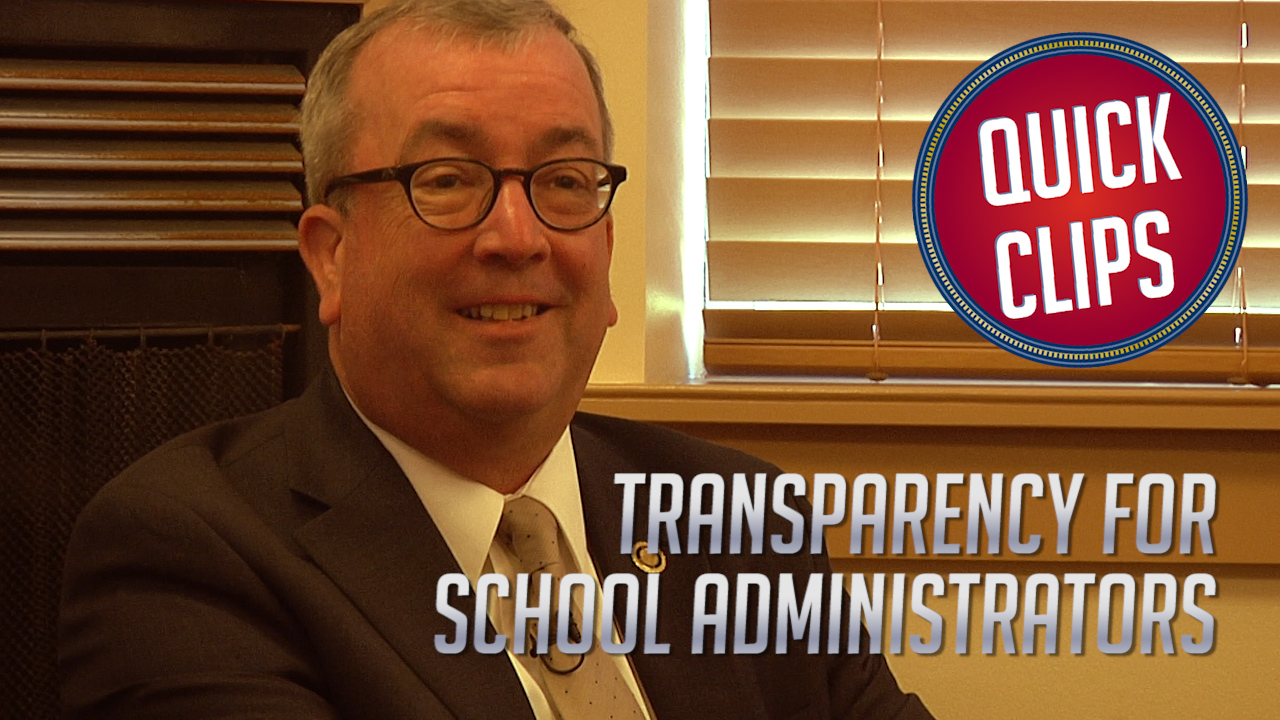
At the Show-Me Institute’s latest Policy Breakfast, Sen. Bob Onder talked about the need for the dealings of government unions to be out in the open. Not only can state and local government agencies, such as school districts, make deals with unions in closed-door sessions, but government unions also get away with keeping their spending hidden. Here’s what Sen. Onder had to say about government union transparency…

Nobody Benefits from School Buildings Sitting Vacant

I joined Kelly Jackson and McGraw Milhaven on “The McGraw Show” this morning to discuss my new paper, “Vacant School Buildings: An Examination of Kansas City and Saint Louis.” Check out the discussion below.

After our on-air discussion, McGraw brought up the similarities between the district and the Saint Louis Land Reutilization Authority (LRA), or what I refer to in the segment as the Land Bank. He offered a good baseball analogy. It seems the LRA and the St. Louis Public School District are looking to hit home runs, but they need to focus on getting hits. The district regularly receives reasonable proposals from charter schools, which the district may not consider a home run, but they are certainly hits.

The district certainly needs to do something with these buildings, because nobody benefits from school buildings sitting vacant.

Support Us

The work of the Show-Me Institute would not be possible without the generous support of people who are inspired by the vision of liberty and free enterprise. We hope you will join our efforts and become a Show-Me Institute sponsor.

Donate
Man on Horse Charging