McKee Wants to Flip Northside Properties at Taxpayers’ Expense

As we discussed recently, the city of Saint Louis is looking to buy back land it sold to Paul McKee’s Northside Redevelopment Corporation a few years ago. The city sold publicly owned property cheap (and the state reimbursed much of the cost of private land), with the hope that Northside would follow through on an extensive redevelopment of North Saint Louis City. No such redevelopment has taken place, and the city now wants to buy back the land to give to the National Geospatial-Intelligence Agency, with the hopes of keeping the agency within city limits.

When we discussed the buyback plans last week, we asked whether the city would be able to buy back the land at the price they sold it for, or whether McKee would profit. Now, shockingly, we are learning that McKee indeed intends to profit. The developer expects to receive $17 million for land that he bought for $3 million. That’s a gain of more than 400 percent.

There’s nothing wrong with a developer buying land from the city and selling it back for a profit if the city decides it needs the property back. But in this case, Northside did not just buy land at a fair price; the city sold it a large number of properties at fire sale prices, and the state reimbursed most of the cost of the private land McKee bought. Northside then failed to pay property taxes on nearly all that land. All this special treatment and public support was supposed to come in exchange for new property and business developments, none of which have happened. Far from a property owner getting lucky from a change in government policy, McKee is expecting to profit from a city policy he helped create and for whose failure he is responsible.

The city has not yet decided whether it will pay the price McKee is asking. If it does, I think state taxpayers should be asking if they get back the $3.5 million in state tax credits McKee received to buy those properties. As for the city, I’d sarcastically ask where eminent domain is when you need it. 

An $11 Minimum Wage Will Still Cost Jobs

Many sci-fi fans would be familiar with one of the key parts of the British science fiction show Dr. Who, regeneration. Whenever the actor playing the Doctor decides to leave the show, the producers have the Doctor regenerate so a new actor can step in and play the role. However, no matter how many times the Doctor regenerates, it’s still the same character. Looking at the proposal to raise the minimum wage in Saint Louis, a Whovian can get a sense of déjà vu.

On Thursday, Mayor Slay announced his support for a compromise proposal. This new proposal would raise the minimum wage to $11 per hour by 2020 instead of $15. Like the original proposal, it exempts small businesses, but it also exempts in-home health care workers and nursing home workers whose services are paid for by Medicare and Medicaid.

While $11 an hour is less than $15 an hour, it will still cost jobs. The Congressional Budget Office (CBO) studied the effects of an increase in the federal minimum wage to $9.00 an hour and $10.10 an hour. In both scenarios, the CBO found that increasing the minimum wage would cost jobs. An $11 minimum wage in 2020 is slightly less harmful than a $10.10 minimum wage today and more harmful than what $9.00 an hour is now. That means this proposal will still harm employment. This harm especially would be felt in Saint Louis City, since businesses can hop across the county line to avoid having to pay the higher wage.

Seeking higher wages for low-income workers is a noble sentiment, but government mandates are not the way to go about it. This proposal, while less harmful than before, will still EXTERMINATE jobs and hurt those it means to help.

How the Convention Hotel Could Drain the General Fund

The Kansas City Business Journal recently published a piece about the proposed catering contract with the Hyatt Convention Hotel. In the story, Brownie Simpson of Kansas City Catering and Steve Shalit of the Westin and Sheraton hotels at Crown Center spoke about the deal.

The pair also expressed concern that the revenue generated from the catering rights arrangement wouldn’t meet the city’s projection of $30 million a year. Even if lack of competition increases prices, Shalit said, the two areas may generate only $17 million in revenue. The Business Journal reported that if gross revenue generated from the catering rights agreement is insufficient to make the scheduled fee payment, the city will have to pay the shortfall from “any legally available” city funds.

This matches other reporting which claims that Kansas City would have to almost double their convention business in order to make the proposed convention hotel work financially.

Right now, caterers pay a fee of 18 percent of their revenue to Bartle Hall for the right to be able to work at the convention center. That amounts to $2.2 million a year and is used to pay off Bartle Hall’s bonds, plus maintenance, operations, and the like.

In the proposed deal being considered by city leaders, Kansas City has guaranteed payments to Hyatt of just over $62 million for 15 years, or about $4.1 million a year. Here’s how that would work: The Hyatt will still pay a catering fee of about 18 percent to Bartle Hall. Bartle Hall will keep 4 percent to service their bonds and provide maintenance, etc., and return 14 percent to the Hyatt to cover the city’s 15-year, $62 million catering commitment.

In order for the project to generate the $4.1 million, Hyatt would have to conduct $30 million in catering each year. (Fourteen percent of $30 million is $4.1 million.) In any year that Hyatt does not reach $30 million in catering, the city would have to make up the difference. Currently, the catering business for Bartle Hall is about $12-15 million each year. If it were to remain at that level, under the new agreement the city would be paying Hyatt $2 million a year to make up the difference, as 14 percent of $15 million is $2.1 million$2 million under the $4.1 million commitment.

The city’s argument that a convention hotel and catering agreement won’t drain the general fund assumes that catering business will double. If it doesn’t double, the general fund will have to support not only the catering agreement with Hyatt, but probably Bartle Hall, as it’s unlikely that their portion of the catering fee is sufficient to service bonds and maintain the property. (The agreement with Hyatt also states, “City will maintain the existing Convention Center to its current standards.”)

“City will maintain the existing Convention Center to its current standards – See more at: https://showmeinstitute.org/blog/local-government/convention-hotels-tax-breaks-and-gimmes#sthash.iTyZkjY2.dpuf
The “City will maintain the existing Convention Center to its current standards. . . .” Isn’t this exactly what the city failed to do with Kemper Arena? – See more at: https://showmeinstitute.org/blog/local-government/convention-hotels-tax-breaks-and-gimmes#sthash.iTyZkjY2.dpuf

No one is promising that building a new 800-room hotel will double business, either in room nights or catering. They would be laughed out of the room if they did. (The deal might actually cost Kansas City business.) But all the financing models make the assumption that business will double. Taxpayers and city leaders have to decide if that is a reasonable gamble.

Half-Million-Dollar Cash Payout Shows Why Public Pension Reforms Are Necessary

The former director of Saint Louis City’s firefighters’ pension system, Vicky Grass, took home a $579,210 payment this summer when she retired at the age of 63. This is in addition to the regular $4,870 pension check she will be receiving each month. While this is no doubt good news for her and her family, it’s an illustration of the sort of excess we often find in public pension systems.

Retirement packages like this are unheard of in the private sector. This is because the market usually will not allow for them. Looking at Grass’s windfall, it’s important to remember a few things:

  1. Grass is cashing in on a system put in place by elected officials. We may feel that Grass is personally ripping us off, but the system was set up through the political process. Grass is simply one lucky beneficiary of a system put in place years ago.
  2. Public pension obligations pose a serious threat to Missouri government finances. The Show-Me Institute’s study on Missouri’s pension systems shows that these systems are often seriously underfunded. Day-to-day government waste is a problem, but when you see municipal bankruptcies, like in Stockton and San Bernardino, the bloated pension systems are usually the key factor in the city’s insolvency.
  3. As the Show-Me Institute’s recent study on the legal options for reforming Missouri pensions shows, once the public is on the hook for retirement obligations like this, it can be very difficult to fix things. Courts often treat pension obligations as contractual obligations protected by the U.S. Constitution. As a taxpayer, this means you can be stuck paying for a sweetheart deal agreed to years before you could even vote.

In order to avoid unfair and unsustainable public compensation schemes, we must vigilantly watch over the agreements entered into by public officials. We need to insist on transparency in public affairs and demand public retirement systems that do not unfairly burden the taxpayer.

Something to Ponder While Debating the Minimum Wage

The latest news regarding the minimum wage debate in Saint Louis makes me feel like Michael Corleone in The Godfather Part III. Just when I thought this thing was on ice, the Board of Aldermen decides it wants to hold a day-long debate on raising the minimum wage and mortgage city buildings in order to fund a new site for the National Geospatial-Intelligence Agency (NGA).

My colleague Joe Miller had a great run-down on what’s going on with the NGA, and I encourage you give it a read. I want to focus on the minimum wage. I’ve already laid out how increasing the minimum wage can cost jobs, hurt economic opportunity, and fail to alleviate poverty. However, it also can raise prices.

This is what is happening in San Francisco, which has raised its minimum wage (H/T Moe Lane). According to one report, Chipotle is seeing prices rise 10-14 percent in San Francisco versus 4 percent in other markets. The report says that the size of this increase is directly attributable to the increase in the city’s minimum wage.

When you artificially raise prices, businesses have to respond. Some (though not all) businesses can absorb the costs. Some will just shed workers or substitute workers with automation. However, others will just pass that cost on to consumers. It seems this is what Chipotle is doing.

As the Board of Aldermen once again debates whether to raise the city’s minimum wage, it should really consider whether the benefits outweigh the costs, not only to businesses and workers but to consumers as well. 

Dispute Shuts Down University City Firehouse

In what some are calling a “sickout,” a group of firefighters in University City appear to have deliberately closed down a firehouse last month. You can read about the incident here and here, and the mayor’s statement on the incident is published here. While it appears that University City residents were not put in significant danger by this incident (University City residents were still served by another firehouse and the mutual aid arrangement with nearby fire departments), the unauthorized shuttering of a firehouse is a serious public policy issue that raises questions about safety and government waste.

If a reduced level of service caused by the closed firehouse did not pose a threat to public safety, then keeping the firehouse fully operational might not be necessary. With a starting salary including benefits of $80,000 per firefighter, keeping an un-needed firehouse fully staffed is probably not the best use of public resources.

However, if the closed firehouse did threaten public safety—even minimally—an unauthorized work stoppage is inexcusable. The University City firefighters already have a labor agreement in place. Withholding their service in a way that puts the public at risk shows that they cannot be trusted to honor their agreements.

In this case, University City would be best served by decreasing its reliance on problematic fire department personnel. There are several changes University City could make to become less dependent on staff, including contracting out for emergency services, increasing its reliance on mutual aid, and exploring volunteer fire protection as a supplement to professional fire protection services. Privatized EMS, mutual aid, and volunteer firefighters are all widely used in Missouri, can save taxpayers money, and, if fire department personnel cannot be relied on to honor their contract, shifting to these alternatives will increase public safety.

Regardless of whether the work stoppage is a serious threat to public safety or a mere bargaining maneuver, last month’s closed firehouse indicates that it’s time to reform practices in the University City Fire Department.

Why Did Saint Louis Get Rid of Its Streetcars?

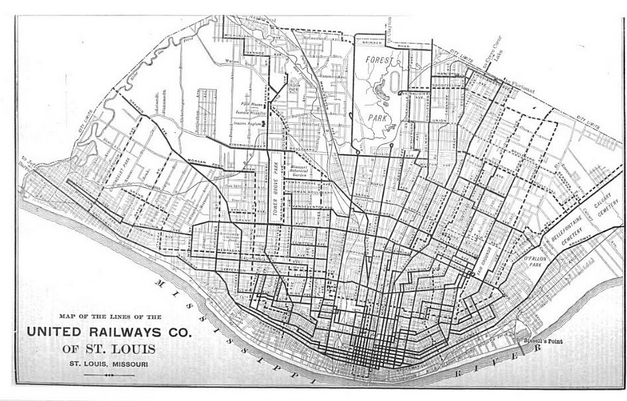
In Saint Louis, and in many cities across the county, there is a push to bring back streetcars. And in cities like Saint Louis, which once had an extensive streetcar system, people often ask why the city got rid of them in the first place. After all, many people think that streetcars are quaint and give urban environments a charm that attracts residents and businesses. Some think their replacement with buses was shortsighted; others even push the idea of a GM-led conspiracy.

In reality, streetcars went away virtually everywhere because of cost, and what people now consider quaint was once seen as outdated technology. Streetcar ridership waned in the early and mid-20th century, as they were outcompeted by buses and private cars. When public transportation became publicly owned, policymakers switched to buses, which were seen as cheaper, faster, and more flexible. Cities where streetcars persisted tended to be those with long tunnel stretches, where diesel buses would have created ventilation issues.

Returning to the question of cost, it’s important to remember that streetcars require their own dedicated infrastructure, while buses can share roads with cars, freight, and bicyclists. People complain about highway subsidies, but from the transit planner’s point of view the local streets are going to be there whether they decide to run a bus route or not. With a streetcar, the rails need to be built, maintained, and replaced on a regular basis.

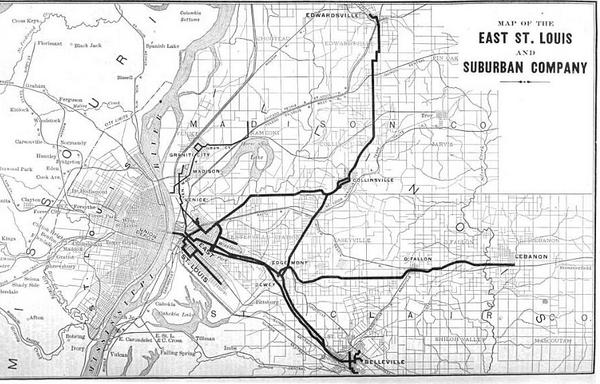
While Saint Louis is building a 2.2-mile vintage streetcar line and considering a modern seven-mile route from downtown to the Central West End, these efforts are more expensive showpieces than a return of streetcar transit. For instance, in 1902, Saint Louis City, Saint Louis County, and Saint Clair County had a combined 560 miles of streetcar lines. That’s a long way from nine miles. Even in cities like Portland, which have spent serious amounts of money to bring back streetcars, total mileage is still less than 20.

Nor could Saint Louis afford to bring such a system back. Modern streetcar lines now require more than $50 million in capital costs per mile. Even assuming some economies of scale and track sharing, building 560 miles of lines would cost billions, possibly tens of billions. If the region went for a less expensive vintage streetcar system (like the Loop Trolley), the cost could still be almost $10 billion to build. For comparison, MetroBus, which runs a system roughly three times as extensive as that 1902 streetcar system, only spent $333 million on capital expenses between 1992 and 2013.

In the end, it was mostly costs that killed the streetcars, and mostly costs that will prevent them from ever being anything more than retro-transportation options for cities with more money than sense. As for Saint Louis, the city needs to consider whether its transportation goals are about moving people or moving the city back 100 years. 

East St. Louis transit

McKee’s Northside Plans Fail, City to Buy Land for NGA

Back in 2009, city government had grand plans for a massive redevelopment of North Saint Louis City. To that end, Northside Regeneration LLC (led by developer Paul McKee) cashed in tens of millions in state subsidies to buy private property and received hundreds of city properties for very low prices. The hope was that Northside LLC would use those properties, along with hundreds of millions in promised local tax breaks, to bring new residential and business developments to North Saint Louis City.

Six years have passed without even the initial parts of the plan coming to fruition. With Paul McKee encountering legal issues it was doubtful whether it ever would. And now, finally, it seems that the city is giving up on McKee. Unfortunately, they’re not giving up by withdrawing the promise of further tax incentives, but by buying many of Northside’s properties to give to a federal agency.

This buyback is part of the city’s efforts to retain the National Geospatial-Intelligence Agency (NGA), which is considering leaving Saint Louis City. To keep the agency, the city plans to gift it a new site in North Saint Louis City, an area where Northside LLC was supposed to bring new development. According to St. Louis Public Radio, the proposed NGA site contains 360 Northside-owned properties. Northside LLC purchased 260 of those properties from the city for a total of $600,000 between 2009 and 2011. The rest were bought from private owners, but Northside LLC received reimbursement from the state to the tune of $3.5 million.

To assemble the land for the NGA site, the city plans to mortgage existing city property to purchase the aforementioned Northside properties for $20 million. Perhaps relieving Paul McKee and Northside LLC of a large chunk of the city will be good for the region in the long run, but all these actions leave a number of important questions unanswered:

  1. With much of the property originally slated for the Northside Redevelopment Plan now being bought back, what is the status of the remaining properties and tax subsidies?
  2. Will the city be able to buy back the land at the price they sold it, or will McKee (or his creditors) profit from the transaction?
  3. Will Northside LLC be forced to return the state tax subsidies it received to buy private land?

More on this to come. 

Kansas City Streetcar Advocates Argue Expensive Streetcar Not Country’s Most Expensive

Recently, an article in the Kansas City Star reported that the cost of the city’s two-mile streetcar line is par for the course among streetcars. The mayor is quoted as saying that those who claim Kansas City’s plan is the most expensive in the country are talking “nonsense.” But whether or not it holds first place, Kansas City’s streetcar will be extremely costly.

According to the Star, the cost of Kansas City’s streetcar is comparable to similar projects in cities like Tucson, Seattle, Cincinnati, and Portland. The paper got their “data” from the Community Streetcar Coalition, which is a pro-streetcar lobbying organization (of which the city of Kansas City and KCATA are members), not a research group.

In dissecting the numbers, the first thing to note is that streetcars are virtually all incredibly expensive for the level of service they provide. That service is comparable to a short bus route, yet they are often an order of magnitude more expensive. That being said, the Star’s claims on the relative expense of the Kansas City streetcar are disputed. According to a report by AECOM (an architectural consulting firm), Kansas City’s streetcar system is more expensive per mile than Tucson, Seattle, and Cincinnati. Furthermore, the system is much more expensive per mile than many “vintage” streetcar lines like the Loop Trolley in Saint Louis, as the following chart demonstrates:


Kansas City

Tucson

Seattle

Cincinnati

Portland

Saint Louis

Year

2016

2014

2007

2015

2001

2016

Length

2

3.9

1.3

3.6

4.6

2.2

Total Cost (Millions)*

102

196

64

148

76

43

Cost per Mile (Millions)*

51

50

50

41

17

20

*2014 dollars                                                                                                                                                                                                                                                                                       

Of course, there are different ways of estimating cost per mile, and (being custom projects) no streetcar system is exactly alike. Asking which streetcar has the highest cost per mile is akin to identifying the most costly SUV on the market given factors like gas mileage, amenities, and dealer warranties. However, arguing the Kansas City streetcar is not the most expensive streetcar out there is a little like saying the Escalade is a better value than the Land Rover. It’s an expensive luxury, whether or not it’s the most expensive luxury.

When Kansas City planned its streetcar, it did not plan a cost-effective transportation system. Instead, it opted for an expensive status symbol designed to move money, not people. And while its costs may be comparable to similar vanity projects in other cities, that in no way indicates shrewd spending by Kansas City planners. 

Support Us

The work of the Show-Me Institute would not be possible without the generous support of people who are inspired by the vision of liberty and free enterprise. We hope you will join our efforts and become a Show-Me Institute sponsor.

Donate
Man on Horse Charging