Time to Reform Fine-Reliant Cities

Policing in North Saint Louis County is under the microscope. The tumultuous events of the last year have turned everyone’s attention to how the many tiny cities of North County enforce the law, and no one likes what they see:

Petty fines landing people in jail.

Budgets propped up by speed traps.

Rigged traffic lights that deceive motorists.

It’s clear that many of these cities use law enforcement more for profit than for protection. But change may finally be coming. State law is about to make it more difficult for municipalities to use police as tax collectors. Rather than double down and fight change, cities should decide how they can reduce their burden on taxpayers. Some might help everyone by going away.

Until this year, the state government failed to enforce a law—known as the Macks Creek Law—that was supposed to limited how much a city could rely on traffic fines. Reports of cities ignoring those limits date back to the late 1990s, but nothing was done. That has changed with the passage of Senate Bill 5. That bill, now signed into law, will strengthen the provisions of Macks Creek Law by lowering the amount of general revenue that can come from traffic fines to 15 percent in Saint Louis County. As for teeth, there are regular reporting requirements, and cities that do not comply will face disincorporation votes.

These changes spell trouble for many smaller cities in Saint Louis County. Twenty-seven North County municipalities have fewer than 3,000 residents, and seven have fewer than 500. Few taxpayers and increasing levels of poverty have pushed these cities to use traffic fines and other fees to stay solvent. More than a dozen of these municipalities get more than 20 percent of their total revenue from fines and court fees.

Disincorporation is a solution to the problem. There is precedent for disincorporation in Saint Louis County, most recently with scandal-ridden Saint George. Essential services, like the police, are now provided by Saint Louis County. Last year, Uplands Park held a vote on disincorporation that almost won the required supermajority.

Another solution is for cities to reduce costs by combining services. Most cities already rely on pooled services for water, power, education, and fire protection. It would not be a stretch for more cities to combine police forces or other essential services. For example, Saint Louis County already provides police for 18 municipalities. That saves money and provides localities with better-trained officers. And unlike some municipal-specific police forces, the county police do not have the same incentive to write tickets for revenue collection purposes.

Instead of turning over policing to the county, some municipalities are integrating police forces amongst themselves, with the recent example of Vinita Park and Wellston. While this in theory saves resources, residents could be stuck with the same revenue-generating practices if cities get rid of their own ticket-oriented police forces only to contract with another city that uses the same questionable practices. For example, Breckenridge expressed interest in contracting police service from Saint Ann, which has gained a reputation for using I-70 like an ATM.

Now that Senate Bill 5 is law, many municipalities are going to have to start making hard choices about whether they can continue to provide necessary services or whether they can continue at all. Residents should consider whether their towns—like Jennings, Wellston, Black Jack, and many others—can reduce spending and combine services. It may be that the best option for residents, and the region, is simply to disincorporate.


More Shell Games from Riverfront Stadium Planners

Last week, the Post-Dispatch published an article detailing yet another change to how a riverfront stadium, designed to keep the Rams in Saint Louis, will be funded. Much ink has been spilt over the last year on this issue, and despite surface changes, the plan’s main problems are the same: 1. Mystery sources of funding, and 2. A proposal to give $400 million to a billionaire.

According to the article, the stadium will now require less money from bond extensions (mostly due to Saint Louis County dropping out), but more in the form of tax credits, state infrastructure fund credits, and unnamed state and city incentives. The stadium task force also increased its expected personal seat license (PSL) revenue by $30 million. And $450 million will still have to come from a team owner, presumably Stan Kroenke, who may have a personal interest in not supporting such a plan.


Funding (Millions)

Funding Source

January

July

NFL Team Owner (G4 Loan + Own Funds)

$450

$450

State and Local Bonds

$350

$201

PSLs

$130

$160

State Tax Credits, Mystery Box

$55

$187

Total

$985

$998


Fortunately, the plan reduced the total public support that would go to the stadium. Unfortunately, that support would still total $388 million, only a $17 million reduction. What’s more, that relief is bought by an increase in estimated PSL revenue. There should be little doubt on who would be left holding the bag, the Rams or the taxpayers, if actual revenue is less than expected.

More than anything else, the new funding plan is just another hand motion in a drawn-out shell game. Lower the amount coming from the Saint Louis area, increase the amount coming from the state. Decrease bond revenue, increase tax credits. Throw in undisclosed funding sources to cover the difference. Keep everything in motion and hope no one notices that none of the important questions have been answered:

  1. Who pays for the $100 million-plus refurbishment of the Edward Jones Dome, along with its continued maintenance needs, when state and local bonds are repurposed? (I’m looking at you, Saint Louis County, whose bond payments will “retire.”)
  2. What are the “additional state and local incentives” that will fund the dome?
  3. Will a team owner actually pay $450 million for a stadium in Saint Louis? And finally,
  4. Should Saint Louis City and the state of Missouri pay hundreds of millions for a billionaire’s stadium, even when economists agree that these stadiums do not create development or increase tax revenue?

Washington Legislature Defunds Lobbying Group Paid for With Tax Dollars

Washington State just defunded the controversial Labor Education Research Center (LERC) after the Freedom Foundation discovered that the taxpayer-subsidized group, based at South Seattle Community College, is heavily involved in lobbying, strategy, and political activism. This is good news for Washington taxpayers who would rather their taxes be used to provide government services than to provide support for a political interest group.

Here in the Show-Me State, we have a similar taxpayer-subsidized labor studies program associated with UMKC, the Institute for Labor Studies. According to the Institute’s mission statement, “the aim of The Institute for Labor Studies is to serve the educational needs of organized labor.” This mission may seem relatively innocuous; however, events put on by the Institute include symposia with slogans like “Revolutionary Organizing” and “Agitate! Educate! Organize!”

Moreover, there’s this story about an activist-led class at UMSL where instructors were recorded advocating violence, physical intimidation, and industrial sabotage as legitimate tactics to be used during labor negotiations. The instructors at the UMSL class are the same folks behind the Institute for Labor Studies at UMKC.

While I do not know whether UMKC’s Institute for Labor Studies engages in overt political activity, the events and speakers listed on their website suggest an ideologically driven mission. Ideology and political activism are fine, but the public should not be forced to pay for it.

The Metropolitan Taxicab Commission and the Myth of Effective Regulation

We’ve written before about the benefits of ridesharing businesses like Uber and Lyft. However, these companies have been met with resistance from taxicab regulatory bodies around the world. Few have been as intractable as the St. Louis Metropolitan Taxicab Commission (MTC), which has blocked cheap ridesharing from entering the city. The MTC even prevented Uber from offering free rides on the Fourth of July weekend.

MTC representatives, along with other opponents of ridesharing, criticize Uber and Lyft as being unsafe, unprofessional, and discriminatory. They argue that these companies need to be regulated so these problems can be addressed. But is the MTC really effective at protecting the consumer? Let’s ask some questions:

  1. The MTC, unlike Uber or Lyft, specially requires cabs to pick up any customer and take them wherever they want to go. So taxis never refuse fares or avoid going to certain neighborhoods?   
  2. The MTC has rules on insurance that they claim are more comprehensive than Uber and Lyft’s policies. So cabs never operate without proper insurance?
  3. The MTC has a myriad of rules to ensure cab drivers dress and act professionally. So all cab drivers provide good service?

The answer to all these is an emphatic no. Cabs have ways to refuse fares and avoid certain neighborhoods. Drivers sometimes act unprofessionally and, as an editorial in the Post-Dispatch claims, even operate without proper insurance.

The presumption that creating a regulatory commission and writing regulations will result in intended outcomes, and only intended outcomes, is an example of the “Unicorn Governance” fallacy; it’s magical thinking. In reality, even when regulators are competent, impartial, and have the public interest in mind, regulation can fail to be effective or even make matters worse. But with a regulatory body like the MTC, which has taxi company representatives as commissioners, impartiality is an unreasonable assumption. And after recent outbursts from the MTC’s chairman, competence is in question as well. Given the incentives at play, it should not come as a surprise the MTC is more effective at blocking competition than protecting consumer safety.

Market competition and open information, not regulation, are the best ways to ensure customers get a safe, comfortable ride when they want. Unfortunately, the MTC still wants to prevent that competition from coming to Saint Louis, to the continued embarrassment of the city. Saint Louisans should consider whether the MTC now does more harm than good. 

New Website May Open Doors for More Educational Choice

Before I spend money on anything, I check out the reviews. Websites like Fandango, Yelp, and Hotels.com ensure that consumers are more informed purchasers of goods and services.

Recently, a new website was launched that can help Missouri parents become better consumers of education. Schoolgrades.org uses an A-F grading scale to evaluate individual schools (as opposed to school districts). The site adjusts for varying academic rigor across state standards and each school’s economic profile.

Prior to this site, Missouri parents had to rely on complicated and hard-to-interpret Annual Progress Report (APR) scores, state standardized test scores, and accreditation statuses, none of which are representative of quality at the national level. Additionally, words like “accredited” and “provisionally accredited” do not intuitively tell parents how a school is doing. A, B, C, D, or F grades provide a better indication.

Within the site, parents can search for a city, place, or individual school.

After looking through a few, let’s just say some Missouri schools did better than others. For example, look at Saline County in West-Central Missouri.

On one hand, Orearville Elementary School received an A. Only 23 percent of schools in the nation earned an A rating. On the other, Bueker Middle, Eastwood Elementary, and Northwest Elementary earned Ds, and Alexander Elementary earned an F.

This highlights the problems of solely looking at APR scores or the state’s accreditation standards. Alexander Elementary is part of the Slater School District, and in 2014 the Missouri Department of Elementary and Secondary Education awarded Slater an accredited status. The district earned 66.1 percent of possible APR points, which signifies (by Missouri standards) that the school district is providing students with a quality education. But for students at Alexander Elementary, clearly it isn’t.

I hope that by looking at the wide range of school performances across the state (rural, suburban, and urban) families and voters will see that all is not well. Perhaps it’s time to give students stuck in D and F schools a chance at something better.

Be Skeptical of Dome Convention Claims

Recently, the Post-Dispatch published an article on the economic effects of the Edward Jones Dome’s conventions. The Convention and Visitors Commission (CVC) claims that convention goers generate $23 million in tax revenue for the city annually. The idea here is that even if the Rams do not generate much tax revenue for the city, the dome still pays for itself through conventions.

But there is ample reason to be skeptical of the CVC’s tax revenue claims. First, the estimate was generated using estimates of estimates, which could easily lead to miscalculation. Let’s assume that the numbers are correct, and convention goers who use the dome go out and add $23 million to city coffers. That still does not ensure that the dome generated $23 million.

Why not? Imagine you owned a passenger train that generated $5 million annually. You decide you can get more riders if you make the train bigger. Post investment, revenue increases to $6 million. Did the improvement generate $6 million or $1 million in new revenue? Obviously $1 million. You were already making $5 million before you spent a dime. Passengers are likely substituting their use of the old train for the improved train; the investment itself may be attracting few passengers. Even worse, you have to consider opportunity cost, or what you could have made had you invested the improvement dollars elsewhere. If you could have earned more putting your money in other projects, the train improvement was a bad investment.

When the CVC claims the dome makes $23 million annually, they ignore substitution effects, assuming much convention spending would disappear without a dome. They also ignore opportunity cost, or that convention center investment could have gone to other projects. In doing so, the CVC is not only coming up with questionable estimates, they are ignoring historical data.

According to the Brookings Institution, the opening of the dome in 1995 had little impact on hotel occupancy. In 1991, downtown hotels combined for 1.16 million room nights. In 1998, three years after the dome had opened, room nights were 1.15 million (10,000 fewer room nights). As the author put it:

In terms of filling more hotel rooms, the city’s investment in more and newer convention center space and a dome had done absolutely nothing to either fill existing downtown hotel rooms or to prompt the private development of more hotels.

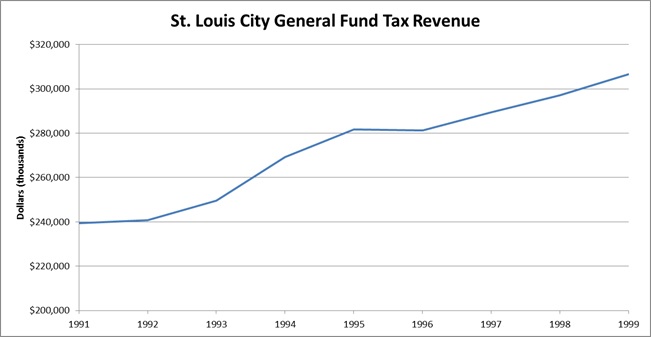
And it’s not just hotel occupancy that remained stagnant. The city’s general tax revenue actually fell in the dome’s opening year:


general fund tax revenue

Revenue growth in the 1990s was faster before the dome opened rather than after. This is not to say the dome decreased revenue growth, just that there is no obvious evidence that the dome created significant revenue expansion.

To sum it up, there are many issues in calculating revenue impact of the dome today. In addition, historical data does not show that the dome significantly impacted the city’s hotels or tax revenue. For that reason, I’d take the CVC’s $23 million estimate with a football-sized grain of salt. 

When It Comes to a New Stadium, John Oliver Tells Saint Louis to “Make Them Pay!”

Last week, comedian John Oliver took on the public funding of sports stadiums on his popular HBO show, Last Week Tonight. The segment echoed the conclusions of economists and our previous writings: Stadiums do not generate economic development and are unlikely to expand tax revenue for cities. With a great deal of humor (and some off-color language), Oliver argues billionaire owners should pay for their own stadiums, and that Saint Louis is much more than just the Rams. Watch the video here.

Land Taxes and Columbia

This past Saturday, the Boone County Chapter 100 Review Panel approved a property tax abatement for Kraft Heinz so that it can modify its plant in Columbia. As I mentioned previously, this would be bad policy. But beyond saying no to awarding subsidies, is there anything Boone County should be doing to make it more affordable for Kraft (and other businesses) to expand and/or modernize?

Boone County could cut its property tax rate. This not only would help Kraft, but all the other property owners in the county as well.

Even better, Boone County could shift away from property taxes and toward a land value tax. Land value taxes are taxes levied against the unimproved value of land and not the buildings, personal property, or other improvements on that land. A broad spectrum of economists support the land value tax versus other types of taxes because it is non-distortionary (i.e., it doesn’t alter behavior, unlike income and sales taxes).

If Boone County imposed a land value tax instead of a property tax, companies like Kraft would not face increased taxes after improving their plant. Unfortunately, only Kansas City is allowed to levy land value tax. There would need to be a change to the State Constitution in order for Boone County to levy a land tax.

Boone County (like other counties and cities) faces a difficult dilemma. It either can erode its property tax base with abatements to select businesses or risk having those companies being lured away to locations that offer subsidies. A land value tax won’t completely eliminate that problem (a jurisdiction could offer to not tax the land at all or provide that business some type of tax rebate), but it will make it more financially viable for businesses to expand facilities already present. If the State Constitution were changed, counties would have another policy option available to retain businesses other than having to resort to tax abatement.

Support Us

The work of the Show-Me Institute would not be possible without the generous support of people who are inspired by the vision of liberty and free enterprise. We hope you will join our efforts and become a Show-Me Institute sponsor.

Donate
Man on Horse Charging