Why NOT let the public vote?

There is breaking News out of the St. Louis Circuit Court. Judge Thomas Frawley has ruled (http://www.stltoday.com/news/local/govt-and-politics/no-vote-on-city-money-for-new-nfl-stadium-in/article_51c33b67-9b72-5055-ba56-94cc9e1b46e2.html) that a city ordinance requiring a vote on the use of public funds to build a new stadium is invalid. This clears one hurdle standing in the way of construction of a nearly $1 billion football stadium on the St. Louis riverfront.

Those interested in reading the ruling can read it here (http://bloximages.newyork1.vip.townnews.com/stltoday.com/content/tncms/assets/v3/editorial/a/71/a7116828-ac39-5c13-ab82-0a558fb68353/55bfaef6e79eb.pdf.pdf). I’m no lawyer so I’m not equipped to discuss the merits of the judge’s decision. However, it is interesting that there has been such an effort by the St. Louis Regional Complex and Sports Authority to block (http://www.latimes.com/sports/sportsnow/la-sp-sn-st-louis-nfl-stadium-lawsuit-civic-vote-20150410-story.html) a vote. One wonders why.

Is it because the new stadium cannot be justified economically (https://showmeinstitute.org/sites/default/files/20150323%20-%20Rams%20Testimony%20-%20Miller%20_0.pdf)? Is it because they know that a new stadium won’t lead to downtown redevelopment (https://showmeinstitute.org/blog/corporate-welfare/show-me-now-new-stadium-rams)? Could it be because they know taxpayers won’t see a positive return on the subsidies that would go into stadium construction (https://showmeinstitute.org/blog/local-government/no-post-dispatch-rams-dont-pay-their-way)?

It’s also not like the Authority didn’t have time to get this issue on the ballot. The stadium taskforce unveiled their plans in January (https://showmeinstitute.org/blog/transparency/thoughts-latest-rams-press-conference. If the April ballot was too soon they could have gotten it on the August ballot (i.e. today’s ballot). What was holding them up?

Whatever the Authority’s reasons might be, it got its wish. The project can move ahead without a public vote. That doesn’t make this project a good idea though, at least economically speaking. Hopefully, policymakers will come to realize that.


A Pat on the Back for Privatization

It’s a good thing when one can improve health services while simultaneously improving the health of one’s budget. That’s why it is commendable that Saint Louis County is looking into privatizing medical and mental health services for the inmates at its Justice and Juvenile Centers.

The County is accepting bids in order to improve services and cut down on costs. It has good reasons to believe that privatizing these services will result in these better outcomes. In 2003, the County privatized its pharmacy services in order to save on costs. What resulted was not only cost savings, but an increased quality of service to residents.

Privatization is not appropriate in all circumstances. For example, privatizing police services would not be good policy. Nor should the ownership and operation of jails themselves be privatized. However, within public jails, certain services can certainly be privatized, including food service and health care.  

There is no guarantee that privatizing inmate health care will have the same great result as privatizing the pharmacy did. However, if past performance is any indicator of future results, Saint Louis County has good reason to continue with this course of action. The County administration deserves a pat on the back for considering this move. I’m confident that, as with the pharmacy, the County will do the due diligence to make this work for better results for taxpayers and better services to inmates.

Missouri’s Rural School Students Need Choice, Too!

Recently, the Foundation for Excellence in Education released a paper about how states across the country are implementing course access programs. Course access programs allow students to direct a portion of their annual per-pupil funding to approved course providers outside of their traditional school and receive credit if they successfully pass the class.

In twelve states and numerous school districts, course access programs are providing students with an opportunity to experience a wider variety of classes than they usually would. In Louisiana, students are using their funds for career and technical certification programs; in Minnesota, students are getting back on track in high school through an online credit recovery program; and students in rural Texas are preparing for the University of Texas through tailored online coursework. 

These programs are beneficial not just to students, but to school districts as well. It can be resource-intensive for a school to create a whole class to meet one child’s interests or readiness for advanced coursework. With course access, a student interested in taking AP Calculus could just head to the school’s library and log into any number of courses offered by universities or other providers.

On the flipside, course access programs also offer school districts an opportunity to earn additional revenue. Teachers can create courses that other students from around the state can attend, and schools can charge for them. Schools that have invested in a highly specialized teacher for a foreign language or advanced math or science course can help defray the cost by having that teacher create an online version of his or her courses.

Such a program would do a world of good in Missouri. Most discussions about educational issues in the state usually involve St. Louis and Kansas City, but it’s easy to forget that more than 97 percent of the land area in Missouri is rural. While 476,765 students attend school districts classified as urban, 383,883 students attend school districts with a rural classification.

Students in rural districts often lack access to advanced math and science courses, Advanced Placement courses, diverse foreign languages, and technical skills training. This puts rural students at a disadvantage. A course access program could greatly expand these students’ horizons.

In an increasingly tech-oriented age, course access is an inevitable step. I hope Missouri join states around the country in this emerging trend.

Taxi Trouble

Show-Me Institute Policy Analyst Joseph Miller talks with St. Louis entrepreneur Ed Domain about Ed’s 2013 accident in a Harris cab and the response of the Metropolitan Taxicab Commission (MTC).

We also reached out to the MTC for their side of the story. Here’s what they told us:

Mr. Domain was in an accident in a Harris Cab. He suffered grievous injuries. As is his legal right, Mr. Domain used the judicial system to reach a financial settlement in the matter.

Harris is in good standing with the Commission. Its CCN was most recently renewed in June 2015.

The MTC inspects every taxi twice a year. As part of that inspection, each vehicle must produce a valid insurance card. In addition, the MTC requires all CCN holders to have valid and current Certificates of Insurance on file.

The MTC has completed an audit of all Cab companies for insurance. All are in compliance today.


Proposition 1 Raises Property Tax for Questionable Purposes

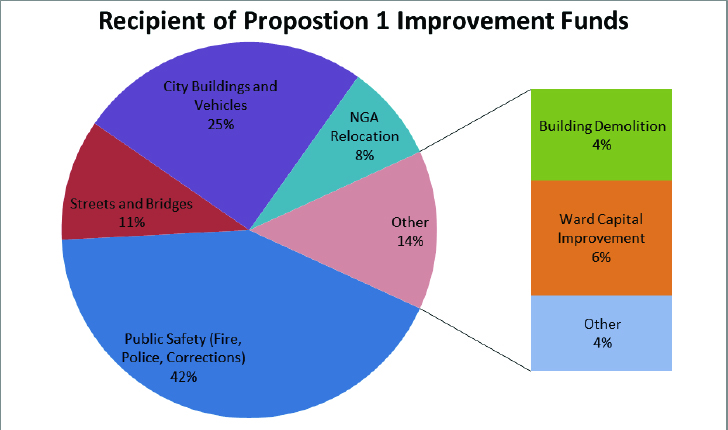
On August 4th, Saint Louis City residents will be asked to vote for a property tax increase (17 cents per 100 dollars of assessed valuation) to raise $180 million for various “improvement” projects around the city. The plan has had little publicity, and many have questioned both the need and appropriateness of the tax increase.

So where would the $180 million go? The short answer is that about two-thirds of the money would go to public safety departments (mostly fire), city-owned buildings and vehicles, and city streets. Most of the rest would go to preparing a site for the NGA, building demolition, and a “ward capital improvement fund.”

Beyond the broad categories, it is difficult to know exactly how the money would be spent. However, the city did outline a large capital improvement wish-list in 2014, much of which would likely be funded through this property tax increase.

      With such a diverse set of projects, residents might want to ask a few questions to gauge this tax proposal’s appropriateness:

  1. The city already spends a significant amount on public safety, about $365 million in 2014 alone. That’s more than a thousand dollars per resident per year. And spending has not been falling; the city’s public safety spending increased more than 22% from 2008 to 2014. Do these departments really have a revenue problem, or are they not making good use of the money they have?
  2. Approximately $15 million would go to preparing an NGA site (listed creatively as “Economic Development”  in most ballot rundowns). How much, if any, of that money will be spent buying back land that developer Paul McKee bought from the city and private owners (using state subsides) just a few years ago?
  3. What is the purpose of the ward improvement fund, especially when the city already has a ½ cent sales tax devoted to the same purpose? Who will decide how those funds are spent?

Perhaps there are satisfactory answers to all of these questions and the city truly needs higher tax levels to fund basic city services. However, given the city’s current level of spending and its push to spend tens of millions on yet another downtown stadium, the real problem may be where the money is already going.

Pew: Medicaid Taking “Growing Slice of States’ Dollars”

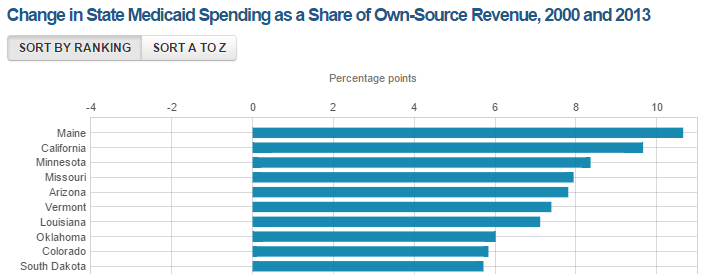
Last week we wrote about how Medicaid costs and enrollment have exploded under Obamacare, driving home yet again the need for reform in the program. But Medicaid was broken long before the Affordable Care Act became law, and the program has been eating into state budgets steadily over the years. According to the Pew Charitable Trusts, state Medicaid spending as a percentage of state tax revenue grew in nearly every state in the country between 2000 and 2013. Worse still, our home state of Missouri ranked fourth overall in the growth of state revenue paid to support Medicaid, behind only Maine, California and Minnesota.

Missouri was one of only seven states that spent “more than one-fifth of their own-source revenue on Medicaid in 2013” at 22.3%, topped only by New York (which spent a whopping 27.2% of its state revenue on the program.)

Given this fiscal threat, Missouri should be especially sensitive to the cost of its broken Medicaid program. State dollars are the primary source of funding for lots of government programs, including primary and secondary education, and as the cost of the state-contribution to Medicaid mushrooms, so do the threats to other state priorities. It is time to reform Medicaid, not only for the patients it should be helping, but also for the others — including our kids — who will get squeezed if the state sits on its hands and does nothing.

Kansas City’s Property Tax Abatement Problem

Just the other day, an unsigned Kansas City Star editorial considered the near future for the new Kansas City Council:

Supporters of universal pre-kindergarten have discussed asking voters to endorse a property tax increase, within the Kansas City Public Schools boundaries, to finance programs designed to get young children off to a stronger start in life. James has made education one of his four main tenets when it comes to improving the city’s quality of life. But will the full council agree to back a tax increase that doesn’t flow into the city’s coffers and instead goes for someone else’s priority?

Never mind that this is the same Star that just asked the City to excuse it from paying $10 million in property tax to the school district. Now that it has been exempted, it wonders if the tax rate should be increased for others.

This would be humorous if it weren’t so sad. The Star is not alone; the city regularly abates property taxes in the name of economic development. In fact, whenever you hear about development in Kansas City, the chances are that the city offered the developer a subsidy of some sort. 

As a result of these abatements, schools, libraries, the county and programs that support mental health services and the zoo are being denied funds. As of 2013 the Kansas City school district suffered a $470,000,000 gap between the assessed value of real estate and the value at which it is taxed. 

That’s almost a half-billion dollars of land value that is going untaxed in the Kansas City school district alone. At the 2014 county property tax rate, that amounts to over $23 million each year in forgone revenue. As a result, the district doesn’t have money to pursue a universal pre-K program the Star thinks is so laudable.

City leaders who allow property owners to pay less than the full share of their tax may be the greatest obstacles to fully funded education. Are they really going to ask rank-and-file taxpayers to make up the difference?

Kansas City doesn’t need a higher property tax rate, it needs to make sure more people are paying their fair share.

Support Us

The work of the Show-Me Institute would not be possible without the generous support of people who are inspired by the vision of liberty and free enterprise. We hope you will join our efforts and become a Show-Me Institute sponsor.

Donate
Man on Horse Charging