
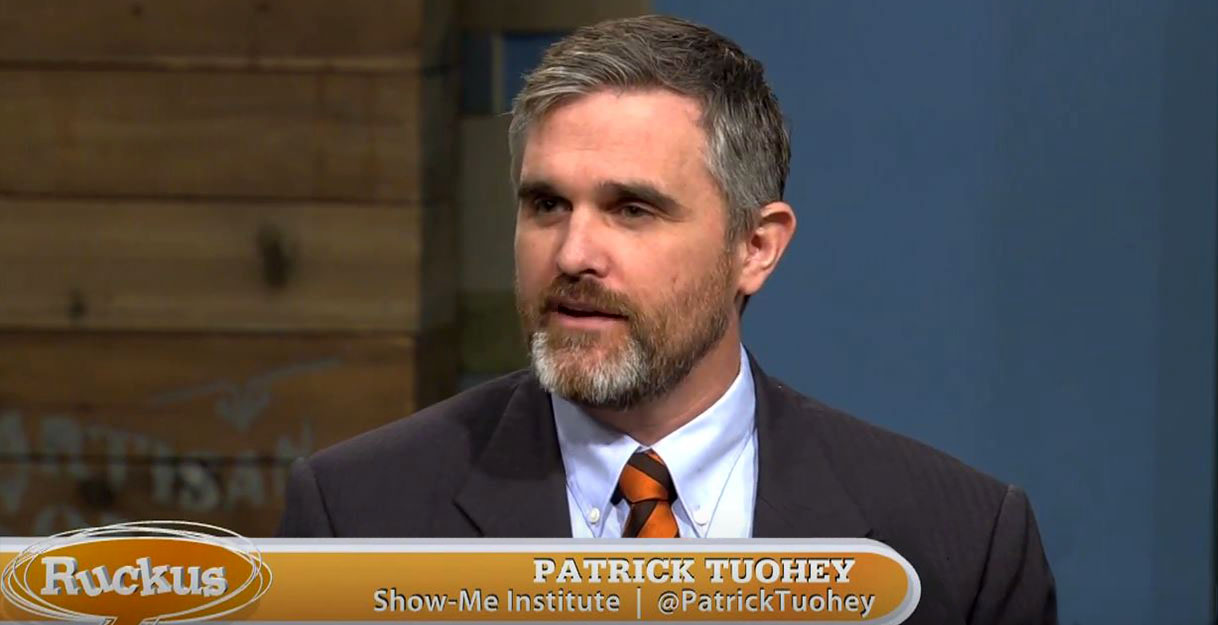
Show-me’s Patrick Tuohey talks about Kansas sales tax revenues on Ruckus!
Friedman Legacy Day with Hon. Jabar Shumate

This year’s Friedman Legacy Day event in Saint Louis focused on the importance of school choice with guest speaker Hon. Jabar Shumate. Shumate is a former Oklahoma state senator and state representative. He has been an advocate for kids trapped in low-performing schools and has fought for increased funding for public education. The Friedman Legacy Day celebrates the life and ideas of Economist Milton Friedman, who championed school choice.
The question and answer portion begins at 31:06.
Local Fuel Tax in Foristell Fails by a Nose

On Tuesday, voters across Missouri cast ballots on many different local issues. Most had to do with bond issuances and local board elections, but in Foristell (located in Saint Charles County), residents voted on transportation funding.
The idea that a Missouri city would vote on a tax increase to fund transportation is not news in and of itself. After all, virtually all cities and counties already use property and sales tax levies to fund various types of transportation. But Foristell did not vote on a property or sales tax, it voted on a fuel tax.
As we’ve written before, Missouri cities and counties can impose local fuel taxes, as long as tax proceeds are spent exclusively on roads, which is what Foristell’s 1 cent diesel fuel tax would have done. Fuel taxes can be a fair and economically sound way of raising funds for local road spending. Those who benefit most from the roads pay more for them, and driving is not subsidized by shoppers or homeowners. Moreover, legal protections in Missouri guarantee that money raised via fuel taxes must be spent on roads, which reduces the likelihood that money is wasted on pet projects.
In Foristell, 65% voted for the fuel tax, but that was not enough because (unlike other forms of transportation funding) local fuel taxes require a 2/3rd majority to pass. The need to obtain a 2/3rd majority for a local fuel tax levy, but only a simple majority for property or sales tax increases, is likely a large reason why no local fuel taxes exist in Missouri.
Foristell’s fuel tax proposal failed. And that may be a good thing, as this specific proposal appears to have been targeted at unsuspecting truckers making a quick stop in Foristell. However, local fuel taxes are in general an option worth considering. If other localities are truly in need of more money for roads, they could try local fuel taxes before attempting to push for sales or property tax increases.
If charter schools are ruining education in Missouri, more please!

The Kansas City and St. Louis school districts saw two of the largest gains in the country in their graduation rates from 2011 to 2013, according to the recently released 2015 Building a Grad Nation report. Kansas City shot up 17 percentage points, and St. Louis 14.
Now, this might strike you as odd when you hear over and over that charter schools are destroying public education. Kansas City and St. Louis each have more than one-third of their students enrolled in charter schools, and yet, the traditional public school districts seem to be getting better. How can this be?
It’s possible that either by stirring competition, more efficiently sorting students into options that serve them, or relieving pressure from school districts, charter schools are helping once struggling districts turn a corner. Whatever the reason, it is hard to look at these numbers and see charter schools harming either district.
I should also point out that both districts started in very bad places. In 2011, Kansas City had a graduation rate of 50 percent and St. Louis was at 54 percent. Even with their gains, the Kansas City School District sits at only 67 percent and St. Louis at 68 percent. This puts them on par with cities like Newark, New Jersey (68 percent) and Compton, California (65 percent). They perform worse in absolute terms than neighboring cities like Little Rock (75 percent) and even Chicago (70 percent). Inauspicious company. Clearly, there is still a long, long way to go.
Around the rest of the state, there was both good news and bad news.
The overall graduation rate in Missouri is up, from 81% in 2011 to 85.7% in 2013. That gain represents the 6th best growth rate in the country over that time period. At the same time, though, Hispanic students in the class of 2013 graduated at a rate of 81 percent, low-income students graduated at a rate of 78 percent, and African-American students graduated at a rate of only 72 percent.
The report also broke out the performance of districts with at least 15,000 students:
- Around Kansas City, North Kansas City saw a graduation rate of 91 percent and Lee’s Summit clocked in at 94 percent.
- In greater St. Louis, Hazelwood saw an 86 percent graduation rate, Ft. Zumwalt 89 percent, Francis Howell 92 percent, Parkway 93 percent, and Rockwood 94 percent.
- Columbia had a graduation rate of 86 percent and Springfield had one of 87 percent.
All in all, a very interesting report that should inform conversations about education around the state.
The Commission’s Omissions?
This summer, Missouri passed a troubling piece of legislation—SS HCS HB 137. The main provisions of it essentially state that license fee offices may not award points to bidders based on the amount of money they would return to the state. While I do not have a major problem with the central purpose of the law, I do find one specific provision very unsettling. It reads as follows:
“The leases, agreements, contracts, or subleases and any amendments for space, usage, or services in any convention center or related facilities owned or operated by a regional convention and visitors commission… must not be considered public records under the Open Meetings and Record law, commonly known as the Sunshine Law…”
It goes on to say that this is only the case if transparency would put the commission at a competitive disadvantage; however it never defines such a situation and seems to leave it to the commission’s discretion.
Upon reading this, I immediately found myself wondering a few things. How is it ever a bad thing for the public to know how a public entity is spending public dollars? What is the possible competitive disadvantage regarding documents to which the parties have already agreed? If there really are legitimate situations in which the Convention and Visitors Commission would be hurt by transparency, why did nobody take the opportunity to tell us what these situations look like? At least the law states that this exemption does not apply if a sports franchise is involved, but I doubt it should apply under any circumstances.
I understand that secondary provisions get tacked on to bills fairly frequently, and perhaps legislators felt very strongly about getting the rest of this bill passed. However, questionable policy is questionable policy. Even if the legislature felt strongly that the main of the bill needed to pass, why did it not take the time to clean up this unrelated, troubling provision?
Some Comments on a Minimum Wage Testimony

There’s been a lot said on the prospect of increasing the minimum wage in Saint Louis. A lot of that has come from Show-Me Institute researchers. However, an interesting perspective on raising the minimum wage comes from Nahuel Fefer, the newly hired Special Assistant to the Mayor for Policy and a recent graduate of Washington University. He testified (testimony starts at 1:20:28) before the Ways and Means Committee the day after I did and he raises some points that are worth discussing.
It appears from the testimony that Mr. Fefer supports raising the minimum wage. The first thing to notice when listening to his testimony is that a lot of it simply relates to the number of workers making below a certain wage level. For example, Mr. Fefer says that 44 percent of the workers in Saint Louis City make less than $15 an hour and 14 percent of workers make the minimum wage or less. Even if Mr. Fefer’s numbers are correct, and for the sake of argument, let’s say that they are, these statistics don’t tell us a whole lot. A key point people need to understand in discussing the minimum wage is that people who earn low wages aren’t necessarily in poor households. A man working as a greeter for $9 an hour at Wal-mart might be an upper-middle class retiree who just wants to stay active. Of course, he might not be, but Mr. Fefer’s statistics don’t tell us one way or another. This information is useful in that it captures the raw number of workers who could see pay increases, but nothing much beyond that.
A bigger problem with Mr. Fefer’s testimony is that he overstates the evidence in support of his position. Mr. Fefer states, “The theory that raising the minimum wage results in job loss has been proved wrong in just about every case.” That’s simply inaccurate. One can point to several studies that show that raising the minimum wage does harm employment.
The minimum wage is certainly a contentious issue. Voices on both sides should be heard and given due consideration. However, it is important that any information which is presented to the public is put in the proper context and any errors are corrected.
Normandy Students-Still Trapped
The Post-Dispatch published a heart-wrenching story yesterday about a family trapped in the Normandy school district. The Harpers have two daughters— seventh-grader Keiara and her older sister Shannon, who attended Ladue High School via the transfer program for the past two years.
Shannon won’t be returning to Ladue next year, and despite having post-traumatic stress disorder from being severely bullied in sixth grade, Keiara will not be allowed to transfer either. Of the 679 students who applied to transfer, only 564 were approved. According to the story, the Harpers were denied, because of the confusing, byzantine process by which families have to demonstrate their eligibility for the program.
The Post-Dispatch reported:
The district has no record of the Harpers’ applying for Shannon to stay in Ladue or for Keiara to leave, said Cindy Gibson, the spokeswoman for the Normandy School District. Diane Harper says she filled out the paperwork for Shannon to stay in Ladue and submitted a mortgage payment and utility bill in January as proof of residency, weeks before the deadline. She said she was unaware of an application deadline for transferring Keiara until she contacted district staff in the spring and was told it was too late.
“Something’s got to happen,” said Robert Harper, sitting in a chair beside his daughters in their home near North Hanley Road. “I’m not going to send my kids there. I’m just not.”
Now, it’s impossible for us to know whether or not the Harpers actually followed the procedure as they said they did. What we do know is that this family should not have to jump through so many hoops to make sure their daughters receive a quality education.
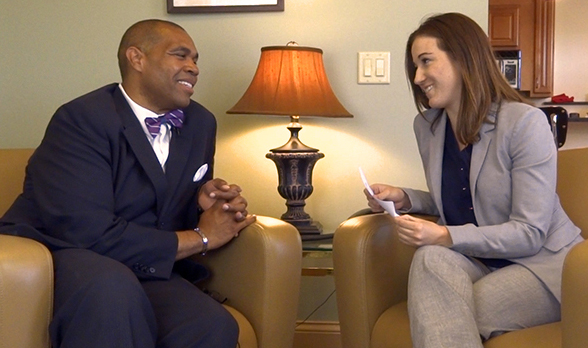
Keaira and Shannon, and many students like them, need more options. Last week, the Show Me Institute hosted former Oklahoma State Senator Jabar Shumate, who spoke about the Sooner State’s efforts to expand school choice. I encourage you to watch my interview with him. While it might be too late for the Harpers this year, we can work to create more and better options for families zoned for failing schools.
No Need for Pension Problems in Springfield
A pension benefit meant to allow Springfield police and firefighters to take early retirement is now underfunded. Employee contributions have been unable to keep up with the cost of this benefit. With the shortfall increasing, Springfield officials are asking whether taxpayers or employees will have to cover the gap.
It is unfortunate that taxpayers and employees are in this position, but this situation could have been avoided if the Springfield Police-Fire fund was a defined contribution plan instead of a defined benefit plan.
Defined benefit plans are plans where retiree benefits are guaranteed based on a formula that typically takes into account various factors like years of service and final average salary. Since the benefits are guaranteed, this creates a liability for the pension plan which must keep paying out benefits as long as the pensioner is alive.
With defined contribution plans, benefits are paid at retirement and consist of the employer and/or employee contribution plus any investment gains or losses. There would be no underfunding of promised benefits since the balance of the account is the benefit. It would also spare taxpayers from having to make up any funding shortfalls since there is no liability going forward.
Alas, Springfield’s police and fire pension is not a defined contribution plan and it is possible that taxpayers will have to cover any shortfalls that occur. For cities/states that want to avoid situations like this, transitioning to a defined contribution plan might be the way to go. It is not a cure-all (benefits already accrued will still have to be paid for), but it could prevent a potential problem from turning into a catastrophe.
University City uses private sector to save taxpayers money
The University City Council voted 5-2 in favor of a proposal to contract out for municipal ambulance services. The five year contract, which is expected to save University City taxpayers upwards of $500,000 each year, would utilize Gateway Ambulance, a private ambulance company. Read the Post-Dispatch’s coverage here and here.
Gateway Ambulance is able to provide a potentially better service than existing ambulance services because of an innovative delivery system. Rather than keep ambulances at a fixed location such as a firehouse, Gateway plans to keep ambulances ready to go out in the community. These locations will be chosen based on a statistical analysis of where they would be most useful. If the city’s needs change and the community is better served with ambulances posted in different locations, the solution is as easy as driving the ambulances to the new posting points. You can’t move a brick-and-mortar firehouse like this.
From reports we’ve heard, Gateway Ambulance can provide a better turnout time than the fire department. “Turnout time” is the length of time between an alarm and when an ambulance starts moving. Most fire departments in St. Louis County have an average turnout time of about 90 seconds. This makes sense because staff need to transition from whatever they are doing, get ready, get to the ambulance, and get the vehicle moving.
Gateway operates out of their ambulances. If it’s hot or cold outside, the vehicle is already running. All the Gateway Ambulance drivers need to do is find out where they are going and they’re ready to go. With the private option, turnout time is virtually eliminated.
Spending less money for a better services sounds like a win-win, right? It’s the sort of outcome that we often see when contracting out for public services. Private companies have a strong incentive to provide a superior service because if consumers, in this case taxpayers, don’t like the service, they can simply go to a different company.
