Pine Lawn Considers Disbanding Their Police Department

                Pine Lawn, a small city in North Saint Louis County, has begun exploring the possibility of disbanding its police department. If the city did so, it would likely turn over policing duties to the Saint Louis County Police Department (which already handles policing for more than a dozen municipalities along with unincorporated areas) or the new North County Police Cooperative, formed by Wellston and Vinita Park.

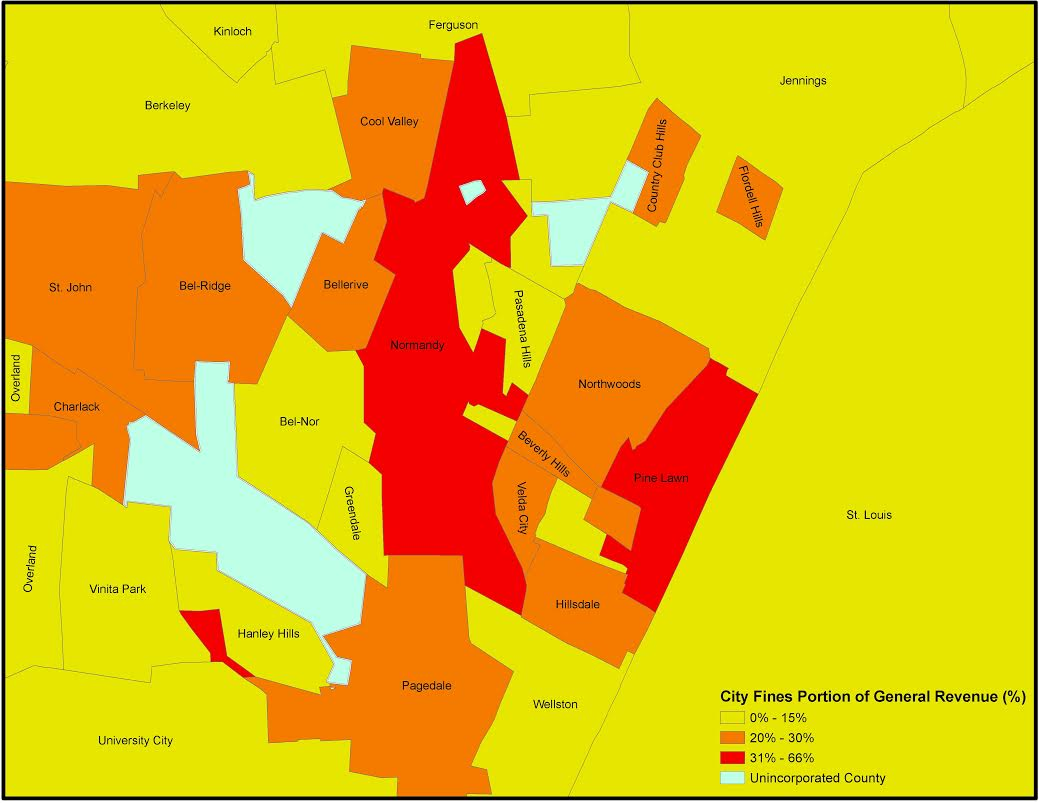
                While the process through which the city is considering such a change has created considerable controversy, there is little doubt that Pine Lawn is in serious need of reform. The city been a posterchild of civic dysfunction, with a former mayor indicted for corruption, irregularities in city expenditures, and a highly criticized criminal justice system that uses poorly trained officers to fund the city through citations. Specifically addressing the last point, a report from Better Together showed that as of 2013 Pine Lawn relied on fines and fees for almost 50% of its general revenue, making it one of the worst offenders of the Macks Creek Law (which capped fines to 30% of general revenue) in Saint Louis County:

                As we’ve written previously, until last this year the Macks Creek Law was regularly ignored and was without enforcement provisions. But with the passage of SB 5 in the last legislative session, things have changed. Cities like Pine Lawn can now collect no more than 12.5% of their general revenue via fines and fees. There are now regular reporting requirements, and failure to comply triggers a disincorporation vote.

                These new legal provisions spell trouble for the status quo in Pine Lawn. Instead of a cash cow, their police force is likely to become a financial burden. That has pushed Pine Lawn and cities like it to do what they should have done a long time ago: join with the county or other cities to provide cost-effective and professional policing.  

Ferguson Commission Misses the Mark on Unemployment

After weeks of deliberation, the Ferguson Commission released its report last week. The report contains a wide range of policy prescriptions, most of which are aimed at rectifying injustices facing the greater St. Louis community.

The report rightly makes the case that one of the biggest issues facing the St. Louis region is unemployment. It then goes on to recommend increasing the minimum wage to $15 an hour. Something doesn’t add up here.

Study after study has shown that minimum wage increases cause unemployment. Laws that drive up the cost of labor and lead to the elimination of jobs are the opposite of what Saint Louis needs.

Oddly enough, the report acknowledges the role of training positions in its discussion of unemployment. From the report:

Internships and apprenticeships are valuable programs to both help students succeed in their careers, and help employers ensure they have a competent, trained workforce. By expanding internship and apprenticeship opportunities for high school and college students, and fostering collaboration between educators and employers in the development of these programs, Missouri can support better learning and economic outcomes that benefit individuals, companies, and communities.

How do the report’s authors envision increasing training opportunities while at the same time doubling the amount that low skilled laborers must be paid?

The Show-Me Institute recently did a video on the revitalization effort of St. Louis’s Dutchtown neighborhood. In that video we tell the story of JJ, a young man from south St. Louis who worked his way to the front of the house at a local restaurant after starting washing dishes. For people without formal work experience, starting at minimum wage and learning skills on the job is the often the only way to train and gain experience. By pulling the bottom rung of the economic ladder up out of reach, a minimum wage increase will make it more difficult for people to move up in our economy.

It seems that the Ferguson Commission wants to propose policies that will help revitalize the underserved parts of our city and improve the lives of those that the system is failing. By calling for a minimum wage increase, they risk making things worse.

Myths of Education Reform

Show-Me Institute's new Director of Education Policy, Michael McShane, digs into the myths and facts about education reform in Missouri. Is there any truth behind common arguments like "St. Louis and Kansas City are the only places in need of reform," "Expanding charter schools would harm public schools," and "Missouri's Blaine amendment makes private school choice impossible"? Watch and find out!
 

Second All-Girls Charter School to Open

This school year, Hawthorn Leadership Academy opened its doors as the first all-girls public charter school in Missouri. Now, the state Board of Education has approved an application for a second all-girls public charter school—Tessera Hall.

Tessera Hall will open to sixth- and seventh-graders, but will expand to include grades 8 through 12 in South St. Louis City during the 2016–2017 academic year. As the Post-Dispatch reported, a group of St. Elizabeth Academy alumni started working to build the school after St. Elizabeth closed in 2013.

Like the once private, religious De La Salle Middle School, which reopened this year as a public charter school, St. Elizabeth struggled with enrollment. Mike McShane, who recently joined the Show-Me Institute as the Director of Education Policy, wrote about this phenomenon in Sector Switchers: Why Catholic Schools Convert to Charters and What Happens Next. While charters like La Salle no longer deliver a religious education, access to public dollars allows them to remain open, ultimately carrying on their mission—providing a quality educational service to a low-income population.

Tessera Hall’s charter school application says it plans to recruit young women in low-performing schools like Roosevelt High School, where 70% of girls score below basic in mathematics. The application reads:

The proposed mission, curriculum, teaching methods and services of Tessera Hall Academy are designed to meet the particular needs of the adolescent urban girls of St. Louis by providing an inclusive and academically challenging experience in a safe, affirming, and empowering environment that enables these young women to achieve success in college, become civicminded leaders, and be resilient life-long learners.

I look forward to hearing more about the state’s second single gender public charter school, as well as other future charter school options. The Missouri State Board of Education accepts charter school applications up until the December board meeting.

Single gender or mixed, students need more quality educational choices. 

A Good Idea from the Post-Dispatch

David Nicklaus’ latest column, “Tax credit would be better for workers than minimum wage hike,” is one well worth reading. In it, he talks about how those opposed to a minimum wage increase need to offer an alternative policy proposal instead of just saying no. Mr. Nicklaus suggests that Missouri create a state Earned Income Tax Credit (EITC) to supplement the federal credit and increase the incomes of the working poor.

                Economists across the political spectrum have been recommending this for years. The Congressional Budget Office, David Neumark, and even Christina Romer  find the EITC is a better policy option than the minimum wage for helping low-income households.

                There a couple of reasons why the EITC is a better policy option than the minimum wage. First, it is specifically targeted to help low-income households. The minimum wage isn’t as well targeted. For example, a teen flipping burgers and making the minimum wage would benefit from a higher minimum wage even if both of her parents are surgeons. The EITC only goes to households making below a certain amount. Secondly, the EITC doesn’t increase labor costs. Increasing the minimum wage means employers will have to pay their employees more per hour. The EITC is a direct government benefit, so businesses won’t have those increased costs.

                The EITC is not a perfect program. It makes a lot of improper payments , costing taxpayers billions. Also, its complicated nature makes it necessary for many people to hire professional tax preparers so that they can receive the credit.

                Despite these drawbacks, the EITC is still a superior alternative to the minimum wage    

Taxicab Commission Still Stonewalling Uber, Residents

At long last, UberX has begun operating in Saint Louis.

Just not legally.

On 10:00 A.M., Uber, a prominent national ridesharing company, simultaneously filed an anti-trust lawsuit against the Saint Louis Metropolitan Taxicab Commission (MTC) and launched UberX in defiance of that commission. This move followed the breakdown of negotiations between the MTC, Uber, and local government officials over new ridesharing regulations. Some MTC commissioners claim they have made all the concessions they can, and that they are simply enforcing state statutes on fingerprinting and background checks. However, Uber and other local officials claim that remaining regulatory barriers are unnecessary and will prevent Uber from serving the metropolitan area.

In addition to its inability to end Saint Louis’s status as the largest city in the United States without cheap ridesharing, the MTC continues to embarrass the city in its spare time. The latest incident came when a local resident submitted a sunshine request asking for comments and complaints received by the MTC in the last 18 months. One might expect a body whose core mission is to ensure quality cab service to have readily accessible complaint data, but that couldn’t be further from the truth. According to the MTC, complaints are not “readily kept in the ordinary course of our record keeping.” They charged the resident nearly $500 dollars, an amazing sum for files that most governmental organizations would have aggregated and digitized. Those who have read about the MTC’s reaction to a  Show-Me Institute sunshine request will be unsurprised by the MTC’s lack of professionalism.

It is exactly one year and seven months since Lyft, another ridesharing company, attempted to enter the Saint Louis market. Since that time, the MTC has constantly resisted reform, treated requests for information with contempt, insulted the public, and engaged in offensive infighting. How can a commission that cannot regulate its own behavior be expected to regulate the taxi market? How long must residents put up with this self-serving commission? As we’ve suggested before, it may be time for the state to disband the taxicab commission altogether. 

A Better Way of Doing Saint Louis’ Dirty Work

In 1992, Patrick Geraty founded St. Louis Composting. Patrick was in the landscaping industry and was looking for a way to diversify his business. “I was also wondering what to do with all this yard waste,” he tells me. His solution was to recycle the dead plant matter into mulch and compost, which can then be used to enrich topsoil.  

As his business grew, he began taking on local governments as clients. Many public spaces produce plant waste that needs to be disposed of, and cities also need mulch to cover ground in public parks.

Privatization can be controversial, but there are some instances where everyone agrees privatization is a smart move. Municipal mulching services seem to be one such case.

In 2010, the city of St. Louis contracted out its green waste disposal to St. Louis Composting. The move saved the city an estimated quarter-million dollars annually.

“Privatization just made sense,” said Greg Hayes, St. Louis’s forestry commissioner. “Antiquated equipment made our operation inefficient. It saved the city from having to invest a significant sum in new specialized machinery. St. Louis Composting is a well-capitalized, accomplished specialist that knows the business inside and out.”

This seems to be a common story. As a city’s older machinery needs to be replaced, it makes sense to contract out with a specialist like St. Louis Composting rather than burdening a city with the purchase of expensive new machinery.

Patrick estimates that his company now has contracts with around 20 to 25 cities in the eastern half of Missouri. His company even handles much of the animal bedding for the St. Louis Zoo.

I asked Patrick about the environmental aspect of his business and he tells me that soil quality has decreased in the last 30 to 40 years. Recycling organic matter back into the topsoil helps fix this problem. “You feel good about what you do” he said.

Support Us

The work of the Show-Me Institute would not be possible without the generous support of people who are inspired by the vision of liberty and free enterprise. We hope you will join our efforts and become a Show-Me Institute sponsor.

Donate
Man on Horse Charging