Minimum Wage Harms the Workers It’s Meant to Help

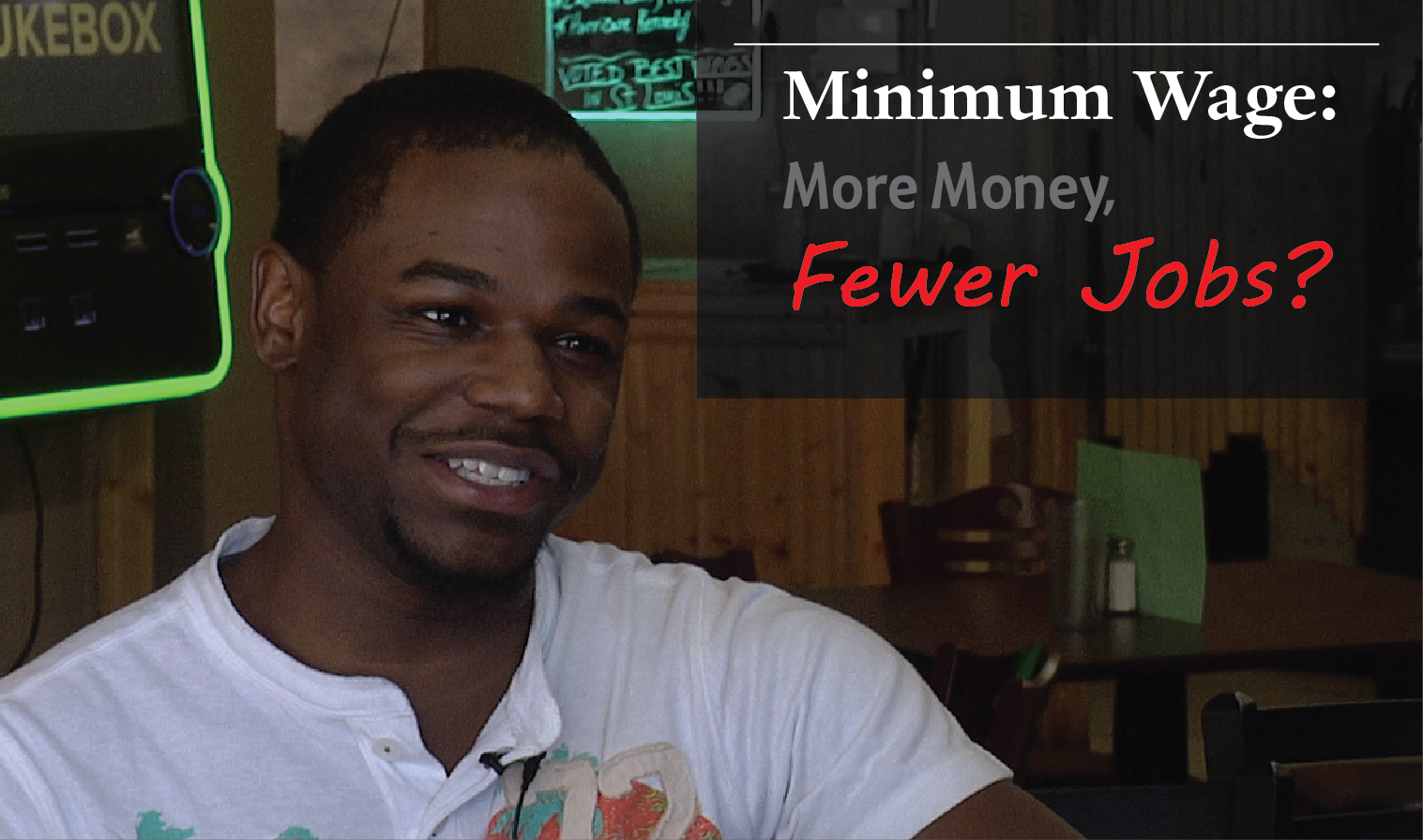
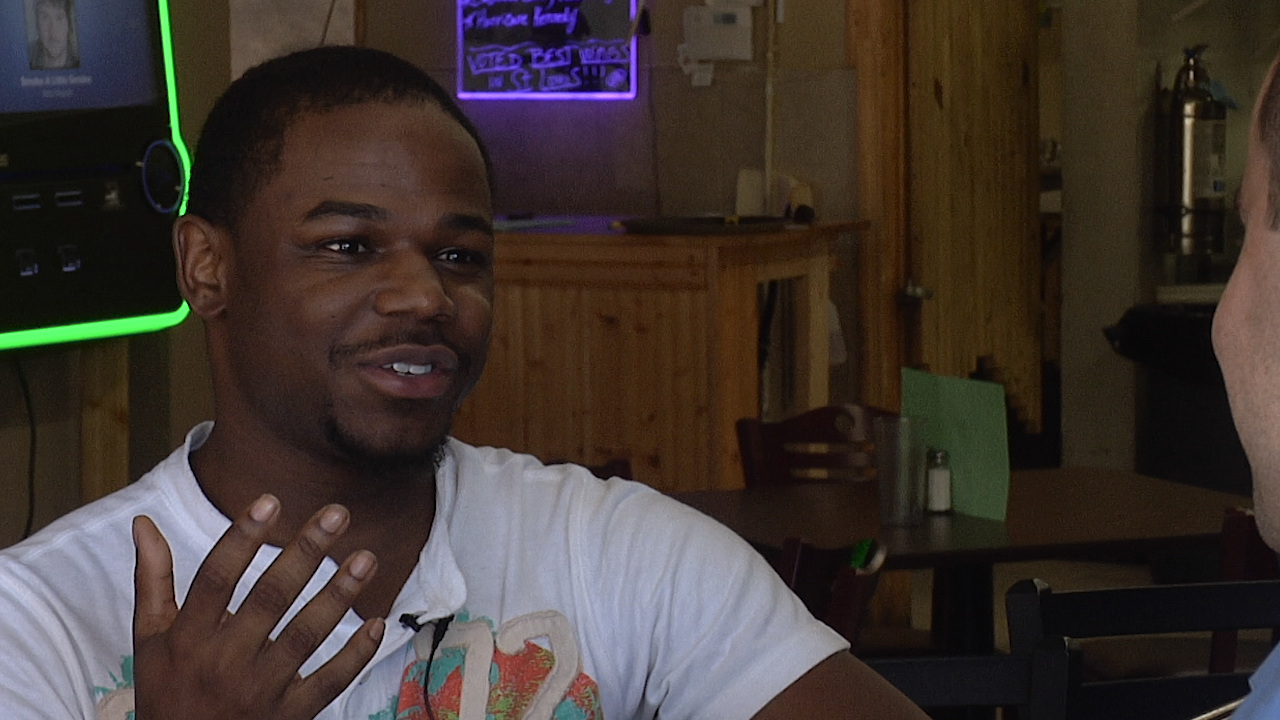
If you grab lunch at Sister Cities in the Dutchtown neighborhood of St. Louis, you’re likely to be greeted by Javion Johnson (going by JJ), who works the front of the popular Cajun and BBQ restaurant several days a week. JJ is 22 years old, lives in the neighborhood, and wants to pursue his passions for art and food. He didn’t start working in the front of the restaurant, however; he got the job when the co-owner, Pam Melton, needed a dishwasher in a pinch.

JJ first stopped into the restaurant after smelling the food. “I could smell the smoke from Louisiana.” JJ tells me. [Louisiana is a street several blocks from Sister Cities.]

When JJ and his girlfriend went inside to check out the place, Pam needed someone to help out in the back of the house. She asked him if he’d like to make some extra money. “I was like, sure, why not?”

After starting washing the dishes, JJ quickly worked his way to the front of the house. Pam told him, “You have a good smile. You have a good personality. I need you in the front. You can’t be nice to the dishes anymore. They’re clean now.”

Now JJ seats customers, takes orders, takes care of checks, and works as a back bar man. Sister Cities put up a chalk board, so JJ taught himself chalk art from a Youtube channel. He now does much of the signage for Sister Cities.

JJ’s story is a common one. When I was a teen I got a restaurant job under similar circumstances; the manager needed someone to wash dishes. I got my foot in the door cleaning, bussing, and earning minimum wage, but soon moved up to a position where I took orders and prepared food.

Minimum wage mandates are so dangerous because they threaten people like JJ who don’t already have formal work experience. If Pam had been forced to pay a starting wage of $11, she probably wouldn’t have taken a risk on someone without previous restaurant experience. If you remove the bottom rung of the economic ladder, it’s harder for people to get the skills they need to move up.

Minimum wage laws can also keep businesses from operating altogether. “I’m afraid I’ll ultimately have to close my doors,” Pam tells me when I ask her about the impact of the minimum wage hike. If Pam has to shut down Sister Cities or move out of the city, JJ will be out a job.


Zoos, Taxes, and Admissions Charges

A recent editorial in the Post-Dispatch by former Clayton Mayor Ben Uchitelle once again set off a debate on how the region funds the Zoo Museum District. Mr. Uchitelle recommended the implementation of entrance fees. The board that runs the district says there are no plans to begin charging admission, with one member stating that he’d rather see property taxes go up in Saint Charles and Jefferson County instead.

Why the need for entrance fees or higher taxes? The district’s institutions, like the zoo, art museum, and history museum, face mounting expenses. For example, just from 2011 to 2014, the art museum’s operating losses grew from $20.2 million to $25.5 million. The zoo’s expenses have also been rising steadily. Add to that ambitious plans for capital improvements (like a gondola over Interstate 64/US 40), and the desire for more revenue is understandable.

The Zoo Museum District depends heavily on property tax revenue. The district’s museums receive the vast majority of their support via property taxes. The zoo, even with private supporters and charges for services, still relies on tax revenue for almost 40 percent of its budget. That property tax, (8 cents per hundred dollars of assessed value in Saint Louis City and County) is maxed out.

Supporters of reform want to broaden the district’s revenue base. They argue it is unfair that Saint Louis City and County taxpayers bear the entire burden of supporting these institutions. Only an estimated 39 percent of zoo visitors come from Saint Louis City and County. Twelve percent are from Saint Charles and Jefferson County, and 37 percent are visiting from outside the Saint Louis area altogether. Mr. Uchitelle’s proposal to make zoo and museum goers pay some sort of entrance fee would allow visitors to jointly invest in these destinations. After all, admission fees are the norm at other popular institutions in Saint Louis, like the Cardinals (obviously), the Botanical Garden, and even the Jewel Box. In other cities, zoos (including the country’s most visited) and museums charge entrance fees without losing their appeal.

Still, to many the idea that zoo or museum improvements should be paid by those who use them is an anathema. They argue that residents at large, regardless of whether they enjoy or approve of the institutions, should have to ensure zoo visitors always get free admission. And because some residents of Saint Charles County and Jefferson County use the zoo, the “fair” method of increasing revenue would be to charge all the residents of Saint Charles and Jefferson County.

There is nothing wrong with putting the question on the ballot in neighboring counties, but convincing residents in Saint Charles and Jefferson County to pay for a luxury hotel and gondolas in Saint Louis City via local property taxes is going to be a hard a sell, “fairness” aside. If the zoo really needs more money for large-scale improvements, perhaps they should take the idea of fairness to its logical conclusion and raise the money from people who actually visit, wherever they might come from. 

Are Missouri Students Ready for College?

Piggybacking off of Brittany Wagner’s post on ACT results, I wanted to direct your attention to the ACT’s recently released college readiness report on Missouri’s Class of 2015. It has numerous interesting data points on how well Missouri’s most recent crop of graduates performed. Let’s look at a few that stand out.

Perfection!

The report shows that 31 Missouri students scored a perfect 36 on the entire test. Within individual tests, 197 students scored perfect on the English section, 108 scored perfect in math, 368 scored perfect in reading, and 289 scored perfect in science.

College Readiness

ACT sets a “college readiness” benchmark on its exams that (they claim) correlates to a 50 percent chance of a B or higher or a 75 percent chance of a C or higher in the first-year college course in that subject. For English, it’s an 18 (out of 36), for math and reading it’s a 22, and for science it’s a 23.

Across the class of 2015, 71 percent of Missouri students scored college-ready in English, 44 percent scored college-ready in math, 51 did so in reading, and 42 percent cleared the bar in science.

Unfortunately, those groups weren’t always overlapping, because in total, only 30 percent of the class of 2015 scored college-ready in all four tested subjects.

If that wasn’t bad enough, breaking down the scores by racial groups shows even worse performance. While 34 percent of white students and 43 percent of Asian American students scored college-ready in all four subjects, only 20 percent of Hispanic students and 6 percent of African American students did.

Everywhere in Missouri, we have room to grow.

Course Access

The ACT also collects information from test takers on the courses that they have taken.

Probably the most eye-catching figure to me was the finding that 6 percent of the students who took the ACT in the class of 2015 took fewer than 3 years of math in high school. Not surprisingly, only 9 percent of those students were ready for college math. (For those students who took 3 or more years of math, 54 percent were college-ready.) The report also shows that 17 percent of the class of 2015 took fewer than 3 years of natural science courses. Preparing students for the 21st Century means preparation in math and science, and in too many places the courses simply aren’t there.

The findings from this report are a challenge to Missouri to step up its game. We won’t be an engine of economic growth, a vibrant cultural center, or a flourishing democracy if so few of our students are prepared for higher-level schooling. We have to do better.

Missouri Mayors and the Minimum Wage

Kansas City Mayor Sly James and St. Louis Mayor Francis Slay recently called for a statewide minimum wage increase in Missouri when efforts to do so in their own cities met with resistance.

Their media release includes the following from Mayor James:

Workers in our cities and across the entire state work at one, two, or sometimes even three jobs, but they still cannot earn enough to provide for themselves and their families. This injustice creates a burden on state and city resources and stalls economic activity in Missouri. While we weren’t able to implement a local ordinance to raise the minimum wage in Kansas City, my commitment to pursuing this policy change has not wavered.

Not to be outdone, Mayor Slay discussed the statewide implications:

A living wage rewards work and alleviates taxpayers from the burden generated by employers who pay too little and whose employees must rely on government subsidies to fill the gaps created by the current minimum wage. Not only would a higher minimum wage benefit employers of our cities by attracting the best workforces, but also I believe that a higher statewide minimum wage would help Missouri attract the best workers in the region.

Kansas City and St. Louis have some of the highest taxes in the region. Both cities tax food, one of the most regressive forms of taxation and the most damaging to the poor. As we've written previously, not only does Kansas City levy regressive sales taxes, but its poor areas actually have a higher rate of sales taxes than wealthier areas. While some may argue that an equitable tax structure should broaden the base, what’s clear is that these tax policies are not written with any concern for the working poor. In fact, both cities also saddle workers with an additional 1% earnings tax, a tax imposed on the first dollar earned. There are no exemptions to spare the poor. And if a low-skilled worker in Kansas City is able to get a job in a restaurant, the city requires that they pay a food-handlers fee, something almost unheard of in the rest of the country. 

Both cities' public school districts suffer because the mayors and tax increment financing (TIF) commissions are eager to redirect property taxes to wealthy developers and away from the classrooms that would otherwise get the funds. Developers take the money and use it to build in the nice parts of town, away from the poor and legitimately blighted neighborhoods of Kansas City's East Side and St. Louis' North Side. Because of the disincentives of high city taxes and low city services, the city governments give out massive subsidies to businesses in the hope that they’ll stick around. 

While it's nice that the Mayors take time away from doggedly pursuing such "touristy frou frou" as streetcars, convention hotels, and airport terminals to consider the needs of workers, it is not enough. The need for sound economic policies in Kansas City and St. Louis requires a more serious approach. If mayors want to be advocates for the poor, they should focus on running their cities effectively and efficiently, rather than passing the buck in the form of wage controls. After all, increasing the minimum wage will likely hurt the very people it is intended to help.

The Minimum Wage and Revitalization in Dutchtown

Dutchtown is a neighborhood in South St. Louis with a rich history and a vibrant community. The oldest standing Ted Drewes location still operates in the neighborhood, and a Dutchtown bakery served the very first gooey butter cake. Although it has struggled in recent years, several small businesses are working hard to rejuvenate the neighborhood.

·         Iron Barley – Tom and Gen Coghill started Iron Barley in 2003 and were the first business to start Dutchtown’s contemporary revitalization. Several Food Network television shows have featured their food. They also put on an annual Tomato Fest; proceeds from the festival go to help local charities.

·         Urban Eats –Caya Aufiero and John Chen started Urban Eats 7 years ago with the express purpose of helping revitalize Dutchtown. Urban Eats shares space with an art collective and hosts community events such as a regular board game meet-up.

·         Sister Cities – Pam Melton and Travis Parfait started Sister Cities in 2013. The restaurant serves Cajun food and barbeque. A local Bitcoin group meets in the restaurant once a month and, as with Urban Eats, art from locals decorates the walls.

I spoke with the owners of all three of these restaurants about the minimum wage hike (parts of my interviews can be seen here). The bottom line: the mandated wage increase will harm this community. Increasing the minimum wage from $7.65 to $11 will force these restaurants to restructure in order to remain profitable. This could mean laying off employees, moving to the county, or perhaps even shutting down.

Travis Parfait, co-owner of Sister Cities, told me that with an $11 minimum wage, he might have to cut out much of his staff completely and work the front of the house himself. “Restaurants are a very low profitability business, and if you increase one of the many costs by almost 50 percent . . .  it can’t hold it. It won’t bear that.”

It’s a similar story at Urban Eats, where John Chen says that poverty is a wider social problem that cannot be fixed by mandating minimum wages for employers. John calls the city’s minimum wage law the “sink or swim” approach: “Here’s the minimum wage increase, and you figure out how to cope with this. . . . That’s irresponsible. I argue that it’s unethical.”

The minimum wage hike is an another government-made obstacle to urban renewal—one that threatens to undermine the efforts of local business owners who have spent years working to help bring economic life back to their neighborhood. Without the jobs and community spaces provided by the people I spoke with, the revitalization of Dutchtown might be stopped in its tracks.

Let’s Talk about the ACT

At first glance, this year’s ACT results in Missouri might give cause for optimism, but a little more digging shows that Missouri high schools could do much more to prepare students for college.

Last week, the Jefferson City News Tribune reported on Missouri’s recently released ACT scores. The 2014–2015 school year was the first year in which every 11th-grader in Missouri was required to take the test, which in theory predicts how well a student will do in college. The Tribune reported that Missouri increased its average score from 21.6 to 21.7, and that Missouri students outscored national averages in every subject area.

But before we pop the champagne bottle, let’s talk about the ACT.

The ACT is an imperfect tool for comparing students from different states. The test is more popular in some states than in others, so participation rates vary. Only thirteen states had 100 percent participation, and 59 percent of students participated nationally. Where participation is voluntary, we might expect scores to be higher on average, as only students interested in taking the test actually take it.

The participation rate in Massachusetts, for example, was 28 percent. The small number of Massachusetts students who took the ACT in 2015 scored a 24.4 on average. Is that because Massachusetts has a superior education system, or because the composition of students is different? New Hampshire, Maine, New York, and Connecticut were also among the top performing states on this year’s ACT, but participation in those states ranged from only 10 to 28 percent.

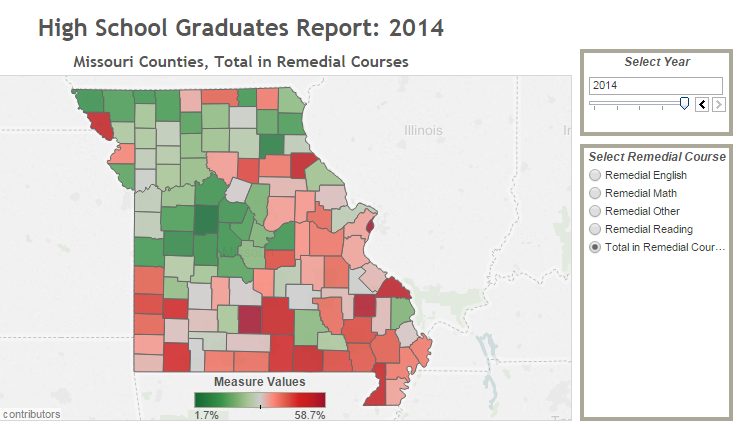
Scores on the ACT should be paired with other data to determine how well schools, districts, and states are preparing students for college. Let’s take a look at another measure—remediation rates. The map below shows the percentage of students by county who enrolled in remedial coursework in college (coursework they already should have completed in high school) in 2014. Red indicates higher percentages and green indicates lower percentages of enrollment in remedial courses. In the lower half of the state, there is a whole lot of red—63.3 percent of graduates from Ash Grove High School in Ash Grove, Missouri, for example, enrolled in remedial coursework in 2014.

Getting students to college is important, but it’s only half the battle. Missouri should not lose sight of the goal of true college readiness. It is great to see that as more students are taking the test, scores are going up. But with remediation rates like those in Missouri, it’s clear that much work remains to be done.


A Greater Gravois May Be a Local Gravois

In recent years, the Missouri Department of Transportation (MoDOT) has faced growing criticism about the maintenance of Gravois Road (Missouri Route 30) in St. Louis City. Complaints range from traffic speeds to road quality to bicycle facilities. A citizen group called Greater Gravois Initiative would like to transform the highway altogether, adding traffic circles, bike lanes, and better transit, in a bid to create more urban development in the area. However, given MoDOT’s differing priorities and limited means, if the city truly wants to transform the area it might consider taking back control of Gravois.

Until 2004, Saint Louis City, and not MoDOT, controlled Gravois Road. The city declined to turn Gravois and other arterial roads over to the state in the 1950s, but by the early 2000s city leaders argued it was unfair that Saint Louis City was the only county that did not receive state support for non-interstate highways. Turning Gravois (along with five other highways) over to the state was billed as a matter of fairness and cost savings for the city.

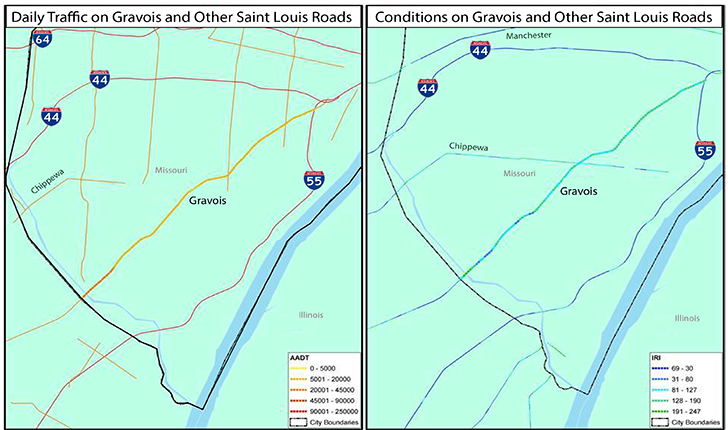
But MoDOT doesn’t have significant resources to spend on Gravois. And what money it does have is usually restricted, by law, to highway improvements (meaning that bike lanes, public transit upgrades, and other street beautification are excluded). Furthermore, MoDOT has to consider congestion and roadway quality, not just the aesthetic appeal of areas along Gravois. After all, it is the state transportation department, not an urban development office. And as things stand, Gravois Road is one of the busiest non-interstate roads in Saint Louis, with poor pavement conditions along much of the roadway, as shown in the maps below. (AADT refers to average annual daily traffic in the map on the left; in the map on the right, IRI refers to the International Roughness Index, a measure of road quality.)

Instead of criticizing MoDOT for failing to spend money it does not have on slowing down a state highway, Saint Louis City should consider taking Gravois back from state control. That would give residents the freedom to transform the road as they see fit, if the city or citizens along Gravois are willing to pay for such improvements. It would also reduce MoDOT’s responsibilities, a useful precedent for a department in control of many highways (which it can’t afford to maintain) that would be local or county roads in other states


Support Us

The work of the Show-Me Institute would not be possible without the generous support of people who are inspired by the vision of liberty and free enterprise. We hope you will join our efforts and become a Show-Me Institute sponsor.

Donate
Man on Horse Charging