Taxpayers Shouldn’t Have to Subsidize Parking in Upscale Central West End Redevelopment

Last week the Tax Increment Financing (TIF) Commission voted to approve Koman Group’s $4.5 million TIF proposal for 32 N. Euclid in the heart of the Central West End. The application will now go before the Board of Alderman for additional approval. David Stokes, director of development at the Show-Me Institute, spoke in April of 2014 to the Missouri House of Representatives on some of the problems with using TIF as a redevelopment strategy. Policy analyst Joseph Miller recently wrote about how the current building, which houses a successful neighborhood bar and dry cleaner, is by no means a “blight” to the community.

Why is it necessary to use TIF in a prosperous city neighborhood to finance two floors of underground parking in a walkable, urban neighborhood? 32 North Euclid is located in a thriving city neighborhood within close proximity to a 160-unit public garage, metered parking, and the Central West End Metrolink station. The program plan presented to the TIF Commission is a six-floor, mixed-use building with ground floor retail, second floor office space, and four upper floors of luxury apartments. The building will ultimately contain between 52 and 68 market-rate units with a very high price point. Koman is estimating it will construct between 70 and 80 subterranean parking spaces at a cost of $45,000 to $60,000 per space. Given these cost estimates, over 70%—and up to 100%—of taxpayer money funding the project will go to pay for parking.

While I understand the financial reason for wanting ground floor retail along Euclid and the aesthetic reason for wanting to hide parking, these simply don’t justify diverting millions of dollars of future tax revenues to finance parking for a luxury development in a neighborhood with a Walkscore in the low 80s. Classifying the current building as a blight to the community is dubious at best. This TIF proposal demonstrates how a subsidy intended to spark redevelopment on sites where development would not occur “but-for” the subsidy is being abused to finance luxury residential developments in wealthy, high-growth neighborhoods at the taxpayer’s expense. 

Is MoDOT’s “325 System” Dead or Alive?

In July, we wrote about how higher-than-expected revenues for the Missouri Department of Transportation (MoDOT) meant the state would be able to match federal dollars for next year. As we have pointed out many times before, the inability to match federal dollars is the main threat to MoDOT’s financial ability to maintain the state highway system. Before that improvement, the state had threatened to implement the “325 System,” which would have allowed most of Missouri’s highways, including some heavily trafficked ones, to fall into a state of disrepair. So Missourians are left asking whether the “funding crisis” is still a crisis and whether the 325 System is dead or alive.

And there seems to be some confusion coming out of MoDOT and the State Highway Commission on this very point. In September, Steve Miller, chairman of the Missouri Highways and Transportation Commission, told the Post-Dispatch that “The state is no longer using the ‘Missouri’s 325 System,’ ” but that the system’s priorities remain the same. He has also stated publically that without increased funding, Missouri’s highways still faced a funding crisis. What’s more, MoDOT still has not altered or taken down the “Tough Choices Ahead,” section of its website, which outlines the 325 System.

However, other MoDOT statements point to a more permanent postponement of the “325 System.” At a meeting held by the Show-Me Institute, MoDOT’s interim director stated that the department no longer talks of the “325 System,” and that the state is no longer in danger of losing federal dollars. Aside from the welcome boost in state income, MoDOT has also worked with the federal government to expand federal funding for preventative maintenance and operations on highways. With MoDOT now able to claim a federal match for “striping, sign maintenance, pavement repair where full width patching or overlays are placed, pavement surface treatments or surface seals, bridge maintenance, and drainage maintenance,” the state has more money to spend on highway projects and will be able to maintain state highways in the near term.

The bottom line is that MoDOT now possibly has the funds necessary to maintain the entire state highway system, without an increase in revenue. While the “325 System” still exists on paper, its implementation is increasingly unlikely. If that’s the case, MoDOT officials should come out and say that, rather than continue to talk of imminent budgetary disaster.

Of course, a reprieve from a funding crisis does not mean all of MoDOT’s problems are solved; there are necessary major highway projects MoDOT does not have the money to take on. But if MoDOT and Missouri have the breathing space necessary to discuss sustainable funding reforms for MoDOT without cries that the sky is falling, that’s for the better.

Taxicab Commission Inappropriately Refused Sunshine Request

As readers of this blog may remember, a couple of months ago we made an official sunshine request to the Saint Louis Metropolitan Taxicab Commission (MTC). What we were looking for was a copy of proposed regulatory alterations from the MTC’s July meeting. The MTC’s custodian of record, the MTC’s Chairman, and even the MTC’s lawyer refused our request. They argued that they proposed changes, despite the fact that they were very nearly voted upon, were not public records.

We found the idea that a government body could withhold documents by simply not giving them to a custodian of records troubling at best, and so we filed a complaint with the Missouri Attorney General’s office. They got back to us last week, and thankfully found the MTC to be in the wrong. As the office put it:

“Generally information retained by the commissioners and presented at a public meeting would be considered a public record. If the information had not been previously provided to the custodian of record, we are not aware of any impediment which would have prohibited the custodian from asking the commissioners to provide them with a copy of the information presented during the meeting…”

The Attorney General’s office sent the MTC a letter explaining these facts, along with eight booklets on the sunshine law. While the response of the Attorney General’s office is to be commended, the MTC was able to effectively withhold documents from the public for months. For this circumvention of the sunshine law, the body has received only a slight remonstrance. We can only hope that the Attorney General’s office, among other state policy makers, will pay closer attention and give closer scrutiny to the MTC’s actions in future.

Note: We did not receive the document, but are no longer seeking it because the draft ordinance has been superseded. 

Read the full letter from the Attorney General by clicking on the link below.

AG_Oct14_2015.pdf

The Battle of Common Core Is Over. The Battle of Parental Control Is About to Begin

Attention opponents of Common Core in Missouri: We won. You petitioned the state legislature and were successful in gaining the passage of HB 1490, a bill that established work groups to write new learning standards. Committees of Missouri parents, educators, and professors were  appointed by legislators and state education organizations, convened, and have completed their task. Those new standards have been submitted to the Department of Elementary and Secondary Education for a hearing on Monday, October 26, and will be vetted by Missourians. You also were successful in getting the legislature to defund standardized tests aligned with Common Core. You engaged the political machinery through the democratic process and have successfully won the battle against Common Core. This was no small feat.

Unfortunately, it seems that many Common Core critics have failed to see just how successful they’ve been. Instead of celebrating the new standards, developed by Missourians, they’ve lambasted them because of their similarity to Common Core. Rather than cheer the change of standardized tests, they continue to criticize the old. Opposition to the Common Core has led to opposition to anything that the state might have its hands in, even charter schools and school vouchers.

Some have been wrapped up in anti–Common Core sentiment for so long that it is difficult to see the forest for the trees. It is time to stop fighting against Common Core and start fighting for the principle that led you into battle in the first place—parental control.

Did you oppose Common Core because the standards were not rigorous enough or were not developmentally appropriate? What you’re saying is that you believe children are unique and deserve an education tailored to their needs.

Did you oppose Common Core because it eroded local control? Then start fighting for true local control: school choice. School choice is the only way to put the power of education back into the hands of parents.

You have been incredibly successful in opposing something. Great. But it takes a lot more effort to promote a new idea than it does to stop a bad one. The battle of Common Core is over. I hope the battle for parental control is about to begin. If we are successful in liberating Missouri’s children to pursue the education of their choosing, posterity will look back on this and say, “This was Missouri education’s finest hour.” 

It Must Be Nice to Own a House in Edmundson

The fact that Edmundson (a small town in North Saint Louis County) doesn’t levy a property tax on residential property might be compensation to its residents for dealing with screaming jet engines every day. However, businesses facing higher property taxes would probably want city homeowners to chip in, jets or no.

You see, ever since Senate Bill 5 became law, the city has had to find new ways to fund city government other than fining motorists. Thus the city zeroed in on raising property taxes.

Raising property taxes is sometimes a necessary evil, but when a city decides to raise property taxes on only one kind of property, it just seems, if not exactly evil, definitely unfair, and what’s especially galling is that (1) commercial properties in Edmundson—and the rest of Missouri for that matter—are already assessed at a higher rate (32 percent) than residential property (19 percent); and (2) commercial properties already pay a much higher property tax rate than residential properties (who pay zero property taxes) in Edmundson.

This commercial property tax hike goes up for a vote on November 3, and I won’t be surprised if city residents vote for a tax that someone else has to pay. But that doesn’t make this proposal good policy. Businesses in Edmundson could be facing tens of thousands of dollars in additional property taxes. Some businesses might even leave if this property tax increase is enacted. Property tax rates should be uniform (or very close to it) and low for everybody. If cities don’t have the self-discipline to have uniform rates, then the state should step in and make it so.

It’s readily apparent that the passage of Senate Bill 5 has caused some municipalities to scramble for new ways to raise revenue. A general property tax increase may or may not be the right way to go. However, singling out a specific type of property for a tax increase is bad policy.

Convention Hotel Field of Dreams

Proponents of a new downtown convention hotel are asking taxpayers to throw all of modern economic theory out the window—as well as the recent history of convention business in Kansas City and around the country—in favor of a "build it and they will come" Hollywood fantasy.

The two most important arguments in the debate over whether Kansas City taxpayers should subsidize a private convention hotel are made by the proponents:

  • First, they argue that it does not make business sense to build a hotel of this size in downtown Kansas City right now. Consequently, they need taxpayers to invest first, and they need taxpayers to invest to the point that it does make sense. (This is the argument with every TIF project, by the way.) The difference here is scale: the project requires the public to subsidize half the cost.
  • Second, they claim that demand will increase simply by increasing hotel room supply. The proponents are not doing anything else, such as increasing the visitor and tourism budget so that they can dedicate more resources to attracting conventions. They're just building a hotel. That's all.

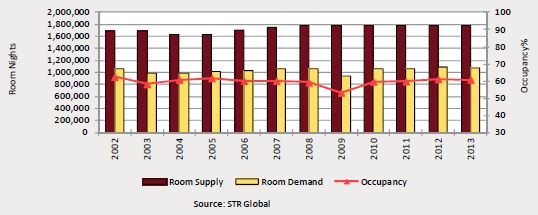
But Kansas City doesn't need more hotel rooms; we're already oversupplied. According to the same consultants hired by the developers for this project, the occupancy rates (the number of rooms sold divided by the number of rooms available) at existing downtown hotels is a paltry 50% to 55%. That means we're only selling half the rooms we have. According to the chart above, taken from an HVS report from 2015, hotel room supply has outpaced hotel room demand in all of Kansas City for years. 

Exactly how increasing room supply (represented by the red bars on the chart) by building a new hotel will increase demand (the yellow bars) or the occupancy rate (the red line), is unclear. But taxpayers are being asked to invest $165,000,000 on that very proposition.

Why Taming the Higher-ed Leviathan is Hard Going

College affordability may prove to be one of, if not the, defining education issue of the 2016 election cycle. More and more jobs require a college degree, more and more students are going to college, and the cost is creeping higher and higher.

There have been a slew of common-sense, market-oriented reforms that have been floated to help rein in the cost of college. No, not just making it “free.” Rather, opening up the college market to more experimentation, innovation, and competition to help hold prices in check.

In general, these reforms have gone nowhere. Why? Well, a new data visualization by Washington D.C.’s New America Foundation puts some great numbers to what  my old friend Andrew Kelly of the American Enterprise Institute has been arguing for years; college and universities are enmeshed in the economies and political ecosystems of the state and nation. That gives them an incredible amount of power to block or water down efforts to spur competition and reform.

New America breaks down the number of institutions, the number of employees, the amount of money institutions receive in Pell grants (federal scholarships for low-income students) and the total amount of money institutions spend by congressional district.

Here’s what Missouri looks like:

Congressional District

Number of Higher Ed Institutions

Number of Higher Ed Employees

Pell Grants

Total Spending

MO-1

28

22,555

$137 Million

$3.47 billion

MO-2

28

3,782

$66.1 million

$527.2 million

MO-3

18

2,741

$34.9 million

$285.6 million

MO-4

26

17,914

$153.5 million

$3.15 billion

MO-5

38

6,954

$71.1 million

$465.8 million

MO-6

24

5,293

$49 million

$597.2 million

MO-7

32

6,861

$118.1 million

$698.6 million

MO-8

19

3,833

$54.9 million

$285.5 million

TOTALS

213

69,933

$684.6 million

$9.48 Billion


Seventy thousand employees, nearly $10 billion in spending, and $685 million straight from the federal government . . . who wants to upset that apple cart? Somebody needs to, because the current trends are unsustainable.

School District Boundaries Are an Issue Here, Too

A public school rezoning issue is unfolding in New York City.

P.S. 199 is a National Blue Ribbon Award-winner with high state test scores, strong parent involvement, a high percentage of white students, and a low percentage of students qualifying as poor. P.S. 191 is made up of mostly poor, Hispanic, and black students from the public housing unit across the street. Because of overcrowding issues, P.S. 191, which sits within nine blocks of P.S. 199, may enroll wealthier students if the districts are rezoned.

Parental response has been mixed. Some want to erase the boundaries between the two schools altogether, allowing for a greater mix of students at each. Others say they’ll move to another school district or send their kids to private school if their children are sent to P.S. 199.

The story of P.S. 199 and 191 may sound familiar to residents of Saint Louis County and City. Here students may live within walking distance of one school but attend another, because of where boundaries are drawn.

For years, numerous groups have advocated for a unified district in the Saint Louis area, but as SMI’s James Shuls has pointed out, this solution is too pie-in-the-sky to make a difference for students who need better education options today. As an alternative, the St. Louis Post Dispatch Editorial Board proposed an open enrollment policy last November. “Districts would agree to a set tuition amount that would follow any student who wanted to cross boundaries. Transportation would be provided for those below poverty level,” they wrote.

Open enrollment policies have become more common over the past several decades. In 1988, Minnesota passed the first mandatory open enrollment law. By 2013, 21 states had allowed students to transfer from their home district to another school district. Some of these states, like Missouri, only allow students to transfer if their current district is failing.

But there are many reasons why a student would want to transfer to another school district aside from poor student achievement. A student might just live closer to a school within another district (this example also applies to students who live in rural parts of Missouri).

Another way to create more options for students would be to allow charter schools to operate anywhere in the region, and allow students to transfer across district lines to attend them. For example, if a charter school opened in the Bayless school district in Saint Louis County, students in the Affton, Hancock, and Lindbergh districts could apply to attend.

In the upcoming legislative session, I hope lawmakers consider the alternative to unifying school districts—expanding the state’s open enrollment policy to include not just students in failing schools, but all students in the Saint Louis area and across the state. 

Support Us

The work of the Show-Me Institute would not be possible without the generous support of people who are inspired by the vision of liberty and free enterprise. We hope you will join our efforts and become a Show-Me Institute sponsor.

Donate
Man on Horse Charging