Why We Joined Rebecca Friedrichs’ Fight

Historically, the Show-Me Institute has rarely joined lawsuits or amicus briefs in Supreme Court cases. But this week, along with several other state public-policy research and educational organizations, the Institute filed an amicus brief in support of the plaintiffs in Friedrichs v. California Teachers Association. When you hear the story of Rebecca Friedrichs, you will know why.

Ms. Friedrichs is a 27-year veteran teacher who currently works in Buena Park, California. According to an interview with the Daily Caller News Foundation, she first encountered the teachers union when she tried to get her school to deal with a colleague who had been abusive to students. As she said, “They couldn’t get rid of her because of teacher tenure. . . . There was absolutely nothing, from my perspective and what I was told, that I could do.”

Friedrichs tried to work with her union, volunteering within it and working to convince her colleagues to be more amenable to some education reforms (like school vouchers) that might give more opportunities to her students. And what, according to Friedrichs, was the union’s response? “They punished me for standing up. . . . For that whole year, for that whole fight, I was treated like dirt.”

Teachers are too important to be treated like that.

Ultimately, what is at issue in this case is very simple: the right of free association, a right protected by the First Amendment. Ms. Friedrichs and thousands of public servants like her do not want to be forced to support a union that does not represent their interests or values.

As James Sherk of the Heritage Foundation points out, for much of the history of the American labor movement, private unions supported that right for public employees. In 1959, the AFL-CIO’s Executive Council wrote “In terms of accepted collective bargaining procedures, government workers have no right beyond the authority to petition Congress—a right available to every citizen.” Why? “It is impossible to bargain collectively with the government.” That was George Meany, President of the AFL-CIO, in 1955.

The issues associated with public unionism are clear. Institute researchers and scholars have written about the dangers of allowing government unions to elect their bosses and thus sit on both sides of the table during negotiations over salaries and benefits, pensions, hiring and firing procedures, and a variety of other policies (like school vouchers) that might only tangentially affect their membership. You can find a small sample of our work here, here, and here.

A victory in the Friedrichs case would strike a blow for individual freedom; it would recognize the millions of teachers and other government workers across the country not simply as interchangeable widgets who all think the same way, but as individuals with independent ideas and preferences.

This kind of fight is worth fighting. We’re happy to join it.


(Click on the link below if you would like to read the full text of the amicus brief.)
 

The Minimum Wage: How it Harms the Workers it’s Meant to Help

Dr. Michael Podgursky opened his presentation by reviewing the recently released Show-Me Institute video about the impact of the minimum wage in Saint Louis's Dutchtown neighborhood. He then spoke on the side-effects of the recent minimum wage increase in Saint Louis City and the impact it has on the workers it is intended to help. His slides are available below.

The House Isn’t On Fire, but It Is at Greater Risk

Several years ago, my wife and I were in the market to buy a house. As is customary, we had an inspection completed on the house we wanted to purchase. Minor things were noted here and there on the report, but one thing in particular caught our eye. Somehow the wires got crossed when the outlets were installed. The electrical outlets still functioned, and we were told it probably would not be a problem. However, the home inspector suggested we be cautious about plugging any large appliances in the outlets until we had an electrician fix the polarity.

The problem our home inspection revealed was below the surface. It wasn’t causing any noticeable problems today. Down the road, however, it could have caused a fire, resulting in irreparable harm.

Recently, Michael Rathbone and I performed an inspection of our own—not on a home, but on Missouri’s teacher pension systems. Similar to my home inspection, we found something troubling just below the surface. Missouri’s teacher pension systems have shifted to riskier assets. This shift has not caused any noticeable problems as of today; and like my reversed polarity, may not ever cause any harm. Of course, an increase in risky assets also increases the possibility that the house could burn down.

Imagine if upon receiving my home inspection, I had yelled at the inspector, “You just hate houses!” As ridiculous as that might seem, that is exactly the reaction Michael and I have received. In response to a recent op-ed in the Springfield News-Leader, in which we called for increased transparency so that the problem could be monitored, we were vilified. One pensioner even claimed that we dislike public education. The author of the response to our op-ed then went on to list several facts that were not germane to the point we made.

Somehow it seems our message has been lost. Therefore, I want to reiterate the point of our paper, “Betting on the Big Returns: How Missouri’s Teacher Pension Plans Have Shifted to Riskier Assets,” one more time. Missouri’s pension investments are becoming more risky. In other words, the house isn’t on fire, but it is becoming more flammable. It would be wise to monitor the investments more closely and plan for these increased risks. 

Parking Is a Privilege in Saint Louis City

                Parking at Lambert-Saint Louis International Airport (STL) can get expensive. Depending on the lot, the airport will charge anywhere from $7 to $23 dollars a day. The prospect of paying so much for airport parking is one reason why many of us will take a cab instead. But expensive parking isn’t a problem for the region’s taxicab regulators, nearly all of whom get free airport parking.

And taxicab commissioners aren’t the only ones. Last week, the Post-Dispatch reported that scores of current and former officials get free parking at Lambert, including former airport commissioners, elected officials, police brass, and industry representatives. According to Lambert Director Rhonda Hamm-Niebruegge, the free parking is a “courtesy.” However, the selective nature of this courtesy leaves open a number of questions. For instance, why honor the mayors of only three Saint Louis County cities? Why give a courtesy to one specific partner from an area law firm? Why do many taxicab commissioners receive free parking? Perhaps there are reasonable answers to these questions (among others), but left unexplained it looks just like another unjustified perk for political insiders.

To its credit, STL officials are planning on phasing out the free parking passes. But parking privilege is not just confined to Saint Louis’s airport. Last year, a city-commissioned parking study (performed to decide where new parking meters should go) found that the city allows any individual employed by the city or county, regardless of their position, to park for free at any metered spot. The city has no comprehensive list of authorized outstanding permits or rules determining which departments and which vehicles are eligible for permits. The study’s authors recommended limiting such permits to positions that require quick access to vehicles (like police officers or emergency response vehicles). Unfortunately, while the city is already well into the process of installing new meters to charge residents, the employee on-street parking policy has not been revised or even reviewed.

Most people understand that free parking is not a right. But it should not be a privilege either, handed out on an ad-hoc basis to entrenched civic insiders. 

By the way, the one member of the Taxicab Commission who does not enjoy free airport parking is Chris Sommers. He is also the only member of the Commission who vocally supports ridesharing in Saint Louis. Go figure. 

Saint Louis Property Taxes, Part 4: All Together Now

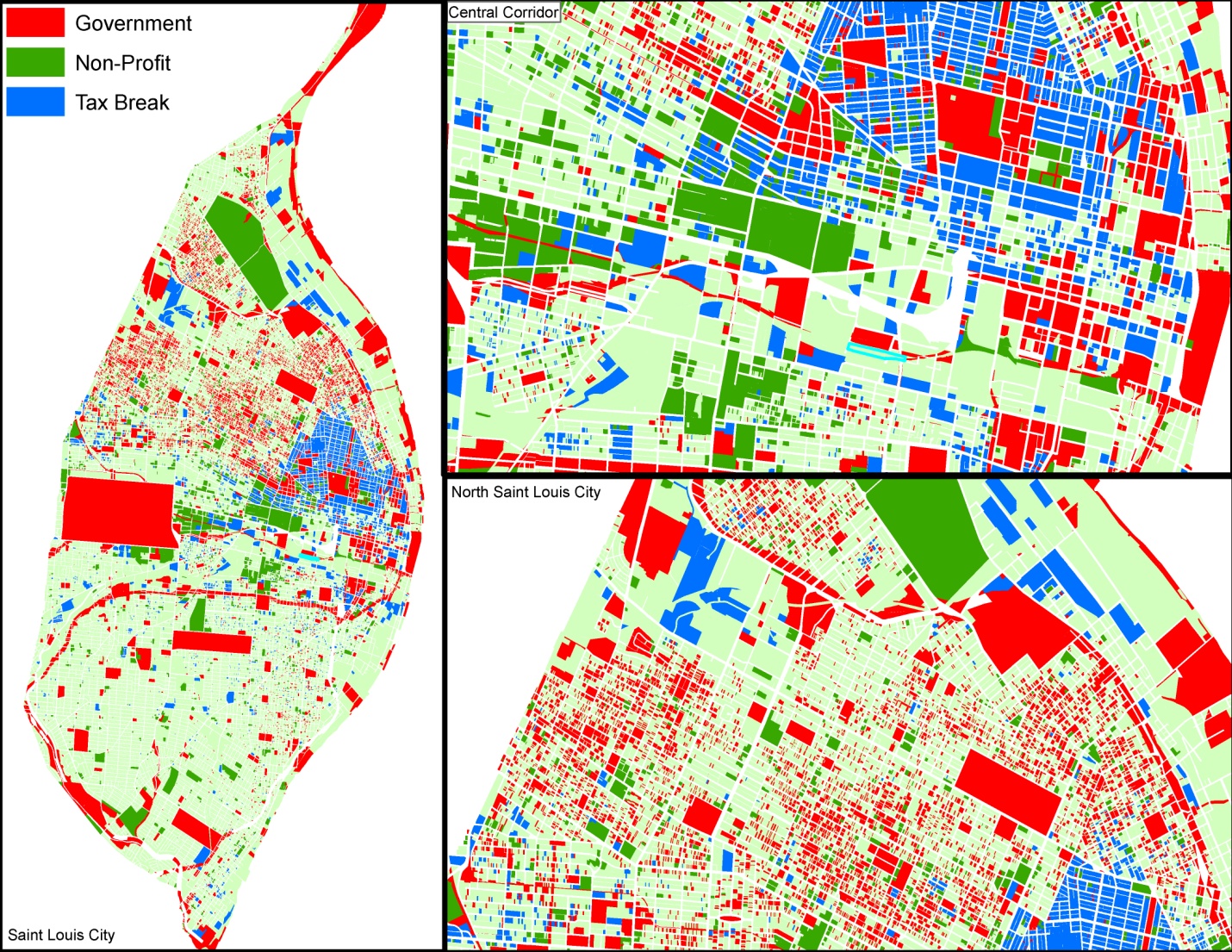
In the first three blog posts in this series (here, here, and here), we have seen how Saint Louis City’s property tax base is significantly curtailed because much of the city’s land is owned by governments and nonprofits, which pay little or no real property tax. Many other properties also receive special real property tax breaks, like TIF and Chapter 353 abatements, further reducing the number of parcels paying the city’s full property tax rate of $7.5850 per $100 assessed value (with a $1.64 commercial surcharge).

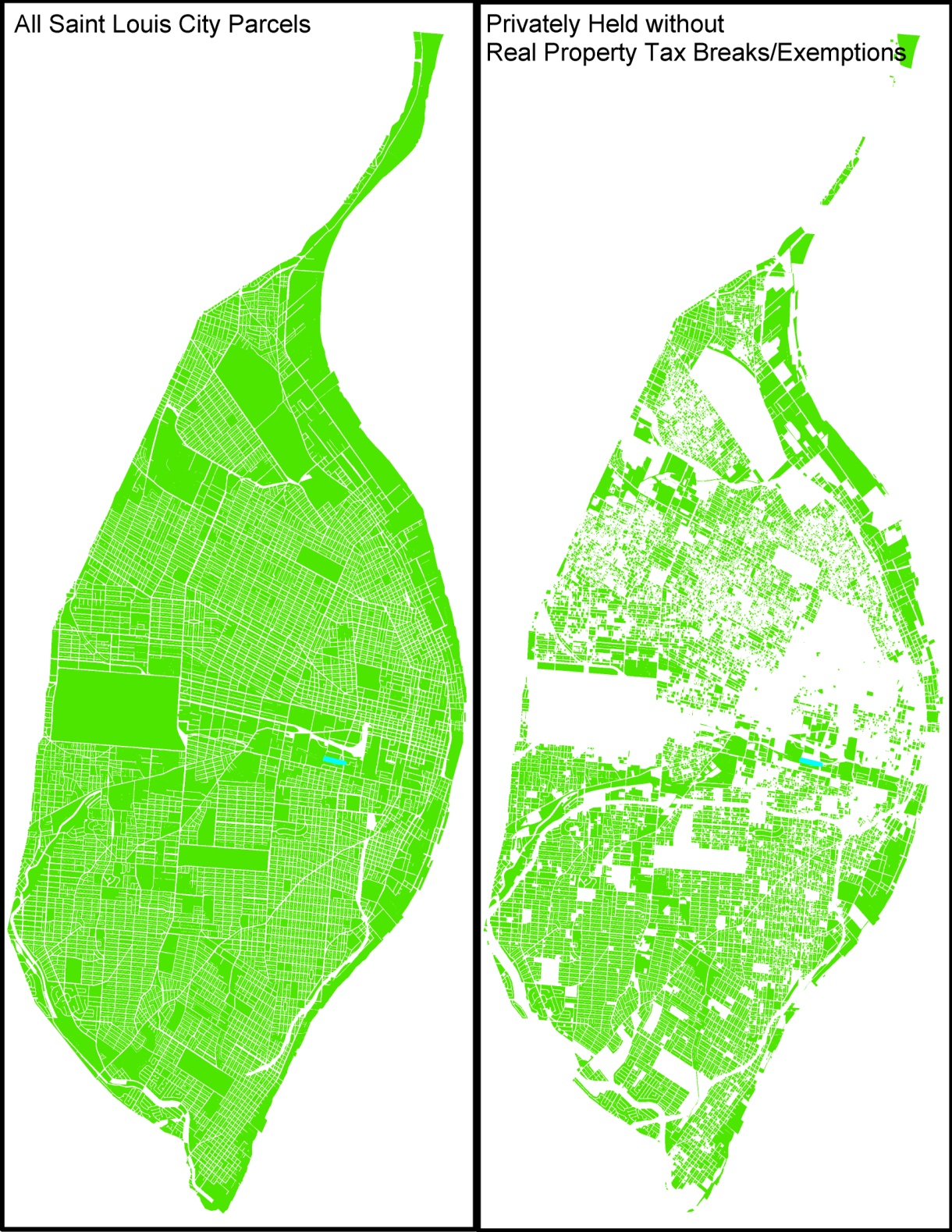
While the share of the city’s property that either gets tax subsidies, qualifies as a non-profit, or is owned by the government is large individually, looking at these issues together shows the scale of the problems confronting Saint Louis’s tax base. In fact, about half of the city’s property by area is either tax exempt or receives tax breaks. Property tax exceptions are basically the rule. The map below demonstrates this:

As we discussed in previous posts, these areas include some of Saint Louis’s most economically important and profitable institutions, such as BJC Healthcare, Washington University in Saint Louis, Busch Stadium, the Eighth Circuit Court, and IKEA. In total, around 40% of the city’s property by value either is tax exempt or receives special tax breaks.

Who is left paying the full property tax rate? For the most part, residential areas on the city’s South (and especially Southwest) side have fewer exempt properties and tax breaks. In terms of value, utilities, casinos, manufacturing and distribution companies, as well as a handful of large businesses downtown appear to pay full property tax rates. However, as the map below shows, when it comes to parcels paying full real property tax levels, the city is hollowed out:

The next post on this issue will discuss some the negative results of this reduced real property tax base, as well as strategies for improving the base. 

Washington University Faculty Oppose Public Dollars for Stadium; Planners Promise Brew Pub

As we have mentioned many times before, economists are virtually unanimous in their agreement that publicly funded sports stadiums are bad investments for cities. They do not generate additional economic growth, promote urban revitalization, or result in increased tax collections. This broad consensus is being reiterated by the faculty of Washington University in Saint Louis.

Last week, Student Life, a WashU college paper, published a story about the Rams stadium. For the story, the author interviewed five WashU faculty from different disciplines. The faculty spoke nearly unanimously against using public money to fund the stadium. Here are some of the faculty’s comments, as reported in the article, the Longest Con:

“It’s really hard to see this as overall a good idea. It’s going to be very expensive…That’s not a very good way to spend government money.”—Glenn MacDonald, an economics professor in the Olin Business School

“We’ve known since the mid-’70s that sports teams don’t bring fast economic benefits, certainly nothing that offsets the kinds of credits they’re getting…Ten times a year, 12 times a year, you get a huge influx of people in, [but] that’s it.”—Sunita Parikh, an associate professor of political science

“What it does is it destroys the area so it vanquishes the blight that it identifies by just knocking everything down,” and “decimates the existing urban character.”—Michael Allen, a University College coordinator and American culture studies lecturer

“I think it’s pretty clear to anyone that spends any time here…that this town’s civic sporting identity is Cardinals first, second, third, fourth, fifth, down through 10, then Blues probably and then Rams. So they’re already the low man on the totem pole… I think it’s kind of silly that some people in cities feel like they need to measure their city by how many teams from the Big 4 leagues they have”—Noah Cohan, a recent Ph.D. and adjunct instructor in English who studies the relation of sports fandom to identity and politics,

The only WashU faculty member interviewed who supported the stadium plan, Rich Ryffel (senior lecturer of finance in the business school who helped finance the Edward Jones Dome), admitted a stadium was “not a good public investment. In other words, if the public puts in a dollar, they’re not going to get a dollar out of it.”

In other news, stadium proponents are touting the final initial design (which I guess is kind of like jumbo shrimp?) of a planned stadium. It will even have a new brew pub. Will policymakers heed the advice of experts or opt for beer and circuses? 

Support Us

The work of the Show-Me Institute would not be possible without the generous support of people who are inspired by the vision of liberty and free enterprise. We hope you will join our efforts and become a Show-Me Institute sponsor.

Donate
Man on Horse Charging