Straight Talk about the Loop Trolley

The Loop Trolley is officially over budget. There was speculation earlier this year that the project could not be completed with its original $43 million budget, but for months officials rejected the idea. But as the Post-Dispatch recently reported, costs have now risen to $51 million, an 18% increase over the initial budget.

So who pays for the overrun? As we’ve written before, the Loop Trolley’s financing plan left virtually no room for error. Any cost overrun, be it $1 million or $100 million, would have sent the trolley planners out with a begging bowl. In this case, the trolley project needs an additional $8.4 million. To get that sum, Saint Louis County will have to spend $3 million of its dedicated transit funds to match $5.4 million in federal dollars, all of which could have been spent on other regional transit improvements had the Trolley kept to budget.

The rising expense of the trolley has prompted a reevaluation of its merits, both in terms of transportation and urban revitalization. Let’s be clear: if viewed as a transportation device, the Loop Trolley has no merits. As we wrote last year:

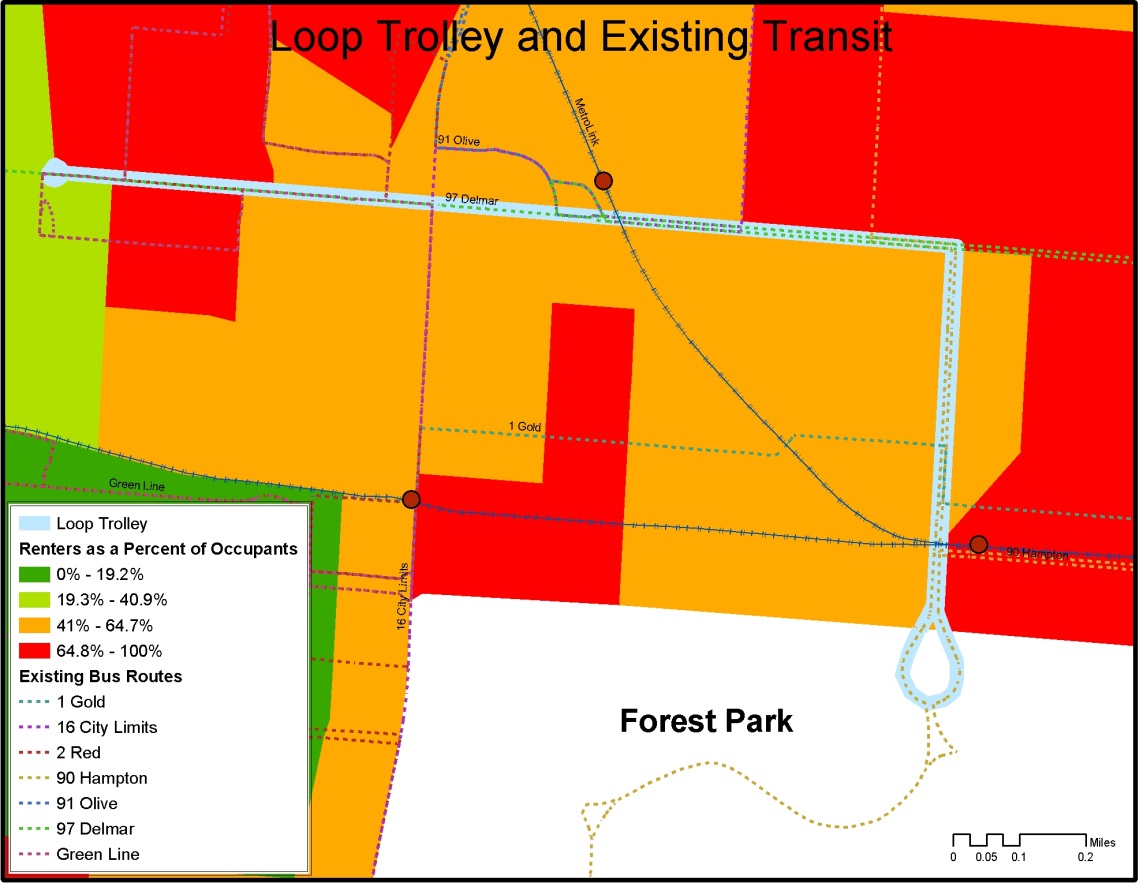
“…the Loop Trolley’s path is intersected by seven MetroBus routes and passes within a few meters of two MetroLink stations. The trolley, if it is built, will be redundant for nearly all conceivable transit trips.” [see the map above]

The project’s slow (10–15 mph average), antique trolley cars are easily outclassed in terms of speed and range both by buses and light rail. And at $23 million a mile, it is certainly not (contra Mr. Edward’s claims) the way of the future for Saint Louis transit. At that cost, recreating the streetcar system of 1902 (with roughly 1/3 the reach of the current bus system) would cost about $13 billion. Streetcars’ only future will be in boutique sections of cities with more money than sense.

The stronger case for the Loop Trolley, and streetcars in general, is that they may spur development. Whether or not streetcars actually create new development is a matter of debate, and the evidence used by proponents is usually weak. However, it is possible that the quaint look of the trolley will draw people to the Loop, and more businesses to area around the tracks. The effect could be similar to having attractive park running down the middle of a street. $51 million is an extremely expensive park, but then the federal government isn’t handing out more than $30 million in transportation grants for local parks.

However, as the Post-Dispatch reported, the construction of the trolley is having a damaging effect on local businesses as potential visitors avoid the chaos. But problems may not end with construction. The slow-moving trollies will operate in mixed traffic in much of the Loop, and aside from creating more congestion, car-on-trolley collisions are just a matter of time. It may be that interest in the trolley will overcome the hassle it creates, but as micro streetcar lines running through kitschy entertainment districts become more common, the Loop Trolley may lose its cache. And that’s something to worry about, because the permanence of a streetcar line can be a double-edged sword.
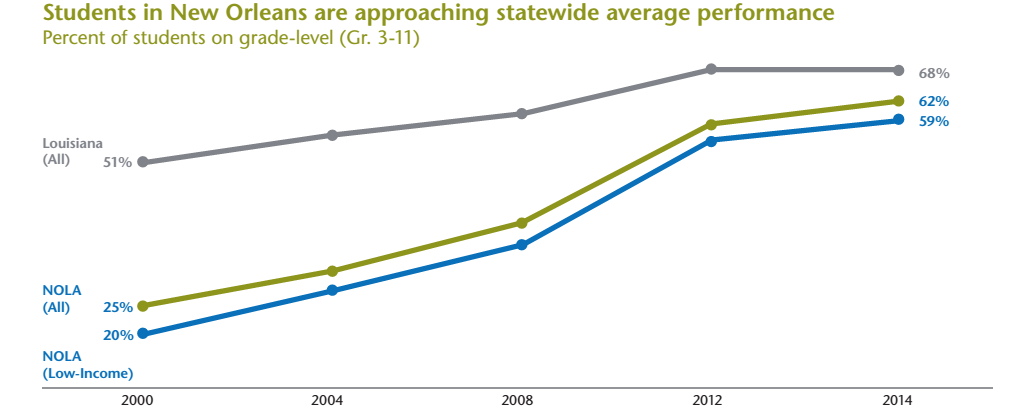

 

Learning from New Orleans

Yesterday I highlighted a recent report that showed just how big a part of Kansas City’s education system charter schools have become. The #1 district in that report, with 93 percent of students enrolled in charter schools, is New Orleans, Louisiana. Given that Kansas City’s charter enrollment only appears to be growing, it’s looking like our school system is going to more closely resemble that of New Orleans in the coming years.

That brings me to this report, authored by Neerav Kingsland, one of the central architects of New Orleans’ education system. In it, he describes how the system works and looks at preliminary results. I recommend reading the whole thing, but my quick reactions are as follows:

  1. The academic results are really encouraging. The graph above (from page 3) shows the progress that New Orleans has made, nearly closing the gap between the city and the rest of the state. I can’t think of any big-city system anywhere that comes that close to the state’s average. Can you imagine if Kansas City or St. Louis achieved at the same level as the state as a whole? Clearly this system can drive improvement.
  2. That said, Kingsland is open about the fact that New Orleans is far from perfect. Just getting closer to the average of one of the lowest performing states in the union is not good enough. New Orleans still has a long way to go toward becoming a world-class system of schools, and to his credit, Kingsland is honest about that.
  3. On another note of caution: New Orleans has a lot of things going for it that might be hard to replicate. As Kingsland points out, a constellation of nonprofits, advocacy groups, educators, civic leaders, and others have come together to help make this system work. There was also a huge infusion of social capital post-Katrina; individuals moved there specifically to help rebuild and improve the city. We have not seen similar levels of comity and commitment in the Show-Me State.
  4. Missouri would have to make several key shifts to make our big city systems look like New Orleans’. The majority of schools in New Orleans are overseen by a statewide Recovery School District that functions very differently from your standard school district. It does not operate schools, or at least does not want to operate schools over the long term. It is designed to be a funder and a regulator, with independent charter organizations operating the schools themselves. There has been an unsuccessful effort to create such a district in Missouri, but it would be possible to try and pivot a shrinking school district like Kansas City into a regulator-funder like the RSD. If charter schooling spreads outside of Kansas City and St. Louis, given the number of small districts that it might disrupt, some kind of state-wide district model might be necessary.

All in all, New Orleans is a hopeful example. It was able to move a district that was one of the worst in the nation meaningfully forward. No one would say it is anywhere close to where it needs to be, but it appears to be on the right track, which is more than we can say for most districts (including those in our own back yard).

The Convention Hotel Deal May Cost Kansas City Conventions

On June 25, we described how the convention hotel deal agreed to by Kansas City officials made the city less attractive to conventions. In short, because the city moved us from open catering, where conventions can seek bids on feeding attendees, to a closed deal where they must use the Hyatt for food service, there was less opportunity for conventions to save money. Yesterday, at least three event planners who have worked in Kansas City wrote to members of the City Council saying that the deal might cause them to go elsewhere. We've reprinted their letters here.

First, from the Evangelical Free Church of America:

Greetings,

I have recently become aware that there are discussions about changing the Kansas City open catering policy at the convention center.  As an event planner, I want to express my concern over this potential change.

In 2014, I brought a week-long event to Kansas City for 5,500 students. This event utilized over 8,000 hotel rooms, over $740,000 in catering to the convention center and various other economic impacts. Having an option to select from a list of caterers was the tipping point for choosing KC. In fact, we had such a good experience, we have already signed to return to KC for the same event in 2018.

We would love to make KC our home for this event every 4 years. However, if the open catering policy changes, we will definitely have to revisit our plans. This is a unique feature that makes KC different in a sea of convention centers across the country.

I am asking that you please work to keep your open catering policy.

Should you have any questions or wish to speak with  me further, please contact me using the information listed below.

Blessings,

Laurie Seay

Event Director

EFCA

Second, from Educational Testing Service:

Dear Council Members,

ETS and The College Board have found Kansas City to be a wonderful location for our Advanced Placement Readings since 2008.  One of the things we like best is the open catering policy at the Convention Center.  The opportunity to competitively bid catering services has been not only financially favorable, it has allowed us to ensure that the quality of food and beverage and related services meets our standards.  In 2015, our catering spend was just short of $2.3M to a combination of three KC local caterers, so you can see that the impact of not being able to competitively bid out this work could be considerable.

ETS is very concerned about the potential for allowing the proposed new hotel to have exclusivity for catering in the Grand Ballroom and Convention Meeting Space.  We hope that you will consider the fact that such exclusivity is described in a non-binding portion of the signed Memorandum of Understanding, and we urge you to consider not moving forward with a binding agreement.

Thanks for your consideration.

Patric Close Mills

Educational Testing Service

And finally, from The Menonite Church USA:

City Council of Kansas City

I’m writing to you representing an organization that recently held it’s national convention at the Kansas City Convention Center. We had a great experience. The convention center staff (including Matt Cunningham and Walter Moore and Steve Lesher) were great to amazing with. The CVB staff (including Juanita Crowder and Esther Walker-Young and Kim Dooley) were phenomenal to work with. Our participants spoke very highly of everyone they came in contact with during our event (vendors, hotel staff, restaurant staff, security guards, etc.). All this is to say that Kansas City has a good thing going!

The main reason I am writing today is to voice concern about the potential change to the open catering policy at the convention center. As someone that has planned large conventions for over 18 years, I can tell you that very few convention centers have open catering policies. I can also tell you that having an open catering policy was one of the selling points of bringing our convention to Kansas City. Having the opportunity to look at multiple caterers and have them bid on our business helped us control our costs. We were able to provide our convention participants with good meals at decent prices. As a non-profit organization, it is hard to go into a convention center with one catering option and have any bargaining power. Your open catering policy allowed us to ensure that we got competitive pricing. I would encourage you to keep the open catering policy as is.

Please do not hesitate to contact me if you have any questions. I would be more than happy to share more of my views on this issue.

Have a great day.

Scott Hartman

Convention Planning Coordinator

Mennonite Church USA

These are legitimate concerns. Kansas City taxpayers have every reason to suspect the wisdom of the deal, and members of the City Council should proceed cautiously before investing public funds in a deal that risks so much.

City Delusional Over Stadium Economic Benefits

A couple months ago, I was sitting in a movie theater watching Jurassic World. When life predictably “found a way,” I wondered what the board meeting that approved spending money on that park looked like. How could they have been convinced, after the events of the first three movies, to build yet another park with killer dinosaurs? Higher fences? More security? A brew pub?

After attending a hearing at the Saint Louis Board of Alderman regarding a plan to spend $152 million on a new NFL stadium, I don’t have to speculate anymore. Decades of objective research has shown that stadiums, and especially NFL stadiums, do not generate economic growth, spur revitalization, or greatly increase tax revenue. Saint Louis has direct experience of this with the Edward Jones Dome, which demonstrably did not bring in new tax revenues or revitalize any neighboring areas. What’s more, there are plenty of warning signs and gaps in the latest funding plan that should give residents pause.

And yet . . .

Stadium proponents pretended that a solid body of research and the city’s own experience do not exist. They argued, again and again, that the stadium will create jobs, redevelop the North side, and increase the city’s tax revenue. It’s like the last 20 years and all those studies on stadium projects never happened.

What about concerns over maintenance at the stadium or construction costs overrun? Don’t worry, say proponents, someone else will have to pay. Dave Peacock, head of the stadium task force, even suggested that the state government might handle cost overruns. With some members of legislature threatening to withhold bond payments to the stadium project without a vote of the legislature, asking the legislature to approve more funding for cost overruns is optimistic to say the least.

The bottom line for city aldermen on the current stadium plan is this:

1.       The city would pay around $152 million to construct a new stadium, and likely more down the road in maintenance and operating costs.

2.       Tax revenue from the project is exceedingly unlikely to approach the costs the stadium, which means that the money would be better spent elsewhere.

3.       The new stadium and the presence of the NFL will probably have little effect on downtown development (unless you count bulldozing the North riverfront as redevelopment).

In other words, if we are basing this stadium plan on tangible economic merits, this should be an open-and-shut case. The fact that the plan is likely headed for approval is troubling. If city leaders can convince themselves that, despite all the evidence to contrary, this deal makes economic sense, what can’t they be convinced of? At this point, I don’t think I’d be surprised if the city approved a Jurassic Park and stuck it in the middle of downtown. I’d only be surprised if they decided not to subsidize it. 

We’re Number 5! We’re Number 5!

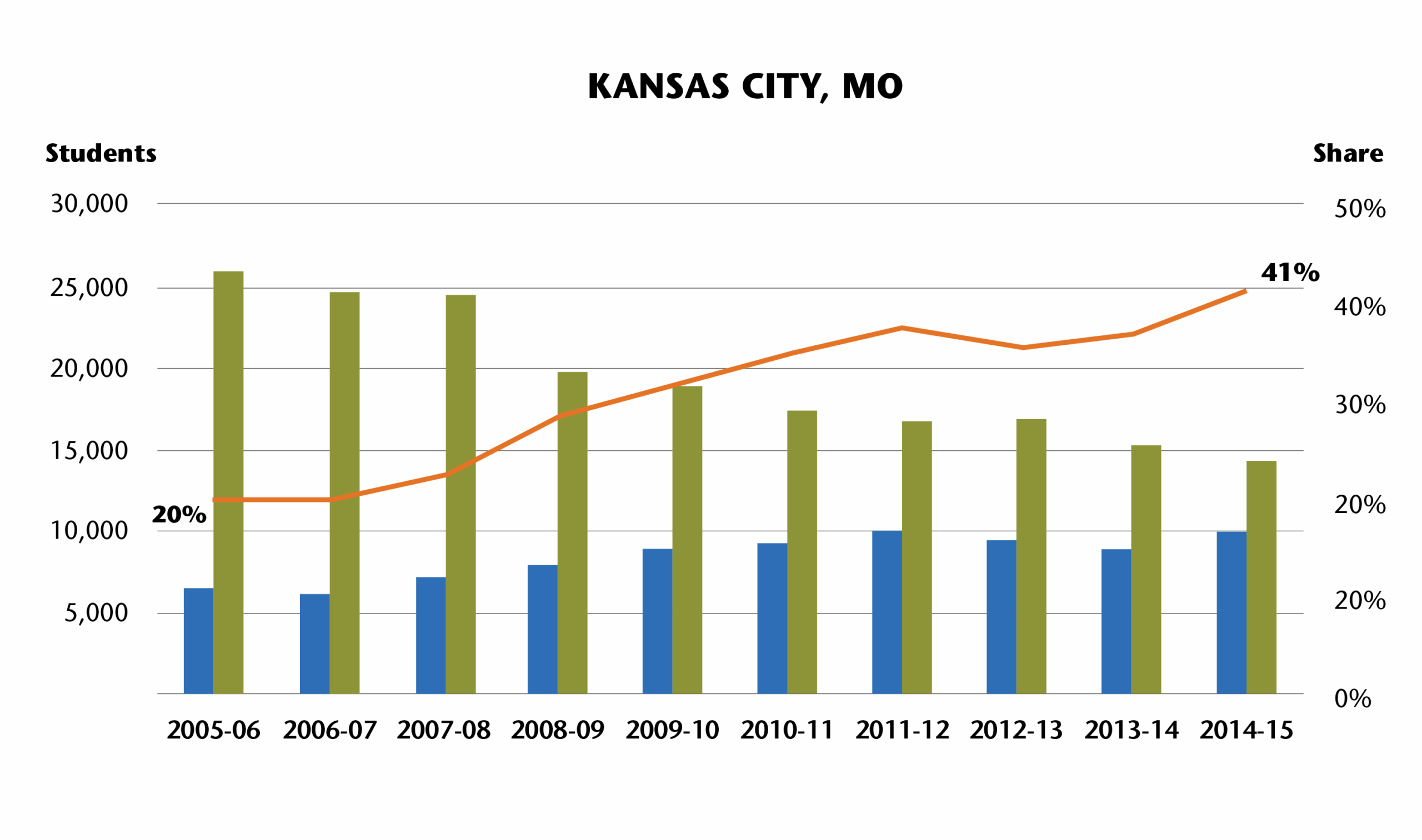
Today, the National Alliance for Public Charter Schools released a report on the market share of charter schools in cities and school districts across the country. When measured by percentage of public school enrollment, Kansas City is #5 in the nation, at 41 percent of all students.

Rank

School District

State

Charter Students

Non-charter Students

Total

Enrollment Share

1

Orleans Parish School District

LA

42,860

3,340

46,200

93%

2

Detroit City School District

MI

52,420

47,040

99,460

53%

3

School District of the City of Flint

MI

5,660

6,490

12,150

47%

4

District of Columbia Public Schools

DC

37,680

47,550

85,230

44%

5

Kansas City, Missouri School District

MO

9,980

14,230

24,210

41%

The trend line (see the graph above) is also significant.  Charter enrollment is going up, and traditional public enrollment is going down.

A few quick reactions:

1.       The narrative, at least coming from the Kansas City School District, is that the district is improving.  Graduation rates are up, and test scores show that the district might be on the path to full accreditation.  If that’s true, it would stand to reason that charter schooling is helping (or at the very least not hurting) the Kansas City public schools.

2.       It is important to remember that the city and the school district are not coterminous; in fact, 16 different school districts cover some part of Kansas City proper. Why charter schools are only allowed in one subsection of the city, especially when there is such clear demand for them, is beyond me.

3.       This report does highlight just how small the Kansas City School District has become.  I don’t think a lot of people realize this, but there are only 14,230 students enrolled in the Kansas City public schools.  When you think that Omaha’s main school district has 51,000 students, Des Moines’ has 33,000, and even Little Rock’s has 25,000, you realize just how much the district has shriveled up over the years.

Ultimately, Kansas City needs to have a conversation about what to do with the school district. If trends continue and more and more students attend charter schools, we have to think about transitioning the district from an institution that operates schools in addition to funding and regulating them to an institution that funds and regulates schools, but leaves operation up to others.

Will Building the Convention Hotel Create Jobs?


Proponents of a new $311 million hotel claim that the project will create construction jobs. At a recent hearing before the City Council, developer Mike Burke said [begins at 46:35], 

Let me talk a little bit about jobs. During the course of construction, which is about 27 months, there are about 1,300 jobs on the site.

Let's be clear about this: there won't be 1,300 jobs for 27 months. If someone were to ask Mr. Burke about this directly, he would probably walk it back immediately. Some jobs, such as heavy digging and foundation, may exist for a few months at the start. Those will transition to other, different jobs once the structure is being raised, and then finally there will be the finishing jobs once the hotel is ready for its final touches. 

Moreover, even the time spent building the hotel won't result in new jobs. The hotel will be just be a new project for those workers who already have jobs. This is why the economic impact statistics for projects such as hotels, stadiums, and airports are so suspect. Proponents want to pretend that without the project in question, people wouldnt be working or traveling or staying in hotels. As my colleague Joe Miller wrote last month regarding a proposed riverfront stadium in St. Louis:

In fact, a paper from an economist at the University of Missouri studied the impact of the Edwards Jones Dome and the Kiel Center (now the Scottrade Center) in Saint Louis specifically. The author found:

By econometrically modeling construction employment during the 1970’s, 1980’s and 1990’s, it was found that there was no more nor no less construction employment within the St. Louis MSA during the time the Kiel Center and the Trans World Dome [Edward Jones Dome] were being constructed…

This perhaps counterintuitive result happened because:

…instead of creating new construction jobs, jobs were shifted from projects that would otherwise have been undertaken, resulting in no net new job creation in the construction industry.

The author concluded:

These results, coupled with the more extensive analysis given in the article on construction employment, suggest that the net impact of stadium construction on construction employment and worker incomes is zero.

Convention hotels aren't stadiums, but that doesn't matter in this case. Jobs are just going to be shifted from other projects. There likely won't be a net gain to the workers of Kansas City.

MoDOT Gets a New Director

Recently, the Missouri Department of Transportation (MoDOT) named Patrick McKenna as its new director. The previous director, Dave Nichols, stepped down earlier this year, and Roberta Broeker had been acting as director on an interim basis.

Mr. Mckenna, currently deputy commissioner of the New Hampshire Department of Transportation, will take over MoDOT at a difficult time. While the department will not fall off a fiscal cliff next year (as was once feared), there is little doubt that MoDOT’s financial position is precarious. Worse yet, there are no funds available for large but necessary highway improvements like the rebuilding of I-70.

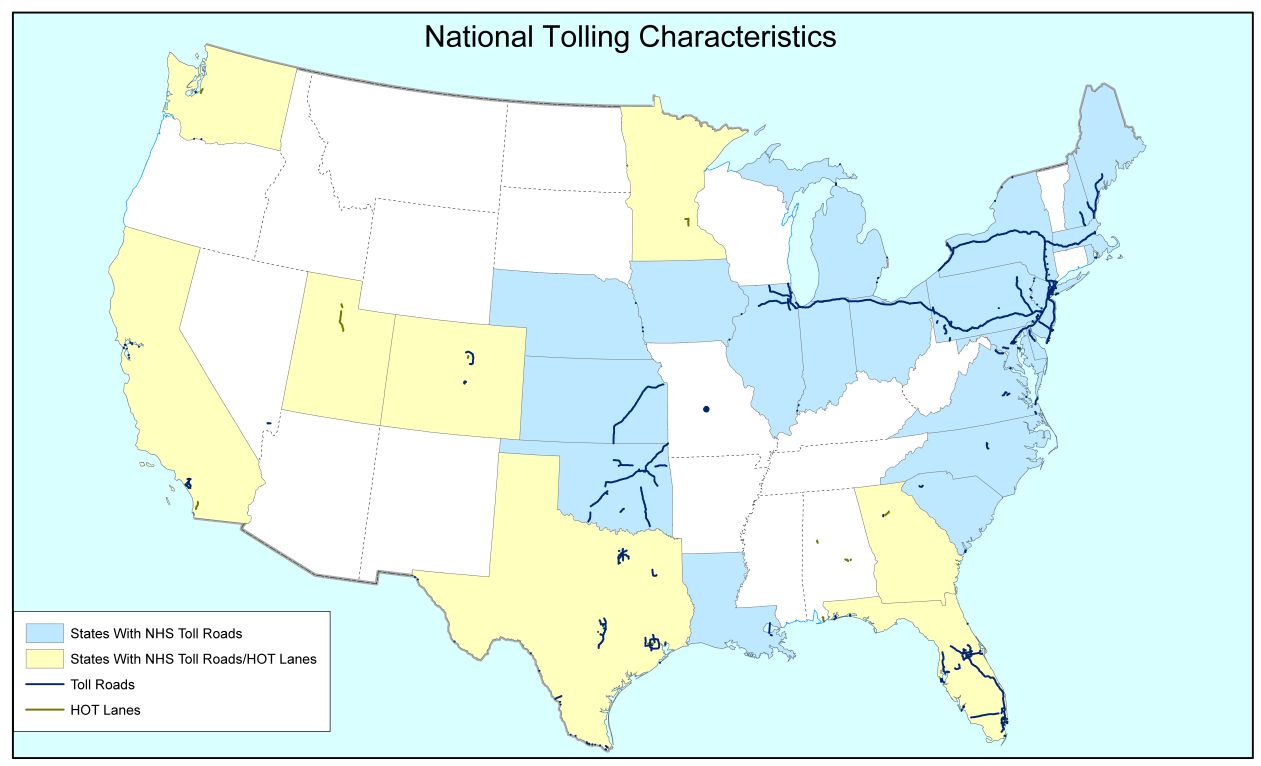
While the problems are challenging, there are solutions available to Missouri that will not require large general tax hikes. For instance, if Mr. McKenna were to drive from the New Hampshire Department of transportation in Concord to MoDOT’s headquarters in Jefferson City, the fastest route would take him through six states with open-road tolling:

Tolls are just one of MoDOT's options for financing I-70 reconstruction and other expensive infrastructure projects, and the success Missouri’s neighbors (and New Hampshire) have had with this method of funding should encourage Mr. Mckenna to consider it.

What Was FDR’s Stance on Government Unions?

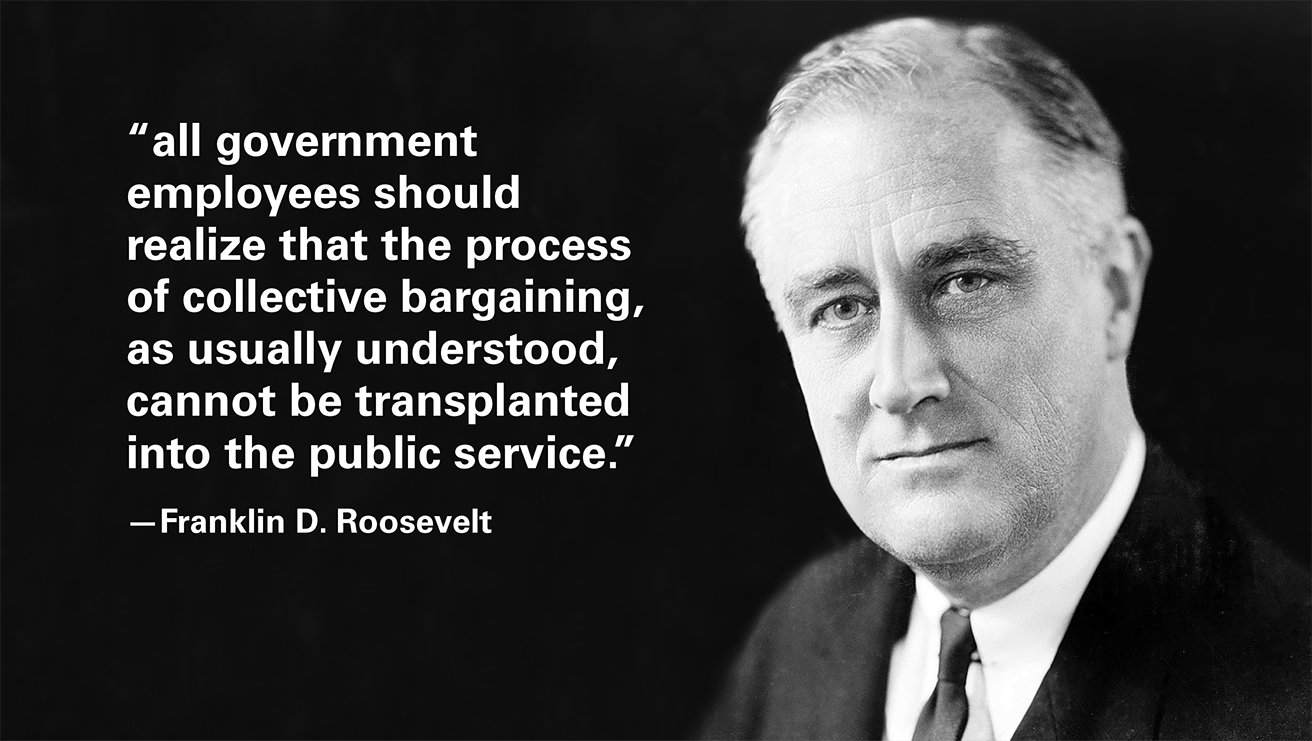
Franklin Delano Roosevelt, the president who brought us modern labor law, famously believed that collective bargaining does not belong in the public sector. This may seem strange to modern readers who know FDR as a supporter of organized labor. Let’s take a closer look at what FDR actually said.

In 1937, Roosevelt wrote to the President of the National Federation of Federal Employees, a government union, and gave his opinion that employee organizations have a “logical” role in government. Roosevelt believed that government employees should organize in order to ensure “fair and adequate pay, reasonable hours of work, safe and suitable working conditions . . . and impartial consideration and review of grievances.”

However, Roosevelt was careful to clarify that “meticulous attention should be paid to the special relationships and obligations of public servants to the public itself and to the Government.” In particular, he believed that collective bargaining agreements were incompatible with public sector work:

The very nature and purposes of Government make it impossible for administrative officials to represent fully or to bind the employer in mutual discussions with Government employee organizations. The employer is the whole people, who speak by means of laws enacted by their representatives in Congress. Accordingly, administrative officials and employees alike are governed and guided, and in many instances restricted, by laws which establish policies, procedures, or rules in personnel matters.

FDR’s issue with government collective bargaining is that in our system of government, “we the people” set public policy through the democratic process. Binding the people to a collective bargaining agreement takes authority away from the people.

FDR applies similar logic to the topic of strikes:

. . . a strike of public employees manifests nothing less than an intent on their part to prevent or obstruct the operations of Government until their demands are satisfied. Such action, looking toward the paralysis of Government by those who have sworn to support it, is unthinkable and intolerable. 

The issues FDR was concerned about affect us today. For example, the Monarch Fire Protection District is still bound by the terms of a collective bargaining agreement signed years ago, before voters put a new, pro-taxpayer board in charge of the district. And in University City, unrest with the firefighters union has caused a couple of incidents imperiling public safety. Now the University City firefighters union is using a collective bargaining agreement to try to limit the city manager’s discretion in contracting out for basic services and managing public safety.

Regardless of whether we should go as far as Roosevelt and prohibit collective bargaining in our government, it is important to craft labor relations laws in light of the important differences between the public and private sectors. Laws ensuring that government remains accountable, even when government workers are unionized, could be called Roosevelt laws in honor of FDR’s legacy.

Support Us

The work of the Show-Me Institute would not be possible without the generous support of people who are inspired by the vision of liberty and free enterprise. We hope you will join our efforts and become a Show-Me Institute sponsor.

Donate
Man on Horse Charging