Charter School Unionization: An Innovative Approach

Al Shanker, longtime leader of the American Federation of Teachers (AFT), was an early cheerleader for public charter schools. Though he believed basic union structures of traditional public schools should remain intact, Shanker saw charters an ideal setting for committed groups of teachers and parents to experiment with new ways of educating children.

Recently, teachers at Grand Center Arts Academy have taken steps toward becoming the first charter school in St. Louis to unionize. Unionization in charter schools is uncommon. According to one survey, only 7 percent of charter schools were unionized in 2012. Last month, about 80 percent of the Grand Center Arts Academy staff signed cards indicating their desire to join a local chapter of AFT.

On the one hand, a union can give teachers a voice. A union that’s accountable to its members allows teachers to participate in the formulation and implementation of school policies. A good union can serve as a counterbalance to an administration that makes decisions without paying attention to the concerns of the people working in the classrooms.

On the other hand, restrictive components of union contracts can interfere with administrative decision-making, offering benefits to employees to the detriment of students. In the Fort Zumwalt School District, for example, the union contract provides guidelines for laying off teachers—last in, first out: new teachers are fired first, even if they are better teachers.

Unlike in traditional schools, families always have the option of leaving a charter school if it doesn’t live up to their expectations. Teachers can’t as easily leave a union. Once teachers unionize, it’s hard to de-unionize.

After an initial union election, no further elections are scheduled, no term limits are imposed, and the union stays in power indefinitely. New employees are forced to accept representation from a union they never had the chance to vote for. A 2015 American Association of Educators survey reported only 8 percent of teachers surveyed had voted for the union representing them.

As Al Shanker believed, charter schools should be laboratories for experimentation. So why not experiment with a new form of union representation in which teachers get to vote for their union in regular elections?

Regular union elections give employees the right to select a union to represent them for a fixed term. When this term ends, employees hold another election where they vote to keep their union, elect another union, or de-unionize the workplace all together. Union elections provide a distinct advantage over traditional union representation, where it can be very hard to remove a union from power if it doesn’t live up to expectations.

In Missouri, school boards get to adopt the labor policy for a school district. Confluence Charter Schools, which operates Grand Center Arts Academy, could set a labor policy that allows its teachers to unionize so long as they are allowed to vote on unionization every two years. This way, if the arrangement with AFT didn’t work out, or teachers wanted the services of a competitor like the National Educators Association instead, they’d have an established policy in place for making this transition.

Confluence has every reason to view the unionization of their teachers with concern. But they can also see it as an opportunity to advance the creative spirit of the charter school movement. And that benefits everyone.

Regionalism for Thee, But Not for Me

In their recent push to keep the National Geospatial-Intelligence Agency (NGA) in Saint Louis City, city leadership has argued the case of economic necessity. As the mayor put it:

The NGA is vital to our City’s economic health, and its relocation to North St. Louis will reinvigorate a significant urban area of our community. Conversely, losing the NGA would be a devastating blow to our City’s economy. The many benefits to the future of both St. Louis and NGA are immeasurable, promising and exciting.

With the NGA as the new centerpiece of the Northside Redevelopment Project (which has failed to achieve anything thus far), the city hopes to turn around a significant section of North Saint Louis City. The loss of the facility would, supposedly, be devastating.

You might be forgiven for thinking that the NGA is choosing between sites in Saint Louis and far away cities in Texas or Maryland. But that’s not the case. The NGA is choosing between sites inside the Saint Louis region, including sites in Saint Louis County and near Scott Air Force Base. If the NGA moves from its current location in South City to either location outside the city, it will change commuting patterns for current employees. However, the effects on the regional economy and regional jobs should be nil. The NGA’s move out of the city will not be a devastating blow to the city’s economy (which is ensconced in a larger region), but rather a blow to the city’s tax rolls, which depend on earnings taxes (more than $2 million a year) that the facility provides.

The city’s apocalyptic attitude towards losing tax revenue underscores Saint Louis City’s love-hate relationship with regionalism. When it comes to funding improvements in—and for the benefit of—Saint Louis City (and usually downtown), city leaders call for everyone to chip in for the Arch grounds and convention centers and stadiums and the light rail. Any refusal by outlying areas to throw in their money is treated as myopic, and a deep regional problem. But now that an important source of revenue might move out of the confines of the city, leadership is treating other parts of the region like they’re the surface of the moon.

The message city leadership sends when they speak this way is that regionalism means coming together to build up the city, not the outlying communities. That is hardly going to inspire residents who do not live or work in Saint Louis City (read: most metro residents).

Finally, just as an aside, would anyone have approved the massive tax subsidies to Paul McKee’s Northside Redevelopment project if they had known its success hinged on relocating a large Department of Defense instillation to the Northside? Wasn’t that project supposed to draw new jobs and residents to the city?

Three Tips for Managing St. Louis Public Schools’ Enrollment Decline

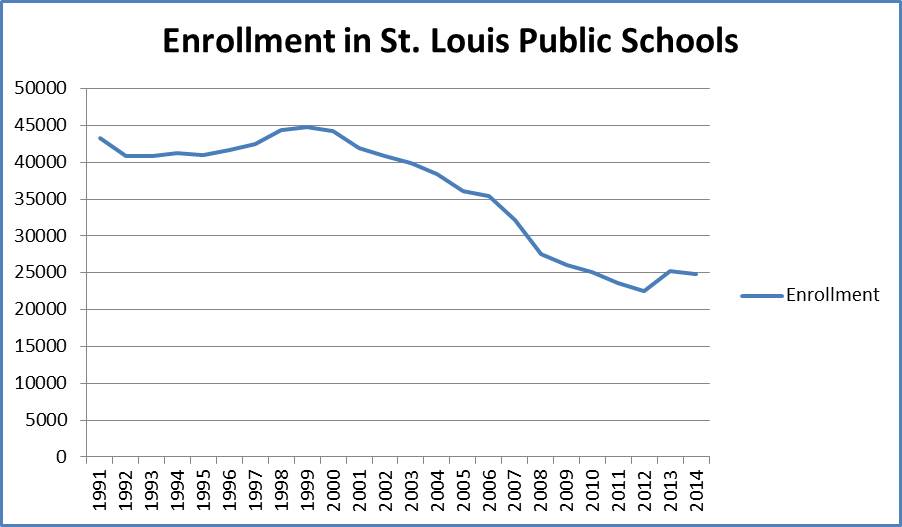
The St. Louis Post-Dispatch reports that enrollment in St. Louis Public Schools (SLPS) is down by nearly 1,500 students. This should not come as much of a surprise, as enrollment in SLPS has been dropping for more than a decade. In recent years, however, it had leveled off. Now, district officials are scrambling for ideas to cut costs. At the same time, they are facing increasing pressure to give teachers, whose salaries have been stagnant for years, a raise.

While the situation is not good for SLPS, the impact on the budget will not be felt immediately. Missouri’s funding formula allows school districts to receive funds based on their highest enrollment over a three-year period. Assuming continuing decline, this year’s enrollment figures won’t fully be realized until 2018. In the meantime, SLPS officials must begin looking for ways to shore up the bottom line or begin attracting students back to the district.

Here are some options:

1.      Sell vacant buildings: SLPS has a glut of vacant school buildings. The district must make every effort to lease, sell, or demolish the vacant school buildings. Every penny spent on maintaining empty buildings is a penny that cannot be channeled into the classroom and teacher salaries.

2.      Consolidate or co-locate within underutilized buildings: According to the Post-Dispatch, SLPS also as a slew of underutilized school buildings; six with fewer than 200 students and three high schools with fewer than 300. Officials must consider closing some of these schools and consolidating students into the remaining buildings. Of course, this is never easy to do, as citizens fear another vacant building in their neighborhood and parents worry about their children being bussed further away. To prevent blight, district officials could look for alternative uses for these buildings. For example, they could share the buildings with charter schools or private schools in need of space. By allowing these entities to co-locate but remain distinct organizations, underutilized buildings can once again be filled with children and even generate revenue for the district.

3.      Restructure staffing models: Salaries are one of the biggest costs in public education. Now is a perfect time for the district to restructure staffing models. As Mike McShane pointed out, the district can curb administrative bloat and redesign the district’s compensation system. The district can also begin exploring alternative ways to deliver education and expand the reach of great teachers, such as blended learning models. The traditional model of a teacher in front of 18 students hasn’t been working and is incredibly expensive.  

Curbing decades-long enrollment declines is a daunting task, and it will only be more difficult if the district fails to make appropriate changes. Indeed, significant changes to improve efficiency may be the only way to change the district’s trajectory.

Licensing Street Performers: Another Example of Government Overreach

Just when you thought licensing hair braiders was the silliest example of government overreach you had ever seen, University City considers doing something sillier. Some in the City Council want to license street performers in the Delmar Loop.

The measure would treat street performers like peddlers and canvassers. Performers would be required to pay a licensing fee and obtain a permit.

Along with the attempt at licensing landlords, this measure is just one of the more recent examples of a government solution in search of a problem. As someone who works near the Delmar Loop and visits there often, I can assure you that street performers are not a nuisance.

Thankfully, a couple of city council members are also skeptical of the need to license street performers. Due to their questioning of provisions within the bill, action on this measure will be delayed until later in the month. The City Council should spend that time reflecting on whether licensing a few street performers is really something that University City should be doing.

Street performers make the Delmar Loop a more vibrant and exciting place to visit. University City should not make it harder for these people to practice their craft. 

Convention Hotel Documents Claim it Will Double Hotel Business

Consultants for the proposed downtown convention hotel are telling us that if we build a new hotel we will almost double our hotel traffic. That may seem crazy, which is probably why the report doesn't make this claim in clear terms, but if you dig though a just-released two-year old report, the argument is clear: build it and they will come.

In Figure 1-5 (page 7) of the report, available below, we learn that at the time of the report, the number of hotel room nights sold owing to the convention center (accommodated demand) was 157,159. On the next page, Figure 1-6 shows the expected annual growth rate for convention-related hotel room business regardless of whether we build a hotel. It ranged from 4% in 2013 to 2% a year in 2018 and beyond. Those assumptions are themselves questionable, as this same report indicates (Figure 1-1) that annual growth rates in 2011 and 2012 were 0.3% and 2%, respectively.

Laying that aside, lets look at how much new business a new convention hotel will bring. In Figure 1-7 (page 9), we see two things: base demand and induced demand. Base demand is the current demand discussed above plus the projected annual increases. This is the growth without a new convention hotel. Induced demand is the projected increase in business due to a new convention hotel. The report does not detail how induced demand is calculated.

In 2021, the base demand is 199,105, roughly 42,000 more than we're getting today. The induced demand is 108,000 room nights. These are both questionable assumptions. Add them together and you get 150,000. The consultants were telling us that if we built a 1,000 room convention hotel we'd almost double our hotel business–from 157,159 room nights in 2013 to 307,105 in 2021. Is that reasonable? Even in the short term, the consultants estimated that by 2017, we'd see an increase of 113,000 room nights over 2013. That is a 72% increase in room nights just because we built a hotel.

Does anyone believe these claims? Are the annual growth rates reasonable? Is the induced demand rate reasonable? On what was it based? Was the previous City Council aware of these reports and projections? Has anyone checked to see if the 2013 and 2014 annual convention growth projections were met? No hotel project should be seriously contemplated until these basic questions are answered.

The Case for “Boutique” Efforts

For my money, one of the most promising developments in American education today is not in public schooling, private schooling, or charter schooling. It is in tiny schooling.

Tiny schools start in a library or classroom with a small group of volunteer students and no more than one or two teachers, usually for a couple of hours on a weekend. For up to a year, the teachers try new methods and get instant feedback, refine what they’re doing, and improve. The students attend voluntarily; they know they’re part of the experiment. If all goes well, after a year, the educators are in a much better place to start a full-fledged school than if they had tried to build a whole school from scratch. What’s more, if the plan doesn’t work, no students are harmed, and very little money is lost.

Spearheaded by 4.0 Schools in New Orleans, tiny schools are a promising response to a stubborn problem—starting a new school is incredibly risky.

Think about it: if you are an aspiring charter- or private school leader and you want to start a school via conventional means, you’re talking about an organization with a million-plus dollar budget, contracts with 10, 20, or more staff and teachers, the rental or purchase of a large building, and the lives of hundreds of children—and that is just the start. This risk explains why even the supposedly agile and entrepreneurial charter school sector has created applications to open schools that stretch into the hundreds of pages. When we’re talking about that much money and that many people, authorizers want as much assurance as possible that the school is going to work. I don’t blame them.

The most common criticism I hear, though, when I get excited talking about small entrepreneurial ventures like tiny schools is that they are simply “boutique” options. They cannot scale. “There are 50 million school children, for crying out loud, and you’re talking about teaching 20!”

Much of this ire has been directed toward AltSchool, a new private school model out of Silicon Valley. AltSchool runs a series of very small schools that personalize education to every (generally wealthy) child who attends them. They made news recently with a $100 million investment from some of the biggest names in technology and venture capital. Their model is intensive and expensive, and most have dismissed it as a viable option for students across the country. They may be right.

AltSchool critics remind me of a blog post written almost 10 years ago by Elon Musk, founder of PayPal, Tesla, and Space X (and promoter of nuking Mars). He too received criticism, particularly from environmentalists, when his first Tesla cars were priced north of $100,000 apiece. “The planet is warming, and you’re building cars only a small number of people can afford!”

Musk’s response to his critics is a good lesson for entrepreneurship in education. In a blog post titled The Secret Tesla Motors Master Plan (just between you and me), he wrote:

Almost any new technology initially has high unit cost before it can be optimized and this is no less true for electric cars. The strategy of Tesla is to enter at the high end of the market, where customers are prepared to pay a premium, and then drive down market as fast as possible to higher unit volume and lower prices with each successive model.

Replace “electric cars” with schools, and you’ll see where I’m going.

So many schools today—traditional public, charter, and even private—suffer from a kind of institutional isomorphism: Each one looks like the next. At the same time, we continue to see statistics indicating that students across the board are not prepared for college-level work. When we narrow our focus to low-income or minority students, the picture gets even worse. In Missouri (where I live), for example, only six percent of African-American students scored college-ready in all four subjects tested by the ACT. Six percent. Innovation is sorely needed.

But trying to create large-scale schools with an envelope-pushing model is expensive and risky. As a result, most people tend to stay in the same safe lane and, at best, try and tinker around the edges. This explains why most charter and even “lab” schools look so similar to the average public school and generally perform about as well.

One solution to this is the high-end model of AltSchools, where wealthy families pay for the innovations that might eventually make their way down market. Another is the small, focused model of tiny schools that rapidly iterate and see themselves as a work in progress rather than a finished product. But in both cases, it is the limited scope and tight focus of the effort that enable the innovation to take place.

We should not be so quick to dismiss “tiny” efforts to rethink schooling. A “tiny” effort in automobiles just made a car that broke Consumer Reports’ rating system. These schools may end up being bigger than we think.

Saint Louis to Try, Once Again, to Spend its Way to Prosperity

A recent article in the Post-Dispatch reported on the city’s plans to spend more than a billion dollars on a new football stadium, a MetroLink expansion, and setting up land for the National Geospatial-Intelligence Agency (NGA). The mayor’s office hopes these expenditures will create:

“anchor investments” to leverage future development, combat crime and wipe out concentrated poverty.

Creating development and wiping out concentrated poverty are lofty goals, but are city’s plans to create “anchor investments” likely to be successful?

History says no. Saint Louis is no stranger to urban regeneration projects, or “anchor investments” for that matter. From 1992 to 2002, the region “invested” almost $1.5 billion (in present dollars) in the original MetroLink and a football stadium (the Edward Jones Dome). Neither of these projects created much ancillary development, and from the 90s to the present day Saint Louis City has continued to lag behind the rest of the nation in population growth and economic vitality. Nor should anyone have expected them to. Economists agree that football stadiums do not boost urban regeneration, and that rail transit provides (at best) incremental improvements in transportation and station-adjacent property values, not civic renaissance.

Saint Louis officials may have learned that they are not one massive redevelopment project from jump-starting an economic revival. Unfortunately, the conclusion they appear to have come away with is that they are many massive development projects away from success. After all,

  • The MetroLink did not go far enough.
  • The Edward Jones Dome has no brew pubs or bike paths.
  • The Arch grounds aren’t pretty enough.
  • There are “gaps” between redevelopment (i.e., tax break) districts. 

Just a few billion dollars more, and the city will finally be business and millennial friendly. All this while city’s business code remains an antiquated mess and the taxicab commission files an injunction to shut down Uber. 

If Apple Were in Charge of Government Transparency . . .

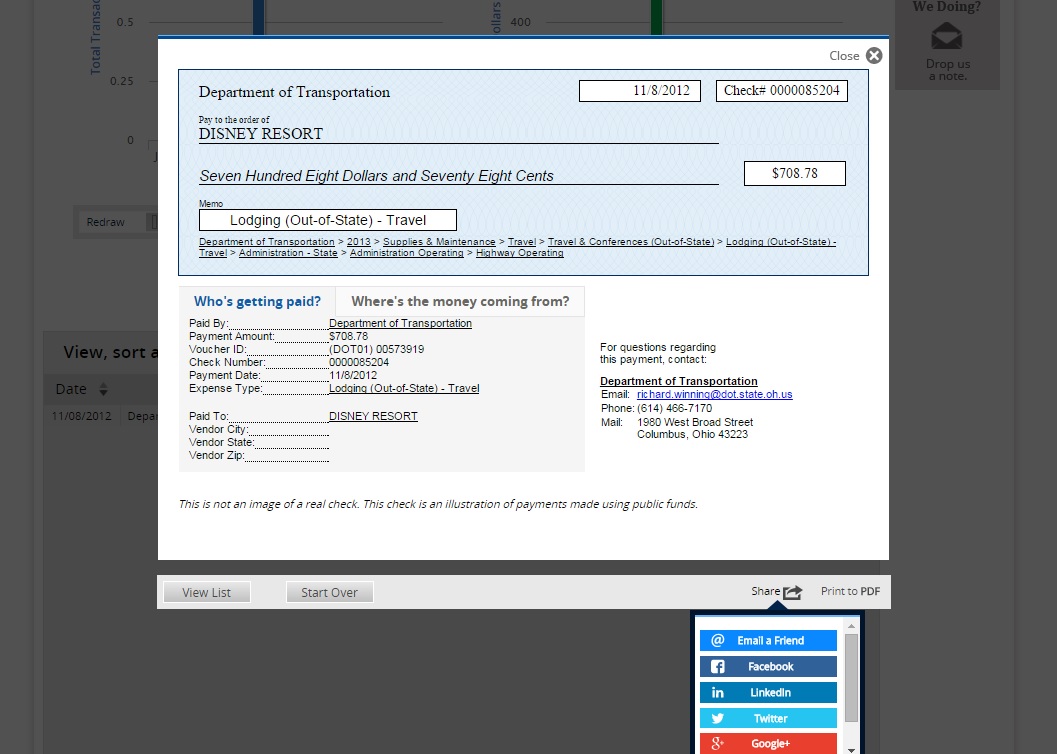
Ohio is leading the way with a Silicon Valley–like way to track each dollar spent by that state’s government. Since December 2014, Ohio Treasurer Josh Mandel has made every check written by the state available digitally on OhioCheckbook.com. This means that all state expenses, both large and small, are available online in an easily searchable database that includes checks written as far back as 2008.

Huge check to a major government contractor? It’s on there. Relatively small check to reimburse a state employee for travel expenses? It’s on there too. Information can be sorted and exported easily. There are even functions that allow you to contact the government official in charge of the agency that issued the check or share your findings on social media.

This site gives Ohioans unprecedented access to public information about how their government spends their tax dollars. And Mandel is working on expanding the database to include information from local governments as well.

Seriously, go there right now and click around. Neat, huh?

Missourians deserve the same level of government transparency. Imagine if we could search for and view each check paid from state funds, contact the responsible officeholders for inquiries about the purpose of each check, and then email accountable officials or share findings on social media—all from one website.

A tool like this would allow citizens and journalists to better understand how their government spends. And it would give government actors a powerful incentive to think twice about how they spent taxpayer money.

Support Us

The work of the Show-Me Institute would not be possible without the generous support of people who are inspired by the vision of liberty and free enterprise. We hope you will join our efforts and become a Show-Me Institute sponsor.

Donate
Man on Horse Charging