Missouri Government Union Contracts Forcing Workers to Pay for Union Politics

The first amendment protects all Americans from being compelled to support political speech. This is why the U.S. Supreme Court has held that even in non–right to work states, where workers may be forced to pay for a union’s services as a condition of employment, workers must be allowed to opt out of paying the portion of their union dues that go to support political activity. In Missouri, this first-amendment right is under attack.

We’ve uncovered several union contracts, such as the contracts at the Jennings Fire Department, the Pattonville Fire District, and the Robertson Fire District, that require employees who choose not to join the union to pay a monthly fee equal to full membership dues. The fact that nonmember fees are equal to full dues means that even if you exercise your constitutionally protected right not to join the union, your monthly fees end up directly or indirectly paying for union politics.

Nonmember fees should be reduced in proportion with the amount of money the union spends on political activity. If 50% of a union’s revenues go to political activities, nonmember fees should be 50% of full member dues. In the contracts where nonmember fees are held equal to dues, a nonmember ends up subsidizing political speech unless that union engages in no politics whatsoever.

The union that holds contracts with the fire districts and departments mentioned above is the International Association of Fire Fighters. According to public filings with the Missouri Ethics Commission, this union has spent over three million dollars on political activities in Missouri over the last ten years. Nonmembers who didn’t have their fees prorated ended up paying for some of this.

Anyone subject to a union contract that doesn’t allow workers to opt out of union politics can fight back. The U.S. Supreme Court has repeatedly upheld a worker’s right to pay only that portion of union dues directly related to representation. A worker who objects to union political activity that he or she pays for should demand a refund of the portion of his or her dues that went to political activity. Below are some resources that can help:

http://www.nrtw.org/a/a_1_p.htm

https://www.unionfacts.com/article/political-money/understanding-beck-rights/

http://www.unionrefund.org/index.asp

Spring 2016 Internships

The Show-Me Institute is pleased to offer internship opportunities for Spring 2016.

  • Internships are open to current undergraduate and graduate students, as well as recent graduates. 
  • Spring internships will last approximately four months. The exact starting and ending dates are flexible, but each intern is expected to work at least 10 weeks.
    No internship shall start prior to January 25. Spring internships will end on or before May 13, 2016.
  • Spring interns can work a full-time schedule (9 a.m.-5 p.m., with one hour for lunch), or arrange for a part-time schedule to accommodate class schedules. 
  • Interns will be involved in virtually all aspects of the Institute’s operations. Interns will work closely with senior staff on a wide variety of projects. They can expect greater responsibility and personal attention than they would receive at larger organizations.
  • Interns will assist staff members with a variety of tasks. These may include researching public policy topics, organizing events, and writing and editing op-eds, newsletter articles, studies, and other documents. Some administrative and clerical tasks will also be required.
  • A Show-Me Institute internship is an excellent opportunity to improve your research and writing skills. Each intern will produce regular blog posts and an op-ed on a public policy topic of interest to him or her. Each intern will receive feedback and assistance from SMI staff members throughout the process.
  • Internships are offered in both the St. Louis and Kansas City offices.
  • Interns will be paid on an hourly basis.

Those wishing to be considered for an internship should submit the enclosed application and the requested supporting materials. Applications will be accepted on a rolling basis. We will begin conducting interviews as applications are received. Applicants can expect a decision no later than Friday, January 8, 2016.

About the Show-Me Institute

Founded in 2005, the Show-Me Institute is a nonpartisan, nonprofit public policy research organization. The mission of the Institute is advancing liberty with responsibility by promoting market solutions for Missouri public policy. For more information:

Phone: (314) 454-0647

Email: [email protected]
Web: www.showmeinstitute.org

Attention Teachers: Professionals Do Not Have a Salary Schedule

When you think of “professionals,” how do you think of them being paid? Do you expect them to have a schedule that says what they will make each year, regardless of their performance? Would you expect that the only way they could earn a raise would be by getting an advanced degree or by sticking around another year? I don’t think so.

Doctors, lawyers, you name the profession—professionals are paid based on what they do. They are paid in proportion to the demand for their labor, their skill, and their hustle. Not so for teachers. Teachers are paid via a single-salary schedule that doesn’t factor in their quality or effort.

Let me be clear, I’m not saying teachers are not professionals. I’m saying they are not paid like professionals.

Elisa Crouch of the St. Louis Post-Dispatch has been following the ongoing dispute in St. Louis Public Schools regarding teacher pay. For seven years, teachers in St. Louis have been stuck at the same level on their salary schedule and have not received a raise. Recently, the unionized workforce rejected a proposed 3.5% salary increase, calling it a slap in the face.

I’m not sure how this dispute will pan out, but now is the time for school district administrators to consider alternatives to the single-salary schedule.

For starters, they should consider alternatives that allow great teachers to be rewarded. A single-salary schedule is quality blind. Now, I’m not talking about simply tying pay to test scores or some mechanistic rating system, but real management and feedback; pairing data with professional judgement.

They should they take into account not only quality, but also the broader labor market. My 2012 study, “The Salary Straitjacket,” demonstrates how math and science teachers make less than P.E. teachers, despite a shortage of math and science teachers. This isn’t a knock on P.E. teachers, but teachers with Math and Science training who don’t feel adequately compensated are likely to have more lucrative options outside of teaching than P.E. teachers. Districts have to take this into account when determining wages, or there will always be shortages.

One of the downsides to a single-salary schedule is that it dictates wages to the district. The salary schedule doesn’t factor in the financial health of the school district. It mandates that teachers earn X more next year, regardless. A much smarter approach would be for the district to determine how much they have available for salaries and then figure out how they want to distribute that money among teachers. Such an approach would facilitate better management of scarce financial resources.

Teachers certainly deserve to be treated like professionals, which is why administrators should start thinking about wholesale changes to the way they pay teachers. Professionals deserve professional pay. 

Saint Louis Transportation Planning Prioritizes Public Transportation, MetroLink

Saint Louisans depend on a functioning transportation system to do practically everything in their lives, from getting to work to enjoying a night on the town. But keeping transportation infrastructure—be it road, rails, or buses—in good shape takes regular investment. The way a city makes those investments now will affect residents’ daily lives in years to come. However, a look at the recent investment plans of the Saint Louis area reveals a growing disconnect between the systems Saint Louisans use and where the money is going.

The first thing to note about Saint Louis’s transportation system is that it is highly dependent on the highway and street system. In Saint Louis City, Saint Louis County, and Saint Charles County, about 89 percent of commuters either drove or carpooled in 2014. Only 3.4 percent used public transportation. More than half of those who did used buses, which also depend on streets and highways. In terms of the flow of goods, almost 70 percent of freight traffic moves by truck (and hence by road) in the Saint Louis area.

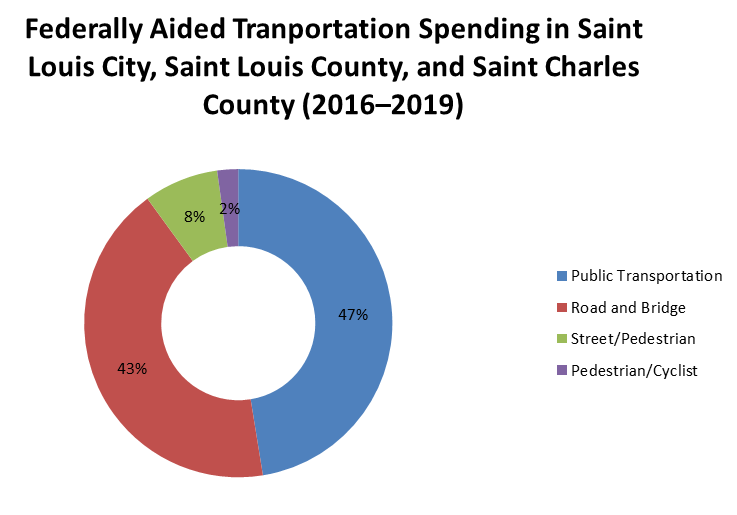
Regional transportation investments for the near future do not reflect these realities. Of the $1.2 billion in federally aided transportation projects slated to move forward in Saint Louis City, Saint Louis County, and Saint Charles County (including multi-state and multicounty projects, the vast majority of which tend to benefit Saint Louis City and County) from 2016 to 2019, 47 percent will be spent on public transportation improvements (see the graph above).

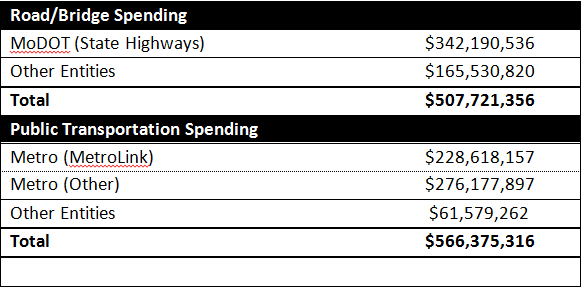
Breaking down the numbers further, investments by Metro (the regional transit agency) will outstrip road & bridge projects made by the Missouri Department of Transportation (which maintains state highways) by more than 30 percent:

Table: Road spending vs public transportation spending

Metro will spend about $230 million (45 percent of investments) on the MetroLink, the region’s light rail. This does not include large-scale MetroLink extension plans (aside from a new $13 million station near Grand Ave.), but instead is mostly intended for maintenance and rehabilitation. In all, somewhere between 15 and 20 percent of federally aided transportation investments benefiting Saint Louis City, Saint Louis County, and Saint Charles County will be spent maintaining light rail.

Perhaps increased spending on public transportation will cause residents to get out of their cars and onto the bus or rail. However, anything more than a modest increase in public transportation’s total travel share is unlikely, given the experiences of other cities. That being the case, systematically favoring transportation systems that few residents and no freight companies use over the one that quite literally moves the metropolitan area is asking for trouble.

Missouri Jobs Increase at Slow Pace

The Bureau of Labor Statistics recently released its current snapshot of labor markets across states. While jobs in Missouri have increased since last October, the rate of increase is quite slow.

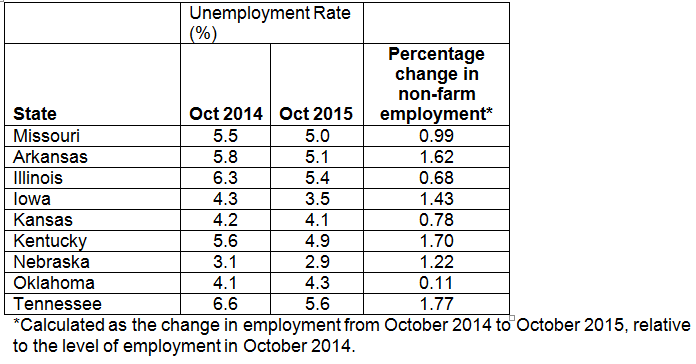
The table below reports three pieces of information pertinent to assessing the job picture in Missouri. The first two columns of data report the unemployment rate in October of 2014 and 2015. In Missouri, the unemployment rate has fallen, dropping from 5.5 percent to 5.0 percent, the same value as the national average. How does this compare to our neighboring states?

All states in the table below (except Oklahoma) also experienced a decline in their unemployment rate over the past year. What is notable is that some states, such as Iowa, Kansas, Nebraska and Oklahoma, have achieved very low rates of unemployment. These values signal very robust labor markets in those states.

The Bureau’s recent release also provides more direct information about job growth. In the last column in the table below I report the percentage change in jobs over the past year (October 2015 data are preliminary.)

This calculation shows that job growth in Missouri has been slow over the past year, increasing at only about a 1 percent rate. Three other neighboring states—Illinois, Kansas, and Oklahoma—have experienced slower job growth, though Kansas and Oklahoma already have achieved very low unemployment rates. In the remaining states, job growth is notably faster than in Missouri.

Regional unemployment data 2014-2015

How Long Have Saint Louis Planners Known About Loop Trolley Cost Overruns?

In a previous post, we discussed the climbing costs of the Loop Trolley project, a 2.2 mile trolley line that will run from the St. Louis History Museum to the Delmar Loop. The project will now cost $51 million rather than the original budget of $43 million. Saint Louis County taxpayers are on the hook for the unexpected overrun. However, while the public may have been unaware of the higher cost of the Loop Trolley until last week, Saint Louis planners have likely known that the project would cost more than billed since mid-July.

                The East-West Gateway Council of Governments, which is responsible for coordinating transportation spending in the Saint Louis region, releases a transportation improvement program (TIP) every year. That program contains all scheduled transportation projects receiving federal aid for the next four years. The latest TIP, approved on July 29, shows the costs of projects (including the Loop Trolley) from 2016 to 2019.

                Despite the fact that the program was released months before the public was told that the Loop Trolley would be over budget, and Saint Louis County residents knowing they were on the hook for the those overruns, the latest TIP accurately puts the Loop Trolley’s cost at about $51 million. When the TIP was proposed (and commented on), the trolley’s cost was still only $44 million. But on the day the TIP was approved (July 29), the East West Gateway board approved a final additional project, sponsored by Saint Louis City, to improve “Delmar, DeBaliviere, and Loop Trolley Infrastructure.”

                The funding for that project comes from a $5.4 million federal STP-S grant, requiring a $1,350,000 local match. That grant should sound familiar, because that’s precisely the grant Saint Louis County is now being asked to match, which will cover cost overruns on the Loop Trolley.

                Given the timeline, it is almost certainly the case that regional planners have known about cost overruns on the Loop Trolley since mid-July. Indeed, they appear to have planned for dealing with problem by committing more federal funds (and the Saint Louis County match) to the trolley. However, they clearly did so before the county government, or county residents, had signed off on the plan. Those funds will come from county’s mass transit sales tax and could have been used to fund any number of other projects in Saint Louis County. No one should be under the illusion that Saint Louis only gets federal STP-S grants for streetcars; in the next 4 years the county is slated to receive 96 such grants.

                Might planners have known about the cost overruns before trolley construction began in the spring? Was this an attempt to make to the additional funding for the Loop Trolley a fait accompli once residents found out about it? We don’t know, but it is clear that the trolley funding process has not been as transparent as Saint Louis County residents could hope.

Missouri Pensions Reward Some, Punish Others

Defined-Benefit public employee retirement systems are terrific for those who stay their full career in a single system. We all can agree on that. But there are a lot more people paying into, and receiving benefits from, the pension system than just individuals who stay their whole career in a single system. This was highlighted as I read a piece on Missouri teacher pensions by KOMU reporter Megan Judy. The article offers quotes from Kathy Steinhoff (a Hickman High School math teacher), Steve Yoakum (executive director of the Public School Retirement System of Missouri), and the Show-Me Institute’s Mike McShane. 

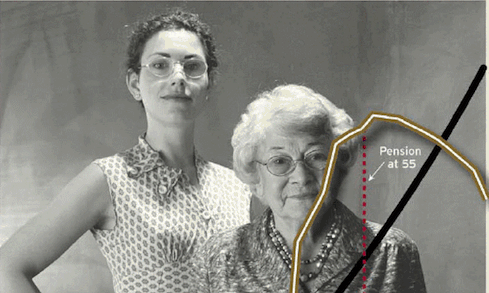
Full graph--Missouri teacher pension benefits

Based on Steinhoff and Yoakum’s comments, I’d like to make three points:

Point #1: Pensions Take From Some to Reward Others

The generous teacher retirement benefits for those who stay in the system for their full career are made possible by the contributions of those who leave the system early. According to Yoakum, “The retirement system is designed to provide a career employee in Missouri schools with roughly the same standard of living they had.” The key phrase there is “career employee.” Workers who leave early face a severe financial penalty.

As McShane pointed out in the article (and as I’ve noted before on the Show-Me Institute blog), benefits from the teacher pension system do not exceed a teacher’s contributions until they have worked for 28 years. 28 years! As a report from the Urban Institute noted, 62% of Missouri teachers do not stay for that long. The majority of teachers are not benefiting from the pension system, but are instead subsidizing the benefits of others.

Point #2: Retirement Benefits are an Ineffective Way to Recruit Teachers

Yoakum contends that the pension system is helping recruit teachers to Missouri. This is a poplar refrain among pension supporters. At first glance, the argument makes sense—better benefits attract more people. The problem is that people, especially young people, typically don’t pay much attention to their retirement benefits. This is illustrated by the quote from Steinhoff, “It is the best kept secret even within the profession because, for most teachers, it doesn’t come on their radar until they’re teaching for about 25 years.” I fail to see how a well-kept secret helps recruit teachers.

As a National Bureau of Economic Research report notes, employees value current pay much more than they value deferred compensation into a pension system.  Thus, a better way to recruit and retain teachers might be to pay them more now, rather than promise them more later.

Point #3: Pensions Pull Some to Stay, Push Others Out

OK, maybe pensions aren’t the best way to recruit new workers, but they do help keep teachers in the system, right? As Yoakum said, “From the employer standpoint, it does provide golden handcuffs to a certain extent. When a teacher has accumulated a certain years of service, it’s very hard for them to leave. This helps our school districts retain those very good teachers.”

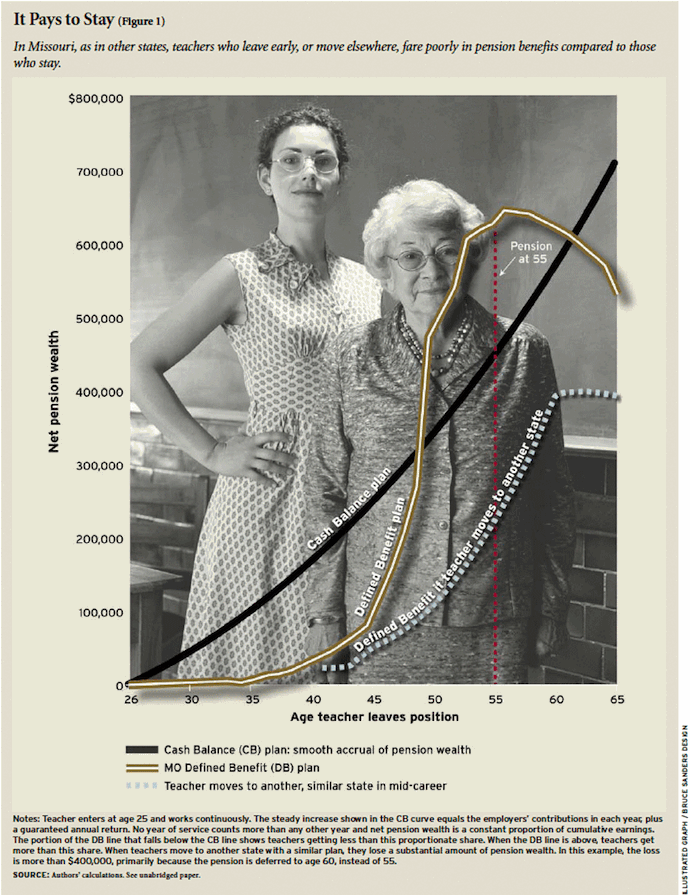
This “Golden Handcuffs” phenomenon is discussed by economists Robert Costrell and Michael Podgursky in an Education Next article with the same name (see their excellent illustration above). The yellow line is the value of Missouri’s teacher pension system, while the black line represents a smooth-accruing cash balance plan. This shows how teachers who leave early are worse off under the current system. As a result, Costrell and Podgursky agree with Yoakum that the back-loaded nature of PSRS pulls teachers to stay until full retirement—but at a cost. First, there is no indication that the “pull” is felt only by the “very good teachers” to whom Yoakum alluded. Indeed, there may be some teachers who are burnt out and want to retire, but feel compelled to stick it out until they reach full retirement. How is that good for kids? And after a teacher reaches their peak pension value, the system punishes them and pushes them out. Thus, beyond a point, the system acts as a disincentive for veteran teachers to stay.

We cannot accept the merits of defined-benefit pension systems simply because they provide a terrific benefit to a fraction of our teachers. Rather, we should consider whether the system is designed to provide fair retirement support for every teacher in Missouri. Clearly it is not. 

Support Us

The work of the Show-Me Institute would not be possible without the generous support of people who are inspired by the vision of liberty and free enterprise. We hope you will join our efforts and become a Show-Me Institute sponsor.

Donate
Man on Horse Charging