Study: Direct Primary Care and Concierge Care Different in More Ways Than One

Last month the Show-Me Institute released our paper on direct primary care, a patient-centric physician practice model that generally cuts out insurance middlemen. I say "generally" because colloquially, both patients and doctors sometimes use the words "direct primary care" and "concierge care" interchangeably, even though there are important differences between the practice models. To clarify: concierge care doctors typically bill insurance for their services, whereas "pure" direct primary care providers typically do not.

But the difference between concierge and direct primary care isn't just academic; the terms also appear to be related to the price of the services rendered by these nontraditional physician practices. According to a study by Phillip Eskew and Kathleen Klink published this month in the Journal of the American Board of Family Medicine, practices that simply self-describe as a concierge service are more than twice as expensive as direct primary care on a monthly basis.

We found the public perception of the term concierge as having higher prices holds true. Self-described DPC practices charged a lower average monthly fee ($77.38) than DPC practices that self-described as concierge ($182.76). Concierge practices such as MDVIP and MD2 have listed average periodic (monthly) fees of $137.50 and $2083.33, respectively; these periodic fees are billed in addition to standard fee-for-service office visit and procedural charges that would be encountered in any traditional medical practice.

In other words, while they sometimes use these terms interchangeably (and for understandable reasons given their similarities), both doctors and patients should be mindful that these models differ in very important ways, and that pricing is perhaps the most important difference. Making that fact clear is especially important for patients seeking cost-effective treatment plans with direct primary care physicians—because in the process of trying to find one, they could balk at the price tag they might find if they're only looking at "concierge" practices.


Missouri Paycheck Protection Is Back for 2016

It appears that the sponsor of last year’s paycheck protection bill will reintroduce the bill in 2016. Paycheck protection safeguards government employees’ right to choose whether their money goes to union political activity. The freedom to support only the political speech you agree with is a fundamental right protected by the first amendment. For Missouri’s government workers, this right is sometimes ignored.

Last year’s paycheck protection bill would have required government unions (such as teachers unions and unions representing state employees) to obtain permission from employees before using dues or fees for political activity. The bill would have required unions to seek permission from employees only once each year; however, for that school teacher or social worker who opposes the politics of union bosses as a matter of conscience, such protection can make a big difference.

Consider the story of Terry Bowman, who started an organization dedicated to providing a voice to union members who feel silenced and marginalized by the union political establishment. Or Andrew Palmer, a public school teacher who started Conservative Teachers of America to provide an alternative perspective on public education. Both of these men bucked the mainstream opinion of their workplaces in order to make sure their voices were heard. This can be hard to do, but it’s a lot easier when the law protects people who swim against the current.

Driving Still Dominant in Saint Louis, Kansas City

When considering investment in transportation infrastructure, be it road, rail, or river, it is important to think about what type of infrastructure people will actually use. In Missouri and around the country, many planners have a “build it and they will come” mentality, essentially hoping that increased spending on planners’ preferred options (read: public transportation) will result in a transformation of habits. There already is a narrative that people are abandoning their cars for public transit, if we will let them. Saint Louis is spending money like that is the case, as public transit will receive around half of total federally aided transportation investment in the near future. However, the latest Census Bureau data provide little evidence that heavy investment in public transportation is having any effect at all on Missouri’s commuting habits.

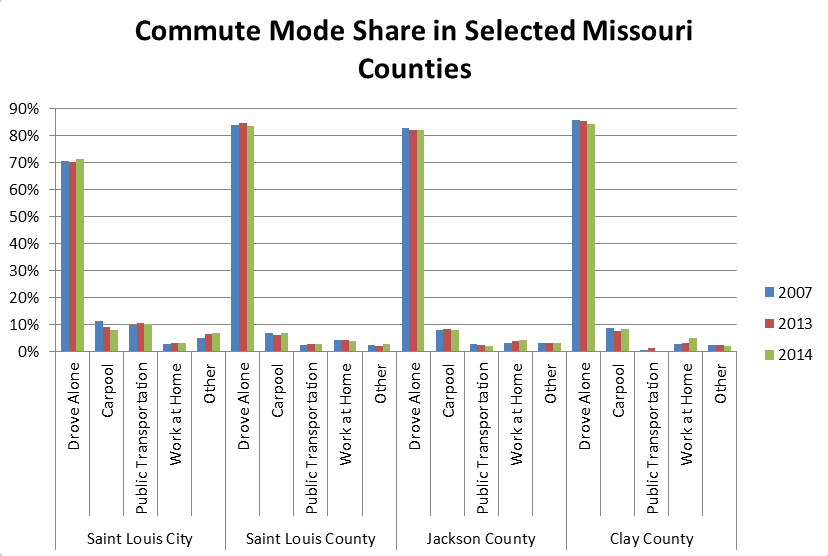
That data indicate that driving is still king, and unlikely to be dethroned any time soon. In 2014, 79% of commuters in Saint Louis City either drove alone or carpooled to get to work. In Saint Louis County, that number was more than 90%. In the Kansas City area, almost 90% of commuters drove alone or carpooled. As for public transportation use, the numbers remain quite modest. Saint Louis City had 10% of its commuters use transit, but in Saint Louis County and Jackson County that number was less than 3%.

If we consider what the numbers in terms of long-term trends, our writing from last year on this subject remain relevant:

Transit’s share of commutes in Missouri and its major cities has slowly decreased over the last few decades; a lower percentage use transit now than in 1990. Taking 2000 as our baseline year, the nadir of public transportation use in the United States as a whole, 1.49 percent of Missourians used transit for their commutes. After 13 years and well over a billion dollars of investments, transit’s share of commuters has remained essentially flat.

Nothing has happened to refute those observations. In fact, from 2013 to 2014 transit commuters as a percentage of all commuters decreased in Saint Louis City, Saint Louis County, Jackson County, and Clay County, as the chart below demonstrates:

Chart: Commuter modes

All of the recent changes have been small and may be within the margin of error. This means we cannot say that transit is definitely drawing a lower percentage of riders than they did last year. But we can say that the Census Bureau’s 2014 data, much like data from previous years, show no evidence of either a rapid rise in the preference for transit or a rapid decrease in preference for driving in Missouri’s largest cities. 

Obamacare Cronyism: Where Does the Bureaucracy End and the Insurance Industry Begin?

When the Affordable Care Act, or Obamacare, was written in 2010, much of it was negotiated behind closed doors with lobbyists from across the health care industry. It's unsurprising, then, that many of those major players—especially in the insurance industry—got sweetheart deals. Requiring Americans to buy health insurance gave insurers instant access to millions of new customers. Assuming that their customer pools had enough healthy people to subsidize beneficiaries who were sicker, insurance companies could expect to make a lot of money—not only through payments from consumers, but also in direct subsidies from the federal government itself.

Well, things are not working exactly has insurers had planned. Just ask United Healthcare.

United Healthcare is the largest U.S. insurer by enrollment, and the company is warning that it may withdraw from Obamacare in 2017. The insurer has already suspended advertising for its Obamacare coverage and stopped paying commissions to insurance brokers for signing people up. It literally doesn’t want consumers to buy its products.

On a United Healthcare call Thursday with Wall Street analysts, Josh Raskin of Barclays asked, “Simply, how long are you willing to lose money in exchanges?” and then followed up, “Are you willing to lose money again in 2017, Steve?” United Healthcare CEO Stephen Hemsley replied: “No, we cannot sustain these losses. We can’t really subsidize a marketplace that doesn’t appear at the moment to be sustaining itself,” adding that “we saw no indication of anything actually improving.”

Not only are enrollees in the insurance market sicker than expected, but thanks to budgetary language passed last year, the insurance companies' shortfalls are no longer the taxpayers' problem. Obamacare's "risk corridors" were designed to transfer some money from profitable insurers to less profitable insurers as a way to shield less successful insurers from the deep losses that could force them to leave the marketplace. Under the original plan, taxpayers would pick up the remainder of the shortfall—a bailout for insurers, negotiated by insurers, and financed by taxpayers. Today, the insurers will bear that risk alone, and appropriately so.

Of course, whether these taxpayer protections will endure in the years to come may depend on the pull of insurance industry cronies— not only in the private sector, but also those cronies who are currently part of the adminstrationThe Washington Examiner's Timothy Carney vividly captures the current, and appalling, health care scene:

This is where the intimate network of the Obamacare insiders comes in. The Centers for Medicare and Medicaid Services (CMS) — which issued the pledge to fully bail out United Healthcare and its cohorts — is run by acting administrator Andy Slavitt. Slavitt is the former CEO of United Healthcare (while he held that position he contributed to Obama's 2008 election)….

Meanwhile, the insurance lobbyist leading the industry's push for more Obamacare bailout money is Marilyn Tavenner, Obama's previous chief of CMS, now head of America's Health Insurance Plans (AHIP). AHIP says risk corridors aren't the group's top focus, but Tavenner is speaking out on it.

In summary: Tavenner helped build the risk corridor program, and then went to the industry that would get the money. Slavitt left the insurer with the biggest losses, and now is the government official promising to bail out his former employer.

You can call it regulatory capture or you can call it a revolving door, but it is cronyism all the same. And it's of a kind that is especially troubling: the kind where cronies don't just try to regulate their own industry, but also try to loot the Treasury while they're in power. The question now is whether Congress will accommodate these cronies by explicitly removing last year's taxpayer protections or will stand by if Obamacare's bureaucracy tries to sidestep the law and hand out money to insurers anyway. We should find out one way or another in the next month or so; stay tuned.

University of Chicago: An Example for Mizzou on Free Speech

Over the past few weeks, the University of Missouri has been turned upside down by protests that, so far, have cost the jobs of the university system President and the school's Chancellor. The protests have also brought to light a lot of troubling behavior by university employees against university students. Between Mizzou staff assaulting students' First Amendment rights and a Mizzou professor literally calling in "muscle" to physically remove a student reporter from a public space, something is rotten in Columbia. It's one thing to have a liberal campus culture, which has long been the case in Columbia. It's another thing entirely to have a culture so liberal that it becomes illiberal.

The thin silver lining here is that Mizzou's broken campus culture—not only among students, but among faculty as well—has finally been laid bare, providing the opportunity for policymakers and administrators to fix it.

So, where does Mizzou go from here? One important step would be to reestablish the University's bona fides as an institution that believes in free speech for everyone, not just those who support the politics of the university faculty. On point, L. Gordon Crovitz wrote in the Wall Street Journal yesterday about a strong, student-supporting free speech policy that the University of Chicago adopted earlier this year. The policy has already been adopted at Purdue and Princeton, and which is now being pushed nationwide by FIRE, a student advocacy group.

You can find the University of Chicago's full report here, but I'd like to pull out two important paragraphs that could have written about Mizzou and its handling of free speech issues. (Emphases mine)

As a corollary to the University’s commitment to protect and promote free expression, members of the University community must also act in conformity with the principle of free expression. Although members of the University community are free to criticize and contest the views expressed on campus, and to criticize and contest speakers who are invited to express their views on campus, they may not obstruct or otherwise interfere with the freedom of others to express views they reject or even loathe. To this end, the University has a solemn responsibility not only to promote a lively and fearless freedom of debate and deliberation, but also to protect that freedom when others attempt to restrict it.

As Robert M. Hutchins observed, without a vibrant commitment to free and open inquiry, a university ceases to be a university. The University of Chicago’s longstanding commitment to this principle lies at the very core of our University’s greatness. That is our inheritance, and it is our promise to the future.

A lot needs to change at Mizzou in the coming months. Administrators should start by unequivocally rejecting the university’s recent Orwellian nonsense on speech matters and commit to the free speech principles on which this country was founded, and possibly by adopting the University of Chicago policy construction. As the University of Chicago statement suggests, open inquiry and speech are the inheritance of all universities. It is up to policymakers and administrators to ensure that this inheritance is not wasted at Mizzou.

Missouri Government Union Contracts Forcing Workers to Pay for Union Politics

The first amendment protects all Americans from being compelled to support political speech. This is why the U.S. Supreme Court has held that even in non–right to work states, where workers may be forced to pay for a union’s services as a condition of employment, workers must be allowed to opt out of paying the portion of their union dues that go to support political activity. In Missouri, this first-amendment right is under attack.

We’ve uncovered several union contracts, such as the contracts at the Jennings Fire Department, the Pattonville Fire District, and the Robertson Fire District, that require employees who choose not to join the union to pay a monthly fee equal to full membership dues. The fact that nonmember fees are equal to full dues means that even if you exercise your constitutionally protected right not to join the union, your monthly fees end up directly or indirectly paying for union politics.

Nonmember fees should be reduced in proportion with the amount of money the union spends on political activity. If 50% of a union’s revenues go to political activities, nonmember fees should be 50% of full member dues. In the contracts where nonmember fees are held equal to dues, a nonmember ends up subsidizing political speech unless that union engages in no politics whatsoever.

The union that holds contracts with the fire districts and departments mentioned above is the International Association of Fire Fighters. According to public filings with the Missouri Ethics Commission, this union has spent over three million dollars on political activities in Missouri over the last ten years. Nonmembers who didn’t have their fees prorated ended up paying for some of this.

Anyone subject to a union contract that doesn’t allow workers to opt out of union politics can fight back. The U.S. Supreme Court has repeatedly upheld a worker’s right to pay only that portion of union dues directly related to representation. A worker who objects to union political activity that he or she pays for should demand a refund of the portion of his or her dues that went to political activity. Below are some resources that can help:

http://www.nrtw.org/a/a_1_p.htm

https://www.unionfacts.com/article/political-money/understanding-beck-rights/

http://www.unionrefund.org/index.asp

Spring 2016 Internships

The Show-Me Institute is pleased to offer internship opportunities for Spring 2016.

  • Internships are open to current undergraduate and graduate students, as well as recent graduates. 
  • Spring internships will last approximately four months. The exact starting and ending dates are flexible, but each intern is expected to work at least 10 weeks.
    No internship shall start prior to January 25. Spring internships will end on or before May 13, 2016.
  • Spring interns can work a full-time schedule (9 a.m.-5 p.m., with one hour for lunch), or arrange for a part-time schedule to accommodate class schedules. 
  • Interns will be involved in virtually all aspects of the Institute’s operations. Interns will work closely with senior staff on a wide variety of projects. They can expect greater responsibility and personal attention than they would receive at larger organizations.
  • Interns will assist staff members with a variety of tasks. These may include researching public policy topics, organizing events, and writing and editing op-eds, newsletter articles, studies, and other documents. Some administrative and clerical tasks will also be required.
  • A Show-Me Institute internship is an excellent opportunity to improve your research and writing skills. Each intern will produce regular blog posts and an op-ed on a public policy topic of interest to him or her. Each intern will receive feedback and assistance from SMI staff members throughout the process.
  • Internships are offered in both the St. Louis and Kansas City offices.
  • Interns will be paid on an hourly basis.

Those wishing to be considered for an internship should submit the enclosed application and the requested supporting materials. Applications will be accepted on a rolling basis. We will begin conducting interviews as applications are received. Applicants can expect a decision no later than Friday, January 8, 2016.

About the Show-Me Institute

Founded in 2005, the Show-Me Institute is a nonpartisan, nonprofit public policy research organization. The mission of the Institute is advancing liberty with responsibility by promoting market solutions for Missouri public policy. For more information:

Phone: (314) 454-0647

Email: [email protected]
Web: www.showmeinstitute.org

Attention Teachers: Professionals Do Not Have a Salary Schedule

When you think of “professionals,” how do you think of them being paid? Do you expect them to have a schedule that says what they will make each year, regardless of their performance? Would you expect that the only way they could earn a raise would be by getting an advanced degree or by sticking around another year? I don’t think so.

Doctors, lawyers, you name the profession—professionals are paid based on what they do. They are paid in proportion to the demand for their labor, their skill, and their hustle. Not so for teachers. Teachers are paid via a single-salary schedule that doesn’t factor in their quality or effort.

Let me be clear, I’m not saying teachers are not professionals. I’m saying they are not paid like professionals.

Elisa Crouch of the St. Louis Post-Dispatch has been following the ongoing dispute in St. Louis Public Schools regarding teacher pay. For seven years, teachers in St. Louis have been stuck at the same level on their salary schedule and have not received a raise. Recently, the unionized workforce rejected a proposed 3.5% salary increase, calling it a slap in the face.

I’m not sure how this dispute will pan out, but now is the time for school district administrators to consider alternatives to the single-salary schedule.

For starters, they should consider alternatives that allow great teachers to be rewarded. A single-salary schedule is quality blind. Now, I’m not talking about simply tying pay to test scores or some mechanistic rating system, but real management and feedback; pairing data with professional judgement.

They should they take into account not only quality, but also the broader labor market. My 2012 study, “The Salary Straitjacket,” demonstrates how math and science teachers make less than P.E. teachers, despite a shortage of math and science teachers. This isn’t a knock on P.E. teachers, but teachers with Math and Science training who don’t feel adequately compensated are likely to have more lucrative options outside of teaching than P.E. teachers. Districts have to take this into account when determining wages, or there will always be shortages.

One of the downsides to a single-salary schedule is that it dictates wages to the district. The salary schedule doesn’t factor in the financial health of the school district. It mandates that teachers earn X more next year, regardless. A much smarter approach would be for the district to determine how much they have available for salaries and then figure out how they want to distribute that money among teachers. Such an approach would facilitate better management of scarce financial resources.

Teachers certainly deserve to be treated like professionals, which is why administrators should start thinking about wholesale changes to the way they pay teachers. Professionals deserve professional pay. 

Support Us

The work of the Show-Me Institute would not be possible without the generous support of people who are inspired by the vision of liberty and free enterprise. We hope you will join our efforts and become a Show-Me Institute sponsor.

Donate
Man on Horse Charging